
You're probably reading this after another rushed shave before the beach, another wax appointment you didn't want to book, or another round of razor bumps made worse by heat, humidity, and salt air. That's a familiar cycle in Clearwater. The weather keeps more skin exposed year-round, and temporary hair removal starts to feel less like grooming and more like maintenance you never quite finish.
For many people, laser hair removal in Clearwater, Florida makes sense for one simple reason. It swaps constant upkeep for a plan with an end point. It's not magic, and it's not right for every hair or skin situation, but done correctly, it can dramatically reduce the amount of hair you have to manage.

Table of Contents
- Your Guide to Laser Hair Removal in Clearwater
- How Laser Hair Removal Actually Works
- Are You a Good Candidate for Laser Hair Removal
- What to Expect from Sessions and Results in Clearwater
- Choosing the Right Laser Clinic in Clearwater
- How to Prepare and Care for Your Skin
- Common Questions About Laser Hair Removal
Your Guide to Laser Hair Removal in Clearwater
A lot of Clearwater clients come in with the same story. They're tired of planning outfits, swimsuits, gym sessions, or weekends around shaving. Waxing helps for a while, but the appointment cycle gets old fast, and sensitive skin often starts protesting before the hair does.
That frustration is exactly where laser helps. It's a long-term treatment built around how hair grows, not a quick surface fix. The best results come from consistency, proper timing, and a clinic that takes skin safety seriously, especially in a coastal Florida climate where sun exposure changes everything.
Why local conditions matter
Clearwater isn't just warm. It's bright, humid, and outdoor-heavy. That means fresh tans, recent sun exposure, and irritated skin are more common here than in many other markets. Those details matter because laser settings and timing should change based on what your skin has been through.
Practical rule: Good laser treatment isn't just about removing hair. It's about knowing when to treat, when to delay, and when skin needs a different plan.
What people usually want to know first
Most clients aren't asking for a physics lesson. They want straight answers:
- Will it work for my skin tone? In many cases, yes, but the device and settings matter.
- Will it work for my hair color? Darker hair usually responds best. Lighter hair needs a more honest conversation.
- How many appointments will I need? Enough to catch hair in the right growth phase over time.
- Is it safe if I have eczema, psoriasis, or recent sun irritation? Sometimes, but only after a real skin review.
That's where most generic local content falls short. It tells you to shave, avoid sun, and show up. It doesn't spend enough time on the harder questions, especially for people with reactive skin, deeper skin tones, tattoos nearby, or light-colored hair.
How Laser Hair Removal Actually Works
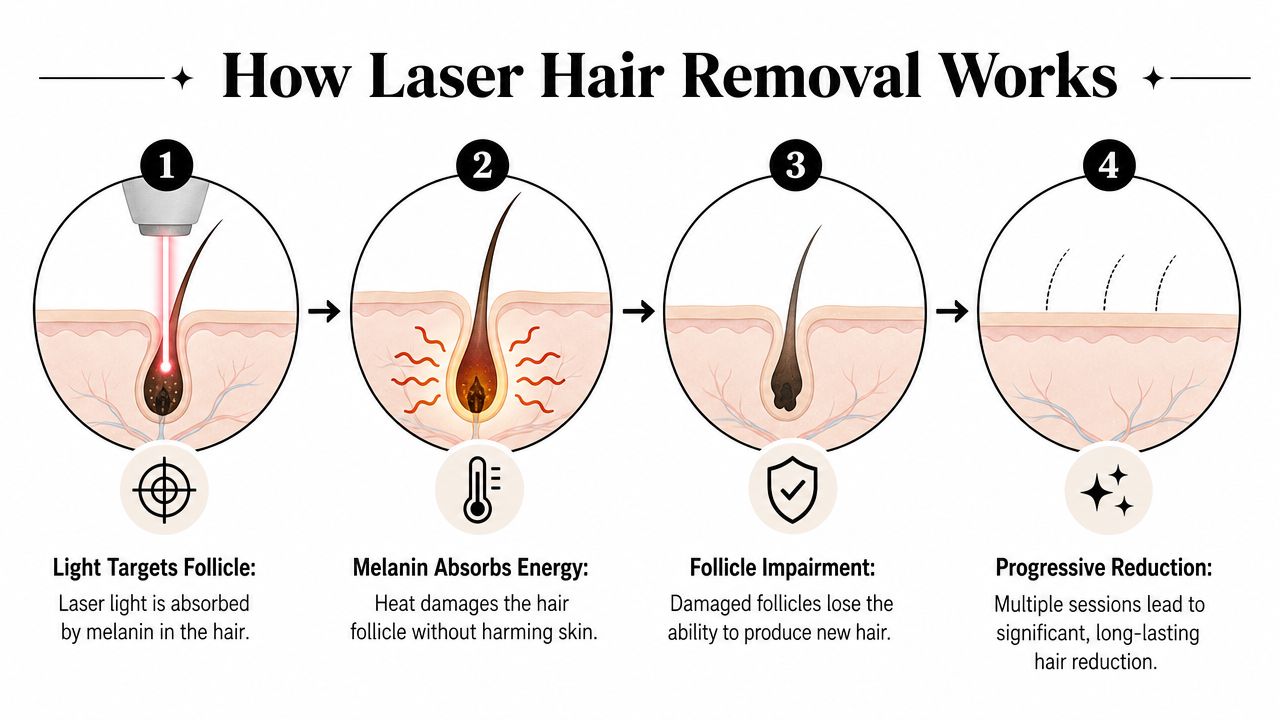
Laser hair removal works through selective photothermolysis. That sounds technical, but the idea is simple. The laser sends light into the skin, and the pigment in the hair absorbs that light and turns it into heat. That heat damages the part of the follicle responsible for future growth.
A useful analogy is a dark T-shirt on a sunny Florida day. Dark fabric absorbs more sunlight and gets hotter than a light shirt. Hair with more pigment behaves the same way. The laser is drawn to melanin in the hair, not to the idea of “hair” in general.
Why dark hair responds best
The clearer the contrast between the hair pigment and surrounding skin, the easier it is for the laser to find its target. That's why dark, coarse hair is usually the most responsive. It gives the device more pigment to work with.
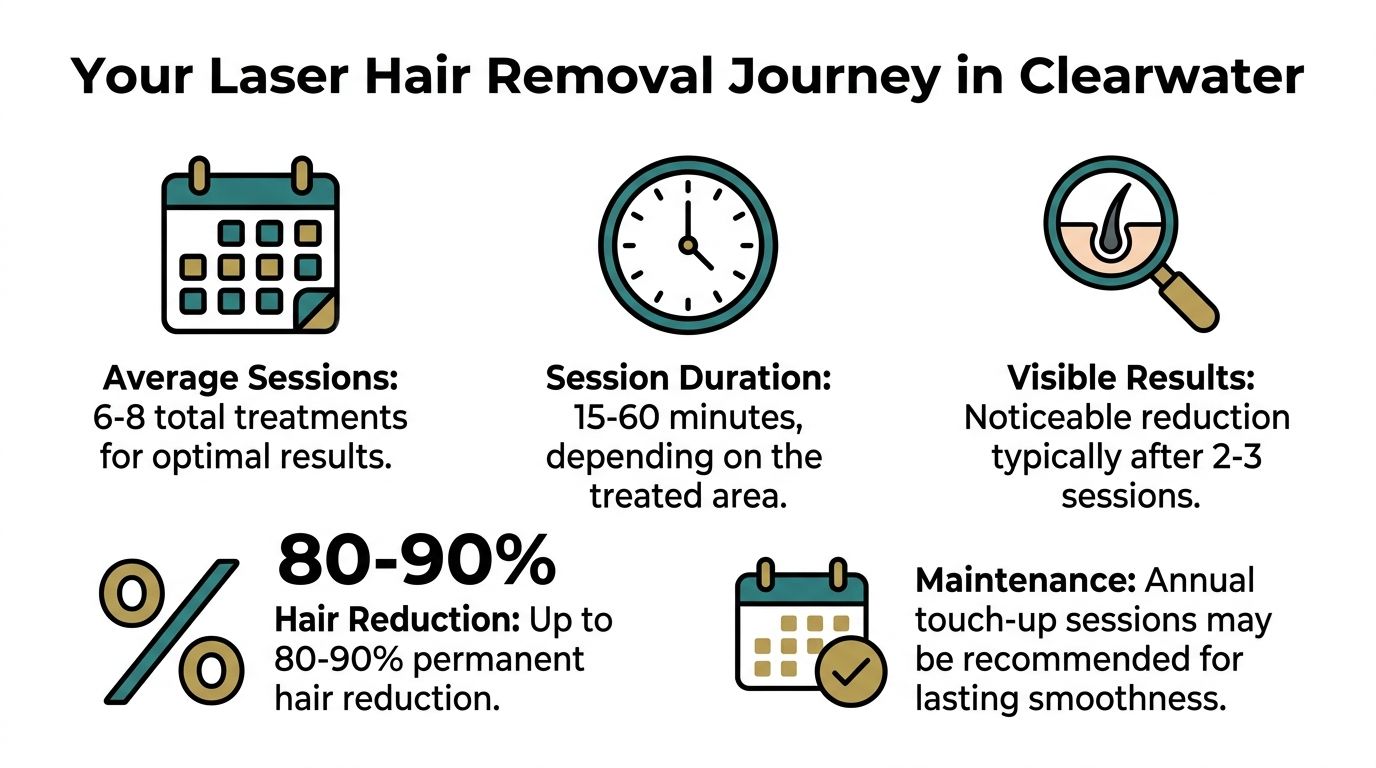
Medical-grade laser hair removal achieves an average permanent hair reduction of 80% to 90% after a complete series of 6 to 8 treatments, according to peer-reviewed clinical studies summarized at Lavish Beauty Laser's review of laser hair removal statistics. The same source explains that the outcome depends on skin type, hair color and coarseness, the body area treated, and the laser technology used.
The laser doesn't “erase” every follicle in one visit. It progressively disables the follicles that are active and targetable at that moment.
Why treatments have to be repeated
Hair grows in cycles. Some follicles are actively producing visible hair, while others are resting or transitioning. Laser is most effective when the follicle is in its active growth phase, because that's when the hair shaft is connected in a way that lets heat reach the structures you want to impair.
That's why treatment has to be spaced out. If you try to rush sessions too close together, you're often treating hairs that weren't ready yet. If you wait far too long, the process gets less efficient and more unpredictable.
A simple way to think about it is this:
- Session one hits what's active now.
- A few weeks later, a different group becomes active.
- The next session targets that new group.
- Over multiple rounds, the overall density drops.
This is also why shaving between appointments is fine, but waxing or plucking usually isn't. You need the hair root in place for the laser to identify the follicle.
Are You a Good Candidate for Laser Hair Removal
Not everyone is the ideal candidate, but the old rule that laser is only for fair skin with dark hair is outdated. Modern systems have expanded what's possible, and candidacy depends more on matching the right technology and settings to the person in front of you than on broad assumptions.
Still, honesty matters. Some hair types respond beautifully. Others respond partially. A few don't respond well enough to justify calling it a great investment.
Skin tone, hair color, and realistic fit
Darker skin tones can often be treated safely with the right platform and a provider who understands wavelength choice, cooling, test spots, and conservative escalation. That's where experience matters. The problem isn't skin tone by itself. The problem is using the wrong device or the wrong settings.
Hair color is where expectations need to be even more direct. Laser depends on pigment. So when someone has light blonde, red, white, or gray hair, there may not be enough pigment for traditional laser treatment to grab effectively.
According to the 2024 International Journal of Cosmetic Science, traditional lasers achieve only 15% to 20% reduction in gray hair after 12 sessions, while newer wavelength technologies show up to 65% reduction. That distinction is important for expectation-setting, and it's summarized in this review of laser hair removal limitations and technology.
If you're still deciding whether laser is worth it compared with temporary options, it helps to compare waxing and shaving methods before committing. For some people, laser is the clear long-term choice. For others, especially with very light hair, a mixed strategy may make more sense.
Clients with deeper skin tones also tend to ask smart questions about pigment safety in energy-based treatments. That same concern comes up in other cosmetic categories, which is why this guide on tattoo removal on dark skin can be useful context for understanding how experienced providers think about skin response and conservative treatment planning.
Clearwater sun exposure and sensitive skin conditions
This is one area that deserves much more attention locally. Clearwater's beach culture creates a constant background risk of recent tanning, sunburn, and skin barrier disruption. Laser on calm, protected skin is one thing. Laser on recently inflamed or sun-stressed skin is another.
A public-facing review of this gap notes that local content often skips the nuance around eczema, psoriasis, and recent sun damage, even though those conditions can change safety protocols and healing timelines. That underserved concern is highlighted in this Clearwater laser hair removal overview discussing condition-specific consultation needs.
If you have any of the following, say it before treatment starts:
- Eczema flare activity
- Psoriasis in or near the treatment zone
- Recent sunburn or heavy tanning
- Broken skin, active irritation, or rash
- A history of strong post-inflammatory pigmentation changes
Those details don't always mean you can't be treated. They often mean your provider should postpone, test carefully, or adjust the plan instead of moving ahead on autopilot.
What to Expect from Sessions and Results in Clearwater
You book your first appointment in Clearwater, spend a weekend near the water, and show up hoping the treatment will act like a stronger wax. That expectation causes a lot of disappointment. Laser hair removal works on the growth cycle under the skin, so the change shows up over time, not all at once.
Results usually build in a steady, predictable way when timing is consistent and the skin is calm. In Clearwater, that second part matters more than many clients expect because beach days, tan lines, and low-grade sun irritation can force delays or lower settings.
What a session feels like
Most clients describe the sensation as a fast snap with heat. The feeling is brief, but it is not identical everywhere. Underarms, upper lip, and bikini areas usually feel stronger than lower legs or arms because the skin is thinner or the hair is coarser.
A few things change the experience:
- Treatment area: Smaller, more sensitive zones usually feel sharper.
- Hair thickness and density: Dark, coarse hair tends to absorb more energy and can feel stronger during treatment.
- Skin condition that day: Sun-exposed, dry, or irritated skin is less comfortable to treat.
- Cooling system and operator technique: Better cooling and careful overlap control make a noticeable difference.
Session length varies by area. Upper lip treatments can be over quickly. Full legs take longer, but many clients still find the process easier than they expected once the first few pulses are done.
How results usually build
The first change is often subtle. Hair may look like it is still growing for a week or two, but much of that hair is shedding from treated follicles. Then regrowth starts coming back more unevenly.
That patchiness is a good sign.
As treatments continue, shaving usually becomes less frequent, the texture often gets finer, and dense clusters start breaking up. By the later sessions, many clients see long stretches with much less visible growth. Some follicles stay inactive for the long term. Others recover partially, which is why a few maintenance visits can still make sense, especially in hormonally influenced areas such as the face.
A practical expectation for Clearwater clients looks like this:
| Stage | What you may notice | Why it matters |
|---|---|---|
| Early treatments | Shedding, slower return, uneven regrowth | Shows treated follicles are cycling out |
| Mid-course | Easier shaving and fewer thick patches | Daily upkeep usually drops |
| Later treatments | Longer-lasting reduction and finer remaining hair | The overall cosmetic benefit becomes much more obvious |
What permanent reduction means in real life
Permanent reduction means a lasting decrease in the number of hairs that come back, not a promise that every follicle is gone forever. That distinction matters. Good laser treatment usually leads to less hair, lighter maintenance, and softer regrowth. It does not guarantee perfectly bare skin in every area for the rest of your life.
Hormones, genetics, treatment timing, and sun habits all affect the finish line. In Clearwater, frequent sun exposure is one of the biggest reasons a plan may need adjustment. If skin is tanned or recently burned, a careful clinic may postpone treatment or lower energy to protect the skin. That protects you, but it can also slow progress compared with someone who keeps the area fully covered and out of the sun.
Package pricing versus single-session pricing also deserves a plain answer. A lower price per visit is not always the better value if the clinic uses weak settings, spreads appointments too far apart, or treats sun-exposed skin so cautiously that results drag out. Ask for the expected number of sessions, likely maintenance needs, and reasons they might delay treatment during high-sun months. That gives you a much clearer picture of the actual cost and the actual timeline.
Choosing the Right Laser Clinic in Clearwater
You book a consult after a week at Clearwater Beach, and the clinic is ready to treat that same day without asking about sun exposure, medication changes, or the rash you mentioned on the phone. That is a warning sign. In this area, a good clinic has to screen for coastal realities, not just sell appointments.
A polished front desk, a discount package, or dramatic before-and-after photos do not tell you much about how carefully the clinic treats skin. The better test is simple. Ask how they handle tanned skin, reactive skin, darker skin tones, and hair that may not respond well. Skilled providers answer with specifics. Sales-driven providers stay vague.
In Florida, the basics are required by law.
Essential Requirements in Florida
In Florida, laser devices used for permanent hair removal must be cleared by the FDA for hair removal or reduction, as required by Florida administrative code on electrology and laser devices. Florida also permits laser hair removal to be performed by a physician, APRN, PA, or licensed electrologist, and licensed electrologists must complete 20 hours of continuing education every 2 years, as summarized in Nextech's Florida laser hair removal licensing overview.
That legal baseline matters, but it is only the starting point. Clearwater clients often come in with fresh sun, self-tanner, saltwater irritation, eczema flares, or active skincare routines that change how conservative a treatment plan needs to be. A clinic that works safely here should already have clear rules for those situations.
Clearwater Clinic Evaluation Checklist
| Criteria | What to Verify (Yes/No) | Why It Matters |
|---|---|---|
| Licensed operator | Yes or No | Florida limits who can perform treatment |
| FDA-cleared device for hair removal | Yes or No | Not every light-based machine is cleared for permanent hair removal |
| Consultation before treatment | Yes or No | Good settings require a skin and hair assessment |
| Experience with your skin tone | Yes or No | Safer treatment depends on proper device selection and judgment |
| Honest discussion of hair color limitations | Yes or No | Light or gray hair needs realistic expectation-setting |
| Clear sun-exposure policy | Yes or No | Clearwater clients often need timing adjustments |
| Protocol for eczema, psoriasis, or irritated skin | Yes or No | Compromised skin may need delay or modification |
| Tattoo avoidance plan | Yes or No | Lasers should not be fired directly over tattoo ink |
| Written aftercare instructions | Yes or No | Redness and irritation are easier to manage with clear guidance |
One more point matters in Clearwater. The clinic should be comfortable saying, “Today is not the right day to treat.” If your skin is too tan, recently burned, peeling, or inflamed, postponing is usually the safer call. That can be frustrating, but it is a sign of judgment, not poor service.
Questions worth asking at a consultation
Use the consult to check how the provider thinks, not just what they charge.
- Which laser platform do you use for my skin tone? You want the actual device type and a reason it fits your skin.
- How do you handle recent sun exposure? In Clearwater, this should be answered clearly and without hesitation.
- What changes if I have eczema, psoriasis, folliculitis, or reactive skin? A careful clinic will explain whether treatment should be delayed, adjusted, or avoided in certain spots.
- How do you approach gray, blonde, red, or very fine hair? Honest clinics will tell you where results are limited.
- Who performs the treatment? The answer should line up with Florida rules.
- What areas will you avoid if I have tattoos nearby? You want a confident answer right away.
- How do you set expectations if one body area responds faster than another? That shows whether the clinic is used to real-world treatment patterns.
If you want a useful comparison for how experienced laser providers think about skin prep, treatment timing, and healing, this guide on how to prepare for tattoo removal shows the same safety-first mindset.
The right clinic earns trust by being precise. It explains limits, adjusts for Florida sun exposure, and puts skin safety ahead of squeezing in one more session.
How to Prepare and Care for Your Skin
Preparation and aftercare decide whether treatment goes smoothly or becomes avoidably irritating. In Clearwater, sun management is the big one. A technically good laser session on freshly sun-exposed skin can turn into a poor experience fast.
The other major point is this. Laser needs the follicle in place. Anything that removes hair from the root interferes with treatment.
Before your appointment
Think of prep as creating the cleanest, calmest target possible.
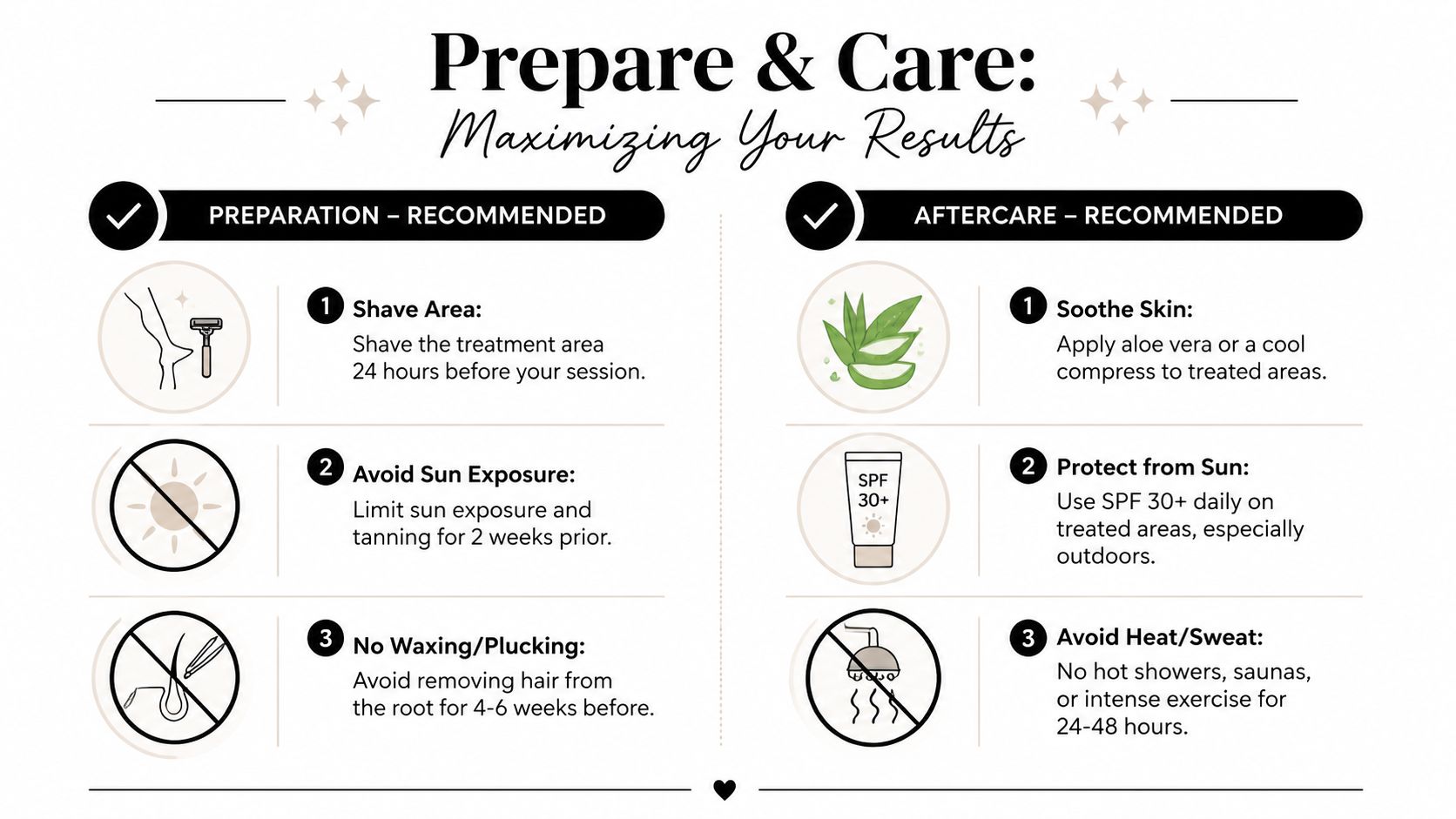
- Shave the area beforehand: Hair should be short above the skin so energy goes where it belongs.
- Avoid heavy sun exposure: Tanned or sun-irritated skin often needs a delay.
- Skip waxing, plucking, and tweezing: If you remove the root, the laser has less to target.
- Report skin changes: A rash, flare, or recent peel matters.
- Keep products simple: On treatment day, avoid anything that leaves skin irritated or heavily coated.
If you want a parallel example of how providers think about prep and healing with another laser-based service, this guide on how to prepare for tattoo removal offers a useful look at why skin condition, sun habits, and aftercare discipline matter so much.
After your treatment
Freshly treated skin usually behaves like mildly irritated skin. It may feel warm, look pink, or seem a little puffy around follicles. That doesn't mean something went wrong. It means the skin needs calm handling.
Use a simple recovery mindset:
- Cool it down. A cool compress or aloe vera can help soothe heat.
- Keep friction low. Tight clothing and aggressive rubbing can make irritation worse.
- Avoid extra heat. Hot showers, heavy exercise, and saunas can amplify redness.
- Protect from the sun. This matters even more after treatment.
- Let the shedding happen naturally. Don't pick at hairs that are working their way out.
Fresh laser-treated skin doesn't need a complicated routine. It needs less heat, less friction, and less experimentation.
If the treated area starts looking more inflamed than expected, or if you have a known skin condition and the response feels different from what was explained, contact the clinic rather than guessing.
Common Questions About Laser Hair Removal
Does it hurt
Usually, it's tolerable. Some spots sting more than others, and dense coarse hair tends to feel sharper. Individuals typically handle it well when the clinic uses a good cooling system and sensible settings.
Can laser go over tattoos
No. Laser hair removal should not be performed directly over tattoo ink. The laser can react to pigment in the tattoo, which creates an unnecessary risk for skin injury and poor outcomes.
What does permanent mean
It means long-term reduction, not a guarantee that every follicle is gone forever. Many people end up with much less hair, finer regrowth, and far less need to shave. Some still need occasional touch-ups over time.
What are the warning signs of a bad clinic
Watch for clinics that avoid specifics. That includes vague answers about who performs treatment, no clear discussion of sun exposure, no interest in your skin history, and no honesty about light or gray hair limitations.
For people who are nervous about laser discomfort in general, not just hair removal, this article on whether laser tattoo removal hurts gives useful context on how laser sensations are usually brief, manageable, and easier when the provider prepares you properly.
If you're considering laser hair removal in Clearwater, Florida, the best next step is a consultation that feels specific to you. Ask direct questions, bring up sun exposure, mention any skin condition history, and don't let anyone rush you past the details that affect safety.
If you're also dealing with tattoo ink you no longer want, EradiTatt Tattoo Removal offers Florida clients a straightforward path to fading or full removal. Their team focuses on safe, progressive treatment plans across multiple convenient locations, with guidance built around your skin, your goals, and your timeline.