
Most Tampa tattoo removal cases clear in about 3 to 9 sessions, and many local clients pay around $100 to $375 per session. The final number depends on the tattoo itself, your skin, and how well the area heals between visits.
If you're reading this, there's a good chance you already know which tattoo you're thinking about. It might be the one you keep covered at work, the one that no longer fits your life, or the one that becomes impossible to ignore once tank tops, beach days, and pool weekends roll around in Tampa.
That feeling is common. Wanting a tattoo gone doesn't mean you made a bad decision years ago. It usually just means your life changed. Good tattoo removal starts with honest expectations, clear planning, and a treatment schedule that works with real Florida life, not a generic aftercare sheet written for a colder climate.
Table of Contents
- Starting Your Tattoo Removal Journey in Tampa
- How Laser Technology Erases Unwanted Ink
- Typical Timelines and Costs for Tampa Tattoo Removal
- Key Factors That Influence Your Removal Results
- Preparing for Sessions and Aftercare in the Florida Sun
- How to Choose the Right Tattoo Removal Clinic in Tampa
- Your Tampa Tattoo Removal Questions Answered
Starting Your Tattoo Removal Journey in Tampa
In Tampa, tattoos spend a lot of time in the sun. That changes how people think about removal. A forearm tattoo that felt easy to ignore in long sleeves can suddenly feel much more visible when you're outside most of the year, heading to the gym, the beach, or a weekend event.
Some clients want full removal. Others only want enough fading to make room for a cleaner cover-up. Both are reasonable goals. What matters is matching the treatment plan to the outcome you want, instead of assuming every tattoo has to disappear completely.
The most successful removals usually start with a simple conversation: what do you want this tattoo to look like six months from now, not just someday?
A practical first visit should feel straightforward. The technician looks at the tattoo's size, color saturation, placement, and skin condition. Then you talk through lifestyle issues that matter in Tampa, especially outdoor work, sports, boating, pool time, and how often that area gets sun.
A clinic like EradiTatt Tattoo Removal offers laser tattoo removal in Tampa using the PiQo4 laser system and a Zimmer Cryo 6 cooling device, which is useful if you're looking for a local option that handles both removal and fading plans in a structured way. The important part isn't the sales pitch. It's whether the provider is clear about what your tattoo will likely require and what could slow the process down.
A realistic mindset from day one
The clients who tend to feel best about the process are the ones who stop treating removal like a single event. It's a series of sessions, healing cycles, and small visible changes.
That can be frustrating if you're in a hurry. It's also what keeps the process safe.
How Laser Technology Erases Unwanted Ink
Laser tattoo removal works by breaking tattoo pigment into much smaller fragments so your body can gradually clear them away. The laser does the fragmentation. Your immune system does the cleanup.
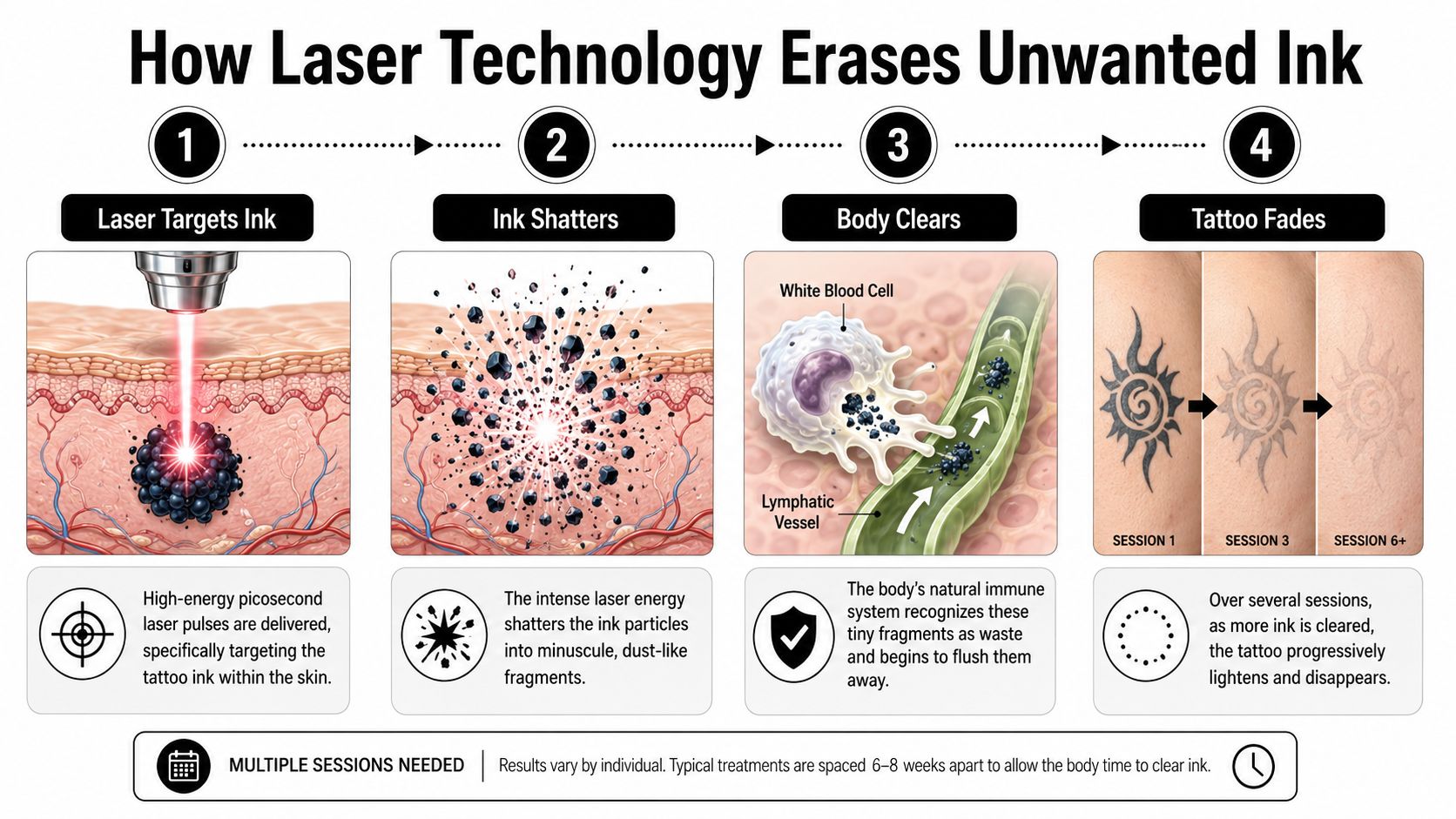
What the laser actually does
A simple way to think about it is this. Fresh tattoo ink sitting in the skin is like a pile of large rocks. Your body has a hard time hauling those rocks away on its own. The laser hits the ink and shatters those rocks into much smaller pebbles. Once the fragments are small enough, your body has a better chance of clearing them over time.
That explains two things new clients often wonder about:
- Why the tattoo doesn't vanish immediately: The ink has to be broken down first, then cleared gradually.
- Why spacing matters: Your body needs recovery time between sessions to process what the laser disrupted.
You may see frosting, redness, swelling, or a temporary surface reaction after treatment. That doesn't mean the tattoo is gone. It means the skin has responded to the session and the clearing process has started.
Why picosecond systems matter
In Tampa tattoo removal, picosecond laser systems are favored because they deliver energy in trillionths of a second, creating stronger photoacoustic fragmentation with less thermal spread than older nanosecond platforms. Reporting tied to Tampa providers notes that this can make treatment 30% to 50% faster, with selected tattoos often clearing in roughly 3 to 9 sessions according to this Tampa-focused picosecond overview.
That doesn't mean every tattoo is a fast tattoo. Dense ink, layered work, and certain colors can still take patience. But picosecond technology has changed the feel of modern removal. Treatments are more efficient because the goal is better ink fragmentation, rather than dumping more heat into the skin.
If you're curious why clinics keep investing in Pico laser systems, that's the reason. Better fragmentation usually means a better path for clearing ink while keeping the focus on precision.
Practical rule: A good laser session isn't just about hitting the tattoo hard. It's about delivering the right energy to break ink effectively without creating unnecessary stress for the surrounding skin.
Typical Timelines and Costs for Tampa Tattoo Removal
Many individuals ask two questions first. How long is this going to take, and what is it going to cost?
Both are fair questions. Both need honest answers.
What most people want to know first
A 2025 peer-reviewed study found an average of 6 sessions across tattoo removals, with a range of 2 to 20 sessions. That same study reported that tattoo age, ink density, location, and the artist's technique significantly affected the number of sessions needed, as shown in the peer-reviewed tattoo removal study.
That range is wide for a reason. A lightly packed older tattoo on a favorable body area is very different from a dense, newer piece with heavy saturation. This is why experienced technicians don't promise a fixed session count after a quick glance.
In practical Tampa terms, many clients planning for removal or strong fading should think in phases, not in one finish line. A consultation should give you a working estimate, but your skin's response over time matters just as much as the tattoo itself.
If you want a more detailed local budgeting breakdown, this guide to tattoo removal cost in Tampa is a useful next read.
Why pricing is usually per session
Tampa tattoo removal is usually priced per session, not as one flat package. One Tampa location lists an average cost of $100 to $375 per session and also notes that U.S. laser tattoo removal commonly ranges from $200 to $500 per treatment depending on tattoo size and other variables, according to this Tampa tattoo removal pricing page.
That pricing structure makes sense for a treatment that unfolds gradually. Session count isn't the only variable. Tattoo size, color complexity, placement, and whether you're aiming for complete removal or partial fading all affect the overall cost.
A useful way to think about budgeting is:
- Session price: What each visit costs.
- Likely number of visits: Your estimated treatment range.
- Goal: Full clearance or enough fading for a cover-up.
Don't judge the plan by the first session alone. Good removal is cumulative, and the visible changes often build session by session instead of all at once.
The cheapest session on paper isn't always the best value if the clinic can't set realistic expectations or doesn't account for healing, sun exposure, and tattoo characteristics. Clear pricing matters. So does clear judgment.
Key Factors That Influence Your Removal Results
Two tattoos can sit on the same body, be treated with the same laser, and still fade at different speeds. That's normal.
Why one tattoo fades faster than another
The strongest evidence on this comes from the same 2025 peer-reviewed study mentioned earlier. It found an average of 6 sessions, but the full range ran from 2 to 20 sessions, and the key drivers included tattoo age, ink density, body location, and the artist's technique. Local Tampa guidance also commonly notes that many patients need 4 to 6 treatments with modern systems for complete removal, but those are still starting expectations, not guarantees.
Ink density matters because tightly packed pigment gives the laser and your immune system more work to do. Older tattoos often respond differently than fresh, heavily saturated work because some natural fading may already have happened. Placement matters too. Some body areas heal and clear more predictably than others.
The tattooer's technique also matters more than most clients expect. Uneven depth, heavy layering, touch-ups, and cover-up work can all make removal less uniform.
Tattoo Removal Factors at a Glance
| Factor | Easier to Remove | More Challenging to Remove |
|---|---|---|
| Tattoo age | Older tattoos with some natural fading | Newer tattoos with strong saturation |
| Ink density | Lighter packing, less concentrated pigment | Dense or layered ink |
| Location on the body | Areas that tend to heal and clear predictably | Areas that may clear more slowly |
| Artist's technique | Even application | Deep, uneven, or heavily reworked application |
| Treatment goal | Fading for a cover-up | Full removal to the lightest possible endpoint |
What this means for your plan
A small tattoo isn't automatically an easy tattoo. A large tattoo isn't automatically a hard one either. The pattern of the ink matters as much as the footprint on the skin.
Here are the trade-offs I usually want clients to understand early:
- Black and dark ink often read simpler visually, but density still matters: A compact black tattoo can take time if the pigment is packed heavily.
- Cover-up tattoos often need more patience: There may be multiple layers or mixed techniques in the same area.
- Placement changes expectations: A tattoo on one part of the body may fade more evenly than one in another spot, even when the artwork looks similar.
- Your endpoint changes the timeline: If your goal is "light enough for a new artist to work over," that may require fewer sessions than total clearance.
Some of the best consultations happen when the client stops asking, "How fast can this disappear?" and starts asking, "What kind of fading can I realistically expect if I treat this consistently?"
That shift matters. It replaces guesswork with a plan.
Preparing for Sessions and Aftercare in the Florida Sun
Florida weather changes tattoo removal planning more than many people realize. Sun exposure isn't a minor afterthought in Tampa. It's one of the biggest safety variables.

A medical review on laser tattoo removal notes that darker or tanned skin has a higher risk of blistering, crusting, pinpoint hemorrhage, pigment change, and scarring when higher laser fluence is used. It also notes that laser tattoo removal can leave skin lighter than surrounding skin, which is why sun exposure and skin-type considerations matter so much before and after treatment.
Before your appointment
You want the skin calm, untanned, and free from recent irritation. In Tampa, that's often the hardest part.
Use this checklist:
- Avoid tanning: If the area is actively tanned, treatment may need to wait.
- Plan around outdoor events: Beach weekends, golf, boating, and yard work can interfere more than people expect.
- Keep the area simple: Skip anything that irritates the skin before treatment.
- Wear easy clothing: Friction on a fresh treatment site can make healing less comfortable.
A lot of clients do better when they schedule treatment windows around their actual lifestyle instead of trying to squeeze removal into the middle of heavy sun exposure. For a more complete visit-by-visit checklist, review how to prepare for tattoo removal.
Aftercare that makes sense in Tampa
Generic aftercare advice often sounds simple until you apply it to Florida. "Avoid sun" is easy to say. It's harder if you work outdoors or spend weekends on the water.
A practical Tampa aftercare plan usually includes:
- Keep the area protected: Covering the site is often more reliable than assuming you'll stay in shade.
- Respect healing time: Don't treat the area like normal skin right away just because the surface looks calmer.
- Be careful with heat and moisture: Humidity, sweat, and rubbing can make a healing site angrier.
- Don't chase cosmetic perfection too early: The skin may need time to settle even after the visible reaction fades.
Some clients also like reading broader skin-health advice around body art and skincare habits. This article on natural skincare with tattoos offers a useful lifestyle perspective, especially if you're trying to keep the surrounding skin in good shape while the tattoo fades.
If you're serious about Tampa tattoo removal, treat sun management like part of the procedure. It isn't optional aftercare. It's part of the treatment itself.
How to Choose the Right Tattoo Removal Clinic in Tampa
Choosing a clinic gets easier when you stop looking for hype and start looking for clear answers.
Questions worth asking before you book
Ask the clinic what laser system they use and why. You don't need a physics lecture. You do need to know whether they can explain how the device fits your tattoo, your skin, and your goals.
Ask who performs the treatment. Experience shows up in judgment, not just in the machine. A good technician should be able to explain why your tattoo may need a slower or more conservative approach, especially if the area gets regular sun.
Ask how they price treatments. Transparent per-session pricing is easier to evaluate than vague package talk, especially when tattoo removal often unfolds over multiple visits.
Ask how they handle comfort and aftercare. Cooling support, realistic healing guidance, and direct answers about sun exposure are all good signs.
If you're comparing local options, this article on the best tattoo removal clinic in Tampa gives a practical checklist of what to look for.
A contact page should also make it easy to take the next step without chasing information.

The clinic itself should be easy to reach, easy to understand, and clear about what happens after the first appointment. If the consultation feels rushed or evasive, that's useful information too.
Your Tampa Tattoo Removal Questions Answered
Is laser tattoo removal painful
It is often described as brief, sharp discomfort rather than prolonged pain. The exact feel depends on the treatment area, your pain tolerance, and the system being used. Cooling support can make a big difference.
Can you remove only part of a tattoo for a cover-up
Yes. Selective fading is common when someone wants to lighten a section so a tattoo artist has more freedom with the new design. In many cases, partial fading is the smarter goal than full removal.
What is the risk of scarring
There is always some risk with any procedure that affects the skin, but careful treatment planning and good aftercare matter a lot. Sun exposure, picking at the area, and treating tanned or irritated skin can make outcomes worse.
When should I start if I live an outdoor Tampa lifestyle
Start when you can realistically protect the area before and after sessions. If you know you'll be in the sun constantly for work or recreation, it's better to plan treatment around that than ignore it.
How do I know if removal or fading is the better choice
That depends on your endpoint. If you want clear skin, removal is the path. If you want a better canvas for new work, fading may be faster, more cost-effective, and easier to fit into your schedule.
If you're ready to get a realistic plan for your tattoo, schedule a consultation with EradiTatt Tattoo Removal. You'll get straightforward guidance on likely sessions, treatment goals, and how to manage removal safely in Tampa's sun-heavy climate.