
You’re probably here because the tattoo that made sense a few years ago doesn’t fit your life now.
For some people, it’s a name they don’t want to explain anymore. For others, it’s a visible tattoo that suddenly matters when they’re applying for a job, planning a wedding, joining the military, or making room for a cleaner cover-up. The hesitation usually sounds the same. “Will it come off?” “How much is this going to cost me by the end?” “Am I signing up for a long, painful process with no clear finish line?”
Those are fair questions. Those considering tattoo removal don’t need another vague promise about “affordable” treatment. They need straight answers about session count, total budget, healing, and what modern laser technology can realistically do.
Your Guide to a Fresh Start in Tampa
A new client often comes in with one small tattoo and three big concerns. They want to know if the ink can fade enough for their next step. They want to know whether the process is safe for their skin. Most of all, they want to know the full financial picture before they commit.
That last concern matters more than many clinics acknowledge. A low session price can sound simple, but tattoo removal isn’t a one-visit service. The primary question isn’t only what one appointment costs. It’s what your complete removal plan is likely to cost, how many sessions you may need, and whether package pricing or payment options make that plan easier to manage.
Affordable tattoo removal Tampa clients can trust starts with clear expectations. That means looking at the tattoo itself, not guessing from a generic ad. A tiny black amateur tattoo behaves differently than a dense professional sleeve. A tattoo meant for a cover-up has a different endpoint than one being fully erased. Skin tone, ink color, placement, and healing habits all affect the path.
What helps most: A realistic plan is more reassuring than a cheap headline price.
The good news is that tattoo removal in Tampa has become more predictable because the technology has improved and pricing structures are easier to understand when a provider lays them out clearly. Free consultations, photo-based estimates, package discounts, and customized treatment plans can make the process much more approachable than often expected.
If you’re trying to decide whether now is the right time to start, focus on two things. First, whether the provider can explain your likely timeline in plain English. Second, whether they can explain your total investment, not just your first visit.
Decoding the Cost of Tattoo Removal in Tampa
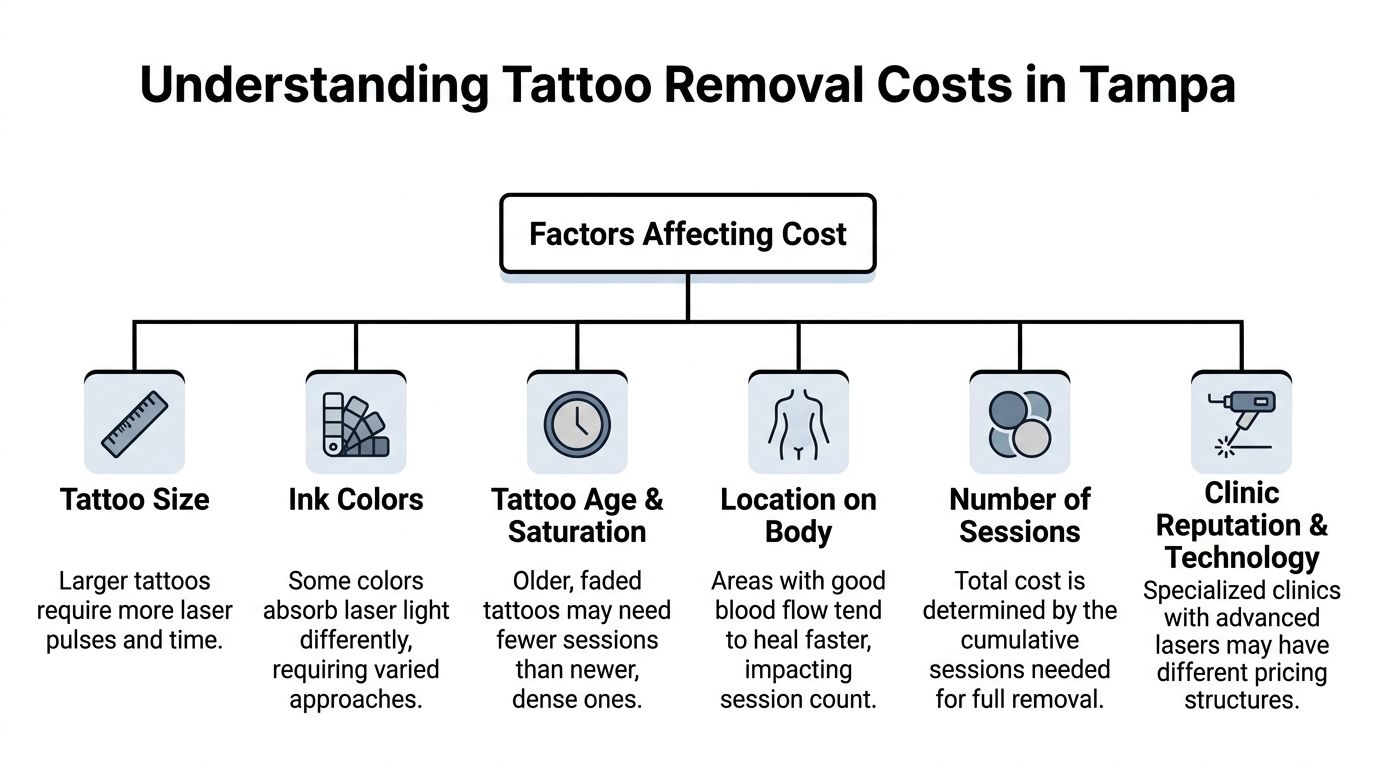
Price only makes sense when you know what drives it. In Tampa, rates are commonly tiered by tattoo size and complexity, often starting at $99 per session for very small tattoos and moving through brackets such as $124 to $149, $149 to $224, $224 to $299, and $299 to $499+ depending on the work involved, as outlined in Tampa tattoo removal pricing details.
Why one tattoo costs more than another
Two tattoos can look similar at first glance and still price very differently. A lightly packed black design on the forearm is usually simpler than a multicolor professional piece with dense saturation. When people hear “affordable,” they often think the lowest per-session price. In practice, affordability comes from matching the plan to the tattoo so you don’t overpay for the wrong approach.
Here’s the cleanest way to think about it.
| Cost Factor | Why It Matters | Impact on Price |
|---|---|---|
| Tattoo size | Larger pieces require more treatment area and more time | Usually increases per-session cost |
| Ink colors | Some colors are easier to target than others | More color complexity can raise treatment difficulty |
| Tattoo age and saturation | Older or lighter tattoos may respond differently than fresh, dense work | Heavy saturation can increase total treatment needs |
| Placement on the body | Some areas heal and clear ink more slowly | Can affect total number of visits |
| Professional vs amateur work | Professional tattoos often sit deeper and contain denser ink | Professional work often costs more to fully remove |
| Goal of treatment | Fading for a cover-up is different from full removal | Partial fading may cost less overall than complete clearance |
The total cost matters more than the first session
Many people get tripped up. They compare entry prices and assume they’re comparing total value. They aren’t. A better question is, “What am I likely to spend from first treatment to finish?”
That’s why I tell clients to ask for the whole picture. Ask what the size bracket is. Ask whether your tattoo is likely to need a longer plan because of color or density. Ask whether package pricing changes the math. If you want a deeper look at why pricing can vary so much from one tattoo to another, this breakdown on why tattoo removal costs what it does is worth reading.
Budget rule: Don’t shop tattoo removal the way you’d shop a haircut. Shop for the likely full plan, the technology being used, and the clarity of the estimate.
Permanent makeup follows its own pricing logic, too. In Tampa, brow removal options commonly fall in the $99 to $199 range in published pricing, which gives clients a separate benchmark from body tattoo work.
The most useful consultation is the one that replaces uncertainty with a plan you can budget around.
How Advanced Laser Technology Erases Ink Safely
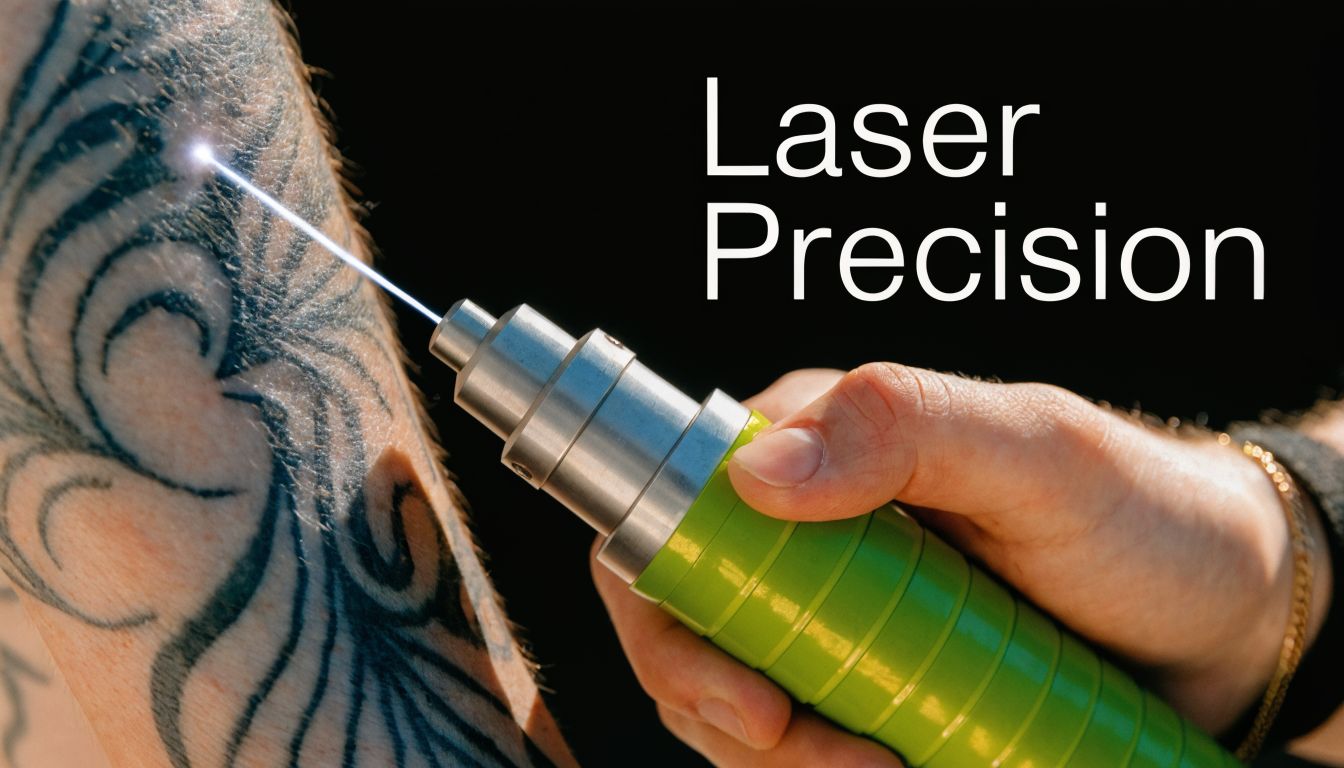
Modern laser tattoo removal works by breaking ink into smaller and smaller fragments so the body can clear them over time. The easiest analogy is a pile of rocks. Large rocks are hard to move. Crush them into fine gravel, and the cleanup becomes much easier.
That’s what a good laser session is trying to do. It isn’t scraping the tattoo out of the skin. It’s targeting pigment under the skin with controlled light energy.
What the PiQo4 system changes
The PiQo4 uses a dual-pulse setup that combines nanosecond and picosecond technology to break ink more efficiently. That design can deliver 20 to 50% faster clearance for multicolor tattoos than older laser systems, according to PiQo4 treatment technology details.
In plain terms, the first energy pass helps disrupt larger and deeper pigment clusters. The shorter picosecond energy then hits smaller remaining particles with more precision. That matters because tattoo ink rarely sits in the skin as one neat, uniform layer. Dense black packing, old touch-ups, and mixed colors all behave differently.
A few practical points matter here:
- Black ink usually responds well: It tends to absorb laser energy effectively.
- Blue and green can be more stubborn: Modern multi-wavelength systems are built to address a broader range of colors.
- Heat control matters: Shorter pulses help limit unnecessary heat spread into surrounding tissue.
- Customization matters: The right settings depend on your skin tone, ink type, and whether you want fading or complete removal.
Why modern treatment feels different from older removal stories
A lot of the scary stories people remember come from older equipment or poorly matched settings. Today’s better systems aren’t just about speed. They’re also about precision.
As a technician, one of the biggest differences I see is predictability. With stronger technology and better customization, treatment plans make more sense from the start. The goal isn’t to blast the tattoo as aggressively as possible. The goal is to fragment ink effectively while protecting skin integrity.
For readers who want a closer look at the mechanics, this overview of newer tattoo removal technology gives a useful primer.
The best session is not the harshest session. It’s the session that moves the tattoo forward while giving the skin a clean chance to heal.
One more point often gets missed. Good technology doesn’t eliminate the need for patience. It improves efficiency, expands color handling, and supports safer treatment. But healing still happens between visits, not during the few minutes the laser is on your skin.
Your Removal Timeline What to Expect Session by Session
Most tattoos don’t disappear in one appointment because the body needs time to clear what the laser breaks apart. In Tampa, a full removal commonly takes 5 to 12 sessions, and advanced picosecond technology can reduce that by 20 to 50%, with many complex tattoos reaching full removal in fewer than 10 sessions, based on session estimates for Tampa tattoo removal.
That range is broad because tattoos aren’t all built the same. Small simple tattoos often land around 5 to 8 sessions. Medium tattoos often fall into 6 to 10 sessions. Large or multicolored tattoos may need 8 to 12 or more sessions. Professional tattoos usually take longer than amateur ones because the ink tends to sit deeper and denser.
What you’ll notice after each visit
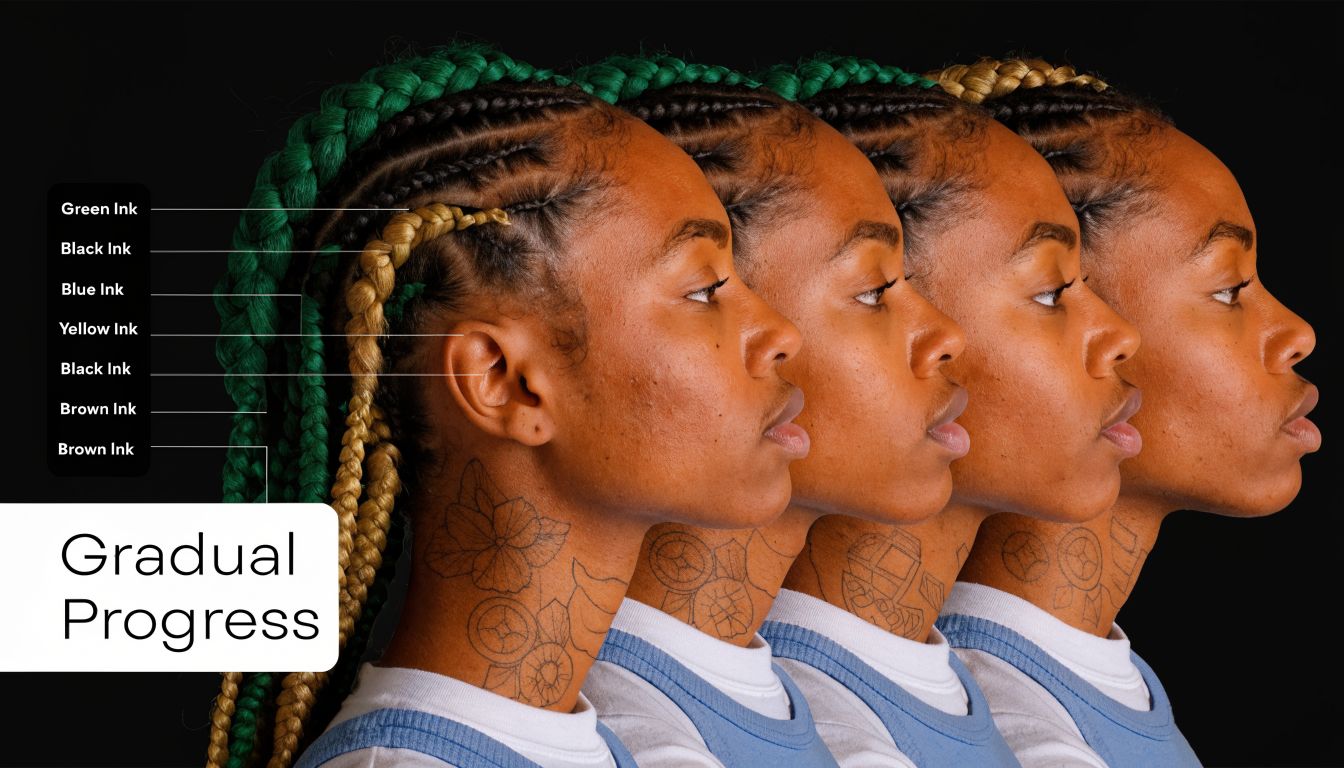
The first visible reaction is often frosting, which is a temporary whitening effect on the treated area. Redness and mild swelling are common right after treatment. Then the skin settles, and fading happens gradually as your body processes fragmented pigment.
Progress usually feels uneven. One session may show obvious lightening. The next may look subtler. That doesn’t mean the treatment failed. It means the body is clearing ink at its own pace, and some pigment layers are more stubborn than others.
A realistic sequence looks like this:
- Early sessions often break up the most accessible surface pigment.
- Middle sessions start thinning dense areas and exposing where ink was packed deeper.
- Later sessions focus on residual haze, stubborn color pockets, or getting the tattoo light enough for a cover-up.
Full removal versus fading for a cover-up
These are different goals, and clients should treat them that way from day one.
If you want a cover-up, you may not need to erase everything. Many people only need enough fading to give the tattoo artist a cleaner base. If you want the tattoo gone completely, expect the final stretch to move slower than the beginning.
A practical expectation: The last traces of ink are often the most time-consuming part of the process.
That’s why honest planning matters. A tattoo that’s perfect for cover-up fading might not need the same investment as one headed for full clearance. During consultation, the right question isn’t just “How many sessions?” It’s “How light do I need this tattoo to become to reach my actual goal?”
How to Choose the Right Tampa Tattoo Removal Provider
Choosing a provider shouldn’t come down to the cheapest ad or the closest parking lot. This is a skin treatment, not a commodity service. You want someone who can look at your tattoo, explain the plan without hype, and adjust treatment intelligently as the tattoo changes.
What to look for in a serious provider
Start with the technology. A provider using modern picosecond laser systems has a stronger toolset for handling a wider range of ink colors and tattoo types. Published industry benchmarks also show visible fading in 87% of sessions at specialized Tampa clinics using modern picosecond lasers, as noted earlier in the pricing benchmark source, which is why equipment quality matters here even when a consultation feels informal.
Then look at the human side of the practice.
- Experience with removal only or removal-focused work: Tattoo removal has its own judgment calls. Settings, spacing, and endpoint decisions matter.
- Free consultation process: You should be able to ask direct questions without pressure.
- Clear before-and-after documentation: Not polished marketing shots alone. Look for consistency across different tattoos and skin presentations.
- Transparent explanations: If the provider can’t explain why your tattoo may take longer or shorter than average, that’s a problem.
The pricing conversation tells you a lot
The estimate itself often reveals whether the clinic is organized. Good providers explain what affects price, how your treatment goal changes the plan, and what discounts or packages may reduce the total investment. One practical example is EradiTatt Tattoo Removal, which uses the PiQo4 laser and offers free consultations based on in-person review or submitted photos, so clients can get a more personalized estimate before starting treatment.
That kind of transparency matters because budget stress leads people to pause treatment halfway through. A provider should help you plan for the entire journey, not just get you in the chair once.
If the consultation feels rushed or vague, the treatment plan usually will too.
For clinic owners and practice managers, there’s also a useful broader lesson in patient communication. Good educational content builds trust before a consultation ever happens. A strong example outside this niche is Transactional LLC's strategies for med spas, which highlights how clear messaging, patient education, and honest positioning help people make better treatment decisions.
In other words, pick the provider who treats informed consent as part of the service.
Financing and Discounts That Make Removal More Affordable
Affordable tattoo removal Tampa doesn’t mean “cheap.” It means manageable.
The base session price matters, but package structure matters more once you know this is a multi-visit process. In Tampa, clinics commonly offer discounts such as buy 4 sessions get 1 free, 10% off for military, veterans, and first responders, and referral credits that lower the total investment across a full treatment plan.
Ways to bring the full plan within budget
Some savings are straightforward. Others only show up if you ask.
- Package pricing: If your tattoo clearly needs multiple sessions, a package can reduce the average cost across the plan.
- Service discounts: Military, veteran, first responder, and healthcare worker discounts may apply depending on the clinic’s policies.
- Referral credits: These can help offset future sessions if you know someone else considering removal.
- Free consultations: A no-cost estimate protects you from paying just to find out the tattoo is more complex than expected.
Ask about the whole cost, not just the next payment
This is the conversation many clients wish they’d had sooner. Ask what complete removal may look like financially. Ask whether the office offers installment options or staged payment arrangements. Ask if your tattoo is a better candidate for a package than for paying visit by visit.
The biggest mistake budget-conscious clients make is assuming they should delay the consultation until they’re “ready.” In reality, the consultation is how you find out what ready looks like.
A clear treatment plan can help you decide whether to start now, whether to begin with fading instead of full removal, or whether to wait until a package option lines up with your budget.
Your Next Steps Safety Aftercare and Scheduling Your Consultation
Good results don’t come from the laser alone. They also come from what happens after the appointment.
Right after treatment, the skin needs calm, clean care. The treated area may look white at first, then pink or red, and it can feel warm or irritated for a short time. That doesn’t mean something is wrong. It means the skin is responding to treatment and beginning the healing cycle.

Aftercare that protects your progress
Simple aftercare usually works best.
- Keep it clean: Follow the clinic’s cleansing instructions and avoid picking or scratching the area.
- Protect healing skin: Friction, unnecessary heat, and sun exposure can complicate recovery.
- Let the skin settle: Don’t rush back too soon just because the surface looks better.
- Report anything unusual: If healing doesn’t look the way your provider described, ask questions early.
Most clients do better when they think in cycles, not isolated appointments. The session creates the change. The healing window is where your body does the clearing. Skipping aftercare or crowding sessions works against the result you’re paying for.
Making the first appointment easier
A consultation should feel practical, not intimidating. Bring clear photos if you’re starting remotely. If you’re coming in person, be ready to talk about your tattoo’s age, whether it was professionally done, whether you want full removal or fading, and any deadlines that matter to you.
At the Tampa location, clients can schedule a free consultation at 1715 N. Westshore Blvd, Suite 100, and the multi-location Florida network also offers centralized scheduling through an 844 line. That setup makes it easier to start with questions, compare options for your own tattoo, and get an estimate built around your actual goal rather than a generic template.
The best next step is usually the simplest one. Get the tattoo evaluated. Get the timeline explained. Get the total cost discussed in plain terms.
If you’re ready to stop guessing and get a clear plan, schedule a free consultation with EradiTatt Tattoo Removal. You can bring photos, ask direct questions about pricing and packages, and find out whether your tattoo is a better fit for full removal or cover-up fading.