
You look at the tattoo that used to make perfect sense and now just feels out of step with your life. Maybe it affects a job opportunity. Maybe it reminds you of a relationship, a phase, or a decision you’ve outgrown. Maybe you still like tattoos in general, but not this one.
Then the next question hits fast. Why is laser tattoo removal so expensive?
The short answer is that you’re not paying for a quick cosmetic touch-up. You’re paying for advanced laser technology, careful treatment planning, trained hands, skin safety, and a process that happens over time instead of in one visit. A tattoo is placed into the skin to last. Removing it safely takes precision.
Cost also isn’t one-size-fits-all. Two people can walk into the same clinic and get very different quotes because their tattoos are different in size, color, depth, placement, and removal goal. One person may want full clearance. Another may only need enough fading for a cover-up. That difference matters.
If you’re in Florida and trying to budget realistically, the useful question isn’t just “what does removal cost?” It’s “what about my tattoo makes this easier, harder, faster, or more expensive?” Once you understand that, the price starts to make more sense.
The Real Question Behind Your Unwanted Tattoo
A lot of people don’t ask about cost because they’re shopping casually. They ask because they’re standing at a turning point. They want to know whether removing a tattoo is doable for their schedule, their skin, and their budget.

That’s the right way to think about it. The main issue usually isn’t sticker shock alone. It’s uncertainty. People want to know what they’re paying for, whether the process is worth it, and how to avoid wasting money on options that look cheaper but often deliver poor fading, burns, or scarring.
Cost feels different when you know what drives it
Laser tattoo removal is expensive for a reason. The procedure depends on high-end equipment, a trained technician, and a treatment plan customized for your skin and your ink. It also takes multiple visits because the laser doesn’t “erase” a tattoo in one pass. It breaks ink into smaller particles, and your body clears that pigment gradually between sessions.
That means your quote isn’t random. It’s built around several practical questions:
- How large is the tattoo
- Is it black ink or multicolor
- Was it professionally applied or more superficial
- Is it on the torso or on a slower-clearing area like a hand, foot, or ankle
- Do you want complete removal or just enough fading for a cover-up
Practical rule: The cheapest option up front often becomes the most expensive option if it causes poor fading, delays, or skin injury.
The goal isn’t always finding the lowest number on a price list. It’s finding the safest and most efficient path to the result they want. Once you understand that framework, the conversation changes from “why does this cost so much?” to “what am I investing in, and what result does that investment support?”
The Six-Figure Technology Behind Erasing Ink
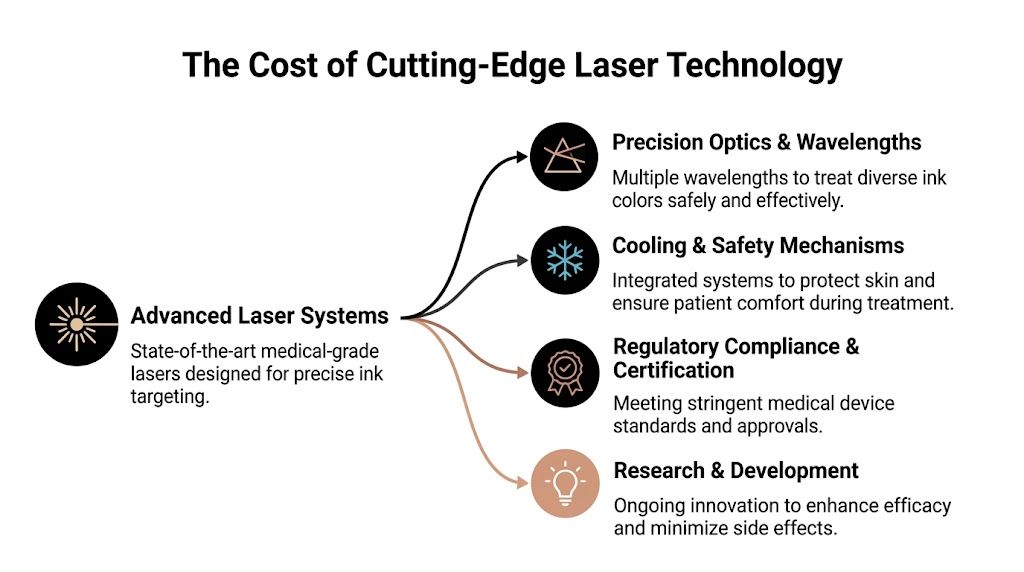
A tattoo removal quote starts making more sense when you know what is sitting in the treatment room. The laser itself is often a six-figure piece of medical equipment, and clinics have to recover that investment while keeping treatments safe, consistent, and suited to the specific tattoo. Advanced systems can cost clinics between $100,000 and $300,000 or more, according to this breakdown of tattoo removal equipment costs.
That purchase price is only part of the story.
Modern tattoo removal depends on more than getting light into the skin. The platform needs the right wavelengths, pulse duration, spot sizes, and cooling controls to treat different ink colors and skin tones with precision. Older systems can still treat some tattoos, but newer picosecond and multi-wavelength devices give a technician more control over stubborn pigment and more options for adjusting treatment safely from one client to the next.
That matters in Florida, where year-round sun exposure can complicate timing and aftercare. A clinic treating active clients in Tampa, Orlando, or Miami needs equipment that allows careful parameter changes based on tan level, skin response, and the specific ink being targeted that day.
Why the machine matters so much
Different inks absorb laser energy differently. Black ink is usually the most responsive. Green, blue, yellow, and layered tattoos are often less predictable, so the machine has to do more than fire a single setting over the whole piece.
The FDA describes lasers used in dermatology as devices that require training, maintenance, and appropriate safety controls, not simple cosmetic gadgets you can swap out without consequence. You can read more in the FDA’s overview of laser-emitting medical devices. In practice, that means session pricing includes calibration, service, replacement parts, protective eyewear, smoke evacuation, cooling methods, and the downtime that comes with maintaining specialized equipment.
A good system also lets us treat selectively. That lowers the chance of unnecessary injury to surrounding skin and gives us better odds of steady fading over time.
Precision is part of safety
Laser tattoo removal works by targeting pigment, but skin is never just a blank canvas. Melanin, blood vessels, scar tissue, and old tattoo layering all affect how energy behaves once it enters the skin. The more precise the platform, the better a technician can match the treatment to the tattoo instead of forcing every client into the same settings.
That same principle shows up in other laser services. If you want a simple example, this explainer on how laser hair removal interacts with tattoo ink shows why lasers and pigment require careful planning.
Better technology improves accuracy, expands the range of tattoos a clinic can treat well, and reduces avoidable setbacks. It does not make every tattoo easy.
What that means for your budget
You are paying for access to a machine that can handle more variables with fewer compromises. For one person, that may mean better response on multicolor ink. For another, it may mean a safer approach for darker skin or a more practical path to fading for a cover-up instead of full removal.
That is why a flat statewide price list is never enough, especially for Florida residents comparing providers in different cities. The better question is whether the clinic’s technology fits your tattoo. If you want to see how one modern platform is built for that kind of flexibility, this guide to PiQo4 laser tattoo removal and why it handles unwanted ink so effectively is a useful reference.
How Your Tattoo's Unique Design Dictates The Price
Once the clinic’s technology is accounted for, the next major factor is your tattoo itself, which can lead to two people getting very different estimates even if they book on the same day.
According to this review of tattoo characteristics and pricing, a small tattoo under 2 inches may cost $150 to $300 per session, while a large tattoo measuring 6 to 10 inches can cost $450 to $700 per session. The same source states that many tattoos need 6 to 10 sessions, a simple removal may total $1,800, and a complex multicolor piece can exceed $7,000.
Size is only the starting point
People often assume size is the whole story. It isn’t. A small tattoo can still be stubborn if the ink is dense, layered, or made up of colors that are harder to break apart. A larger tattoo in mostly black ink can sometimes be more straightforward than a smaller but highly saturated multicolor design.
Three things usually raise the total cost fastest:
- Color complexity. Greens and blues are often harder to treat than black ink.
- Ink density. Professional tattoos usually place more pigment deeper into the skin.
- Layering or cover-ups. More ink in the same area means a longer road.
Placement affects removal speed
The body doesn’t clear every tattoo at the same pace. Areas with stronger circulation tend to respond more predictably than extremities. Hands, feet, lower legs, and ankles often clear more slowly, which can mean more visits before you reach your goal.
That’s one reason a tiny ankle tattoo may end up costing more over time than someone expects. It looks small. It behaves stubbornly.
A quick way to estimate your own cost drivers
Use this table as a planning tool, not a final quote.
| Tattoo Characteristic | Impact on Cost | Estimated Additional Sessions |
|---|---|---|
| Small, simple black tattoo | Lower per-session pricing and typically simpler targeting | Often stays within the lower end of the average treatment range |
| Large tattoo | More treatment area, more time, more pulses | Often moves treatment toward the higher end of the average range |
| Multicolor tattoo | Harder colors may need specialized wavelengths and more precision | Can require extra sessions beyond a simple black design |
| Dense professional ink | Deeper, heavier saturation can slow fading | May need more sessions than lighter, more superficial ink |
| Layered or cover-up tattoo | Multiple ink loads in one area increase difficulty | Often extends the treatment plan |
| Tattoo on hands, feet, or ankles | Slower clearance can lengthen the process | May need additional visits compared with torso placement |
If you want the clearest budget estimate, stop thinking in terms of “small, medium, large” alone. Think in terms of size, color, density, and location together.
Florida-specific budgeting matters
Florida clients often want practical planning because appointments have to fit work, commuting, beach exposure, and sun-care habits. If you live in Tampa, Orlando, St. Petersburg, Bradenton, Sarasota, Palm Harbor, or nearby areas, that planning matters even more because your treatment schedule has to work with real life, not just a price chart.
A personalized quote is valuable because it translates your tattoo’s design into expected treatment effort. That’s the difference between a generic range and a removal roadmap you can budget around.
The Human Expertise You Are Paying For
A tattoo removal appointment isn’t just machine time. You’re paying for someone to assess your skin, your tattoo, your healing response, and the safest settings for that particular visit.
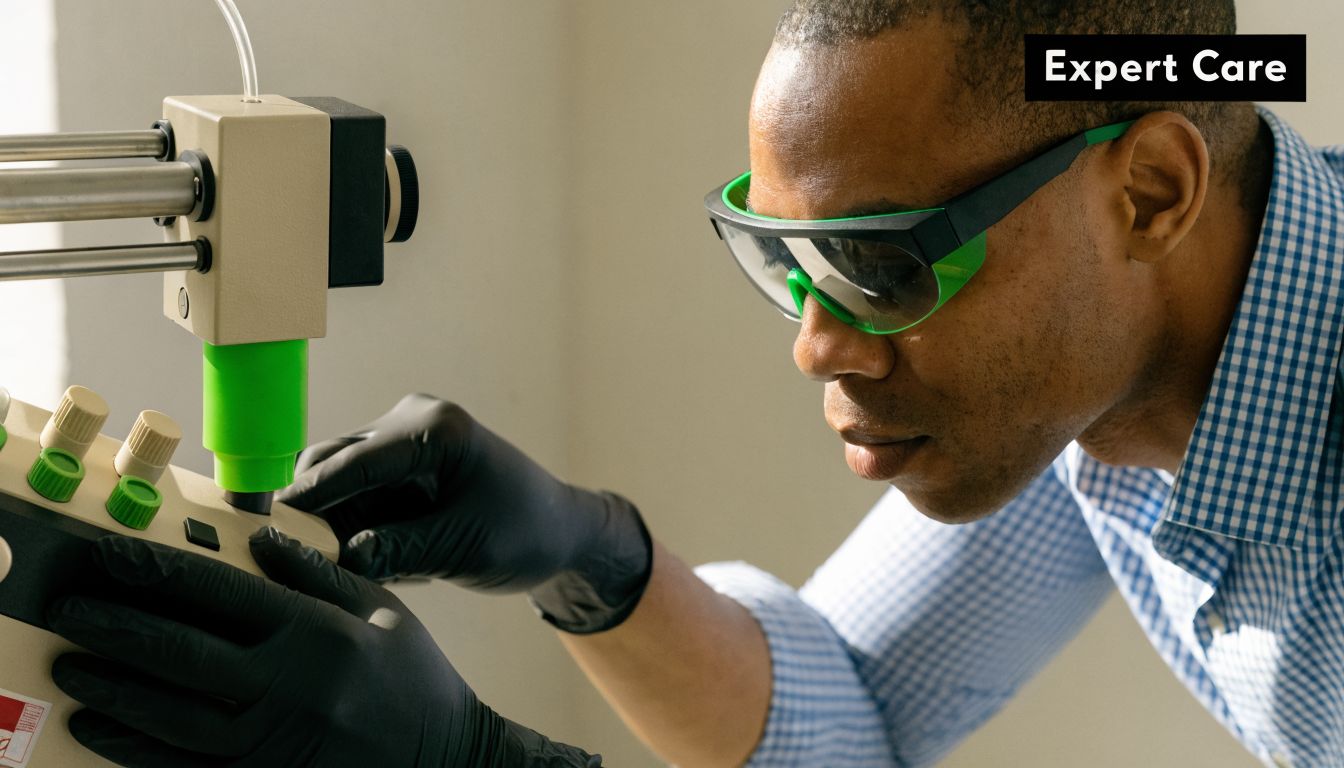
That matters because laser settings should never be copied blindly from one person to another. A trained technician has to balance effective treatment with skin protection. Too aggressive, and you raise the risk of injury. Too conservative, and progress slows unnecessarily.
Why training changes the outcome
According to this analysis of removal cost factors and treatment variables, tattoos on extremities like hands and feet clear slower due to reduced lymphatic flow, which can require more sessions. The same source notes that darker skin tones, including Fitzpatrick types III-VI, often require lower laser fluences to reduce burn risk, which can also increase the number of visits. An expert technician adjusts the treatment strategy accordingly.
That adjustment is skilled work. It involves reading the tattoo, knowing how different wavelengths interact with pigment and melanin, and deciding how aggressively to treat without creating unnecessary risk.
What low-cost options usually leave out
A budget price can sound appealing until you look at what may be missing:
- Experience with different skin types so settings are adapted safely
- Proper consultation and patch assessment instead of rushing into treatment
- Sterile technique and protective protocols for healing and comfort
- Reliable equipment maintenance so the laser performs the way it should
- Clear aftercare guidance to reduce complications between visits
The skill in tattoo removal is not just firing the laser. The skill is choosing the right treatment for the skin in front of you on that day.
Peace of mind is part of the cost
Clinic overhead isn’t glamorous, but it is part of a safe procedure. Insurance, compliance, trained staff, eye protection, room setup, sanitation, device servicing, and follow-up support all sit behind each appointment. Patients don’t always see those line items, but they benefit from them every time a treatment is done carefully.
That’s why experienced care costs more than a bargain option with outdated equipment or poor oversight. You’re not paying extra for fluff. You’re paying for judgment, consistency, and a lower chance that a bad decision today becomes a skin problem that lasts much longer than the tattoo.
Mapping Your Treatment Timeline and Aftercare
One of the biggest misunderstandings about tattoo removal is the idea that the laser removes the tattoo all at once. It doesn’t. The laser breaks up ink particles, and then your body gradually clears that fragmented pigment over time. That’s why removal happens in stages.
A lot of the total cost is tied to patience. You’re not buying one dramatic event. You’re committing to a series of treatments spaced out enough for the skin to recover and for fading to happen between visits.
Why multiple sessions are normal
A tattoo sits in layers of skin, and different areas of the tattoo may respond at different speeds. One color may lighten faster than another. One section may be denser. A cover-up may reveal how much extra ink is packed into the same spot only after treatment starts.
That’s why realistic planning matters. A projected number of sessions gives you a useful budget range, but your skin’s healing response still plays a role in the pace of progress. This overview of how long tattoo removal takes is helpful if you want a practical sense of timeline expectations.
Aftercare affects value
Good aftercare protects the result you just paid for. If the treated area gets irritated, overexposed to sun, picked at, or poorly managed during healing, you can slow progress and raise the chance of unwanted skin changes.
A simple aftercare mindset works best:
- Keep the area clean and follow the instructions you’re given.
- Protect healing skin from sun exposure, especially in Florida.
- Don’t rush the process by trying home remedies or over-treating the area.
- Report unusual healing concerns promptly so they can be assessed.
Healing time isn’t dead time. It’s part of the treatment.
There can also be small out-of-pocket costs along the way for basics like bandages or ointment, depending on what your provider recommends. Those expenses are minor compared with the procedure itself, but they’re still part of the overall budget and worth planning for.
How to Smartly Manage Your Tattoo Removal Budget
A smarter budget starts with the right goal. Not every tattoo needs complete removal. Some people only need enough fading to make a cover-up easier, cleaner, and more flexible. That can change the financial picture right away.

If your main objective is to move on from the current design, fading for a future cover-up may cost less than chasing full clearance. If your goal is a completely clean slate for personal or professional reasons, then the plan should be built around full removal from the start.
New payment models can reduce uncertainty
According to this tattoo removal cost guide discussing payment models and newer laser systems, some clinics now offer flexible monthly plans that cover complete removal, which can be easier to budget than pay-per-session treatment. The same source notes that newer picosecond lasers can reduce total sessions by 20 to 30 percent compared with older Q-switched technology, potentially lowering long-term cost even if each session costs more.
That trade-off matters. A cheaper session price isn’t always the cheaper treatment path if the technology is less efficient for your tattoo.
Practical ways to budget better
Here are the approaches that usually make the most sense:
- Choose the right endpoint: If a cover-up is your real goal, ask whether fading is enough.
- Ask about package structure: Some payment plans reduce the uncertainty of session-by-session billing.
- Budget for the full journey: Include consultation, treatment visits, and healing supplies in your planning.
- Don’t chase bargain treatment: A poor result can cost more to correct than doing it properly from the start.
The consultation saves money when it’s done well
A real consultation should assess your tattoo’s size, color mix, density, placement, and your skin type. That’s the point where broad internet ranges stop being useful and the numbers become personal.
For Florida residents comparing options, affordable laser tattoo removal isn’t just about finding a lower advertised session fee. It’s about matching the right technology and treatment goal to the tattoo you have. In practice, EradiTatt Tattoo Removal provides consultations that evaluate those variables so clients can compare full removal against fading for a cover-up and plan around a clearer budget.
The best financial decision is usually the one that reduces uncertainty. A personalized plan does that better than any generic price list.
Your Next Step Toward Clearer Skin
By the time someone asks why is laser tattoo removal so expensive, they already know the tattoo no longer belongs in their life. What they need is a clear explanation of the price, not vague reassurance.
The price reflects real inputs. It reflects six-figure laser systems, trained judgment, skin-safe treatment planning, multiple sessions, and careful healing between visits. When you understand those pieces, the cost stops feeling arbitrary.
That doesn’t mean you should move forward blindly. It means you should make the decision with good information. If you’re comparing removal methods, timelines, or what to expect in another market, this guide to tattoo removal in Bournemouth is a useful example of how clinics explain process and expectations for local readers. The location is different, but the core idea is the same. Good removal starts with understanding the tattoo in front of you.
A good consultation should leave you with fewer mysteries, not more.
If you’re in Central or West Florida, the next step is simple. Get your tattoo assessed by a qualified provider, ask whether full removal or fading makes more sense, and build your budget around your actual treatment plan. Clearer skin is usually a process, not a quick fix, but it’s a very workable one when the plan is honest from the beginning.
Frequently Asked Questions About Removal Costs
Is financing available for tattoo removal
It can be. Some clinics offer payment plans or monthly structures instead of charging only by individual session. That can make the process easier to budget because you’re not guessing month to month what the total will feel like. The most useful question to ask is whether the plan covers complete removal or only a set number of visits.
Is it cheaper to fade a tattoo for a cover-up than to fully remove it
Often, yes. If your goal is to lighten the tattoo enough for new artwork, fading may require fewer treatments than full clearance. That can reduce the overall investment. It also gives your future artist more freedom, because they don’t have to build the new design around such a dark base.
Do clinics offer package pricing
Some do. Package pricing can be helpful when you want more cost predictability than pay-per-session billing provides. Ask what the package includes, whether it applies to full removal or fading, and what happens if your tattoo responds faster or slower than expected.
Why can’t a clinic quote the exact total immediately
Because tattoo removal isn’t like buying a fixed product off a shelf. The final number depends on how your tattoo responds over time, how many sessions your ink requires, and how your skin heals between treatments. A good quote should still give you a realistic range and explain the factors behind it.
Is the cheapest clinic the best value
Usually not. Value comes from safe settings, good technology, accurate planning, and a lower risk of complications. A low headline price can become expensive if progress is poor or your skin is damaged.
What should I bring up during a consultation
Bring up your end goal first. Say whether you want complete removal or fading for a cover-up. Then discuss the tattoo’s age, whether it has been reworked or covered before, how much sun exposure the area gets, and any skin sensitivity or scarring in that area. Those details help shape a realistic plan.
If you’re ready to get answers based on your actual tattoo, EradiTatt Tattoo Removal is a practical next step. A consultation can help you understand what’s driving your cost, whether fading or full removal makes more sense, and how to map out a treatment plan that fits your budget and timeline.