
Tattoo removal success rate is best understood as the percentage of pigment cleared, and the rate rises with treatment time: one large cohort reported therapy success for 47.2% of patients after 10 laser sessions and 74.8% after 15 sessions. Complete removal isn't usually a one-visit outcome, and the result depends on what “success” means for your goal.
Maybe you're looking at an old tattoo before a wedding, a job interview, enlistment, or a cover-up appointment. You may want every trace gone, or you may only need the design light enough for a tattoo artist to work over it. Those are different targets, so they shouldn't be judged by the same percentage.
A useful way to think about removal is as a spectrum. Substantial fading can be a successful result even when a faint shadow remains, while complete or near-complete clearance requires a longer course and depends on ink color, density, age, depth, skin type, and healing response. The sections below translate the clinical numbers into practical expectations, explain how lasers and the immune system work together, and give you questions to ask during a consultation.
Table of Contents
- Introduction to Tattoo Removal Success and What It Means for You
- How Tattoo Removal Success Is Measured and Defined
- Typical Tattoo Removal Success Rates and What Studies Show
- Key Factors That Influence Your Tattoo Removal Outcome
- Laser Technologies and Treatment Protocols That Drive Results
- Expected Sessions Timelines Risks and Realistic Expectations
- How to Evaluate Providers and Take Your Next Step with EradiTatt
Introduction to Tattoo Removal Success and What It Means for You
A person with a bold black tattoo may see the first treatment as the beginning of a clean slate. A person with a multicolored cover-up may see the same appointment as preparation for a new design. Neither person should use a single online success rate to predict their final result.
The first question is more specific than “Does tattoo removal work?” Ask instead, “What level of fading do I need?” If your goal is a cover-up, your tattoo artist may need the original lines and darker areas softened rather than erased. If you want bare skin, you'll be aiming for complete or near-complete clearance, which is a more demanding endpoint.
Clinical literature reflects that difference. A review reported complete removal in 38% of 157 surveyed patients, while another cohort of blue and black tattoos reported 75% to 100% clearance in 92% of patients after 3 to 6 treatments, with treatment intervals of at least 8 weeks. These findings come from different tattoo groups and protocols, so they aren't contradictory. They show why the phrase “success rate” needs context. The clinical review in PMC describes both outcomes and the variation between them.
Start with your desired endpoint
Use these three practical categories:
- Cover-up fading: The existing tattoo is light enough for a new design to cover it.
- Substantial clearance: Most visible pigment has faded, but a residual tint or outline may remain.
- Complete clearance: The tattoo is no longer visibly apparent, or only a very slight trace remains under close inspection.
Your provider should assess the tattoo itself rather than quote a universal promise. Ask which pigments are present, whether the ink appears dense or layered, what laser wavelengths may be appropriate, and how progress will be judged from one visit to the next.
Practical rule: A realistic consultation defines success before it estimates sessions.
How Tattoo Removal Success Is Measured and Defined
Clinicians usually measure progress by comparing the amount of visible pigment before treatment with the pigment remaining afterward. If a tattoo looks much lighter but isn't gone, the result may be described as a percentage of clearance. That percentage is an estimate, not a perfect measurement, because lighting, skin tone, color contrast, and the observer can affect how the tattoo appears.
Think of the ink as layers of pencil on paper. The laser doesn't lift the entire drawing in one motion. It breaks pigment into smaller fragments, and the body gradually removes those fragments. Each session can erase another layer, but the remaining pigment may become harder to see and harder to measure accurately.
Three endpoints that often get confused
Complete removal means the clinician and patient can no longer see meaningful tattoo pigment. It doesn't necessarily mean the treated skin will look identical to untreated skin, because temporary or persistent pigment changes can occur.
Near-complete removal means only a faint remnant remains. This can satisfy someone who wants the tattoo to be unobtrusive, but it may not satisfy someone seeking perfectly clear skin.
Fading for a cover-up has a different standard. A tattoo artist may prefer the old design to be substantially lighter, especially in areas where a new composition will use darker lines or shading. Total erasure may add treatments without improving the cover-up enough to justify the extra time.
Read percentages with their definition attached
A reported clearance threshold matters. Studies may describe success as more than 70% pigment clearance, at least 75% clearance, or complete removal. Those aren't interchangeable outcomes.
Picosecond-laser studies have reported 69% to 100% of tattoos reaching more than 70% pigment clearance after 1 to 10 treatments, according to a clinical summary of the literature. This review of laser tattoo-removal effectiveness is useful because it shows how results look more favorable when success means substantial fading rather than total erasure.
Before treatment, ask your provider:
- How will you define success for my goal?
- Will progress be judged by photos, pigment clearance, or readiness for a cover-up?
- What residual color might remain?
- How long will the skin continue changing after the final session?
A clear definition prevents a common disappointment. You may achieve an excellent fading result while still seeing a small trace of ink.
Typical Tattoo Removal Success Rates and What Studies Show
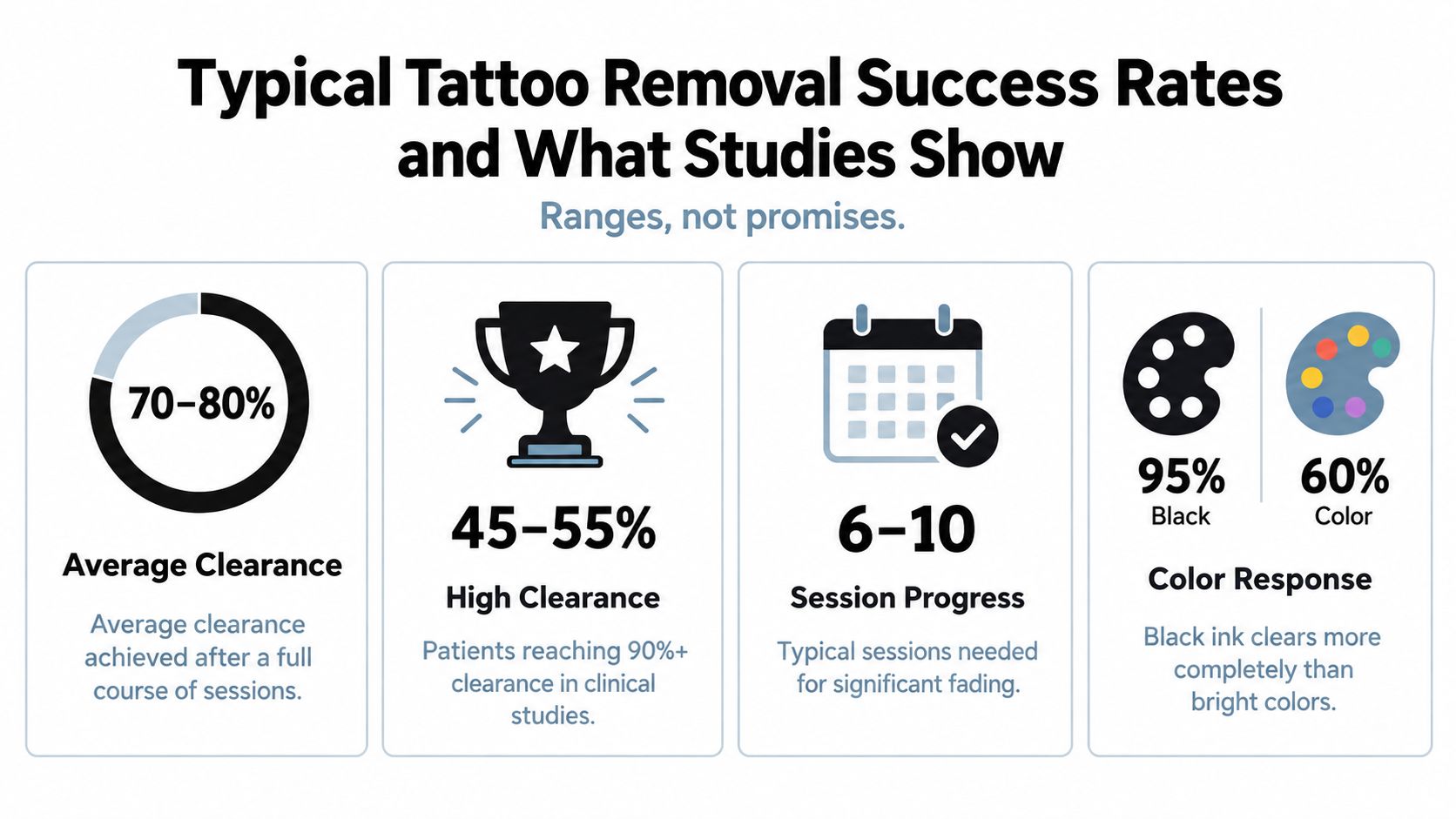
A tattoo can be a success after fading enough for a cover-up, or only after nearly all visible pigment has disappeared. The reported tattoo removal success rate depends on the number of sessions, ink color, treatment method, and the definition of clearance used in the study.
A large Q-switched-laser cohort found that 47.2% of patients reached therapy success after 10 sessions, rising to 74.8% after 15 sessions. The JAMA Dermatology cohort study shows why session count must stay beside any success figure. Judging the result after only a few appointments can be like checking a photograph before the image has finished developing.
A separate 2026 review of Nd:YAG laser studies found that most black and blue tattoos achieved meaningful clearance in 4 to 8 sessions, generally reaching at least 75% clearance. The systematic review of Nd:YAG tattoo removal supports a practical expectation of substantial fading, not a guarantee of completely clear skin.
Why ink color changes the reported rate
Black pigment often responds more predictably because suitable laser wavelengths can target it efficiently. Color adds another layer of planning. Different pigments absorb different wavelengths, so a multicolored tattoo may need more than one laser setting or technology during its treatment course.
A retrospective analysis found that ink density, color, age, and patient or tattoo age, together with the number of treatments, significantly affected efficacy. It also described color-specific wavelength behavior, including green responding better to ruby and red to 532 nm Nd:YAG treatment. The PubMed analysis of tattoo-removal determinants explains why a black outline and bright green fill should not receive the same forecast.
| Outcome being measured | What it means in practice |
|---|---|
| Partial fading | The tattoo is visibly lighter, but the original design remains clear |
| Substantial clearance | Most pigment has faded and the tattoo has less visual weight |
| Cover-up readiness | The existing design is light enough for a new tattoo plan |
| Near-complete clearance | Only a faint remnant remains |
| Complete removal | No meaningful visible tattoo pigment remains |
A clinical review of Nd:YAG studies also reported a mean visible pigmentation reduction of 64.1%, with a standard deviation of 18.1%. Improvement continued for up to 1 year after the final treatment session, according to the separate clinical study summarized in this Nd:YAG laser evidence review. These figures describe a study group, not a promise for every tattoo.
For a broader explanation of how effective laser tattoo removal can be, compare the reported rate with your actual goal. A lighter canvas, cover-up readiness, and the closest possible result to untouched skin are different endpoints.
Key Factors That Influence Your Tattoo Removal Outcome
Two tattoos can look similar in a photograph and respond very differently. The difference often comes from what sits beneath the surface, how the pigment was placed, and how the person's skin heals between sessions.
Tattoo characteristics
Ink color is a major variable. Black and blue pigments often respond more predictably to appropriate laser wavelengths, while green, yellow, and some bright colors can require a more approach. Multicolored tattoos may need multiple wavelengths because one setting won't target every pigment equally.
Ink density affects the workload. A lightly applied amateur tattoo may contain less pigment than a dense professional design. Heavy shading, saturated color, and cover-up layers give the laser and the immune system more material to process.
Age can help, but it doesn't decide the outcome. Older tattoos may have already lightened as the body gradually broke down some pigment. A newer tattoo with deep, concentrated ink may remain more resistant, though age alone can't predict the final clearance.
Size and layering influence planning. A large design contains more treatment area, while a cover-up may contain several ink layers and colors. These features can extend the course or make the final result less uniform.
Patient and treatment context
Skin type affects safe laser settings. Providers must balance effective energy delivery with protection against unwanted pigment changes, particularly in skin that is more prone to post-treatment darkening or lightening.
The body also has to clear the fragmented ink. Immune health, circulation around the treatment area, healing behavior, sun exposure, and aftercare can all affect how the skin looks during the course. These factors don't mean a difficult tattoo can't improve. They mean the provider may need to adjust energy, spacing, and expectations.
Location matters as well. A tattoo in an area with slower clearance may fade differently from one in another body region. Your provider should consider the site, skin condition, and your history of healing rather than rely on a generic session estimate.
A session doesn't remove the tattoo by itself. It creates smaller pigment fragments, and your body completes much of the clearing afterward.
For a patient-friendly checklist of variables that can alter progress, review six factors that can affect tattoo removal progress. Bring details about the tattoo's age, whether it covers older ink, previous laser treatments, and any reactions to skin procedures.
Laser Technologies and Treatment Protocols That Drive Results
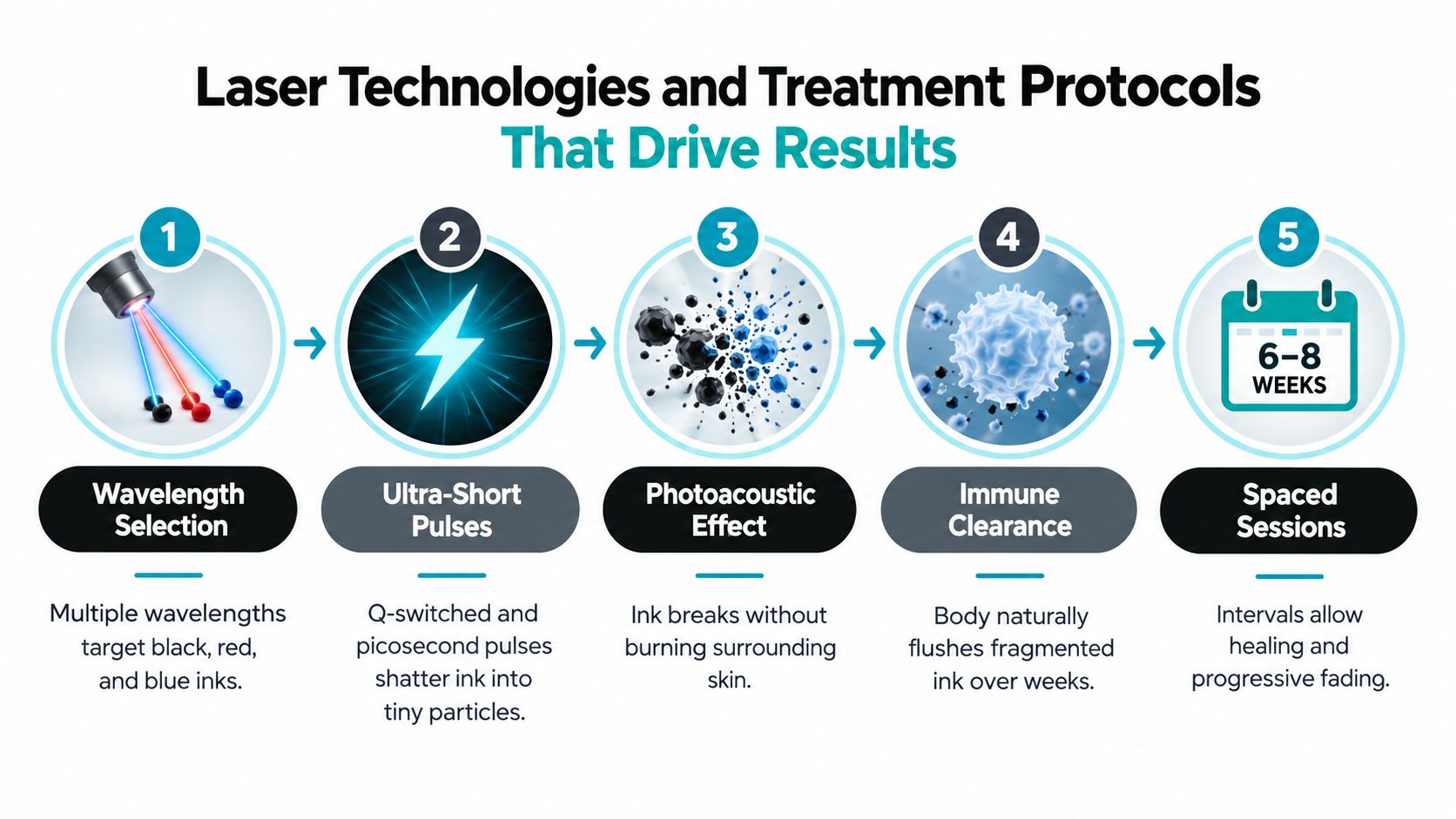
Laser treatment works through a partnership between short pulses and the body's natural clearance process. The device delivers energy to tattoo pigment, the pulse breaks the ink into smaller fragments, and immune cells gradually transport and remove those fragments.
What happens during a treatment course
First, the provider selects wavelengths. Black, red, and blue pigments absorb different parts of the light spectrum. A multicolored tattoo may therefore need more than one wavelength across its treatment plan.
Next, the laser delivers an ultra-short pulse. Q-switched systems use short pulses, while picosecond systems use even shorter pulse durations. The aim is to create a photoacoustic effect that fractures pigment without relying on prolonged heating of the surrounding skin.
Then, the body takes over. The laser has done the fragmentation work, but the visible fading continues during healing. That's why a tattoo may keep lightening after the skin looks normal and after the appointment itself is over.
Why settings and spacing matter
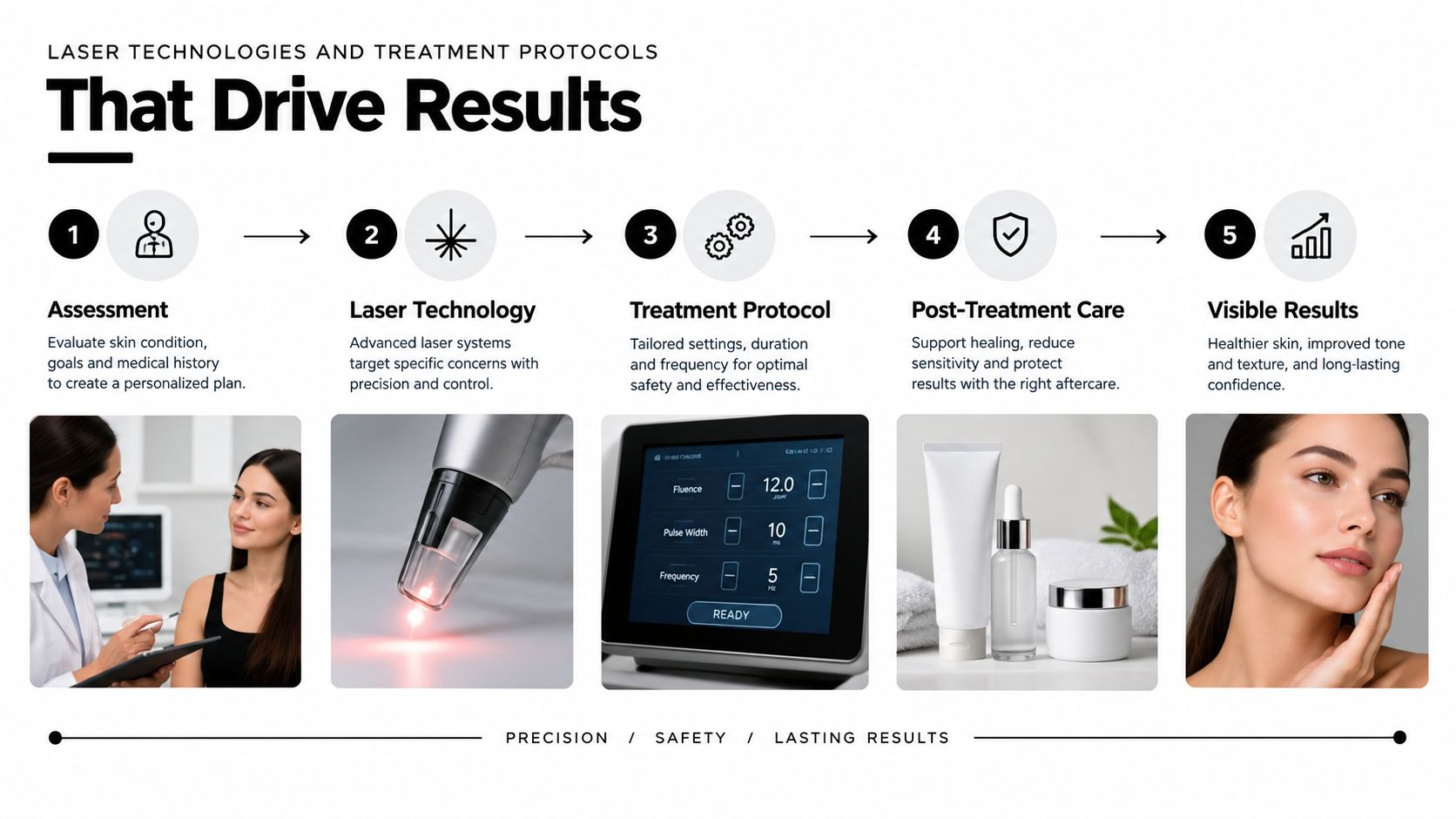
Spot size, fluence, pulse duration, and repetition rate influence how energy reaches the pigment. A 2026 clinical paper on unified golden parameter therapy reported complete clearance in 95% of 160 cases after 30 monthly picosecond-laser sessions, using a 7 mm spot size, 0.75 J/cm² fluence, 450 ps pulse duration, and 10 Hz pulse rate. The clinical paper on unified picosecond parameters is a specific example of how treatment settings and a long schedule can shape reported outcomes. It shouldn't be generalized to every tattoo or provider.
Spacing protects the healing process. Treating too aggressively or too soon can increase irritation without giving the body enough time to clear the fragmented pigment. Your provider should explain why the planned interval fits your skin, tattoo, and response to earlier sessions.
Learn more about types of laser tattoo removal before your consultation. The useful question isn't which laser sounds newest. Ask which wavelengths and pulse types match your ink, how the provider will adapt settings, and how progress will be reviewed.
Expected Sessions Timelines Risks and Realistic Expectations
Tattoo removal usually unfolds as a gradual course, not a quick correction. Fading may become noticeable after several treatments, while the chance of reaching the chosen endpoint can continue to increase with additional sessions. A small, lightly inked design may need less time than dense, multicolored, layered, or resistant work.
Treatment intervals commonly span 6 to 8 weeks or longer, based on healing and the treatment protocol. The body may keep clearing fragmented pigment after the final appointment, and one clinical study reported continued improvement for up to 1 year afterward. Judge the result after that response has had time to develop, rather than assuming early slowing means the treatment has failed.
What healing may look like
Immediately after treatment, the area may show redness, swelling, frosting, tenderness, blistering, or crusting. These reactions can reflect the skin's treatment response, but your provider should explain what fits your settings, skin type, and tattoo.
Follow the clinic's written aftercare. Keep the area clean, avoid picking and unnecessary friction, protect healing skin from sun exposure, and contact the provider if symptoms worsen instead of improving.
Use a consistent record to separate real progress from day-to-day changes:
- Use comparable photos: Keep lighting, angle, and distance as consistent as possible.
- Record your sessions: Note the date, treated colors, settings if provided, and healing response.
- Judge at the right time: Compare after healing and fading have developed, not immediately after treatment.
- Separate goals: Fading enough for a cover-up may be a successful endpoint even when some pigment remains. Complete clearance requires a different standard and may take longer.
Temporary pigment changes can occur, and scarring is an important risk to discuss. Before setting expectations, a careful provider should review your skin type, previous treatments, medications, sun exposure, and history of unusual healing.
Ask before booking: What would make you pause treatment, change the settings, or refer me for medical evaluation?
Seek prompt guidance for severe or increasing pain, spreading redness, drainage, fever, an unexpected reaction, or healing that concerns you. Laser tattoo removal is a medical procedure, so personalized instructions matter more than a generic timeline.
How to Evaluate Providers and Take Your Next Step with EradiTatt
A responsible consultation should leave you with a plan, not just an optimistic percentage. Start by asking how the provider defines success, whether the goal is cover-up fading or complete clearance, and which ink colors may remain more resistant.
Use this checklist:
- Technology: Ask which laser systems and wavelengths are available for your specific colors.
- Skin experience: Confirm that the provider treats a range of skin tones and understands how settings affect pigment safety.
- Session planning: Request a progressive estimate based on ink density, age, layering, size, location, and your desired endpoint.
- Progress review: Ask how photos and healing responses will guide later settings.
- Aftercare support: Make sure you'll receive clear instructions and know whom to contact if healing changes.
EradiTatt Tattoo Removal offers consultations for people seeking complete removal or fading before a cover-up. Its Florida locations include Orlando, Bradenton and Sarasota, St. Petersburg, Palm Harbor, and Tampa, and its published approach includes the PiQo4 platform for addressing different ink colors with treatment planning.
Call the central 844 number or contact the clinic that suits you to discuss your tattoo, skin type, color complexity, lifestyle, and preferred outcome. A good consultation should help you understand what the tattoo removal success rate means for your case, including what may be achievable and what remains uncertain.
Bring a clear photo, the tattoo's approximate age, information about prior treatments, and your intended goal. You'll get a more useful conversation when the provider knows whether you're preparing for a cover-up, meeting a professional requirement, or pursuing the most complete clearance possible.
EradiTatt Tattoo Removal provides progressive laser treatment planning for complete tattoo removal and cover-up fading across its Florida clinics. Visit EradiTatt Tattoo Removal to find a convenient location and request a personalized consultation about your tattoo removal success rate and next steps.