
You glance at a tattoo you've had for years and catch yourself thinking, “That used to look darker.” Maybe the edges don't feel as crisp. Maybe the color doesn't pop the way it did when it healed. A lot of people assume something went wrong, or that fading only happens if they spent too much time in the sun.
Usually, it's simpler than that. Tattoos live inside skin, and skin is alive. It changes, repairs itself, responds to light, and shifts with age. So tattoo fading over time isn't random, and it isn't just a cosmetic mystery. It's a measurable biological process.
Table of Contents
- Why Your Tattoo Looks Different Now
- How Tattoo Fading Actually Works
- Factors That Speed Up or Slow Down Fading
- Aftercare and Realistic Protection Strategies
- When to Consider Fading, Touch-Ups, or Removal
- Professional Fading and Laser Tattoo Removal Explained
Why Your Tattoo Looks Different Now
A client notices it in an ordinary moment. They roll up a sleeve in the mirror, or catch their forearm in bright car-window light, and the tattoo looks off. The black reads more like charcoal. Tiny lines that used to stand apart now seem closer together. Nothing dramatic happened that day. They are finally seeing a slow process clearly.
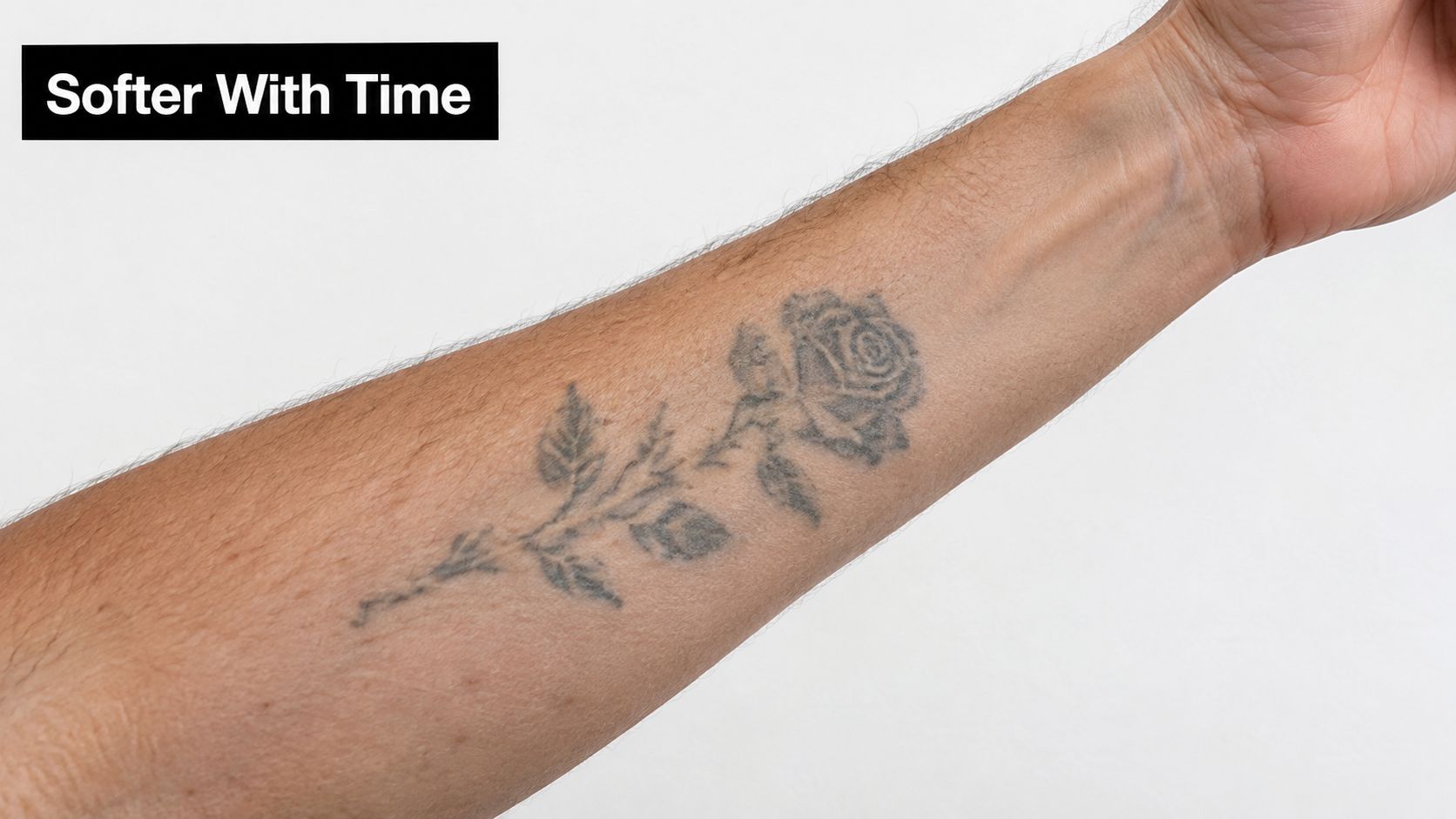
That shift can feel personal, but it is usually biological. A tattoo sits in living skin, not in plastic or paper. Skin repairs itself, stretches, sheds light differently as it ages, and changes how sharply pigment shows through. If you have ever looked at a newer tattoo and wondered whether dullness was healing or true fading, this plain-language guide on whether tattoos fade during healing helps separate the short-term healing phase from long-term change.
Fading is measurable, not mysterious
A well-applied tattoo can still look lighter years later. That does not automatically point to bad ink, bad aftercare, or poor artistry. It often means the amount and position of visible pigment in the skin have changed over time.
That distinction matters.
What is easy to miss: a tattoo can look lighter because pigment has shifted, broken down, or become less visible through changes in the dermis, not just because the surface looks dry.
Clients often describe fading as if the tattoo "lost color" all at once. In practice, they are noticing several small changes stacked together. A dense black area may reflect light differently. Fine lines may spread slightly as the skin ages. A colored section may stay present but lose contrast against surrounding skin. The result is a tattoo that reads softer, even before someone could point to one single cause.
Your skin changes the picture too
Ink is only part of what you see. The skin over that ink works like a filter. If that filter gets rougher, looser, more sun-worn, or less elastic, the design can appear older even when a fair amount of pigment remains. That is one reason two tattoos of the same age can look very different on different people, or on different parts of the same body.
Some people support overall skin condition with simple skincare habits and options such as natural anti-aging oils. That will not stop normal pigment change inside the skin, but healthier-looking skin can help a tattoo read more clearly.
So if your tattoo looks different now, the most useful question is not "Did something go wrong?" A better question is "What changed in the pigment, the skin, or both?" That answer helps you decide whether to leave it alone, protect it better, refresh it with a touch-up, or start planning for removal or a cover-up.
How Tattoo Fading Actually Works
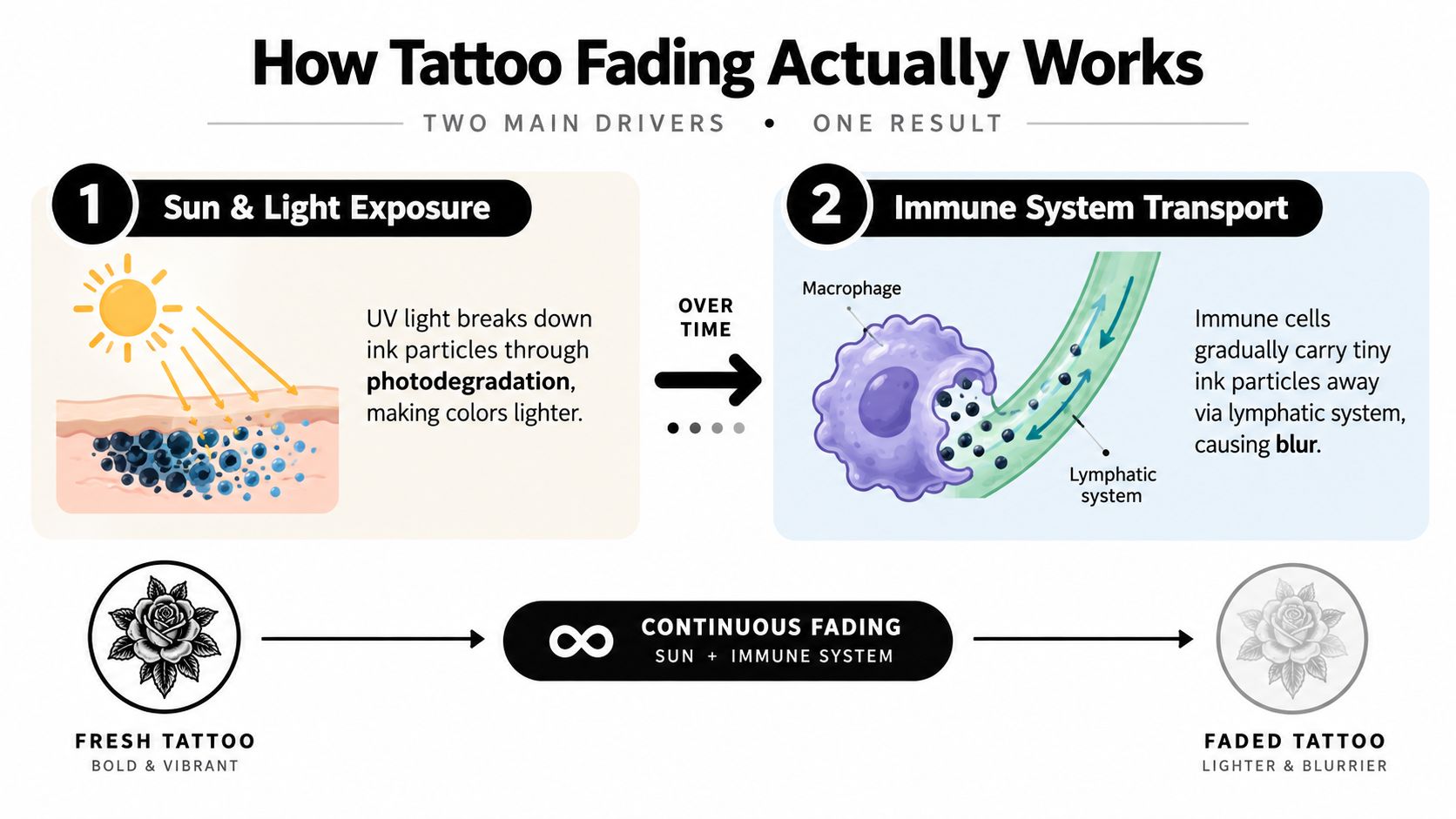
Most long-term tattoo fading over time comes from two main mechanisms. Light breaks pigments down, and your immune system slowly transports pigment away from where it started.
That combination is why an old tattoo can look both lighter and less sharp.
Light breaks pigment apart
Sun-exposed tattoos change faster because light can trigger photodegradation. In plain language, the pigment particles get chemically altered by repeated exposure. Think of a permanent marker left in a sunny window. It doesn't disappear all at once. It loses punch, then depth, then clarity.
That helps explain why color can flatten out before the whole tattoo looks obviously old.
Your immune system never fully ignores tattoo ink
The second mechanism is less visible, but it's just as important. A clinician-focused review describes tattoo fading as a mix of light-driven pigment breakdown and biologic transport. Macrophages take up ink particles, pigment can migrate through the lymphatic system, and some pigment can reach draining lymph nodes and even internal organs. The visible design can also blur as ink-bearing cells move deeper or away from the original pattern in the skin (clinical review of tattoo pigment movement and fading).
That's why fading isn't only “less color.” It's also less precise placement of color.
Older tattoos often don't just pale out. They spread softly at the edges because the pigment pattern in the skin is no longer as tightly organized as it was at the start.
The process is measurable, not just subjective
Clinical observation backs up what artists, clients, and removal technicians see in practice. Data presented on tattooed nipple-areola complexes in 39 patients found that longer time after tattoo placement correlated inversely with both color score and shape score, with p<0.0001 for color and p=0.0007 for shape. The same analysis found that individual color parameters fit one-phase exponential decay models, meaning fading didn't happen in a straight line. The more noticeable loss happened earlier, then slowed over time (long-term fading model data).
That curve matters. People often expect a tattoo either to stay stable or suddenly collapse in quality. Real life usually looks different.
What that means in plain terms
- Early change is often more noticeable: A tattoo may lose some crispness sooner, then keep changing more gradually.
- Blur and lightening are separate issues: One tattoo can stay fairly dark but lose edge definition. Another can lighten more than it blurs.
- You can't “stop time” with one product: Good care helps, but fading is cumulative biology.
If you understand that, you stop chasing a perfect freeze-frame version of the tattoo and start making better decisions about preserving it, covering it, or lightening it.
Factors That Speed Up or Slow Down Fading
Two people can get tattoos around the same time and watch them age very differently. That doesn't always mean one artist was better than the other. The tattoo itself, the skin it sits in, and the way that area lives day to day all affect the result.
What you can influence and what you can't
Some fading drivers are under your control. Some only partly are. Some aren't.
A good way to think about it is to separate exposure factors, skin factors, and application factors. If you're comparing your own situation with common treatment variables, this guide on factors that affect tattoo removal progress is useful because many of the same issues that influence removal also shape how tattoos age in place.
Quick comparison table
| Factor | Tends to increase fading | Tends to decrease fading | Client control |
|---|---|---|---|
| Sun and light exposure | More frequent unprotected exposure | Consistent protection habits | High |
| Placement on the body | Areas with more friction or regular exposure | Areas protected by clothing and lower wear | Medium |
| Skin aging | Loss of elasticity and collagen over time | Supportive skin care and protection habits | Low to medium |
| Immune activity over time | Ongoing cell turnover and pigment transport | Not something you can stop | Low |
| Ink color complexity | More colors can create uneven aging patterns | Simpler, darker designs often read longer | Low once tattooed |
| Technique and depth | Uneven placement can make aging look patchier | Solid application in the dermis | None after tattooing |
Sun is real, but it isn't the whole story
People love a single-cause explanation, and UV gets treated like the only villain. It isn't. Sun absolutely matters because it helps break pigment down, especially on areas that stay exposed. But a major dermatology source also notes that appearance changes come from collagen and elasticity loss in aging skin, and that there is no special sunscreen made specifically for tattooed skin (MD Anderson guidance on tattoo appearance and sun protection).
That's why someone can be careful outdoors and still notice their tattoo looking duller or less crisp years later.
A tattoo ages inside aging skin. If you only think about sunshine, you miss half the picture.
Placement changes the daily stress load
A forearm tattoo and a rib tattoo don't live the same life. One sees more daylight. One may rub on sleeves less. One may stretch differently over time.
Common trouble spots include:
- Frequently exposed areas: Hands, forearms, and lower legs usually see more light.
- High-friction zones: Waistbands, bra lines, socks, and shoes can keep rubbing the same skin.
- High-movement skin: Joints and areas that flex often can make fine detail look older sooner.
Your body keeps recycling cells
A tattoo isn't left alone after healing. The immune system continues to interact with it. An immunology explainer notes that macrophages engulf ink in the dermis, and when those cells die and are replaced, pigment gets released and re-engulfed. Over repeated cycles, a small amount can be destroyed or removed, contributing to gradual fading (how immune-cell turnover affects tattoos).
That's one reason fading feels slow but relentless.
Skin quality affects how the tattoo looks
Dry, rough, sun-damaged, or aging skin can make the same amount of ink appear flatter. That doesn't mean skincare can keep a tattoo frozen in time, but it can improve how clearly the skin presents what's still there. If you're interested in broader skin-recovery topics, the Resty guide to light therapy gives background on how people think about skin support and appearance, even though it isn't a tattoo-specific fading fix.
The practical point is simple. Biology wins in the long run, but your daily habits still affect how fast the visible changes show up.
Aftercare and Realistic Protection Strategies
A lot of bad advice around tattoo fading comes from extremes. One side acts like nothing matters. The other acts like one missed sunscreen day ruins your tattoo forever. Real protection sits in the middle.
Protect the skin first
The best aftercare strategy is boring, which usually means it works. Let the tattoo heal fully, avoid irritating it, and protect the skin it lives in. If you're healing a fresh piece, this guide on how long to keep a tattoo covered for safe healing helps with one of the most common early mistakes.
For long-term management, focus on routines you can maintain:
- Use broad sun protection consistently: Exposed tattoos benefit from regular sunscreen use and practical cover-ups like sleeves or shade.
- Keep skin in good condition: Hydrated, calm skin tends to show tattoo detail more clearly than dry, irritated skin.
- Reduce repeated abrasion: Tight straps, rough athletic gear, and constant rubbing can make older ink look more tired.
- Respect healing windows: Picking, over-scrubbing, and rushing exfoliation can affect how a tattoo settles.
Don't chase “tattoo-only” miracle products
People get misled. There isn't a magical tattoo-preserving product category that overrides biology. As noted earlier from MD Anderson, there's no special sunscreen made specifically for tattooed skin, and a visible change in tattoo quality often reflects skin aging, not just UV alone.
That's worth remembering when someone tries to sell you a cure-all.
Practical rule: Protect the skin, protect the pigment, and don't expect topical products to reverse normal long-term aging.
What aftercare can and can't do
Aftercare can lower preventable stress on the tattoo. It can't stop the immune system from turning over cells, and it can't stop time.
That's why people looking at design longevity often review established body art tattoo styles from Timebomb Tattoo & Piercing before committing to very fine detail, very soft contrast, or placement choices that may not age the same way as bolder work. Style choices and maintenance habits work together.
A tattoo that softens with age isn't a failed tattoo. It's a normal tattoo. Good care helps preserve appearance, but some change is built into the material you're working with, which is living skin.
When to Consider Fading, Touch-Ups, or Removal
You look at a tattoo you have seen for years and notice it reads differently now. The lines are still there, but the contrast is lower. A shaded area looks flatter. Maybe it no longer fits the next piece you want in that spot.
That change is not just a cosmetic mood shift. It is a visible sign that pigment, skin texture, and contrast have changed enough to affect your options.
Living with fading makes sense when the tattoo is still doing its job
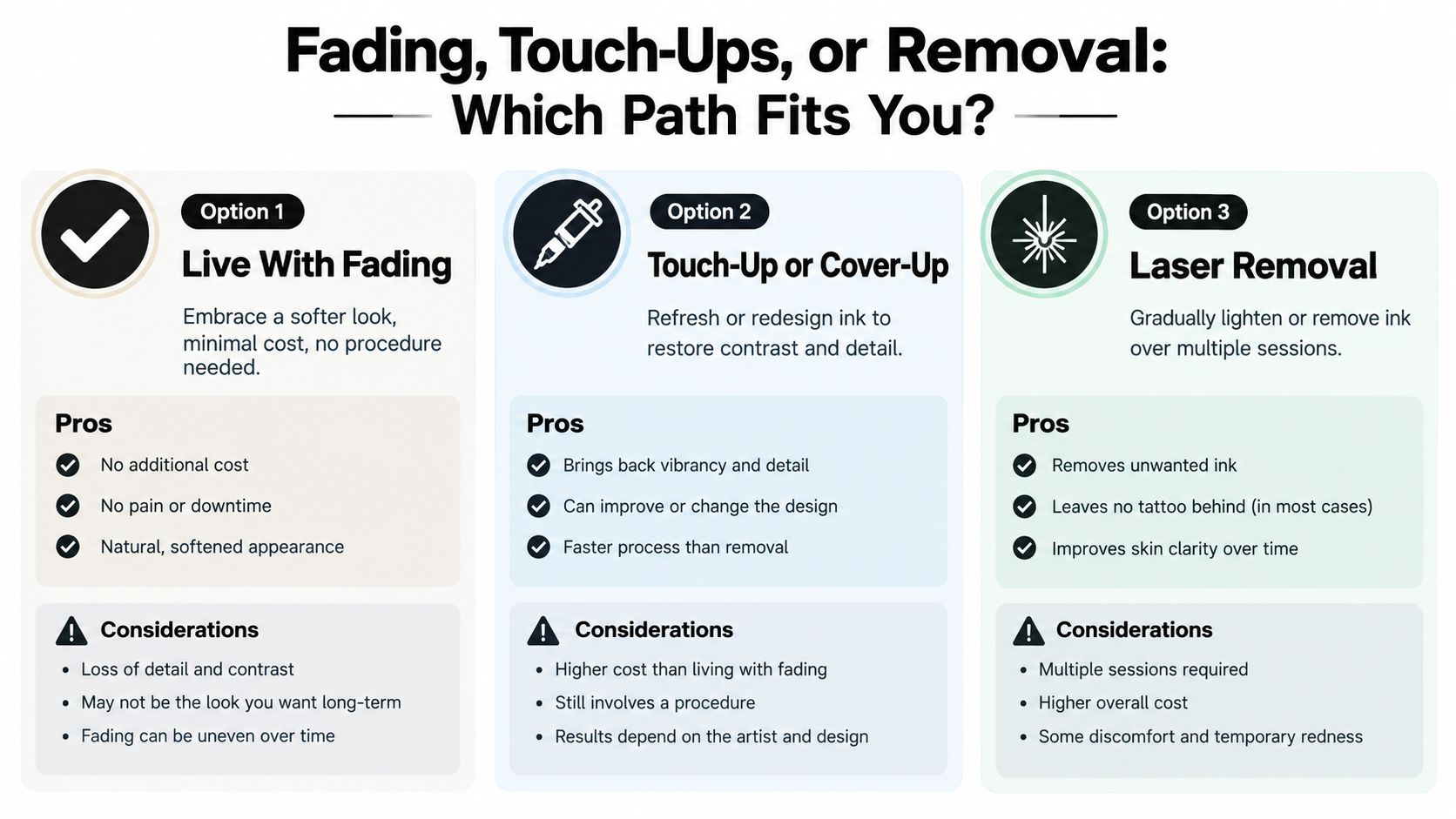
Some tattoos age gently. The edges soften a little, the darkest areas lose some punch, and the piece still reads clearly from a normal viewing distance.
If that softer version still suits your style, you may not need to intervene.
A useful test is simple. Ask whether the tattoo still looks intentional on your skin, not whether it looks identical to the day it healed. Skin is living tissue, not photo paper. A tattoo can change and still be successful.
Touch-ups fit tattoos that still match your original goal
A touch-up makes sense when the design is still the design you want. You are not trying to hide it. You are trying to restore clarity.
That usually means reinforcing contrast, sharpening sections that have blurred, or refreshing spots where the pigment reads unevenly. It works best when the structure is still strong. If the composition, size, or placement no longer works for you, adding fresh ink can make the next step harder.
The practical question is this: do you want the same tattoo to look stronger, or do you want a different outcome entirely?
Fading before a cover-up can create a better working surface
Cover-ups depend on what remains visible underneath. If the old tattoo is dark, dense, or high in contrast, the new design has to spend part of its visual energy hiding what is already there. That limits the artist.
A partially faded tattoo gives the cover-up more room to breathe. Lighter leftover pigment works like a pencil sketch under paint. Heavy leftover pigment works more like permanent marker.
Natural fading can help over time, but it is slow and uneven. If your goal is a cleaner canvas for a new piece, deliberate fading is often the more predictable route.
Removal makes sense when your goal is skin, not replacement art
Some clients do not want a revised design. They do not want a smarter cover-up plan. They want the tattoo gone as far as current treatment can reasonably take it.
That is a different decision.
Removal is usually the better fit when the issue is not just softness or age. It is regret, a major life change, visible interference with work, or a design that no longer belongs on your skin in any form.
A simple decision check
- Keep it as is if the tattoo still reads well enough for your taste and your concern is minor aging.
- Touch it up if you still want the same design and mainly need stronger contrast or cleaner definition.
- Fade it professionally if an artist needs a lighter base for a cover-up.
- Remove it if your end goal is clearer skin rather than new artwork.
One practical option people consider in that third category is EradiTatt Tattoo Removal, which provides laser fading for clients who want to prepare for a cover-up as well as those seeking full removal. The useful part is not hype. It is matching the treatment plan to the endpoint before the first session.
If your goal is a better cover-up, partial fading may be enough. If your goal is clear skin, stopping at partial fading can leave too much residual ink.
A good consultation should assess the tattoo the way a technician or artist sees it in real life. How dark is the remaining pigment? How much contrast is left? Which areas will interfere with new work? Those are measurable questions, and the answers usually point clearly toward leaving it alone, touching it up, fading it, or removing it.
Professional Fading and Laser Tattoo Removal Explained
Laser fading is controlled, gradual pigment disruption. It doesn't erase a tattoo in one pass because the laser doesn't vacuum ink out of the skin. It breaks pigment into smaller fragments, and then your body does the clearing.
That's why patience is built into the process.
Why multiple sessions are normal
A clinical review of laser tattoo removal notes that treatment commonly requires multiple sessions, typically spaced at least 6 weeks apart, because each visit fragments only part of the pigment and the body clears the smallest pieces gradually between appointments (laser removal timing and session spacing).
If someone expects instant disappearance, they'll be frustrated. If they understand the biology, the timeline makes sense.
Color affects strategy
Different colors respond to different wavelengths. One clinical paper reports 1064 nm for black ink and 532 nm for the remaining colors, while another source summarized in the same clinical context notes that red, orange, and rose respond well at 532 nm, brown at 1064 nm, yellow and green at 448 nm, and blue at 600 nm (clinical wavelength guide for tattoo colors).
That's why a simple black script tattoo and a multicolor sleeve don't get planned the same way. Color complexity affects expectations from the start.
What a realistic consultation should cover
A useful removal or fading plan should account for:
- Your end goal: Full removal, light fading for cover-up, or selective reduction.
- The tattoo itself: Size, density, age, and color mix.
- Your skin: Skin type and how your body tends to heal.
- Your lifestyle: Sun exposure, work schedule, and ability to space sessions appropriately.
Professional fading works best when the goal is clear before treatment starts. A person preparing for a cover-up needs a different endpoint than a person who wants the tattoo gone. That difference should shape the plan from day one.
If your tattoo looks older, softer, or harder to work around, you don't have to guess what's happening. EradiTatt Tattoo Removal helps clients plan either gradual fading for a cover-up or full removal based on ink color, skin type, tattoo size, and the result they want. A consultation can turn “I'm not sure what to do with this tattoo anymore” into a clear next step.