
Have you ever wondered why Q-switched laser uses extend far beyond tattoo removal, even though the technology is widely known for unwanted ink? The same basic ability, delivering a precise burst of energy that pigment absorbs, also explains its role in freckles, lentigines, café-au-lait patches, Nevus of Ota, and other benign pigmented lesions.
The important question isn't whether a laser works. It's which pigment it can see, how deep that pigment sits, how the patient's skin responds, and whether another pulse technology may be a better fit. Understanding those four points makes consultations clearer and helps prevent unrealistic promises about speed, complete clearance, or safety.
Table of Contents
- What a Q-Switched Laser Is and Why It Matters
- How Ultra-Short Pulses Break Up Pigment
- The Main Q Switch Laser Uses in Clinical Practice
- Matching Wavelengths to Ink Color and Skin Type
- What Realistic Fading Looks Like Across Multiple Sessions
- Q-Switched Lasers Versus Picosecond Devices in 2026
- Suitability Factors and Safety Considerations
- Is Q-Switched Laser Treatment Right for You
What a Q-Switched Laser Is and Why It Matters
“So what exactly is a Q-switched laser?” In plain language, it's a laser that stores energy and releases it in an extremely brief burst instead of sending out a continuous beam. That burst is designed to concentrate on pigment, while limiting heat spread into the surrounding skin.
The “Q-switch” is the internal mechanism that holds energy until the device reaches a precise firing point. It then releases the stored energy in a pulse measured in nanoseconds. A useful analogy is a camera flash with far more control. The device doesn't keep warming the area. It delivers a quick, targeted event.
Q-switched ruby, Nd:YAG, and alexandrite lasers were already described as standard options for tattoos and benign pigmented lesions by the late 1990s. The first Q-switched ruby laser was used for tattoo removal in 1965, a turning point that moved treatment away from older approaches such as excision, dermabrasion, chemical removal, and thermal techniques that often caused scarring, as reviewed in this clinical history of Q-switched lasers.
Why the history still matters
The ruby system operated at 694 nm with pulse widths of approximately 25 to 40 nanoseconds, according to the same review. Those details matter because the technology's importance wasn't just that it was powerful. It could deliver energy selectively enough to destroy pigment with much less injury to nearby skin.
That principle made Q-switched platforms foundational for tattoo removal and pigment-lesion treatment worldwide. The devices became a clinical workhorse because technicians could choose different wavelengths for different pigment targets, rather than treating every mark as if it absorbed light in the same way.
Practical rule: A Q-switched laser isn't one single treatment. It's a platform whose usefulness depends on the wavelength, pulse, fluence, spot size, pigment, and skin type working together.
As 2026 approaches, that established track record still matters. Picosecond devices have changed the conversation, especially for some resistant colors, but Q-switched technology remains a proven reference point. The newer option doesn't erase the older one. It gives clinicians another way to manage cases where pigment fragments slowly or stops responding.
How Ultra-Short Pulses Break Up Pigment
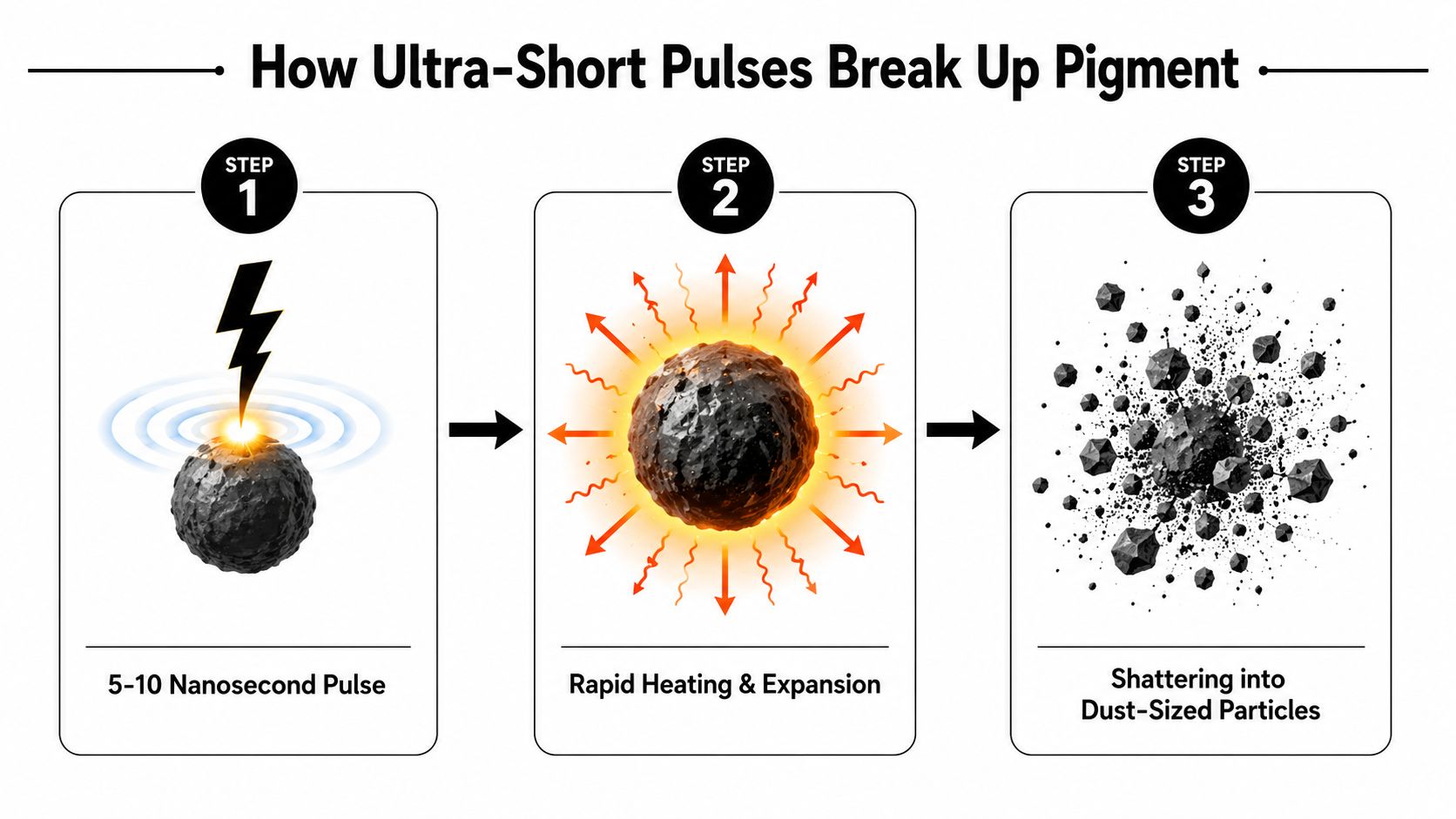
A tattoo pigment particle behaves like a tiny glass bead trapped in the skin. A Q-switched pulse acts less like a hot oven and more like a sharply timed impact. The pigment absorbs the light, heats rapidly, expands, and breaks into much smaller fragments.
This process is called photoacoustic disruption. In the treatment room, a patient may hear a snapping sound or feel a quick rubber-band sensation. The reaction happens rapidly between the laser energy and the pigment, rather than through slow heating of the surrounding tissue.
Why pulse duration controls selectivity
The pulse must be brief enough for the pigment to absorb the energy before heat spreads into nearby cells. A pulse in the 5 to 10 nanosecond range concentrates energy around the target. Longer delivery gives heat more time to diffuse, increasing unnecessary tissue injury and the risk of scarring.
This explains why raw power alone does not guarantee a better result. A stronger pulse with a poorly matched wavelength or setting may create more heat without breaking the intended pigment efficiently. The technician selects an energy pattern that reaches the target while limiting exposure to the surrounding skin.
What absorbs the light
The target is a chromophore, a structure that absorbs a particular wavelength. Tattoo ink is one chromophore, while melanin is another. Some vascular-related pigment concerns also involve light-absorbing targets.
Nearby structures absorb that wavelength less strongly, so they are affected less. This selective interaction forms the basis of selective photothermolysis. Once the pigment fragments, the immune system gradually transports and clears the smaller particles. Visible fading usually develops between treatment sessions, not as a finished result immediately after the pulse. That mechanism explains why Q-switched lasers became workhorses for both tattoos and pigment lesions, while picosecond devices now offer another approach for some difficult-to-clear pigment.
The Main Q Switch Laser Uses in Clinical Practice
The easiest way to understand clinical Q switch laser uses is to group them by the pigment being targeted. The device isn't removing “a mark” in the abstract. It's interacting with a specific chromophore at a particular depth.
Tattoo removal
Tattoo removal is the most familiar use. Tattoo ink sits in the dermis, where pigment particles become embedded among immune cells called macrophages. Q-switched wavelengths target those particles so the body can gradually clear the resulting fragments.
This applies to amateur tattoos, professional tattoos, and some cosmetic makeup tattoos, although cosmetic pigment needs extra caution. Black and dark blue ink are generally the most responsive targets for a 1064 nm Q-switched Nd:YAG laser. A controlled study found that after four treatment sessions at 10 to 12 J/cm², 77% of black tattoos achieved an excellent response, defined as more than 75% ink removal, while 11 of 39 black tattoos, or 28%, cleared more than 95% of the ink, as reported in the controlled Nd:YAG tattoo study.
Benign pigment lesions
The same selective action can target clusters of melanin in benign lesions. Common examples include:
- Freckles and ephelides, where melanin creates small areas of increased color.
- Solar lentigines, often called sun spots, which contain concentrated pigment.
- Café-au-lait patches, which are flat areas of increased pigmentation.
- Nevus of Ota, a dermal melanocytic lesion that generally requires deeper-targeting wavelengths.
Dermatology reviews also describe Q-switched lasers for melasma, other epidermal and dermal hyperpigmentation, and selected vascular-related pigment concerns, as outlined in this review of Q-switched laser applications. That doesn't mean every dark spot should be lasered. A clinician must first identify what the lesion is, because a suspicious or changing mark needs medical assessment rather than cosmetic treatment.
For broader daily-care strategies around discoloration, readers may also find this guide to treat dark spots and melasma useful.
Selective and specialist applications
Technicians may also use Q-switched systems to lighten permanent makeup, address certain traumatic tattoos caused by embedded debris, and manage stubborn pigment left after some drug reactions. These cases aren't interchangeable. Cosmetic pigments can contain compounds that darken after laser exposure, while traumatic pigment may sit at an unusual depth.
The central question remains the same: what absorbs the wavelength, and where is it located? That question determines whether Q-switched treatment is appropriate, which handpiece is needed, and whether a test spot should come before broader treatment.
Matching Wavelengths to Ink Color and Skin Type
Wavelength is the laser's color of sight. A 1064 nm beam can reach deeper pigment and is absorbed less by epidermal melanin, which is why clinicians often favor it when treating darker skin tones. A 532 nm beam is useful for red and orange pigment, but epidermal melanin absorbs it more readily, so pigment-change risk deserves closer attention on tanned or deeper skin.
Other wavelengths can fill gaps in the color spectrum. In practice, the correct pairing depends on both the ink and the patient's Fitzpatrick skin type. A green tattoo on light skin isn't the same treatment problem as a green tattoo on pigmented skin.
Quick reference matrix
| Wavelength | Best For, Ink Color | Safer Skin Types | Caution Notes |
|---|---|---|---|
| 1064 nm | Black and dark blue | Broadest practical use, including darker tones when settings are conservative | Reaches deeper pigment, but still requires test treatment and calibrated fluence |
| 532 nm | Red and orange, with selected lighter warm pigments | Lighter skin types generally tolerate it more readily | Epidermal melanin absorbs more of this wavelength, increasing pigment-change risk on tanned or deeper tones |
| 755 nm | Green and blue | Most suitable after careful skin assessment, especially on lighter tones | Use greater caution as skin pigmentation increases |
| 660 nm | Selected stubborn red and related pigment targets | Determined by test spot and skin response | Dye handpieces require careful matching to the specific ink |
| 585 nm | Selected stubborn blue or red targets, depending on the handpiece and pigment | Determined clinically rather than by color name alone | A color label on a tattoo doesn't reveal its complete pigment mixture |
A 1064 nm Nd:YAG wavelength is the main choice for black and dark ink, while 532 nm is used for red and orange pigment. Deeper dermal pigment generally suits 1064 nm, whereas more superficial epidermal pigment may respond to 532 nm, as described in this overview of laser interaction physics.
Skin-type reminder: On Fitzpatrick types IV through VI, a clinician should consider a test spot and conservative fluence before treating a larger area.
Some green and blue tattoos need a 755 nm approach, while stubborn sky blue or bright red may call for dye handpieces around 585 or 650 nm. If you're comparing treatment approaches for green ink, this resource on laser tattoo removal for green ink can help you prepare more focused questions for a consultation.
What Realistic Fading Looks Like Across Multiple Sessions
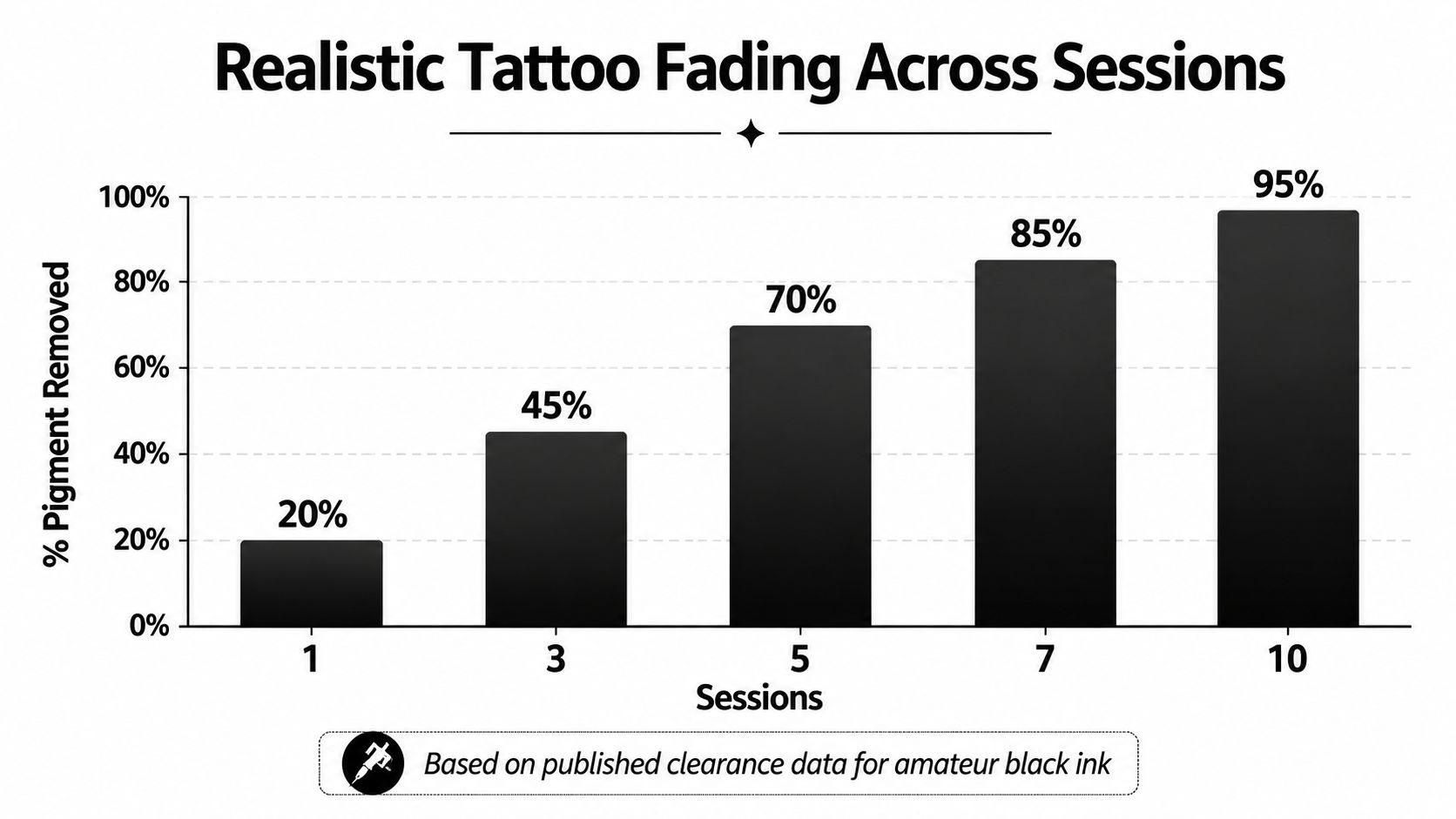
A treatment room rarely matches an advertisement promising complete removal in four visits. Published data show that fading builds across repeated sessions. In this cohort study, cumulative success reached 47.2% after 10 sessions and 74.8% after 15 sessions. Those results explain why a clinician plans gradual change rather than promises a fixed endpoint.
Fading often follows a diminishing curve. Early sessions may create the clearest visible improvement because they reach pigment that is easier to disrupt. Later sessions can appear slower when the remaining ink is dense, layered, professionally applied, or positioned in an area that clears less readily. The laser breaks pigment into smaller pieces, but the body still needs time to remove those fragments.
What changes the timeline
An amateur black tattoo may respond more predictably than a dense, professional multicolor piece. Cover-ups contain additional layers of pigment, while mixed colors may need different wavelengths during the course. The body's immune response also affects how efficiently fragments leave the treated area.
Body location matters. Ink on fingers and feet may fade more slowly than ink on the torso because circulation and drainage vary between sites. Consistent photographs provide a better progress record than judging the tattoo under changing lighting after every appointment.
Photograph the area between sessions from the same distance, angle, and lighting. Keep the skin relaxed and avoid filters. Appropriate spacing gives the body time to clear fragmented pigment before another controlled treatment disrupts what remains. This waiting period is one reason tattoo removal takes multiple sessions.
The practical takeaway is simple: a responsible clinician plans a course, not a single dramatic appointment. A Q-switched laser may remain a reliable workhorse, but realistic results depend on pigment, body site, healing, and time.
Q-Switched Lasers Versus Picosecond Devices in 2026
Are Q-switched lasers still the right choice in 2026, or should everyone choose a picosecond device? The honest answer is that neither technology wins every case.
Q-switched systems use nanosecond pulses and have an established clinical record. Picosecond systems use even shorter pulses and can create a stronger photoacoustic effect for some pigment particles. A 2026 review reported 75% to 95% clearance for black ink, while noting that multicolored tattoos generally need multiple wavelengths and longer treatment courses. The same review highlighted increased pigment-change risk for darker skin types, Fitzpatrick IV through VI, as discussed in this 2026 review of tattoo-removal technology.
The real trade-off
Q-switched treatment may be a sensible starting point for straightforward black or dark blue ink, particularly when the wavelength matches the pigment and the operator has strong experience. Picosecond treatment may offer an advantage when a color is resistant, when a tattoo has plateaued, or when the clinician believes a shorter pulse could improve fragmentation.
That advantage isn't universal. The gap may be smaller for easy black ink, and results vary between devices and treatment protocols. A patient shouldn't choose a platform solely because its name sounds newer.
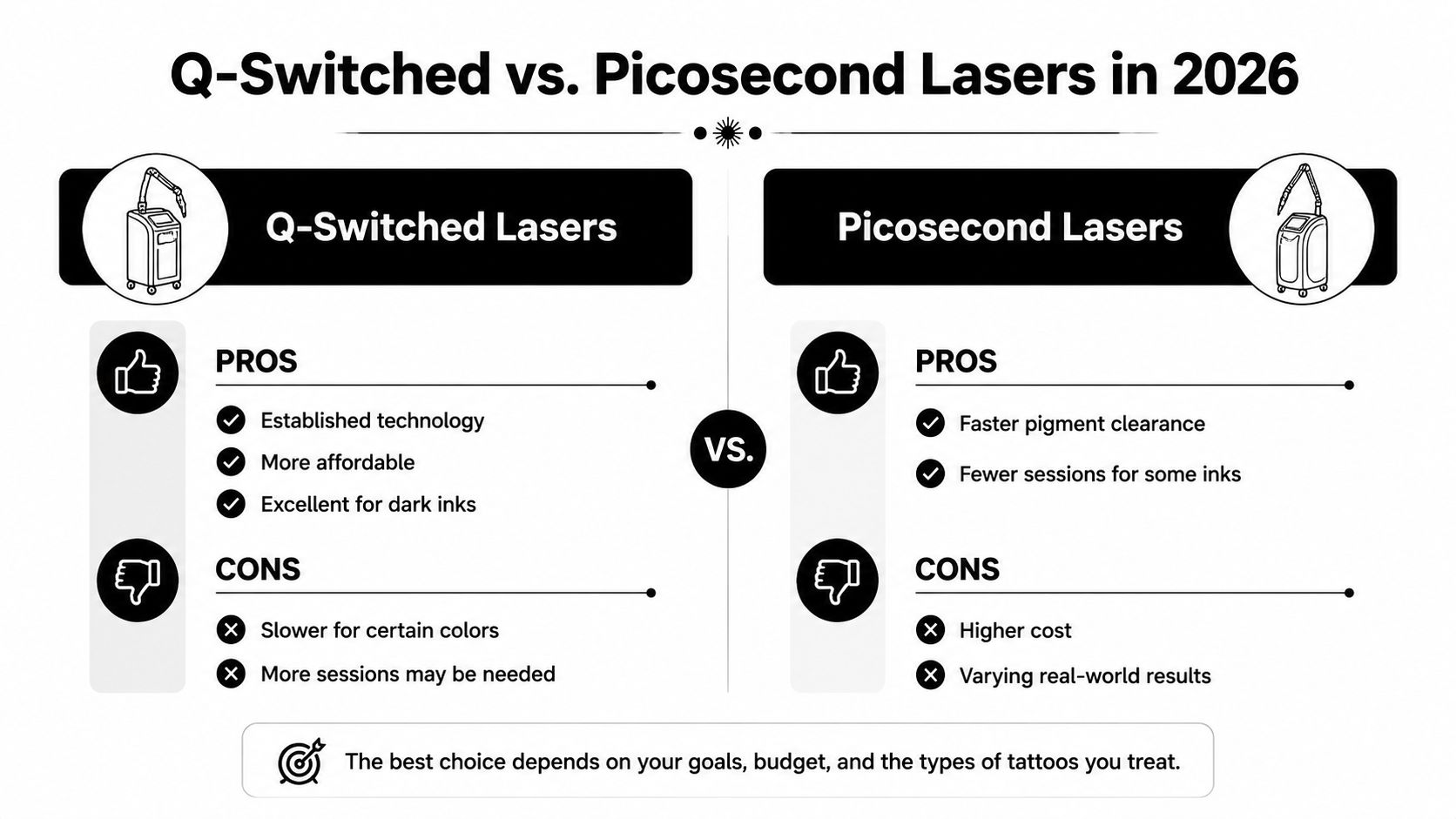
Cost also enters the decision. Picosecond sessions commonly carry a higher price, while Q-switched systems remain more widely available. If the tattoo is responding steadily to a properly selected Q-switched wavelength, switching automatically may add expense without solving a real clinical problem.
A practical decision rule is to start with Q-switched treatment when the ink history, color, skin type, and budget suit it. Consider picosecond treatment when resistant colors, slow progress, or a specific clinical assessment makes the shorter pulse worthwhile. This comparison of Pico laser options and treatment considerations can help you organize questions before deciding.
Suitability Factors and Safety Considerations
A good candidate isn't defined by tattoo color alone. Skin tone, tanning history, pigment depth, medical history, ink composition, and the presence of symptoms all influence whether Q-switched treatment is sensible.
Lighter skin tones, commonly grouped as Fitzpatrick I through III, generally carry less risk of unwanted pigment change than darker tones. Fitzpatrick IV through VI can still be treated, but the clinician may use more conservative settings, a longer assessment period, and a carefully chosen wavelength.
Red flags before treatment
Active infection, a history of keloid formation, pregnancy, and recent isotretinoin use should be discussed before treatment. A clinician also needs a complete medication and skin-history review rather than relying on a quick visual inspection.
Patients should avoid sun exposure and active tanning before treatment. They may also need to pause irritating products such as retinoids and glycolic acids according to the treating professional's instructions. Sun protection remains important after treatment because recently treated skin can react unpredictably to ultraviolet exposure.
Allergic and reactive tattoos
A tattoo that itches, swells, forms recurring bumps, or appears inflamed needs medical evaluation before laser treatment. Recent expert coverage advises against lasering a tattoo with a suspected allergic response because breaking up pigment can release fragments and worsen a systemic reaction, as summarized in this safety report on allergic tattoo reactions.
Red, yellow, and white pigments can also create special problems. Some cosmetic and tattoo pigments may darken paradoxically after laser exposure, so a hidden test spot is especially important before treating a larger area. In suspected allergy cases, a clinician may consider patch testing or alternatives such as surgical excision instead of proceeding directly with laser.
What safe practice looks like
In a professional setting, protective eyewear is mandatory. Cooling, appropriate spot-size selection, controlled fluence, and test-spotting help the operator limit unnecessary heat and observe how the skin responds.
Temporary erythema, hypopigmentation, hyperpigmentation, and swelling can occur. These effects deserve honest counseling, particularly for darker skin, where pigment changes may be more noticeable or persistent.
Is Q-Switched Laser Treatment Right for You
Start with the target, not the machine name. Are you treating tattoo ink, a benign pigment lesion, permanent makeup, or a mark that hasn't been diagnosed? The answer changes the assessment, the wavelength, and sometimes the entire treatment recommendation.
Ask how deep the pigment sits and which colors dominate. Black and dark blue ink often give a clearer match for 1064 nm treatment, while multicolored tattoos may require several wavelengths and a longer plan. Cosmetic pigment deserves its own discussion because ingredients such as iron oxide or titanium dioxide can behave differently from conventional tattoo ink.
Your skin type matters just as much. A clinician should explain how your Fitzpatrick classification changes the risk of hyperpigmentation or hypopigmentation, especially if the proposed wavelength is strongly absorbed by epidermal melanin.
Questions to take to a consultation
Bring specific questions instead of asking only, “How many sessions will I need?”
- Which wavelength will you use? Ask why that wavelength matches the ink or lesion.
- Will you perform a test spot? A small test area can reveal how your skin and pigment respond before broader treatment.
- What cases resemble mine? Request before-and-after photographs involving similar colors, skin tone, tattoo density, and location.
- Who will operate the device? Training and practical experience influence settings, safety, and how the operator responds to unexpected healing.
- What happens if progress plateaus? A responsible plan should explain when to adjust settings, change wavelengths, or consider another pulse duration.
Q-switched treatment remains an accessible, established choice when expectations are realistic and the pigment matches the available wavelength. Picosecond treatment may be useful in selected cases, but newer doesn't automatically mean necessary. EradiTatt Tattoo Removal uses a Pico plus Q-Switch technology option for tattoo removal, giving clients a treatment pathway to discuss alongside skin type, tattoo color, fading goals, and the expected course.
If you're considering treatment, book a consultation with a qualified dermatologist or licensed laser technician who can inspect the tattoo in person and provide a personalized plan. Ask for clear guidance on complete removal versus cover-up fading, aftercare, spacing, and the risks specific to your skin.
EradiTatt Tattoo Removal offers progressive laser tattoo-removal sessions for complete removal or cover-up fading, with treatment planning based on tattoo color, size, skin type, and personal goals. Visit EradiTatt Tattoo Removal to explore locations and schedule a consultation about the wavelength and approach suited to your tattoo.