
You pull your sleeve back in the bathroom mirror and find yourself looking at the same old tattoo again. The lines may have blurred, the design may feel tied to a past version of you, or the ink may no longer fit your work, relationships, or personal style. You don't necessarily want bare skin. You want a better piece.
That crossroads is more common than many people realize. Pew Research found that 32% of U.S. adults had at least one tattoo in 2023, while 24% of tattooed adults regretted at least one tattoo. The same survey reported tattoos among 41% of adults under 30 and 46% of adults ages 30 to 49, so the need to redesign existing ink isn't limited to a small group of clients. Pew Research's 2023 tattoo findings help explain why cover-up work has become a lasting part of modern tattoo care.
A tattoo cover up specialist helps at this exact moment. The right professional can determine whether your old tattoo can be incorporated, whether it needs partial laser fading, or whether complete removal makes more sense. The process starts with understanding the old pigment, then matching the fading plan to the new design you want.
Table of Contents
- Standing in Front of the Mirror Again
- What a Tattoo Cover Up Specialist Actually Does
- Cover Up Versus Fading Versus Full Removal
- How to Prepare Your Skin and Your Tattoo
- The Science Behind Successful Cover Ups
- How to Choose the Right Cover Up Specialist
- Timelines, Sessions, and Realistic Costs
- Questions People Ask Before Booking
Standing in Front of the Mirror Again
Consider a client with a small black symbol on the upper arm. It looked fine when it was new, but years later the edges have softened, the placement feels awkward, and the design no longer represents the person wearing it. They don't want a blank patch of skin. They want a botanical design with open space, lighter transitions, and enough detail to look intentional rather than like a hurried disguise.
That request is different from full tattoo removal. A removal client usually wants the old image gone. A cover-up client wants the old image visually controlled, often through a new composition that uses darker values, texture, color, and placement to redirect attention. Sometimes the original ink is light enough for an artist to work over it immediately. Sometimes dense black lines or saturated color leave too little room for a lighter, more modern result.
Pew Research found that 22% of U.S. adults had more than one tattoo in 2023, and tattoo prevalence has risen from 21% in 2012 to 30% in 2019 and 32% in 2023, according to the same survey data. That broader pattern of tattoo ownership and regret means more people are making decisions about old ink after their original tattoo appointment is long past.
Why a cover-up can be the better reset
A cover-up preserves the idea of having body art while changing the message, style, or visual balance. It may be appropriate for an outdated design, unwanted lettering, uneven work, or a tattoo that has become difficult to live with but doesn't need to disappear completely.
The important decision isn't whether you should feel regret. It's how much visual freedom you need from the next design. A consultation with an experienced specialist can turn that emotional mirror moment into a practical plan involving design, fading, healing, and timing.
What a Tattoo Cover Up Specialist Actually Does
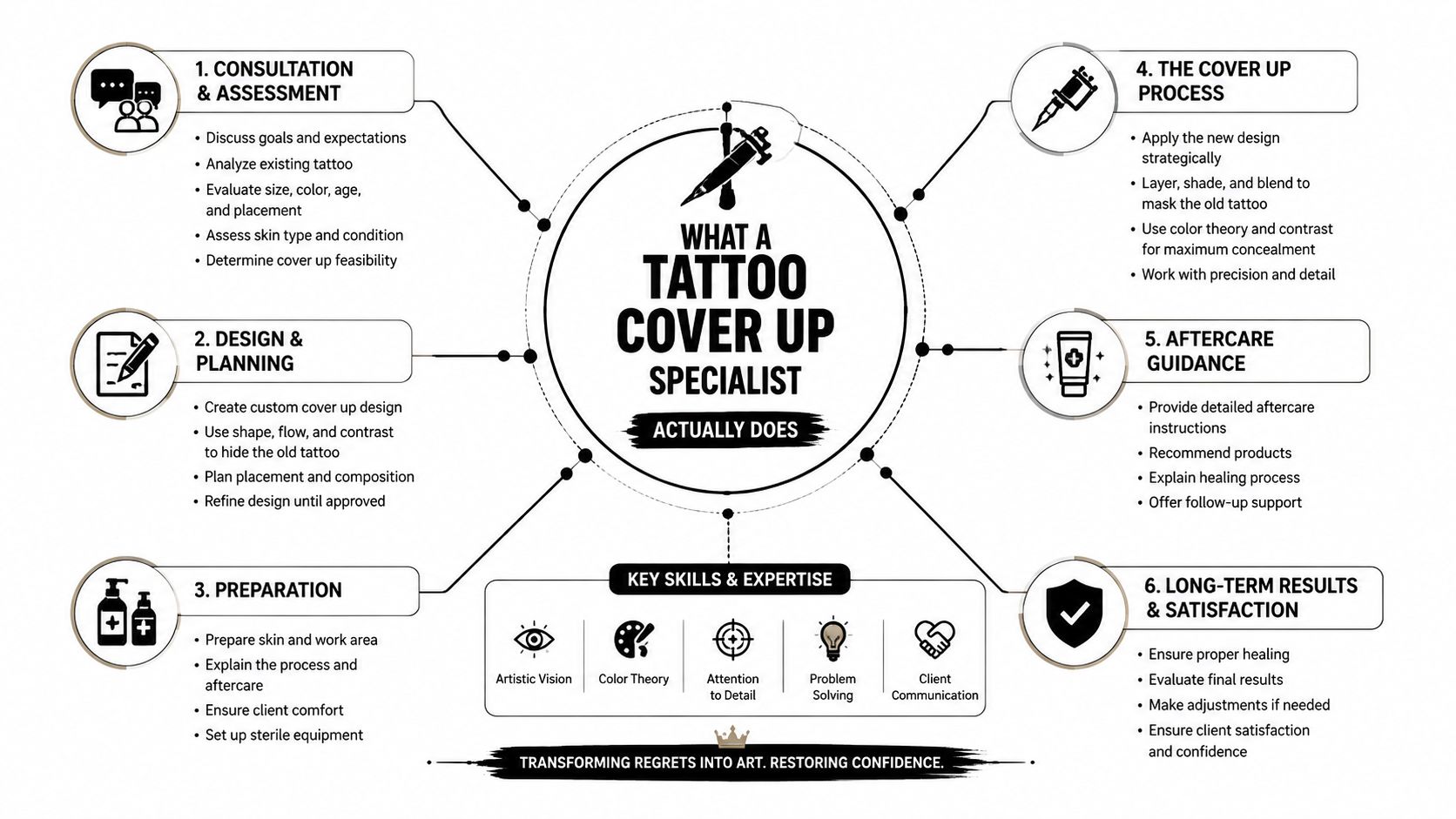
A useful analogy is renovating a wall instead of demolishing the building. Full removal tries to clear the existing pigment. A cover-up specialist studies the structure already there, identifies the darkest areas, and builds a new image that makes the old one irrelevant to the eye.
That requires two kinds of judgment. The artist must understand composition, scale, line weight, color, and how a design will follow the body. The clinical provider must understand pigment response, skin tone, laser safety, healing, and the difference between fading enough for a cover-up and treating until the tattoo is gone.
What happens during a serious consultation
A thorough consultation should address the old tattoo and the proposed replacement as one project.
- Visual assessment: The specialist examines pigment density, linework, color, scarring, placement, and how the tattoo has aged.
- Design mockups: The artist tests whether the new concept can conceal the old image without forcing unnecessary size or darkness.
- Fading strategy: If the original ink is too dense, the artist may recommend targeted laser fading before tattooing.
- Skin assessment: Skin tone, undertone, healing history, and prior reactions affect how conservative the fading plan should be.
- Timeline planning: The team maps fading appointments, healing intervals, design approval, tattooing, and later evaluation.
The same planning principle applies to specialized placements, including cover up tummy tuck incision tattoos, where body contours and scar tissue can affect both design flow and treatment decisions.
A cheap appointment can become expensive if it ignores these variables. The value of a specialist isn't just the drawing. It's the ability to sequence the work so the new tattoo has enough visual room to heal cleanly and remain readable.
Cover Up Versus Fading Versus Full Removal
The three options target different end states: a replacement design, a reduced-contrast foundation, or a blank canvas. Your choice depends on the look you want, the old tattoo's pigment density and colors, your skin, and the time available for treatment and healing.
| Option | Typical Goal | Best For |
|---|---|---|
| Cover-up | Replace the old image with a new tattoo | Clients whose existing ink can be concealed through design, shading, texture, or color |
| Partial fading | Reduce the old tattoo's optical density | Clients who want a lighter or more flexible cover-up without waiting for complete removal |
| Full removal | Clear as much existing pigment as possible | Clients seeking a clean slate or maximum freedom for a future design |
Cover-up
A direct cover-up can work when the existing tattoo is relatively light, compact, or compatible with the new composition. The artist must still account for old lines showing through healed pigment. If the underlying contrast remains strong, a design that looks concealed on tattoo day may later appear less convincing.
Partial fading
Partial fading is often the practical link between laser treatment and cover-up artistry. The target is not zero ink. It is enough reduction in visual weight for the artist to preserve negative space, softer values, lighter colors, or finer detail instead of defaulting to dense blackwork.
Pico Laser's explanation of cover-up preparation describes a common target as a “ghost” appearance, often around 50% to 70% fading. Dense dark areas are reduced, and the remaining pigment becomes less dominant. The right endpoint is design-dependent. A delicate floral cover-up may need more fading than a bold, heavily shaded composition.
A staged cover-up removal and fade plan can help coordinate laser sessions, healing, and the artist's design review. The clinician and artist should judge progress by how the tattoo reads through the planned design, not by a fixed session count.
Full removal
Full removal suits clients who want no replacement tattoo, whose existing placement restricts realistic designs, or who prefer to decide later. It generally requires more treatment and patience than targeted fading, and different pigment colors respond differently. If you are also researching pigmentation treatment elsewhere on the body, find laser dark spot treatment options, while remembering that tattoo ink requires its own assessment.
The key question is not whether the tattoo can be covered. It is how much old ink must be softened to give the artist genuine design freedom.
How to Prepare Your Skin and Your Tattoo
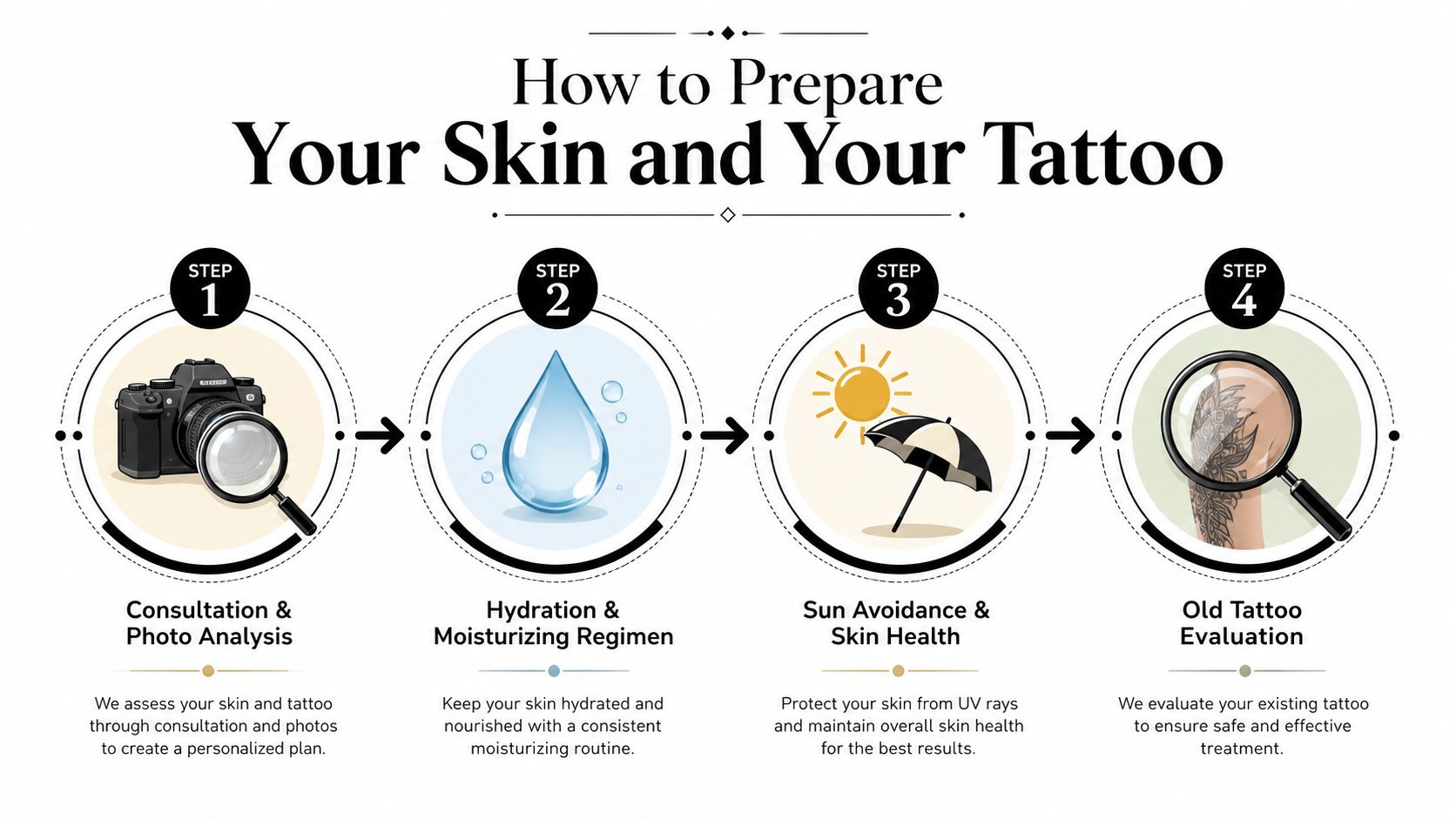
You are standing with the artist's design on your phone, but the old tattoo still shows through the screen. Preparation connects that proposed cover-up with what your skin and existing pigment can realistically support. Bring clear photographs, approximate measurements, the tattoo's age, any previous removal history, and examples of the style you want. The laser clinician and artist can then compare the planned design with the old ink's density, colors, and placement.
Ask to see the design at its intended size on the body. A small phone sketch may need to become larger to conceal heavy linework. If you want fine detail, softer color, or a less dominant cover-up, selective fading may preserve more design options than adding dense blackwork.
An orderly preparation checklist
- Start with assessment. Have the tattoo, surrounding skin, and scarred areas examined before treatment settings or a final design are approved.
- Define the fading target. Tell the artist whether you want realism, fine detail, soft color, black and grey, or a bolder composition. The required fading follows that goal.
- Protect the skin between appointments. Limit unnecessary sun exposure, follow wound-care instructions, and avoid picking or irritating treated areas.
- Allow genuine healing time. Skin needs to settle before another fading appointment or tattoo session. Healing and pigment clearance continue between visits, so scheduling should follow the provider's assessment rather than a rushed calendar.
- Coordinate the handoff. The laser provider and artist should record what was treated, when it was treated, and how the skin responded.
Hydration and ordinary moisturization may improve comfort, but they cannot replace healing time. Smoking, heavy sun exposure, friction, and inconsistent aftercare can complicate recovery. Discuss those factors openly so the treatment plan reflects your skin's actual condition.
For practical preparation steps, read this guide to preparing for a tattoo cover-up. It can help you organize information for both appointments and clarify whether the goal is a lighter “ghost” of the original tattoo or a more substantial fade.
The Science Behind Successful Cover Ups
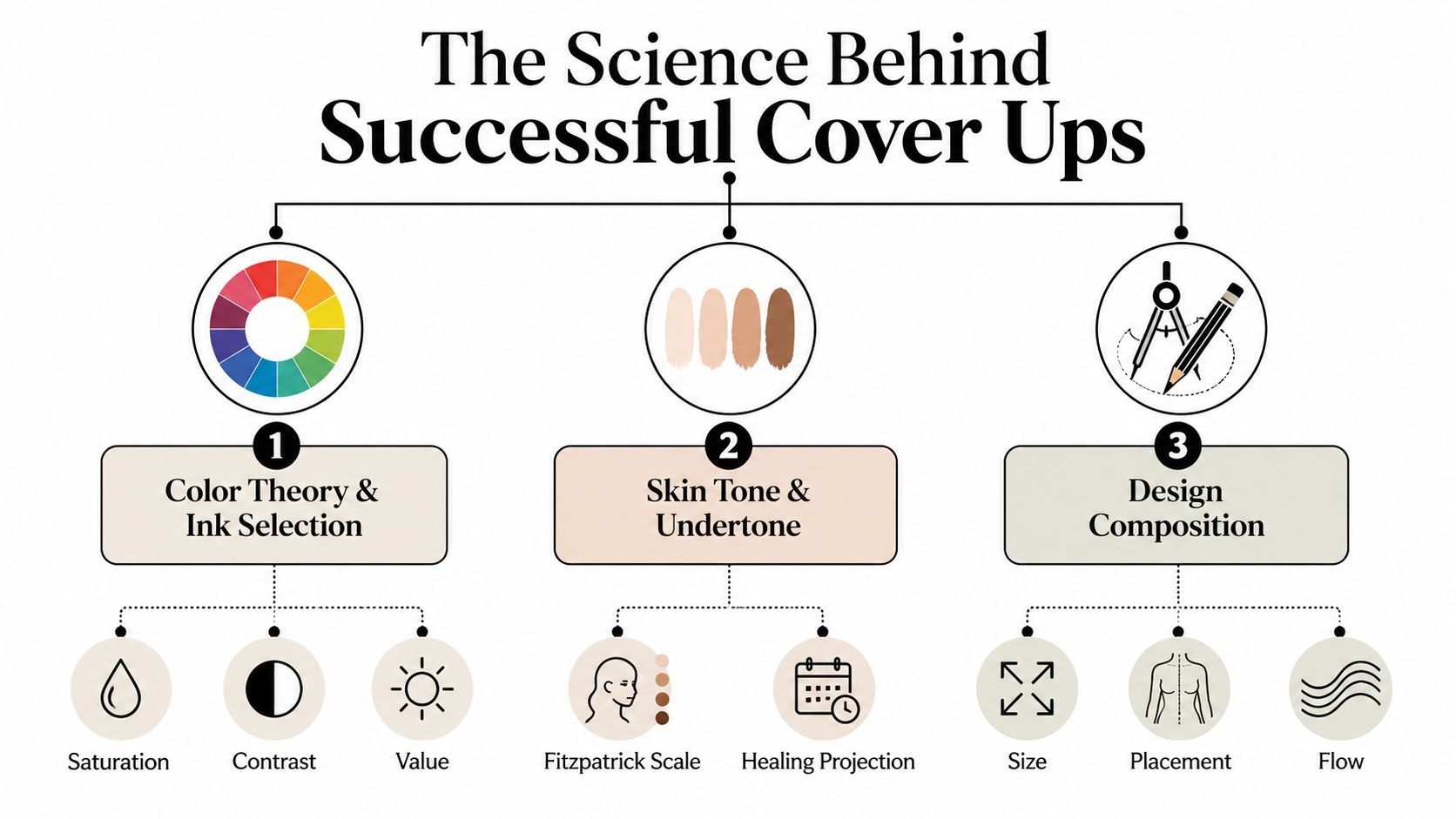
A cover-up succeeds when the new design controls the old pigment instead of just piling more ink on top of it. The specialist evaluates color, skin, and composition before deciding how much fading is appropriate.
Color determines the fading route
Black pigment generally responds more readily than green, yellow, or white pigment. A clinical review reports typical ranges of 3 to 6 sessions for amateur black tattoos, 6 to 10 sessions for professional single-color tattoos, and 8 to 12 or more sessions for professional multicolor tattoos. Those are treatment ranges, not promises, and the starting density, ink composition, location, and skin response still matter. The review in the National Library of Medicine explains why pigment selection changes the difficulty of removal.
Laser wavelength also matters. 1064 nm is used for darker pigments such as black and blue, while 532 nm is more responsive to red, orange, and yellow dyes. Shorter wavelengths require particular caution in darker skin because melanin can absorb more of that energy.
Skin tone changes risk management
Darker skin contains more melanin, so an aggressive setting can increase the risk of pigmentation change or scarring. The same dermatology guidance identifies 1064 nm Nd:YAG treatment as generally safer for deeper skin tones because it is less absorbed by melanin. A careful provider may choose conservative settings and adjust the plan after observing how your skin heals.
Residual pigment affects design
Research on tattoo pigment shows that fading can reduce ink particles until they no longer appear obvious to the naked eye. Yet forensic imaging research has found that latent ink can remain detectable under infrared light, and a secondary cover-up may still allow parts of the original tattoo to be distinguished in that context. The dermatology research on pigment behavior and infrared visibility supports a practical rule: plan for residual pigment, even when the tattoo looks sufficiently faded in ordinary light.
Clinical rule: Fade for the design you want, not for an arbitrary promise of complete clearance.
How to Choose the Right Cover Up Specialist
The portfolio should show healed cover-ups, not only fresh photographs taken immediately after tattooing. Look for examples with similar pigment density, body placement, skin tone, and desired style. A specialist who can explain why a particular flower, animal, geometric form, or color arrangement works over your tattoo is giving you more useful information than someone who promises to hide it.
Questions worth asking
- How many cover-ups have you completed? Ask for relevant examples rather than a general tattoo count.
- What would you fade first? The answer should connect specific dark or saturated areas to the proposed design.
- Which laser wavelength is appropriate for my pigment and skin tone? A responsible provider should explain the reasoning in plain language.
- Do you provide fading or coordinate with a clinical provider? Clear responsibility prevents gaps between appointments.
- How will the design look after healing? Ask to see healed work and discuss how the artist handles future softening.
- What happens if the old ink remains visible? A realistic plan includes reassessment, not just a one-time promise.
Clean practice is essential. The artist should explain sterilization, single-use supplies, barriers, consent, and aftercare without becoming defensive. The laser provider should document your skin response and give you clear instructions for the treated area.
Red flags include pressure to book immediately, refusal to discuss skin type, vague answers about fading, and a portfolio filled only with untouched skin. Use this cover-up tattoo artist selection guide to organize your questions before the consultation.
Timelines, Sessions, and Realistic Costs
A client may have a wedding date, a trip, or a work deadline in mind, while the tattoo still needs fading and healing. Planning works better when you separate treatment time, healing time, and design time. Laser appointments allow the skin to recover and the body to process fragmented pigment. Tattooing comes later, once the area has settled enough for the artist to work safely.
The number of fading appointments depends on the old tattoo's color, age, density, location, and your skin response. Clinical removal ranges can help explain why complex pigment takes longer, as detailed in the science section above, but they are not a personal forecast for partial fading. A cover-up may stop once the darkest areas have softened enough to give the artist design choices. The goal is not automatically to erase every trace. It is to reduce the visual weight that would otherwise force dense blackwork.
Build the calendar around healing
Start with an assessment of the tattoo and the surrounding skin. The provider can then decide whether fading is appropriate, which areas need attention first, and how the plan fits the intended cover-up. The artist and clinical provider should share the same target, because the laser plan is useful only when it supports the future design.
Allow roughly a month between fading appointments as a basic planning interval. Longer spacing may be appropriate when the skin needs more recovery or pigment clearance. The next fading session should wait until the treated area has healed adequately, rather than following a calendar date regardless of skin condition.
The cover-up itself should be scheduled only after the treated skin is fully healed and the artist confirms that the remaining pigment supports the design. The finished tattoo also needs time to heal before you judge its color, texture, saturation, or relationship with the old ink. First-day appearance can be misleading because swelling and surface changes temporarily alter the result.
Build extra room into the calendar. Travel, employment requirements, enlistment, or a wedding can make a deadline feel fixed, but fading and tattoo healing do not always follow an exact schedule. A rushed final appointment leaves little room for reassessment or design changes.
What drives the price
A credible provider should explain the factors behind the quote instead of presenting one universal figure. Cost can change with tattoo size, pigment colors, density, location, skin type, provider qualifications, and the number of fading appointments. The total may also differ when clinical fading and tattooing are booked with separate providers.
A direct cover-up may cost less at the beginning, yet extensive laser preparation can offer more flexibility and help avoid a result built around heavy black coverage. Ask for the cost of each stage, what follow-up visits include, and whether the estimate changes if the skin needs more healing or the artist adjusts the design.
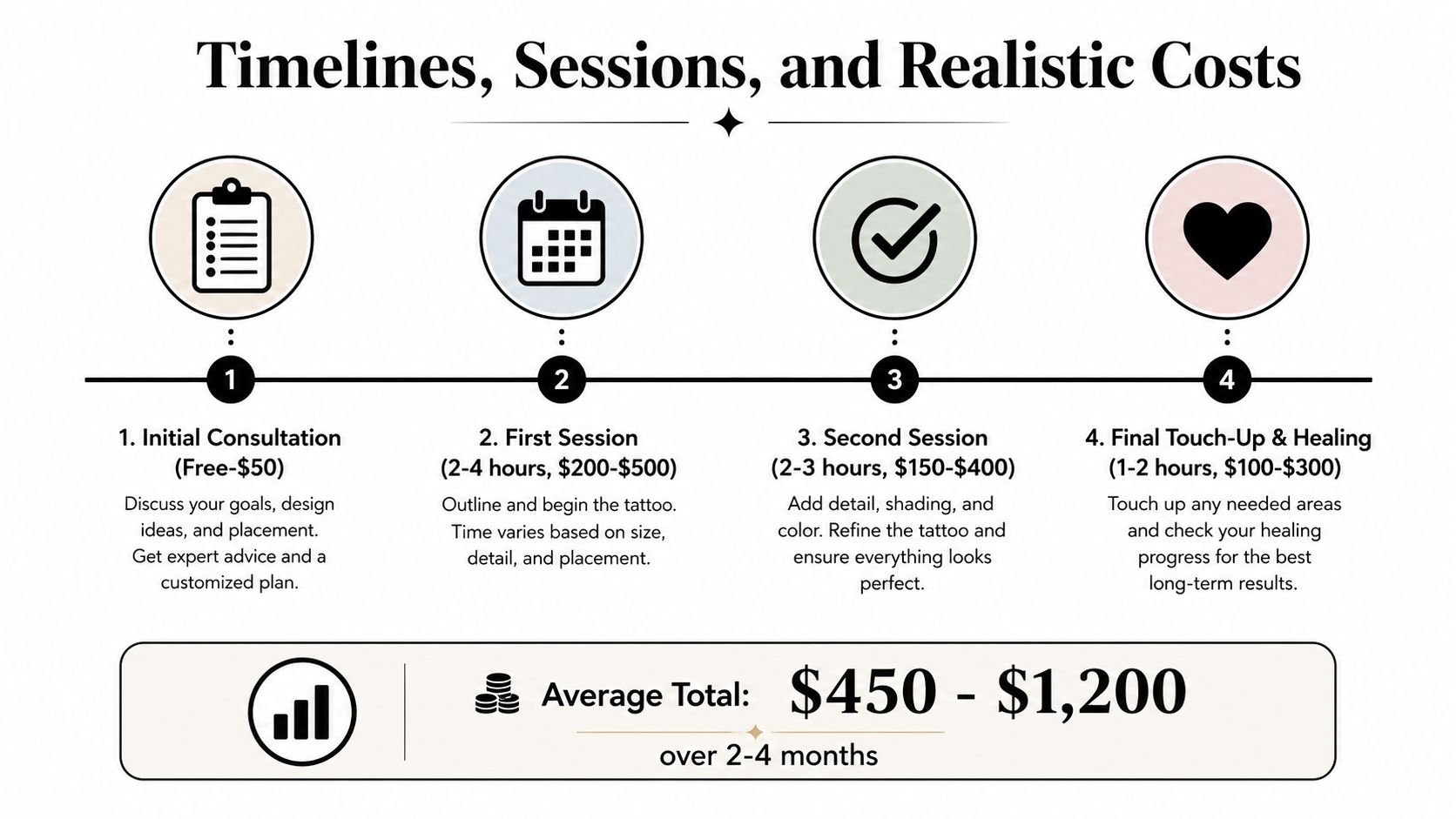
The infographic below shows an example planning framework. Its dollar amounts are not verified treatment quotes and should not be treated as a promise of local pricing.
Three assumptions that limit clients
“Every cover-up has to be huge.” A larger design can provide more coverage, but selective fading may preserve a controlled footprint. Ask how much scale is needed to conceal the darkest original elements without overwhelming the body area.
“The only answer is solid black.” Blackwork can work well over heavy black lines, but it is not the only option. Fading can leave room for complementary color blocking, blues, purples, warm tones, texture, and contrast. Interest in fine line and micro-realism also makes early fading useful for clients who want a lighter visual effect. Ray Studios' discussion of tattoo removal and cover-up trends describes this move toward more individualized outcomes.
“Laser fading always damages skin for the new tattoo.” Poorly chosen settings can create problems, particularly when skin tone and healing are ignored. A carefully planned treatment aims to reduce optical density while protecting the skin, giving the artist more choices for color, spacing, and detail.
Current discussions of pigment and workflow also mention laser-compatible inks, high-density pigments, design simulations, and improved healing films. These tools may assist planning, but they do not replace a skin assessment or guarantee a specific result. This 2025 cover-up guidance on color correction and workflow is industry commentary, not individualized clinical advice.
Questions People Ask Before Booking
Can a cover-up look light and modern?
Sometimes. The starting tattoo, its darkest areas, and the new design's contrast requirements all matter. Partial fading can create space for open skin, fine detail, softer transitions, blues, purples, warm colors, and controlled color blocking. If you want a lighter, more discreet result, tell the artist before the design is drawn. That preference sets the target for fading and helps preserve more design choices than defaulting to dense blackwork.
Does an old tattoo cover more easily than a fresh one?
Age changes appearance, but it does not determine the result by itself. Pigment density, color, line thickness, scarring, body location, and previous treatment usually matter more. An old, softened tattoo may be easier to cover than dense black ink, while concentrated dark areas can still limit the new design.
How many fading sessions will I need?
Ask for a plan based on your tattoo and the cover-up you want, rather than a fixed promise. The specialist should assess skin tone, pigment colors, line density, scarring, and the artist's proposed placement. Ask what visual change they are aiming for, which areas need the most fading, and how progress will be reviewed before each treatment. The full removal ranges discussed earlier are not automatically the right target for a cover-up. Many plans stop once the artist has enough contrast and flexibility to work safely.
What happens if the original tattoo has heavy black linework?
The cover-up artist may place the new design's darkest elements over those lines, enlarge selected shapes, or use texture to interrupt the old geometry. Targeted fading can reduce the strongest visual points first. Heavy black linework narrows the available light areas, but it does not automatically require a blackout design. Ask to see how the proposed composition handles the original tattoo before booking.
Can residual ink still matter after fading?
Yes. A tattoo can look faint in ordinary lighting while pigment remains beneath the surface. That remaining pigment may affect how the new tattoo heals and how its colors appear. Ask both professionals to identify the darkest residual areas and explain how the cover-up will account for them. Visual fading is a design milestone, not proof that every pigment particle has cleared.
Choose a professional who can discuss both clinical fading and tattoo design. For clients in Central and West Florida, EradiTatt offers tattoo removal and light fading for cover-up preparation at locations including Orlando, Bradenton and Sarasota, St. Petersburg, Palm Harbor, and Tampa. Personalized plans are available through its central 844 number or directly with a clinic, depending on location and needs.
EradiTatt Tattoo Removal offers progressive laser treatment for complete removal or targeted fading before a new tattoo. Plans consider skin type, tattoo size, pigment complexity, and the design goal. Visit EradiTatt Tattoo Removal to request a consultation and discuss how much fading your cover-up needs.