Professional tattoo removal laser machines typically cost $20,000 to $100,000, while the broader market stretches from about $100 portable units to $200,000 or more for premium systems. The right tattoo removal laser machine price depends less on the sticker and more on wavelengths, pulse technology, certifications, service, and the patient mix you plan to treat.
A Florida med spa owner may start with a simple question: should the clinic buy a machine, finance one, or send tattoo-removal patients to an established provider? A low-cost listing can look attractive beside a five-figure system, but the cheaper device may offer fewer wavelengths, limited skin-type flexibility, weaker support, or a higher ownership burden.
This guide translates the market into practical decisions. You'll see what each price tier generally includes, why a Picosecond platform costs more than a basic Nd:YAG unit, which operating costs appear after purchase, and when partnering with a Florida provider may make more sense than taking on equipment debt.
Table of Contents
- Introduction to Tattoo Removal Laser Machine Pricing
- How Tattoo Removal Lasers Work and Why Technology Affects Price
- Tattoo Removal Laser Machine Price Ranges by Tier and Condition
- Key Factors That Drive Tattoo Removal Laser Machine Cost
- Hidden Operating Costs Beyond the Purchase Price
- Financing Options and ROI for Clinics Considering a Purchase
- Smarter Paths to Offering Tattoo Removal in Florida
Introduction to Tattoo Removal Laser Machine Pricing
A Florida clinic owner may see a low-priced laser listing and wonder whether it can support a real tattoo-removal service. The answer depends on what the clinic needs to treat, how often patients will book, and which responsibilities come with ownership.
The phrase tattoo removal laser machine price covers several product categories. A portable unit for limited, entry-level work is not comparable to a professional system built for repeated clinical use. Wavelength options, pulse technology, cooling, safety controls, certifications, staff training, and service support can all change the purchase decision.
The wider market runs from about $100 to $200,000. Professional-grade equipment generally falls between $20,000 and $100,000. Portable Nd:YAG units may cost around $200 to $600, while vertical Q-switched or picosecond systems begin around $1,500 to $3,500. High-end FDA-approved Q-switched Nd:YAG systems, including the Lucid Q PTP, are listed at roughly $20,000 to $100,000, according to this professional tattoo removal machine cost guide.
Those figures describe the purchase price, not the full cost of adding the service. A clinic may also need training, maintenance, insurance, compliance work, marketing, and enough appointment volume to keep the equipment in use. Certifications and skin-type coverage matter too. A lower quote can become less attractive if the device limits the patients or tattoo colors the clinic can treat.
Consider a Florida med spa with treatment rooms, trained staff, and patients asking about unwanted ink. Buying may support a new service line, while working with a provider such as EradiTatt can let the owner test demand without purchasing equipment first.
Practical rule: Match the machine's expected clinical role to patient demand, not to the lowest online listing.
The following sections explain how laser technology affects price, what each tier may suit, and which ownership costs deserve attention before a clinic buys, leases, rents, or uses an established Florida provider.
How Tattoo Removal Lasers Work and Why Technology Affects Price
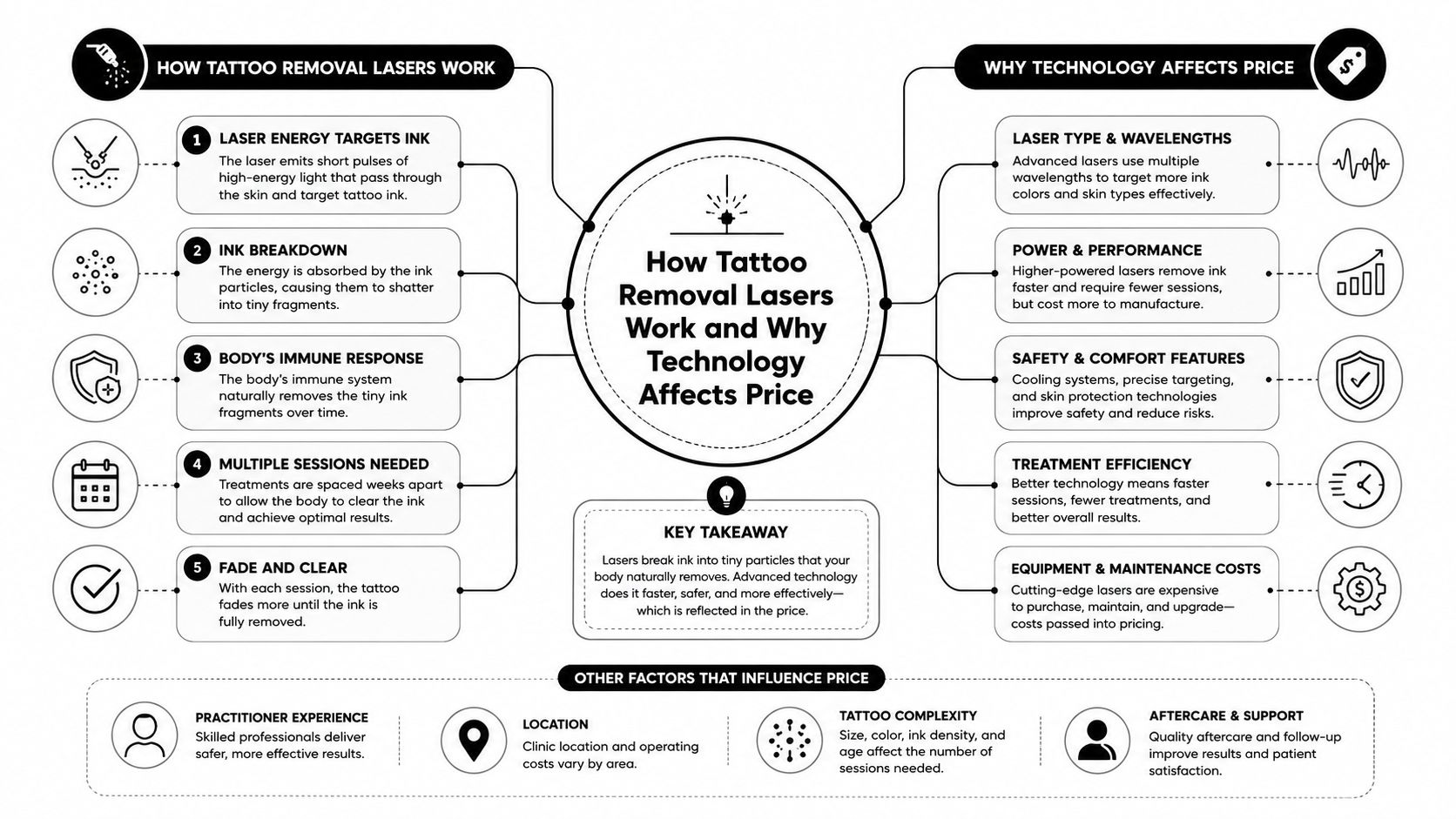
Tattoo ink sits in the dermis, where the body can't easily remove the pigment on its own. A laser delivers concentrated light energy into the tattoo, breaking ink particles into smaller fragments that the immune system can gradually clear. The machine's wavelength, pulse duration, energy delivery, and cooling system all influence how precisely that process can occur.
A useful analogy is striking glass. A broad, heavy hammer may break it, but it can also create unwanted force around the target. A precise tap from a specialized tool can fragment the glass with better control. Nanosecond systems use pulses measured in billionths of a second, while picosecond systems use pulses measured in trillionths of a second. Shorter pulses can create a more concentrated mechanical effect, which helps explain why premium systems command higher prices.
The FDA clearance document for the Picocare Family specifies 1,064 nm and 532 nm wavelengths with pulse durations of 450 picoseconds. It indicates use for dark-colored inks and multicolored tattoos containing dark inks across Fitzpatrick skin types I through VI, as described in the FDA Picocare Family clearance document.
Pulse duration and treatment control
A Q-switched Nd:YAG machine commonly uses nanosecond pulses. These systems can be practical for dark tattoo ink and may cost less than true picosecond platforms. A picosecond system, by contrast, is engineered to deliver much shorter pulses, which adds complexity to the optical cavity, switching electronics, and calibration requirements.
That doesn't mean a premium label automatically guarantees a better business decision. A clinic needs to match the technology to the tattoos, skin tones, and treatment goals arriving through its door. A practice focused mainly on straightforward dark ink may not need every advanced option. A practice treating dense, multicolored work or serving a broad range of skin types may place greater value on wavelength coverage and pulse precision.
Why wavelengths matter
Wavelengths determine which ink colors and depths a system can target effectively. 1,064 nm is associated with deeper dark pigment treatment, while 532 nm is useful for specific lighter or red-toned pigment applications. The FDA-cleared Picocare example shows how one platform can combine both wavelengths with short pulse delivery.
Before comparing prices, ask whether a quote includes the wavelengths you need. A low headline price may refer to a base configuration, while additional handpieces or wavelength options carry separate costs. For a plain-language overview of newer tattoo-removal technology, see this guide to new tattoo removal technology.
Tattoo Removal Laser Machine Price Ranges by Tier and Condition
The most useful way to compare prices is by machine tier and condition, not by brand name alone. Current listings show how widely prices can vary, even within one seller's catalog. A 2026 U.S. marketplace listing included regular prices of $3,999.95, $5,999.00, $29,000.00, and $39,900.00, according to the seller's tattoo-removal laser machine collection.
That spread exceeds tenfold. It reflects different technologies, configurations, warranties, and intended workloads, not different marketing strategies.
| Machine Tier | Typical Price Band | Best For |
|---|---|---|
| Portable Nd:YAG | About $200 to $600 for basic portable models | Entry-level or limited-use applications |
| Entry-level professional | About $1,500 to $5,000 in some market summaries | Small operators comparing initial capital requirements |
| Mid-range professional | About $5,000 to $20,000 | Med spas and smaller clinics building treatment volume |
| Premium Q-switched | About $20,000 to $100,000 | Professional practices needing established clinical systems |
| Premium picosecond | About $50,000 to $100,000 or more | High-volume practices seeking advanced pulse performance |
| Used premium systems | About $50,000 to $85,000 for used Quanta Discovery Pico listings | Buyers prepared to verify condition, service history, and support |
The broader price guide places basic portable Nd:YAG machines around $200 to $600, vertical Q-switched or picosecond units around $1,500 to $3,500, and professional-grade systems largely between $20,000 and $100,000. Another market summary places entry-level portable Nd:YAG devices around $1,500 to $5,000, mid-range professional units around $5,000 to $20,000, and high-end picosecond systems at $50,000 to $100,000 or more, as documented in this 2026 tattoo-removal machine guide.
What the lower tiers can and can't do
A portable unit may reduce the initial barrier to entry, but buyers should inspect its wavelength coverage, pulse specification, cooling, certification status, and service arrangements. A low price can become less attractive if the machine can't address the tattoo colors or skin types represented in your market.
Mid-range systems sit closer to the practical needs of a developing clinic. They may offer stronger construction, more consistent output, and a more suitable configuration for regular appointments. Still, the exact specification matters more than the tier label.
Why used equipment needs careful review
Used equipment can place premium technology within reach, but the purchase price isn't the complete story. Ask for service records, calibration documentation, operating history, included handpieces, warranty terms, and evidence that replacement parts remain available.
The same marketplace summary cited used Quanta Discovery Pico machines around $50,000 to $85,000, while some high-end new systems can reach $300,000. That comparison shows why a used quote should be evaluated as a risk-adjusted purchase, not as a discount.
Key Factors That Drive Tattoo Removal Laser Machine Cost
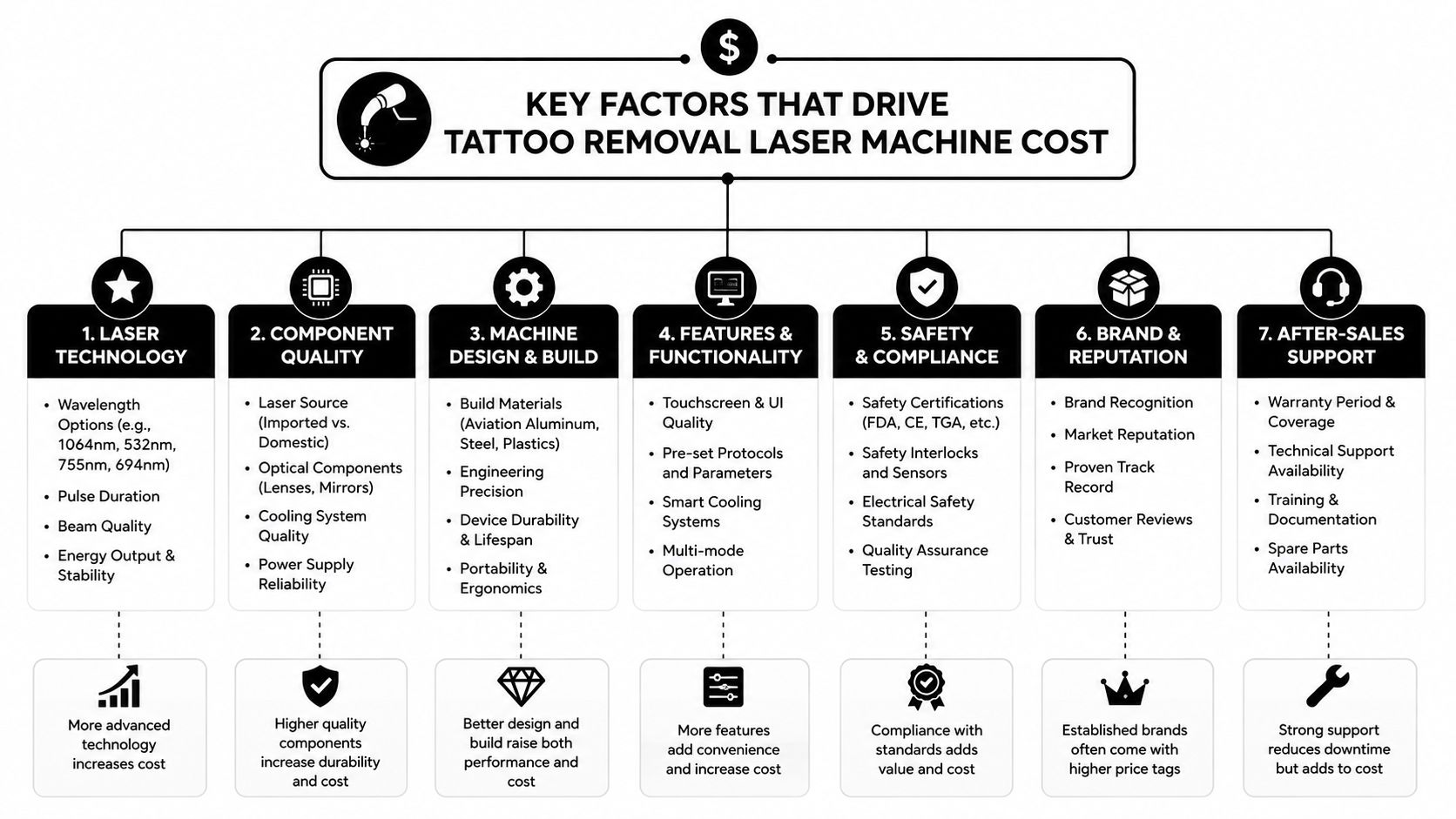
Two machines with similar prices can produce very different business value. Read the quote as a list of capabilities, not as a single number.
Wavelength coverage
Wavelengths determine the range of pigment a system can address. A platform with only one primary wavelength may suit a narrow case mix, while a multi-wavelength system can offer broader options for dark, red, blue, or green ink. Coverage also matters when your clinic serves patients across Fitzpatrick skin types, particularly when operator judgment and conservative settings are essential.
Pulse technology and power
Pulse duration affects how energy interacts with pigment. Nanosecond Q-switched technology and picosecond technology shouldn't be treated as interchangeable labels. Ask the seller for the measured pulse duration, available energy settings, repetition rate, and how output is verified.
Handpieces and spot sizes
Handpieces affect treatment speed, access, and precision. Different spot sizes can help an operator work across small symbols, dense sections, and larger areas without relying on one configuration for every patient. Confirm whether the quote includes the handpieces you need or lists them as optional accessories.
Cooling and build quality
Cooling protects patient comfort and helps the operator manage heat during treatment. Build quality affects reliability, uptime, and the machine's ability to handle repeated use. A cheaper system may look affordable until downtime disrupts booked appointments.
Clearance and certifications
Regulatory documentation deserves close review. The FDA document for the Picocare Family provides a concrete example of how a cleared system identifies wavelengths, pulse duration, intended tattoo indications, and Fitzpatrick skin types. Ask for the exact clearance or certification that applies to the model and configuration being sold, rather than accepting a general claim about a product family.
Warranty and service contracts
A warranty protects more than the hardware. It can determine how quickly a clinic receives technical support, whether travel or labor is included, and which parts are excluded. Service terms should specify response procedures, calibration, software support, replacement components, and loaner arrangements where applicable.
Quote-reading test: If the seller can't explain what the system can treat, what the quote includes, and how service works, the price isn't transparent enough to compare.
For a closer look at Discovery Pico technology and its place in the market, review this Discovery Pico laser resource. Use it as a prompt for questions, then verify the exact model, configuration, and service terms in your own proposal.
Hidden Operating Costs Beyond the Purchase Price
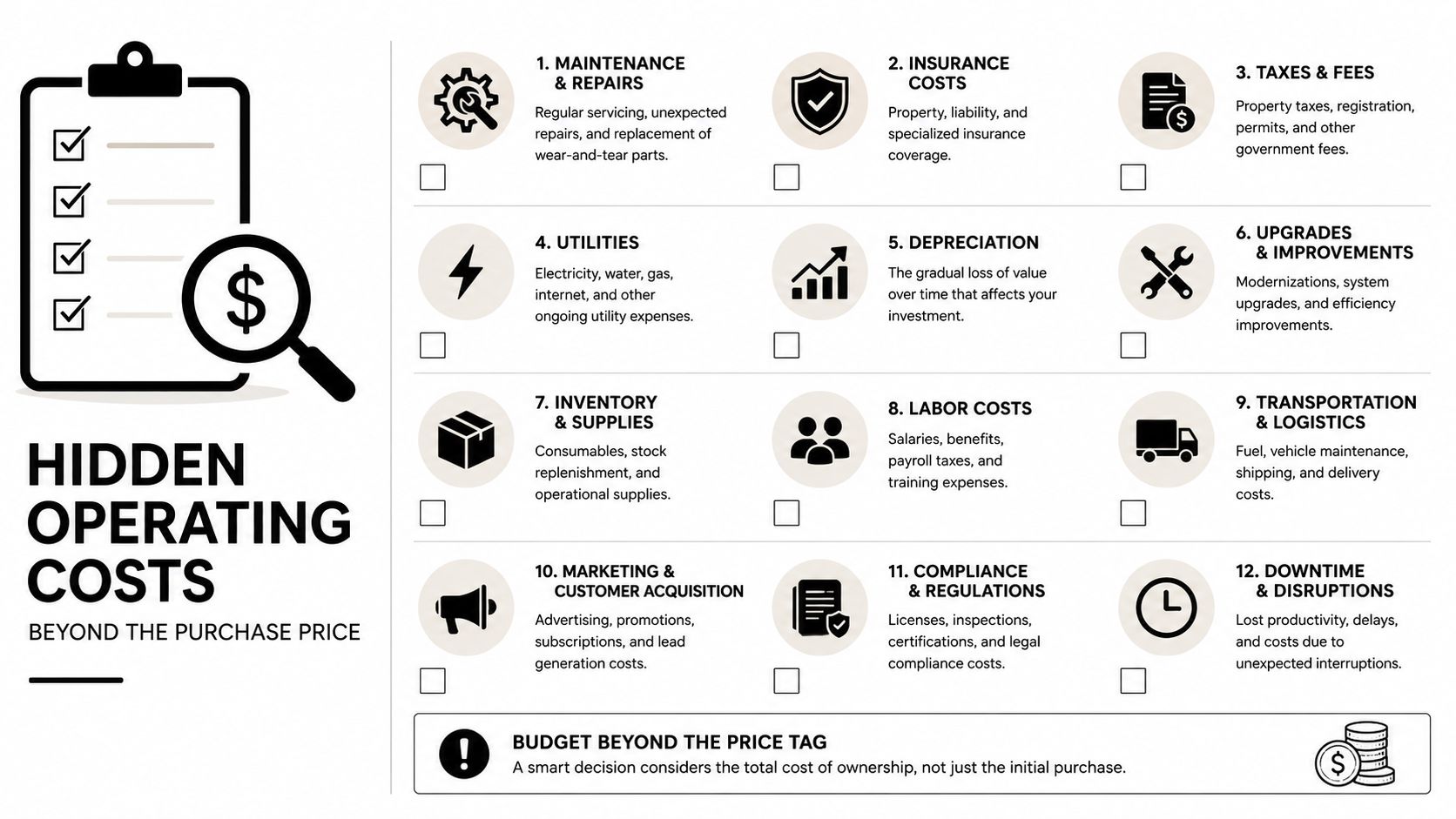
The purchase invoice is only the beginning of ownership. A clinic also pays in time, labor, compliance, and maintenance. These costs can change the margin on every appointment, especially when a lower-cost machine requires more operator attention or creates more downtime.
A useful budget separates fixed ownership costs from per-treatment costs. Fixed costs may include maintenance agreements, calibration, insurance, facility requirements, software, and financing. Variable costs can include protective supplies, aftercare materials, staff time, consumables, and handpiece wear.
The ownership categories buyers overlook
Maintenance and calibration keep output consistent and help identify problems before they interrupt appointments. Ask how often the manufacturer recommends service and whether calibration is included in the warranty or billed separately.
Handpieces and replacement parts can create a major cost difference between systems. A quote should identify what wears out, how long parts typically remain supported, and whether replacement components must come from the original manufacturer.
Training and certification affect both safety and productivity. Include initial training, refresher education, staff turnover, and time spent learning settings for different tattoo colors and skin types.
Facility and compliance requirements may include electrical work, room preparation, protective eyewear, signage, documentation, licensing, and local operating requirements. These aren't optional line items just because they don't appear on the machine invoice.
Insurance and risk management should cover the equipment and the service itself. Confirm that the policy recognizes the specific laser, operators, treatment setting, and procedures your clinic plans to offer.
Marketing and appointment generation determine whether the machine stays productive. A technically capable system still loses money if the clinic hasn't built a consultation process, pricing structure, referral flow, and follow-up system.
A simple treatment-cost model
Before signing, calculate:
- Annual fixed ownership cost: financing, service, insurance, compliance, and facility expense.
- Cost per appointment: staff time, room time, supplies, and payment processing.
- Expected utilization: the number of appointments you can realistically fill.
- Contribution per treatment: collected revenue minus the direct appointment cost.
- Break-even requirement: the treatment volume needed to cover fixed ownership costs.
Two clinics can buy different machines and reach opposite financial results. One may pay more upfront but experience reliable uptime and efficient appointments. Another may spend less initially but face limited capability, extra support costs, and unused appointment capacity. The machine price only makes sense when connected to the entire operating model.
Financing Options and ROI for Clinics Considering a Purchase
A Florida clinic choosing a purchase method is also choosing how much cash remains available for daily operations. An outright purchase avoids interest but commits working capital immediately. An equipment loan spreads payments and preserves funds for staffing or marketing. A lease can reduce the initial burden and support an upgrade later, though the total obligation and end-of-term conditions require careful review. Rental or revenue-share arrangements limit commitment while the clinic tests demand.
ROI comes from matching the machine to the clinic's actual schedule. The calculation includes equipment and financing costs, the amount collected per treatment, the number of sessions each client may need, and the appointment volume the clinic can sustain. A premium system may fit a Florida practice with a dependable caseload and sufficient room capacity. It may place unnecessary pressure on a clinic that is still testing demand.
Use break-even logic before sales projections
Begin with the price tier under consideration. For professional equipment, calculate how many completed treatments must contribute toward the obligation after staff time, supplies, maintenance, insurance, and marketing. If the machine carries a higher purchase price, test conservative, moderate, and strong utilization assumptions instead of relying on one optimistic forecast. As noted earlier, published professional price ranges can help frame the comparison, but the purchase price is only one part of the ownership decision.
Florida-specific planning also includes local competition, seasonal scheduling, patient travel distance, and whether clients seek complete removal or fading before a cover-up. Flexible appointment capacity may matter as much as the treatment fee. An empty room does not repay financing.
Owners comparing loan structures can review Business Loan Warrior equipment financing as a starting point for medical-equipment funding options. Compare the full repayment obligation, fees, collateral requirements, early-payoff terms, and effect on working capital before selecting a lender.
Break-even question: How many treatments must the machine support each month after every operating cost is included, and can your current patient pipeline support that number?
Smarter Paths to Offering Tattoo Removal in Florida
Buying makes sense when your clinic has a defined patient pipeline, trained operators, suitable space, and enough expected use to support ownership costs. It can also make sense when tattoo removal complements existing services and the equipment will remain active rather than sitting idle between occasional bookings.
Partnering or outsourcing may be more practical when demand is untested, capital is limited, or your clinic doesn't want responsibility for calibration, repairs, training, and regulatory administration. This approach lets you focus on referrals and patient relationships while an established treatment provider manages the laser service.
For Florida residents, EradiTatt Tattoo Removal offers treatment through locations including Orlando, Tampa, St. Petersburg, Palm Harbor, and Bradenton/Sarasota. The provider supports consultations through central phone assistance and can discuss plans for complete removal or progressive fading before a cover-up. Its Florida laser tattoo removal pricing guide gives prospective clients another way to evaluate treatment costs without purchasing clinic equipment.
The decision is straightforward when you match the path to your situation:
- Buy when: You can support consistent treatment volume, staff training, service coverage, and the full cost of ownership.
- Finance when: The expected contribution from appointments supports repayment without weakening essential operating cash.
- Partner when: You want to test demand, avoid equipment risk, or offer tattoo removal without building a laser department.
- Refer when: An established provider can deliver a more convenient or specialized patient experience for your audience.
EradiTatt Tattoo Removal helps Florida clients pursue complete tattoo removal or fading for a future cover-up through convenient regional locations and personalized treatment planning. Visit EradiTatt Tattoo Removal to discuss your tattoo, skin type, treatment goal, and next steps without committing to the capital expense of a laser machine.