
You may be staring at your reflection and noticing the same thing every morning. The liner that once looked crisp now looks blue-grey, the shape has softened, or the pigment has shifted beyond the lash line. Sometimes the issue isn't a bad result at all. Your style changed, your makeup routine changed, or you don't want permanent eyeliner anymore.
That situation is common, and it's fixable. Eyeliner tattoo removal is no longer an unusual or experimental service. In the right hands, with the right laser and strict eye protection, it's a highly controlled medical-aesthetic process designed for one of the most delicate treatment areas on the body.
Table of Contents
- Regretting Permanent Eyeliner? You Have Options
- How Laser Eyeliner Tattoo Removal Actually Works
- Comparing Your Eyeliner Removal Options
- Safety First Eye and Eyelid Protection Protocols
- Your Removal Timeline from Start to Finish
- Understanding the Costs of Eyeliner Removal
- How to Choose Your Specialist and Book a Consultation
- Frequently Asked Questions About Eyeliner Removal
Regretting Permanent Eyeliner? You Have Options
A typical eyeliner removal consultation starts with a familiar story. Someone got permanent eyeliner years ago, loved it at first, and then watched it slowly become less flattering. The line may have blurred, migrated, faded unevenly, or changed tone. In other cases, the tattoo still looks technically intact, but it no longer fits the face, age, or makeup style of the person wearing it.
That frustration is real because eyeliner sits in one of the most visible places on the face. You can ignore a tattoo on your shoulder for months. You can't ignore your eyelids every time you wash your face or look in a mirror.

Permanent eyeliner is a cosmetic tattoo placed along the lash line or just above it. Even when it was applied well, pigment can behave differently over time than people expect. Skin changes. Sun exposure adds up. Pigment chemistry matters. The original artist's depth and saturation matter too.
Why people seek removal
Some clients want complete removal. Others want fading so the area can be corrected more safely later.
- Faded shape: The line no longer looks defined.
- Color change: Black may soften into blue-grey or another unwanted tone.
- Migration: Pigment appears to sit outside the intended lash line.
- Style shift: A permanent look no longer matches current preferences.
Clinical reality: Feeling unhappy with permanent eyeliner doesn't mean you made a mistake. It usually means the tattoo has aged, the pigment has changed, or your goals have changed.
Modern laser treatment gives you a practical path forward. When performed properly around the eye, it can reduce or remove unwanted cosmetic pigment in a measured way. The process isn't instant, and this isn't an area where shortcuts are acceptable. But for most suitable candidates, there is a reliable way to start over.
How Laser Eyeliner Tattoo Removal Actually Works
Laser removal works by delivering light energy that targets tattoo pigment inside the skin. A simple way to think about it is this. The laser doesn't “erase” ink in one pass. It breaks large pigment deposits into much smaller fragments, more like turning a rock into pebbles than wiping ink off a surface.
Once those fragments are small enough, the body starts clearing them gradually. That's why fading continues between sessions rather than only during the appointment itself.
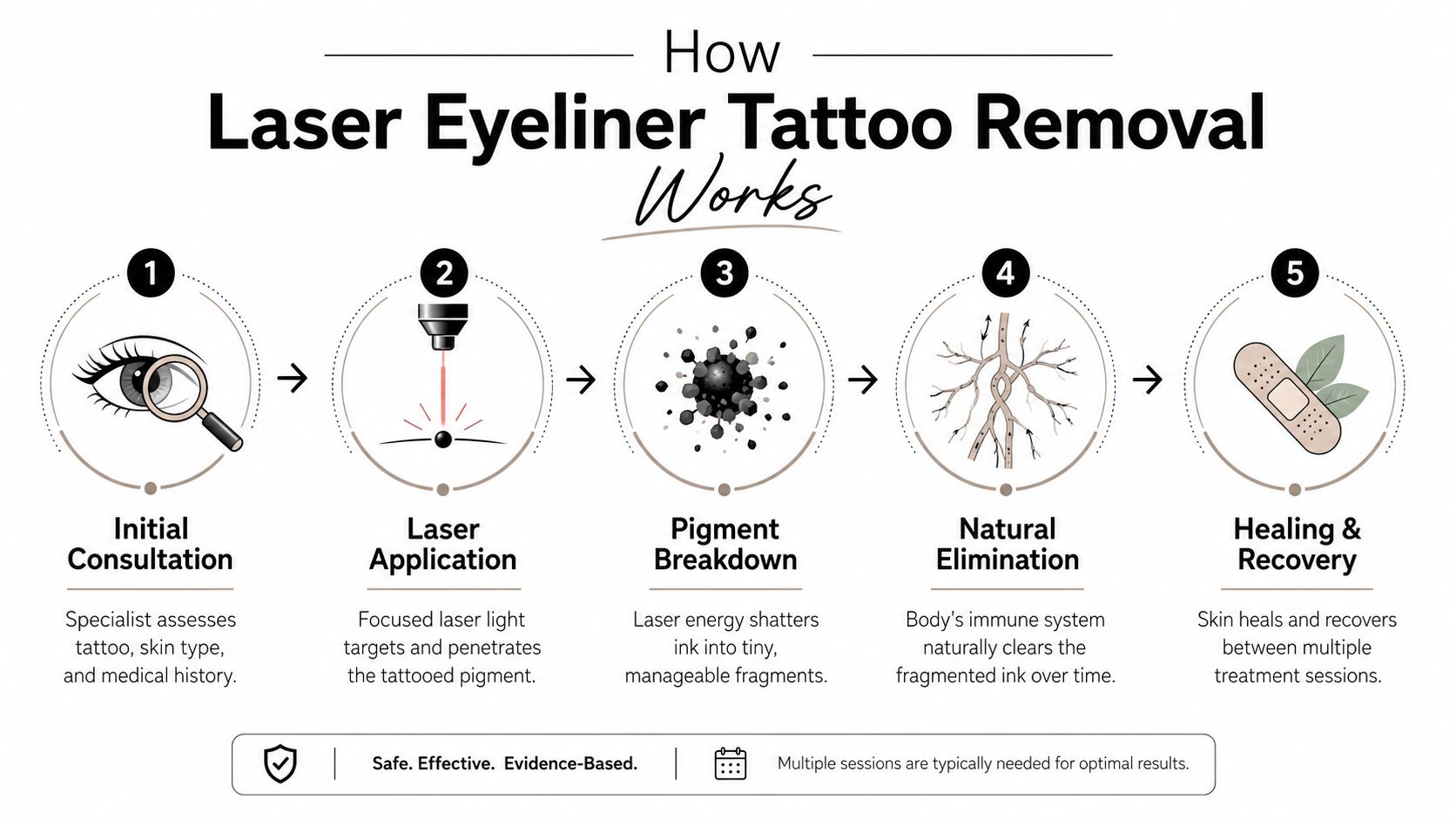
Laser treatment is widely regarded as the strongest option for tattoo removal because it uses specific wavelengths of light to break up pigment colors without damaging surrounding skin tissue, although cosmetic tattoos like eyeliner can initially darken before they fade, as explained in WebMD's overview of laser tattoo removal.
Why the process takes time
The laser does one part of the job. Your immune system does the rest.
That matters because clients often expect immediate disappearance after a successful first session. What usually happens instead is staged improvement. The pigment is disrupted during treatment, then the body spends the following weeks clearing what it can. If the tattoo is dense, placed at depth, or chemically stubborn, that process has to be repeated.
For anyone comparing devices, this is also why technology matters. Clinics using modern systems are aiming for more precise pigment targeting and less collateral heat in a sensitive area. If you want a broader look at device advances, this overview of new technology in tattoo removal gives useful context.
What you may notice after a session
The treated line usually doesn't look “finished” right away. It can look lighter, darker, patchier, or more obvious for a short period before improvement becomes clearer.
Common early observations include:
- Temporary whitening or frosting: A normal immediate response to laser impact on pigment.
- Mild swelling near the lash line: Expected because eyelid tissue is thin and reactive.
- Color shift before fading: Some cosmetic pigments darken first, especially if certain ingredients oxidize.
- Gradual clearing over time: The visible result changes more in the weeks after treatment than in the hour after treatment.
The mistake people make is judging the final outcome too early. Eyeliner removal is a sequence, not a single event.
What doesn't work well is chasing speed. Aggressive treatment can increase irritation without giving the body enough time to process fragmented ink. The best results usually come from a steady plan, careful intervals, and realistic expectations about the eye area.
Comparing Your Eyeliner Removal Options
When people start researching eyeliner tattoo removal, they usually encounter two broad paths. One is laser removal. The other is a non-laser lifting method often described as saline removal. Both aim to reduce pigment. They do not offer the same level of precision, and they are not equally suited to the eyelid.
For the eye area, the main question isn't just “Which method removes pigment?” The better question is “Which method gives the safest control in extremely thin, highly visible tissue close to the globe of the eye?”
Why laser is usually the medical standard
Laser removal treats pigment under the skin by targeting it with calibrated light. That allows a trained practitioner to work in a more controlled way around a small treatment zone. It's also the method most consistently described as the safest and most effective option for tattoo removal in the available patient-facing medical guidance already noted earlier.
Saline removal works differently. It generally relies on placing a removal solution into the skin so pigment can be drawn upward during healing. That can have a place in some cosmetic tattoo correction settings, but eyeliner is a particularly unforgiving area for methods that depend on a more superficial wound-healing response. The margin for textural change, prolonged irritation, or uneven clearance is smaller on the eyelid than almost anywhere else.
Bottom line: Near the eye, precision and tissue preservation matter more than novelty.
Laser vs. Saline Removal for Eyeliner Tattoos
| Feature | Laser Removal | Saline Removal |
|---|---|---|
| Safety | Generally preferred for eyeliner when performed with proper internal eye shields and experienced technique | Can be less predictable on eyelid tissue because it relies on skin injury and healing to lift pigment |
| Effectiveness | Strong option for fading and full removal goals, especially for dark pigment | May help lighten some cosmetic pigment, but results can be uneven in the lash line area |
| Number of sessions | Varies by depth, density, and pigment behavior | Also varies, often with less predictability for eyeliner |
| Ideal use cases | Established option for unwanted permanent eyeliner, especially when eye-specific laser protocols are followed | More limited role, usually considered carefully due to the delicacy of the area |
| Precision | High treatment control in a narrow zone | Less precise endpoint because healing response influences outcome |
| Main trade-off | Requires specialized equipment and strict ocular protection | Can involve more surface trauma and may not be the best fit for the eyelid |
A lot of confusion comes from broad tattoo-removal advice that treats all areas of the body as if they behave the same way. They don't. Eyeliner sits on mobile, thin tissue with lashes, mucosal structures, and the eye itself directly beneath the treatment field.
That's why this choice should be conservative. If the goal is safe, controlled pigment reduction around the eye, laser treatment usually gives the cleanest path.
Safety First Eye and Eyelid Protection Protocols
The most important part of eyeliner tattoo removal isn't the laser pulse. It's the protection protocol that makes treatment possible in the first place.
Many people assume regular goggles are enough because that's what they've seen used for other laser treatments. They aren't enough for eyeliner. The beam is being delivered at the eyelid margin, not a distant facial area. External glasses protect against ambient exposure. They do not substitute for proper shielding when the treatment zone sits directly over the eye.
What proper eye protection looks like
For true lash-line eyeliner treatment, the standard safeguard is intraocular eye shields. These are protective devices placed over the eye itself after appropriate preparation. Their job is to block laser energy so the cornea and deeper ocular structures are protected during treatment.
That's the essential difference between safe practice and casual practice.
A careful protocol also includes protection for the lashes and surrounding tissue. Depending on the tattoo pattern, the practitioner may need to separate skin, control lid tension, and limit unnecessary overlap so the laser reaches pigment without excessive irritation to hair follicles or untreated skin.
Key safety checks should include:
- Internal eye shields: These are used when the treated eyeliner is close enough to require direct ocular protection.
- Appropriate laser settings: The eye area isn't the place for guesswork or body-tattoo settings carried over without adjustment.
- Clear lid control: Movement matters. The eyelid must be stabilized so energy goes where intended.
- Aftercare planning: The client needs precise instructions before leaving, not vague advice.
If you're also evaluating other procedures around the eyes, a well-written complete guide to eyelid surgery can help you understand eyelid anatomy, healing expectations, and why specialist-level care matters so much in this region.
Why provider training matters more than marketing
The eye area punishes inexperience. A clinic can advertise advanced equipment and still be the wrong place for eyeliner removal if the team doesn't routinely work near the lash line.
Ask direct questions. Do they use intraocular shields for true eyeliner removal? How do they protect lashes? What immediate reactions do they expect? What does healing usually look like? If the answers are vague, that's your answer.
Practical rule: If a provider talks more about “quick results” than about eye shields, lash protection, and healing, keep looking.
Recovery support matters too. The eyelid usually looks more dramatic after treatment than clients expect, even when the response is normal. Strong aftercare reduces avoidable irritation and helps the skin settle properly. This resource on why aftercare matters after laser tattoo removal is useful if you want a better sense of how much healing practices affect the overall experience.
Your Removal Timeline from Start to Finish
A realistic eyeliner removal plan starts with this expectation. The eyelid may recover on the surface before the tissue underneath is ready for another session. Around the eyes, safe pacing matters more than speed.
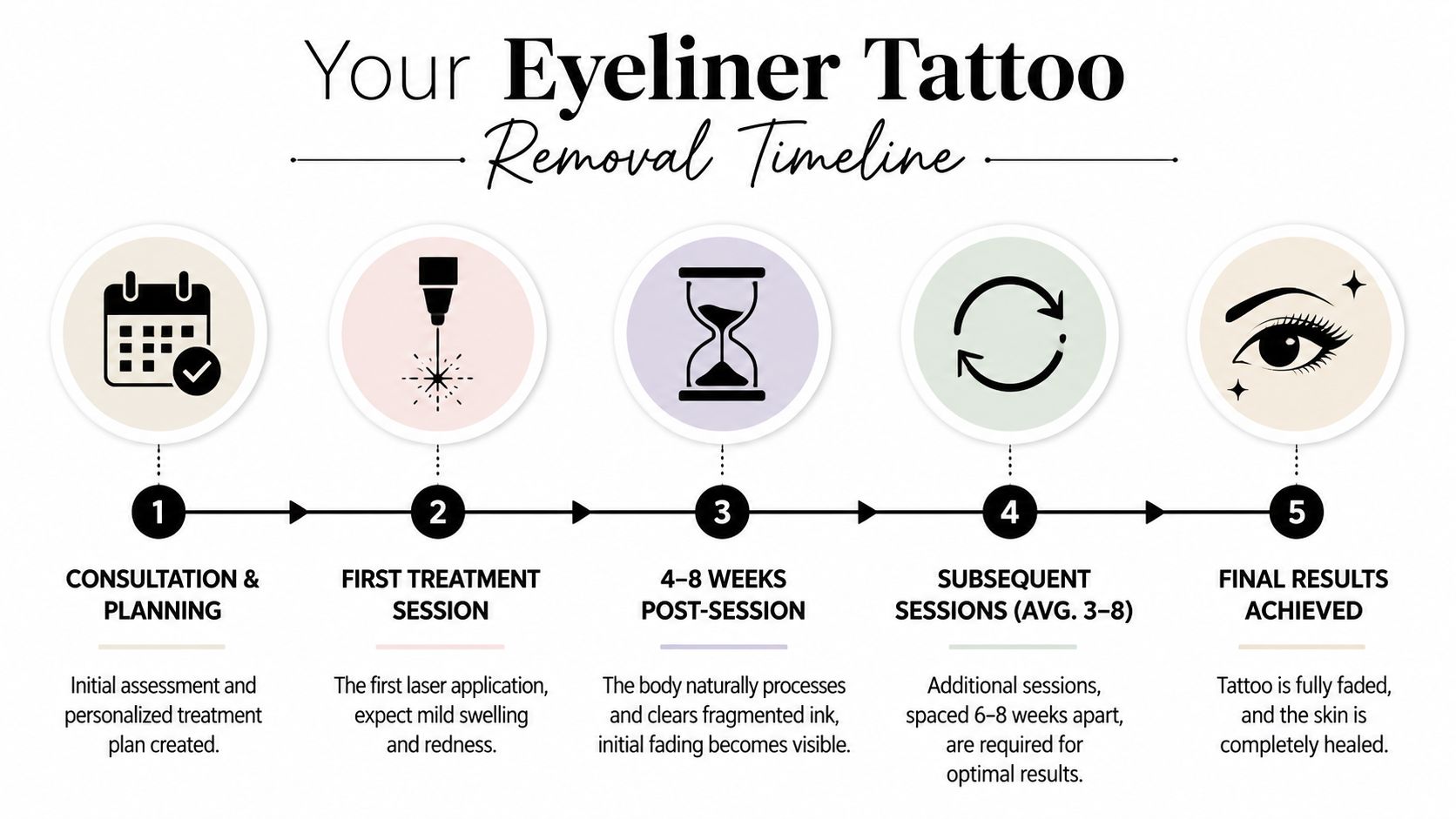
Most clients need a series of treatments rather than a single appointment. The exact timeline depends on pigment density, ink chemistry, depth of placement, your skin response, and whether the goal is full removal or controlled lightening for correction. Eyeliner placed right along the lash line often needs a more cautious schedule than body tattoos because the treatment zone is smaller, more delicate, and less forgiving if the skin is still irritated.
What the clinical timeline really looks like
A typical sequence looks like this:
- Consultation and assessment: The pigment is checked for color, saturation, shape, migration, and exact distance from the eye surface. This is also where a specialist decides whether the tattoo is suitable for laser treatment.
- First treatment: The first session tests how the pigment responds and how the eyelid handles treatment. Swelling, redness, and a heavier feeling in the lid are common early reactions.
- Healing interval: The visible irritation settles first. Deeper recovery takes longer, which is why repeat sessions are spaced out instead of booked too close together.
- Reassessment before each session: Progress is reviewed each time, not assumed. If the lid is still irritated or the pigment response suggests a change in plan, the schedule should be adjusted.
- Later sessions for refinement: Stubborn sections, retained color, or uneven clearing are addressed gradually.
- End point: Some clients reach full clearance. Others stop once the remaining pigment is light enough for a safer correction.
In a clinical review published in the Journal of Clinical and Aesthetic Dermatology, 76 patients treated for eyeliner and eyebrow tattoo removal needed different numbers of picosecond laser sessions depending on pigment density and depth. The same review also reported that hidden colors sometimes appeared after early treatments, but those colors still responded to the appropriate wavelengths without adverse events such as scarring, necrosis, or burns when proper protection protocols were used, as described in the JCAD review of laser removal for eyeliner tattoos.
That point matters in practice. The timeline is shaped by what shows up after treatment, not just by what the tattoo looked like on day one.
Why progress can change mid-course
A line that looks black, charcoal, or dark brown may contain other pigments underneath. Once the darker particles break apart, red, orange, yellow, green, or blue tones can become more visible. Clients often worry at this stage, but color shift during removal usually reflects the original ink blend rather than a treatment mistake.
The FDA also notes that tattoo removal results vary by ink color, tattoo age, and ink depth, and that some colors are harder to remove than others. Green, red, and yellow shades are often more resistant than black pigment, which helps explain why one eyeliner tattoo may clear quickly while another turns into a longer project, as outlined in the FDA guidance on tattoo removal options and results.
The practical takeaway is simple. Expect a staged process, with reassessment at every visit, especially in the eye area where conservative timing protects both the skin and the structures underneath.
If you want a better sense of the budget that goes with a multi-session plan, this guide to permanent makeup removal cost factors explains what usually changes the total investment.
Understanding the Costs of Eyeliner Removal
The cost of eyeliner tattoo removal can't be reduced to one honest flat number because the work itself isn't one-size-fits-all. Two clients may both have “black eyeliner,” but one has a soft faded lash enhancement while the other has a dense, heavily packed line with color shift or migration. Those are different treatment plans.
That's why good clinics talk about value in terms of safety, device quality, time, and provider skill, not just a per-session bargain.
What actually drives the price
Several factors shape the total investment:
- Pigment density: Heavier saturation usually means more work over time.
- Ink chemistry: Some cosmetic inks fragment and clear more predictably than others.
- Depth of placement: Deeper pigment generally extends the process.
- Goal of treatment: Full removal usually costs more than partial fading for correction.
- Eye-area expertise: The protocol for eyelid work is more specialized than standard body tattoo treatment.
The broader market helps explain why more clinics are adding cosmetic tattoo correction services. The global tattoo removal market was valued at USD 1.29 billion in 2025 and is projected to reach USD 4.87 billion by 2034, with North America leading the market, according to Fortune Business Insights' tattoo removal market report. That growth signals stronger demand, but it also means patients need to be selective. More availability doesn't automatically mean more expertise.
For a closer look at the variables that shape pricing, this guide to permanent makeup removal cost is useful.
Why the cheapest option often costs more later
Low pricing can hide an underlying risk. If a clinic lacks proper eye-area protocols, uses outdated equipment, or pushes treatment before tissue has healed, the short-term savings may disappear quickly.
A careful plan may not be the cheapest line item on day one. It's often the least expensive path to a safe outcome. On the eyelid, that trade-off matters more than almost anywhere else in tattoo removal.
How to Choose Your Specialist and Book a Consultation
Choosing a provider for eyeliner tattoo removal should feel closer to choosing a medical specialist than booking a routine beauty service. The equipment matters, but the decision should rest on how the clinic handles risk, evaluates pigment, and explains the process before anyone comes near your eyelid with a laser.
The consultation should answer your questions in plain language. It should also surface issues you didn't know to ask about, especially eye shields, lash-line anatomy, pigment behavior, and healing expectations.

A practical consultation checklist
Look for these signs of a strong clinic:
- Eye-area experience: Ask specifically about permanent eyeliner and lash-line tattoos, not just tattoo removal in general.
- Modern picosecond technology: Device capability matters in cosmetic pigment work.
- Safety protocol clarity: The clinic should explain how the eye is protected during treatment.
- Realistic expectations: Be cautious if someone promises instant clearance.
- Structured aftercare: Good providers explain what to do before problems start.
A serious consultation also includes a discussion of whether your goal is full removal or fading for revision. Those are not the same plan, and the difference affects settings, pacing, and endpoint.
What a good clinic should discuss before treatment
The conversation should cover pigment color, depth, prior touch-ups, history of migration, and whether the eyeliner contains mixed tones that may reveal themselves later. It should also cover the possibility of transient lash changes, swelling, and short-term cosmetic inconvenience.
If you're looking in Florida, EradiTatt uses the PiQo4 laser and offers consultations across Orlando, Bradenton/Sarasota, St. Petersburg, Palm Harbor, and Tampa. Those details matter because convenience helps people stay consistent with spaced treatment plans, and consistency supports better decision-making over time.
A good consultation should leave you informed, not pressured. If you leave knowing exactly how the clinic protects your eye and what the healing curve looks like, that's a strong sign.
Booking should be straightforward. Call the clinic, ask whether they routinely treat eyeliner tattoos, confirm the laser platform they use, and request a consultation focused on eye safety and pigment assessment before discussing scheduling.
Frequently Asked Questions About Eyeliner Removal
A common consultation starts the same way. Someone sits down, points to the lash line, and asks a very reasonable question: “Can this be removed without harming my eye?” That is the right place to start, because eyeliner removal is not handled like tattoo removal on the arm or ankle.
Will I lose my eyelashes
Temporary lash shedding can happen, but it is usually limited and grows back. The risk is tied to heat near the follicle, treatment settings, and whether the eye is protected properly during the session.
This is why I focus so heavily on technique around the lash margin. The goal is to affect pigment while limiting unnecessary heat to nearby structures. Short-term swelling is more common than any meaningful lash change, and clients should expect that the eye area can look puffy for a few days.
Can migrated eyeliner be treated
Often, yes. Migrated pigment can respond well, but the plan depends on how close the blur sits to the lashes, whether the color has spread unevenly, and whether there are multiple pigment tones hiding in the area.
Migration also changes the cosmetic endpoint. In this part of the face, the job is not just to fade ink. It is to improve a very visible border without creating a harsh line, patchy clearance, or avoidable irritation.
How long should I wait after getting eyeliner tattooed
Do not rush to treat a fresh eyeliner tattoo. Early pigment can still settle, soften, or shift in tone, and the skin needs time to recover before it is exposed to laser energy.
A physician on RealSelf notes that waiting before laser treatment is often advised for cosmetic eyeliner tattoos, especially when the pigment is new and the final color has not fully declared itself, as discussed in this laser tattoo removal timing for eyeliner tattoo discussion. In practice, I want the tissue calm, the pigment stable, and the treatment goal clear before the first session is scheduled.
Can black eyeliner be fully removed
Black eyeliner often responds better than lighter or mixed shades, but full clearance is never something I promise on day one. Depth, ink composition, prior touch-ups, and hidden undertones all affect the result.
Some clients reach a point where the remaining pigment is faint enough that they stop treatment and move to correction work instead of chasing complete removal. That decision is often the right one. If you are comparing providers for any appearance-sensitive procedure, these tips for selecting a plastic surgeon are useful because the same screening habits apply here: check experience, ask how complications are handled, and do not choose a clinic on price alone.
If you're ready to discuss safe, realistic options for eyeliner tattoo removal, EradiTatt Tattoo Removal can help you schedule a consultation and review a treatment plan based on your pigment, skin, and goals. With locations in Orlando, Bradenton/Sarasota, St. Petersburg, Palm Harbor, and Tampa, their team can guide you through whether you're aiming for complete removal or gradual fading for a future correction.