That old tattoo usually starts bothering you in ordinary moments. You catch it in the mirror while getting dressed for work, or you see an old name, symbol, or trend-piece that no longer fits who you are now. The good news is that unwanted ink doesn't always need full removal before you move on.
A strong cover-up can turn a mistake, memory, or outdated design into something that feels intentional again. But cover-ups only work when the design matches the reality of the old tattoo underneath. Ink density, color, placement, scar tissue, and available skin all matter. Lighter colors won't hide darker ink, and small redesigns often fail because they don't give the artist enough room to break up the original shape.
That's why the smartest tattoo cover up ideas start with honest planning. Some tattoos can go straight into a new design. Others need fading first. A practical rule many artists use is that the new piece should be larger, often much larger, than the old one to heal cleanly and read as a new tattoo rather than a patch job. This guide walks through 10 cover-up directions that work well in practice, plus where laser fading with EradiTatt can open up better options before fresh ink goes in.
Table of Contents
- 1. Floral and Botanical Cover-Ups
- 2. Geometric and Abstract Pattern Cover-Ups
- 3. Animal and Wildlife Cover-Ups
- 4. Blackwork and Solid Black Cover-Ups
- 5. Nature-Inspired Landscape and Scenery Cover-Ups
- 6. Mandala and Spiritual Symbol Cover-Ups
- 7. Portrait and Face-Based Cover-Ups
- 8. Japanese and Asian-Inspired Cover-Ups
- 9. Color Gradient and Watercolor Wash Cover-Ups
- 10. Placement Repositioning and Size-Adjusted Cover-Ups
- Top 10 Tattoo Cover-Up Styles Comparison
- Your Path to a Perfect Cover-Up
1. Floral and Botanical Cover-Ups
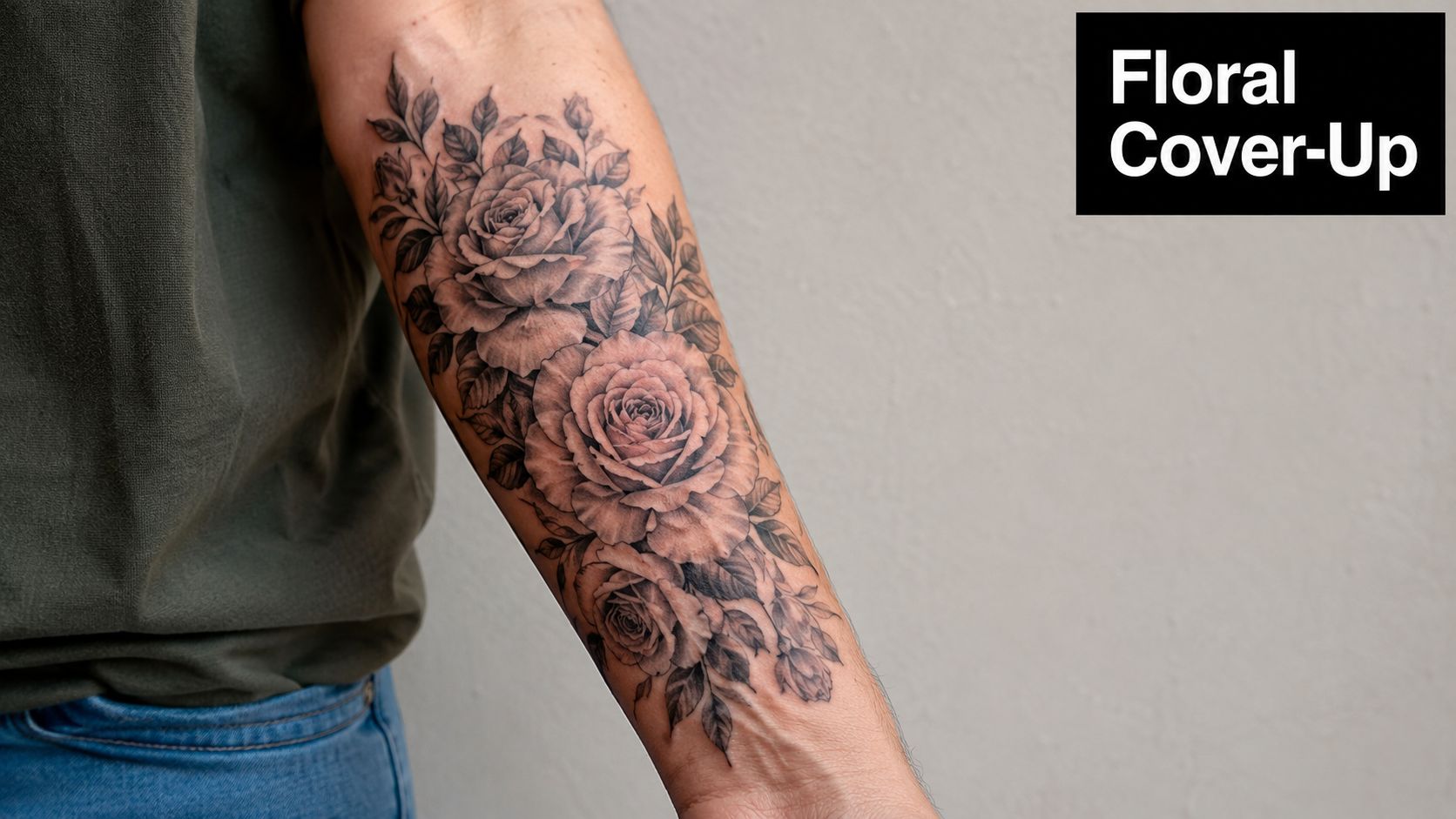
Flowers are one of the most reliable tattoo cover up ideas because they give an artist natural tools to hide old ink. Petals overlap. Leaves taper. Stems create direction. Dense centers and shadowed folds can land exactly where the darkest parts of the original tattoo sit.
They're especially useful for names, script, old wrist tattoos, ankle tattoos, and narrow forearm pieces. A rose cluster can break up readable lettering. Orchids can stretch awkward vertical tattoos into something softer. Wildflowers work well when you need movement instead of one heavy block of coverage.
Why flowers work so well
The best floral cover-ups don't stay delicate everywhere. They mix soft edges with dark cores, heavy leaves, and enough texture to keep the eye moving. Designs with open petals only look pretty on paper. On skin, they often leave the old tattoo peeking through once healed.
Practical rule: Floral cover-ups work best when at least part of the bouquet has deep shadow and layered foliage.
A realistic example is an old ex-partner name on the inner forearm. Instead of placing one bloom directly over the script, a better fix is often a small bouquet that extends above and below the original line so the cover-up reads as a balanced composition.
If your old tattoo is very dark, ask both the tattoo artist and an experienced cover-up tattoo artist resource from EradiTatt whether a little fading would help first. That extra preparation can make the difference between a rich botanical piece and a flower that has to be packed too dark to stay clean over time.
2. Geometric and Abstract Pattern Cover-Ups
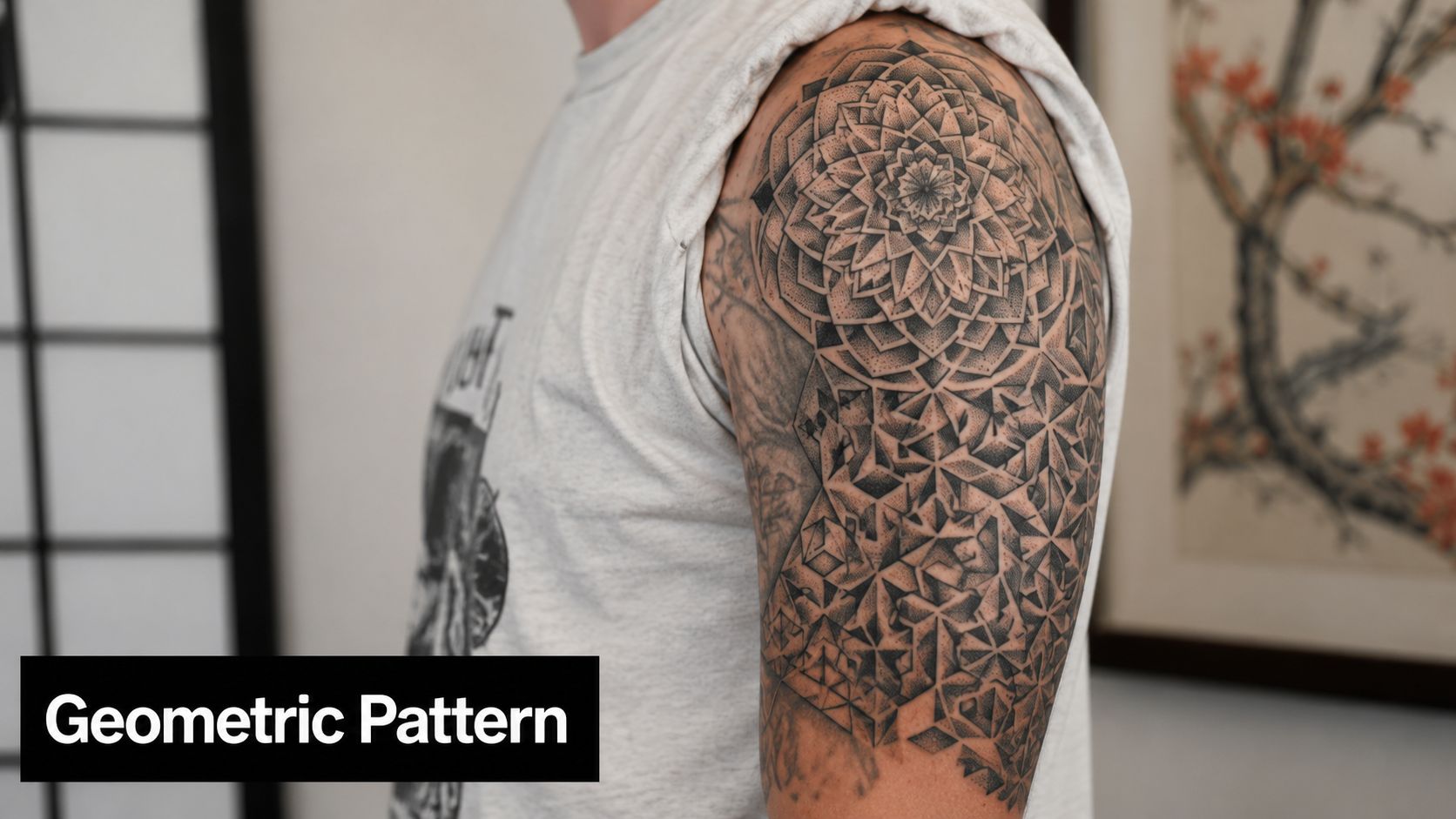
Geometric cover-ups succeed when the old tattoo is messy but the new design needs control. Sharp line groups, repeating shapes, dotwork, and layered patterning redirect attention fast. Your eye follows the pattern instead of trying to read the original design underneath.
This style works well on shoulders, chests, outer arms, and calves where there's enough room to build repeat structure. Mandala-based geometry can cover a faded symbol in the center. Tessellated shapes can swallow uneven old shading. Abstract patterning also helps when the original tattoo doesn't have one neat outline.
Where structure helps most
The catch is that geometry exposes bad planning. If the artist misjudges spacing or places light areas over strong old pigment, the failure is obvious. Digital planning matters here. Tools like Procreate let artists place the proposed design over a photo of the original tattoo, adjust opacity, and check whether every problem area disappears, as shown in this cover-up planning demonstration using Procreate.
A realistic scenario is an old tribal fragment on the shoulder. Clean radial geometry can work, but only if the darkest bands sit over the boldest old lines. Thin ornamental pattern alone usually won't do enough.
- Ask for overlays: Request a mockup on a photo of your actual tattoo, not a sketch on blank paper.
- Check line weight: Thin lines look elegant, but heavier anchors often need to carry the cover-up.
- Consider fading first: If the original is dense, preparing for a tattoo cover-up with fading support from EradiTatt can create more freedom in the final pattern.
3. Animal and Wildlife Cover-Ups
Animals give cover-up artists something extremely valuable: texture. Fur, feathers, scales, wings, and shadowed anatomy create natural places to bury old lines and patchy saturation. That makes wildlife designs a strong option for upper arms, shoulders, calves, and larger side-body pieces.
An eagle can absorb an old shoulder tattoo because the wing structure creates broad dark sections and directional flow. A wolf head can hide a dense calf tattoo if the muzzle, ears, and mane are positioned around the original shape instead of just over it. A phoenix works well when you need upward motion and dramatic shadow.
Best subjects for heavy old ink
Not every animal is equally useful. Subjects with texture and heavy lighting effects tend to perform best. Cover-up artists often lean toward flowers, organic forms, Japanese imagery, skulls, underwater scenes, and biomechanical styles for the same reason, and cover-up design guidance on effective subject matter points to high texture and deep shadows as major advantages.
Dense old ink needs a subject that naturally allows darkness. You never want to force darkness into a design that should stay open and light.
A realistic example is an old, uneven forearm piece that can't be disguised with fine line work. A lioness portrait with deep mane shadow may solve the coverage problem. A delicate butterfly probably won't.
Choose an animal you'll still want years from now. Symbolism matters, but practicality matters more in a cover-up.
4. Blackwork and Solid Black Cover-Ups
Blackwork is the blunt instrument of cover-ups. When an old tattoo is heavily saturated, poorly placed, or already layered, solid black can be the cleanest visual reset. Bands, blocks, abstract blackout shapes, and negative-space patterns can turn visual clutter into something deliberate.
This isn't a style to choose casually. Once you commit to large areas of black saturation, future options narrow fast. Covering a wrist tattoo with a black band is one thing. Converting a forearm or leg into broad blackout work is a long-term design decision.
When blackout is the right call
Black covers because dark pigment can overpower lighter visual information underneath. Lighter colors can't do the same in reverse. Tattoo pigments sit at the same depth in the skin, which is why darker pigments are required over darker existing ink, as explained in this technical overview of why dark pigment covers better.
The biggest mistake is treating blackout like a shortcut. It still has to be designed. Negative space must be intentional. Edges have to suit the body. Saturation has to heal evenly.
- Commit to the aesthetic: Blackwork should look like a chosen style, not a panic response.
- Use shape well: Strong curves and negative space can keep blackout from feeling heavy and flat.
- Think ahead: If you may want more change later, ask whether fading first opens a less extreme path.
Blackwork can solve hard problems. It can also create a bigger one if it's used just because the first idea failed.
5. Nature-Inspired Landscape and Scenery Cover-Ups
Scenic cover-ups work by spreading attention across distance, texture, and atmosphere. Mountains, forests, waves, clouds, and sunset bands give the artist multiple depth planes. That makes it easier to hide an old tattoo inside a larger scene instead of trying to erase it with one object.
This approach suits upper backs, outer arms, thighs, and chests where the body gives enough width for a real composition. A mountain ridge can absorb an old band of script. A forest line can bury broken lettering. Ocean movement can hide uneven old shading that would look obvious in a flatter design.
Using depth to hide old shapes
A key advantage is layering. Foreground trees can be darker. Mid-ground forms can carry texture. Sky or water can soften transitions. That variation is useful when the original tattoo has both dark and light zones that need different treatment.
A realistic example is an old chest tattoo with a symbol in the center and faded rays around it. Instead of fighting the placement, a horizon scene can use the center as the darkest focal area and build outward into lighter surroundings.
Artist's note: Scenery works best when the old tattoo becomes part of the value map, not when the new scene ignores it.
This style needs patience. If the original tattoo is strong, a multi-session approach may produce a better healed result than trying to fully saturate everything in one pass. It also helps to preview the whole composition, because scenery fails when the darkest coverage zones look random rather than natural.
6. Mandala and Spiritual Symbol Cover-Ups
Mandala cover-ups are strongest when the old tattoo sits in a central or rounded area. Shoulders, upper arms, knees, sternum placements, and upper back spots often suit this style because symmetry can anchor the design and make the cover-up feel intentional from a distance.
The appeal is obvious. Repetition, dotwork, ornamental petals, and radial shading let an artist distribute dark values evenly. Instead of one suspicious dark patch, the viewer sees rhythm and structure. That's useful when the original tattoo is compact but visually loud.
Symmetry can solve awkward placement
Mandala work still has limits. If the old tattoo sits off-center or stretches too far in one direction, forcing a symmetrical design over it can make the final piece look crooked on the body. In those cases, the answer may be a mandala with supporting ornamental elements rather than a perfect circle.
Research the meaning behind spiritual symbols before committing. A design that feels grounding now should still feel aligned later. If you're working around a very dark old tattoo, it also helps to understand what removal can and can't do before choosing the final style. EradiTatt explains that well in this overview of how permanent tattoos are and whether they can be removed.
One practical example is a small but dense shoulder symbol. A centered mandala can work beautifully there. The same idea on a long forearm script usually needs major adaptation or a different concept altogether.
7. Portrait and Face-Based Cover-Ups
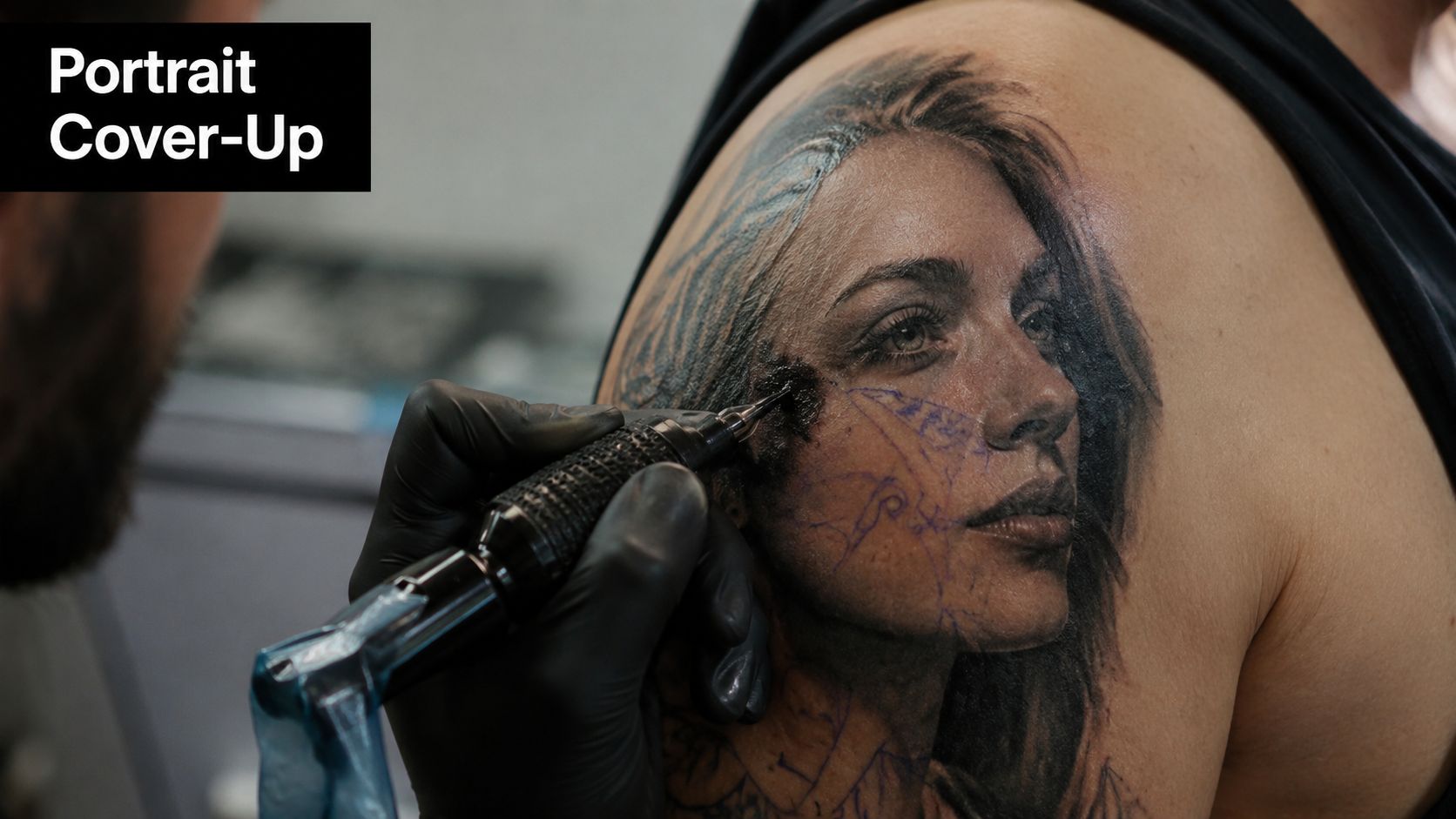
Portrait cover-ups are some of the most demanding and most rewarding options. A strong face draws attention immediately. If done well, it replaces the old tattoo completely in the viewer's mind. If done poorly, every flaw is obvious.
This style fits larger arms, shoulders, thighs, and torso placements where the artist has enough room for facial structure, shadow transitions, and background support. A portrait almost always needs surrounding elements to carry the cover-up. Hair, fabric, smoke, floral forms, or dark backdrop textures often do as much concealment work as the face itself.
Portraits need a cleaner canvas
Portraits need value control. Light skin tones in the face, catchlights in the eyes, and subtle midtones can't sit on top of a very dark old tattoo and still look believable. That's why fading-first thinking matters so much here. Industry discussions around cover-ups note that a significant share of consultations are better approached with fading before redesign, especially when the existing tattoo is dark or multi-colored, as discussed in this cover-up planning article focused on fading-first decisions.
A realistic scenario is an old chest piece with heavy black script. Turning that directly into a realistic face often forces the artist to over-darken the lower half, which can flatten the portrait. Fading first can open cleaner options.
- Choose the right artist: Portrait skill doesn't automatically mean cover-up skill.
- Request healed examples: Fresh portraits can look stronger than healed ones.
- Use background wisely: Smoke, drapery, or ornamental framing often makes the portrait possible.
8. Japanese and Asian-Inspired Cover-Ups
Japanese-inspired cover-ups have a built-in advantage. They flow. Dragons curve around existing shapes. Koi move with the arm or leg. Wind bars, waves, clouds, blossoms, and background shading help connect awkward old tattoo fragments into one larger piece.
This style works especially well when the original tattoo has irregular edges or broken placement. A dragon back piece can consume scattered shoulder ink. A koi can turn a clumsy calf tattoo into a design with direction. Cherry blossoms and wind can bridge empty spaces that would otherwise make the cover-up look patched together.
Flow matters more than subject alone
Cultural respect matters here. Don't choose a motif just because it covers well. Choose it because you understand the imagery and want to live with it. Traditional references, composition, and body flow all matter more in this style than many people realize.
There's also a practical ink issue. Cover-ups rely on darker pigments such as blues, browns, and blacks because they conceal preexisting ink more effectively, while reds, yellows, and oranges often can't fully obscure dark tattoos. The broader tattoo market is also growing, reaching a valuation of USD 2.43 billion in 2025 and projected to reach USD 5.99 billion by 2034, according to tattoo market projections and cover-up pigment guidance from Fortune Business Insights.
Traditional Japanese-inspired work often succeeds because the background and movement do as much work as the main subject.
9. Color Gradient and Watercolor Wash Cover-Ups
Watercolor-inspired cover-ups attract people who want something softer and less obviously heavy. The trouble is that soft doesn't automatically mean effective. Washes, gradients, and painterly edges can look beautiful, but they aren't good at hiding strong old ink on their own.
This style performs best when the original tattoo is already light, partially faded, or strategically reduced before the new work starts. Otherwise the artist usually has to sneak in much darker anchors than the client expected, and the final piece stops looking airy.
Why fading first matters here
Laser-assisted planning matters more here than in almost any other style. Existing cover-up guidance notes that attempts without prior fading often end in muddy, overly dark results, and that a small series of fading sessions can create cleaner linework and more room for lighter value areas. It also notes the need for healing time after the final laser appointment before fresh tattooing begins in this discussion of laser-assisted cover-up timing and outcomes.
A realistic example is a dark old shoulder tattoo that someone wants turned into a watercolor splash with birds or florals. Without fading, the center often has to be packed with so much darkness that the watercolor effect only survives at the edges.
- Use watercolor as support: Let stronger forms do the hiding, then use washes to soften transitions.
- Be realistic about longevity: Very light passages may need maintenance.
- Leave time between steps: Skin needs to settle before tattooing over laser-faded areas.
10. Placement Repositioning and Size-Adjusted Cover-Ups
Sometimes the best cover-up idea isn't a style. It's a change in scale and placement logic. If the old tattoo is cramped, off-center, or stuck in a bad spot, expanding the design across more of the body often fixes the underlying problem.
That might mean turning a forearm tattoo into a half-sleeve, extending a shoulder piece onto the upper chest, or widening a thigh tattoo into a full outer-leg composition. Done well, the old tattoo stops being the center of attention because it becomes one hidden part of a broader design.
Bigger is often the fix
This isn't just artistic preference. Cover-ups need room. For a cover-up to be imperceptible after healing, the new design generally needs to be 2 to 3 times the size of the original tattoo, according to cover-up sizing guidance from Tattooing 101.
The removal side matters too. Layered tattoos are harder to remove than single-layer tattoos and can require up to 75% more treatment sessions. Benchmarks for full removal of layered tattoos often run around 10 to 14 laser sessions spaced 6 to 8 weeks apart, compared with 8 to 10 for non-layered tattoos, based on laser removal factors for layered and cover-up tattoos.
If you're already unhappy with one tattoo, don't let a rushed second tattoo create a larger removal problem later. Expanding thoughtfully is smarter than stacking ink reactively.
Top 10 Tattoo Cover-Up Styles Comparison
| Style | 🔄 Implementation Complexity | ⚡ Resources & Time | ⭐ Expected Outcome | 📊 Ideal Use Cases | 💡 Key Advantage / Tip |
|---|---|---|---|---|---|
| Floral and Botanical Cover-Ups | Moderate, requires cover-up skill and composition | Moderate, 1–3 sessions; may need 1–2 light fading sessions | High ⭐, natural-looking, adaptable concealment | Versatile: small accents to full-coverage, organic aesthetics | Choose flowers with personal meaning; consult EradiTatt about light fading |
| Geometric and Abstract Pattern Cover-Ups | High, precision and consistent line work needed | Moderate, skilled precision artist; often fewer fading sessions | High ⭐, excellent for large or dark tattoos; clean modern finish | Large/dark tattoos, mandala/mandala‑like placements, contemporary styles | Request detailed mockups and discuss line weight/spacing |
| Animal and Wildlife Cover-Ups | High, anatomy and texture expertise required | High, multiple long sessions with realism specialists; fading often helpful | High ⭐, dense, detailed coverage with storytelling impact | Large/problematic areas needing detailed concealment and symbolism | Select artists with proven wildlife portfolios; consider fading for dark ink |
| Blackwork and Solid Black Cover-Ups | Low–Moderate, technical saturation but simpler compositionally | Moderate, can be single or few sessions; minimal fading required | Very High ⭐, most reliable opacity; irreversible visual effect | Extremely dark or large tattoos; clients who want bold, graphic look | Commit fully before proceeding; choose artist skilled in even saturation |
| Nature-Inspired Landscape and Scenery Cover-Ups | Very High, requires mastery of perspective, layering, color | High, multiple sessions (2–4+); expert colorists; pre-fading recommended | High ⭐, cohesive, immersive final pieces; excellent concealment when done well | Full-back, chest, or large-area projects; clients wanting meaningful locations | Request color mockups and plan multiple sessions; use EradiTatt fading for cleaner color |
| Mandala and Spiritual Symbol Cover-Ups | High, precise radial symmetry and centering required | Moderate–High, detail-oriented sessions; may require multiple appointments | High ⭐, visually striking, naturally conceals centered tattoos | Circular/central placements (shoulder, chest, upper back); spiritual designs | Ensure perfect centering; ask for symmetry previews and artist precision examples |
| Portrait and Face-Based Cover-Ups | Very High, elite portrait skill; errors highly visible | Very High, 2–4+ detailed sessions; pre-fading strongly recommended | Very High ⭐, powerful personal statements if executed well; risky if poor likeness | Large areas where photorealism is desired; clients seeking emotional connection | Select portrait specialists, request sketches/mockups, expect multiple sessions |
| Japanese and Asian-Inspired Cover-Ups | High, authentic style knowledge and flowing composition needed | High, multiple sessions; artist trained in traditional motifs preferred | High ⭐, rich symbolism with natural flow around irregular shapes | Back, sleeves, and flowing compositions; clients seeking cultural motifs | Research symbolism and artists' irezumi experience; approach respectfully |
| Color Gradient and Watercolor Wash Cover-Ups | High, requires color theory and paint-like technique | High, 2–3+ sessions; artists with fine‑art/watercolor experience; fading beneficial | Medium–High ⭐, artistic, soft blending; may require touch-ups over time | Contemporary, painterly concealment for medium-sized tattoos | Discuss color longevity, request mockups, and plan for future touch-ups |
| Placement Repositioning & Size-Adjusted Cover-Ups | Very High, large-scale composition and anatomical flow required | Very High, multi-session expansion projects over months; fading can help | High ⭐, transforms awkward placements into cohesive large works | Clients willing to expand coverage to integrate or relocate original ink | Share full‑body vision with artist; document colors between sessions and plan timeline |
Your Path to a Perfect Cover-Up
The best tattoo cover up ideas don't start with a Pinterest screenshot. They start with an honest read of the tattoo you already have. Size, saturation, color, placement, and skin condition decide what's possible. Once that's clear, design choices become much easier.
That matters because tattoo regret is common. About 26% of tattooed adults in the United States report regret for at least one tattoo, and among that group, 42.5% pursue removal or fading specifically to prepare for a cover-up or complete removal, according to this study on tattoo regret and removal motivations. In practice, that means a lot of people aren't choosing between removal and a cover-up. They're combining both.
A few fading sessions can dramatically improve the final tattoo when the old piece is dark, colorful, or visually crowded. It can open lighter styles, cleaner linework, better skin tone transitions, and more balanced compositions. It also reduces the risk of forcing your artist into an overly dark solution just to make the old tattoo disappear.
The main trade-off is time. Fading adds appointments and healing. But rushing a direct cover-up on the wrong tattoo often creates a larger, darker, more restrictive piece that's harder to live with and harder to remove later. If your goal is long-term control over how the final tattoo heals and looks, preparation is worth it.
EradiTatt Tattoo Removal can be part of that preparation. For adults planning a cover-up, especially professionals, job seekers, or anyone getting ready for a major life event, fading-first treatment can create a better canvas before the artist starts redesigning the area. That doesn't mean every tattoo needs laser work. Some can go straight into a new design. But when fading is needed, it's better to know that at the beginning rather than after a failed cover-up attempt.
If you're ready for a fresh start, bring both ideas to the consultation. Show the current tattoo. Show the style you want next. Ask whether the design can work now, or whether fading first would give you a cleaner result. That's how the strongest cover-ups happen.
If you're weighing tattoo cover-up ideas and want to know whether fading first would improve the result, contact EradiTatt Tattoo Removal. The team provides tattoo removal and cover-up preparation for clients across Florida, with personalized treatment plans based on your existing ink, skin, and end goal.