
If you're staring at a green tattoo and wondering whether it can be removed, you're asking the right question. A lot of people have already heard the short version: green ink is hard. That's true, but it's incomplete.
The better answer is this: green ink is hard to remove when the laser doesn't match the pigment well. When the technology and wavelength are right, green tattoos become much more manageable. The U.S. FDA notes that green, red, and yellow are among the most difficult colors to remove, and that the laser wavelength has to correspond to the ink color for effective breakup and immune clearance, as explained in the FDA's overview of tattoo removal options and results.
That scientific detail matters more than most clients realize. If you understand why green resists treatment, you'll also understand why one clinic may be equipped to treat it well and another may only partially fade it. If you're new to the process, this first-timer breakdown of how tattoo removal works is a helpful place to get the basics before focusing on color-specific treatment.
Table of Contents
- Starting Your Green Tattoo Removal Journey
- Why Green Tattoo Ink Resists Removal
- Choosing the Right Laser Technology for Green Tattoos
- What to Expect During Your Treatment Process
- How to Prepare for Sessions and Ensure Proper Healing
- Choosing Your Tattoo Removal Expert in Florida
Starting Your Green Tattoo Removal Journey
Green tattoo removal usually starts with frustration. You may have already looked at your tattoo and thought, “It's only one color, so why is everyone making this sound complicated?” Or maybe you've heard stories about green fading slowly, stalling halfway, or needing a different laser than black ink.
All of that comes back to one issue. Laser tattoo removal green ink requires precise wavelength matching.
A black tattoo absorbs a broad range of light, which makes it comparatively straightforward to treat. Green pigment is pickier. If the wavelength isn't a strong match, the laser can hit the skin without breaking up the pigment efficiently. That's why two providers can give very different answers about the same tattoo.
What most clients need to know first
The first thing to understand is that “difficult” doesn't mean “impossible.” It means the treatment has to be designed correctly.
A proper consultation for green ink should answer a few practical questions:
- Which shade of green is in the tattoo: Dark forest green, blue-green, and lighter mint tones can respond differently.
- Which wavelengths are available in the clinic: Equipment matters more with green than it does with simple black linework.
- Is the goal full removal or fade for a cover-up: Those are different plans, with different stopping points.
Consultation mindset: Don't ask only, “Can you remove green ink?” Ask, “Which wavelength will you use for my shade of green, and why?”
Why a science-first approach helps
Clients usually feel better once they understand that removal isn't guesswork. The laser isn't “scrubbing” ink out of the skin. It's delivering energy that the pigment has to absorb well enough to fragment into smaller particles. Then your body clears those particles over time.
That's why expectations matter. Green often needs a more selective approach, more patience, and a clinic that can adapt when one setting isn't enough. But when the equipment matches the pigment, the process becomes far more predictable.
Why Green Tattoo Ink Resists Removal
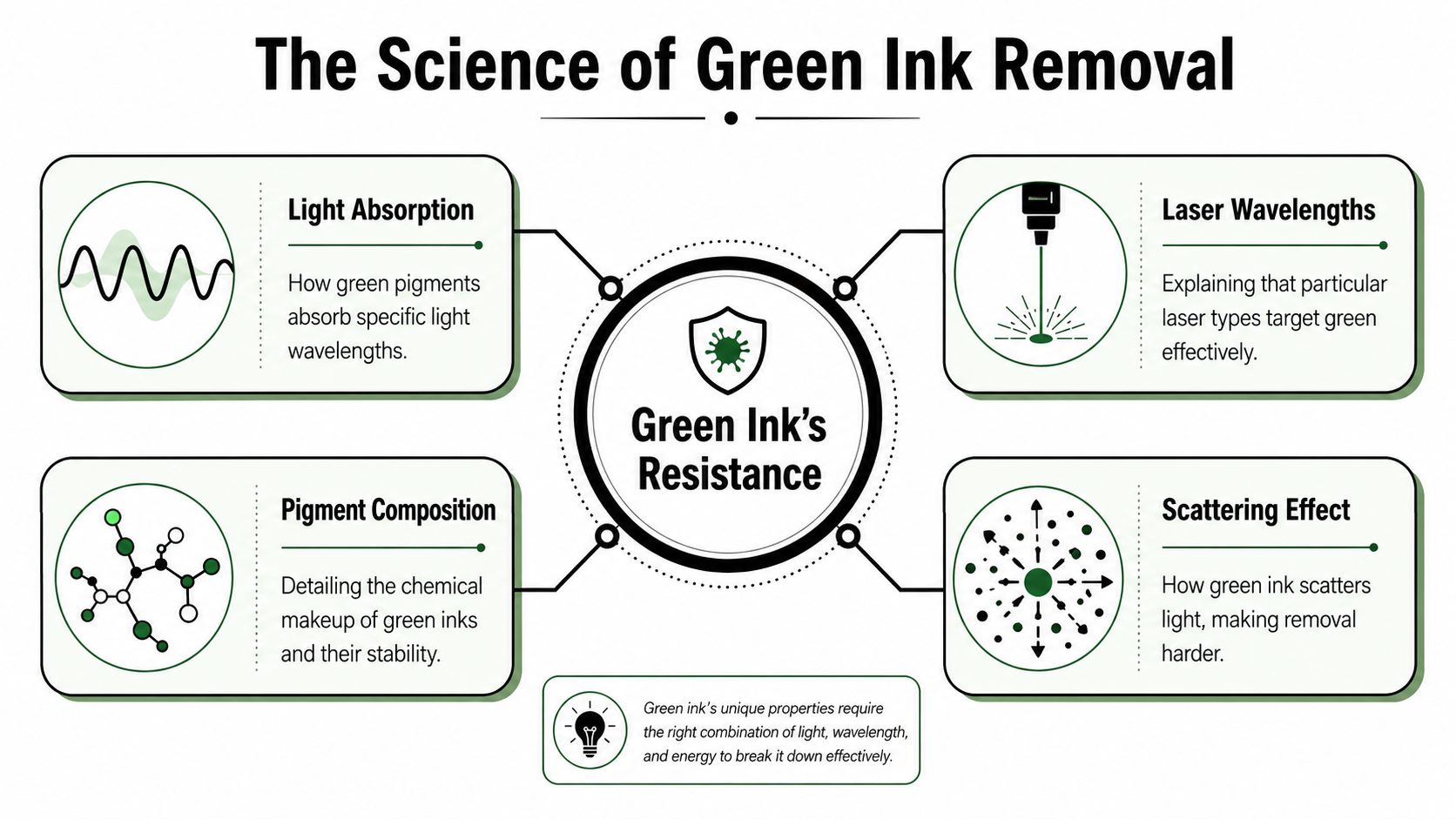
Green ink doesn't resist removal because it's stronger in some vague sense. It resists removal because light and pigment have to interact correctly, and green doesn't respond well to every tattoo laser.
The easiest way to think about it is a lock and key. The tattoo pigment is the lock. The laser wavelength is the key. If the key doesn't fit well, the laser still fires, but the pigment won't absorb the energy efficiently enough to break apart the way you want.
It's a wavelength problem, not a willpower problem
Green pigments have long been treated as a challenge because they need more specific wavelength targeting than black ink. Clinical references consistently point to 755 nm alexandrite and 694 nm ruby as key options for green pigments, and green often needs more sessions than a simple black tattoo because of those wavelength requirements, as noted in StatPearls on laser tattoo removal.
That's the part many articles skip. They say green is stubborn, but they don't explain why. The actual reason is simple: the wrong wavelength can underperform even when the operator is experienced.
Why standard treatment can stall on green
Clients sometimes receive mixed messages. A clinic may have a strong system for dark black tattoos and still struggle with green if it can't deliver the right wavelength for that pigment.
A few practical issues tend to make green harder:
- Selective absorption: Green pigment won't absorb every common tattoo-removal wavelength well.
- Ink variation: “Green” isn't one formula. Different manufacturers and shades can behave differently in skin.
- Full-color tattoos complicate treatment: If the tattoo includes black, green, blue, or purple in the same area, one wavelength may help one pigment while barely touching another.
Green ink is hard to remove, but the obstacle isn't mystery. It's wavelength compatibility.
That's why a one-size-fits-all approach often disappoints people with color tattoos. When a clinic treats every tattoo as if it were black script, green is one of the first colors to expose that limitation.
Choosing the Right Laser Technology for Green Tattoos
A client sits down after two or three disappointing treatments elsewhere and says, “They told me they had a strong laser. Why is the green still there?” In most cases, the problem is not effort. It is a mismatch between the ink's light absorption and the technology being used.
That is the decision point with green tattoos. The provider has to choose the right wavelength for the pigment, then pair it with a pulse duration that can break that pigment into particles your body can clear.
Nanosecond and picosecond pulses do not perform the same way
Older Q-switched systems fire in nanoseconds. Picosecond systems fire in shorter pulses, which changes how energy is delivered into the tattoo particle.
For green ink, that difference matters because removal is not just about putting heat into the skin. The laser has to hit a pigment that already resists many common wavelengths, then fragment it efficiently enough to produce visible fading without creating more heat than necessary in surrounding tissue. In practice, picosecond platforms are often chosen for resistant color because they can produce a stronger photoacoustic effect, especially when the wavelength is well matched to the ink.
That does not mean nanosecond systems are useless. They can still treat green in the right hands, particularly with the right wavelength. The trade-off is usually efficiency. Some tattoos respond steadily. Others plateau and require a change in strategy.
Practical rule: Ask two separate questions. Which wavelength are you using for my green ink, and is the platform picosecond or nanosecond?
If you want to see how a modern multi-wavelength platform is used for resistant color work, this guide to PiQo4 laser tattoo removal gives a clear treatment-focused overview.
Picosecond vs Q-Switched Lasers for Green Ink
| Feature | Picosecond Lasers | Q-Switched Lasers |
|---|---|---|
| Pulse duration | Shorter pulse delivery | Longer pulse delivery |
| Effect on stubborn pigment | Often more efficient at breaking resistant particles when paired with the right wavelength | Can still work, but green may respond more slowly |
| Green ink performance | Commonly selected for resistant color tattoos because of stronger mechanical fragmentation | May require more sessions or a technology change if fading stalls |
| Thermal profile | Often used to reduce reliance on heat alone | More dependent on thermal effect |
| Best use case | Difficult multicolor tattoos, dense pigment, or previous partial response | Simpler cases or clinics using established older systems |
What works in consultation
In consultation, the recommendation should be based on the tattoo in front of us, not on whichever device sounds most advanced.
I look at four things first:
- Whether the available wavelength is well matched to the green pigment
- Whether the tattoo includes other colors that may require a multi-wavelength plan
- How dense and layered the ink appears
- Whether your goal is full removal or enough fading for a cover-up
Skin tone matters too. So does tattoo age. So does body location. A newer, saturated green section on the ankle can behave very differently from an older green area on the upper arm, even if the color looks similar in photos.
The best technology choice is the one that fits the pigment, the skin, and the treatment goal. That is how green tattoos are removed predictably.
What to Expect During Your Treatment Process
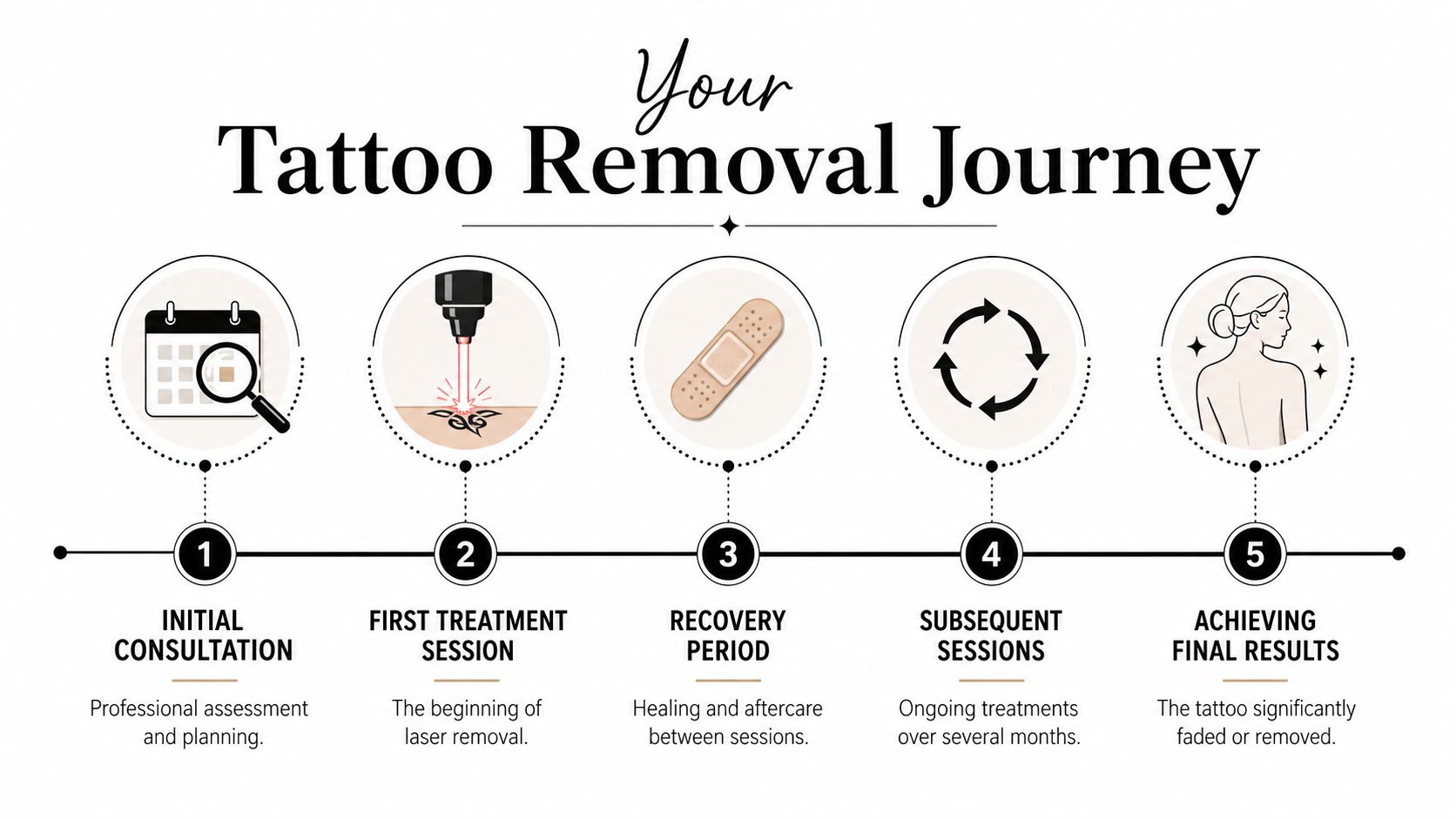
A green tattoo usually changes in stages, not all at once. After the first session, clients often see a temporary white frost on the surface, then redness, warmth, mild swelling, and tenderness for the next day or two. The visible fading comes later, as the body clears the ink fragments over the following weeks.
What happens at the first appointment
The first appointment is part assessment and part treatment planning. I look closely at how the green presents in the skin. Bright green, dark forest green, and green mixed with blue do not always respond the same way, even if they look similar in a photo. I also check the tattoo's depth, density, body location, and whether the goal is full removal or enough lightening for a cover-up.
Once treatment starts, the laser delivers very short pulses into the ink. If the wavelength is well matched to the pigment, the energy is absorbed by the tattoo particles instead of passing through with minimal effect. That is the scientific part clients rarely get explained clearly. Green is harder because the ink does not absorb every laser wavelength well. During treatment, we are trying to deliver the kind of light that the pigment will take in, so it can break into smaller particles your body can clear.
The session itself is usually brief. The after-effects are often more noticeable.
Why spacing between sessions matters
Your immune system does a large share of the work between appointments. The laser breaks the pigment apart. Then the body spends weeks processing and removing those smaller fragments.
That is why sessions are spaced out instead of stacked too close together. Treating green again before the skin has settled can add irritation without giving you more fading. In clinic, steady spacing usually produces cleaner progress than rushing.
I also tell clients that each session gives us information. We watch how that specific green responds, how the skin recovers, and whether settings need to be adjusted at the next visit. That step matters with resistant color work.
What affects how long removal takes
Green ink can fade well, but the timeline is not identical from one tattoo to the next. These factors change the pace:
- Ink density: Heavily packed professional ink usually takes longer to break up.
- Exact shade of green: Some shades absorb treatment light better than others.
- Layering: Cover-ups and reworked tattoos often have multiple pigment depths.
- Body location: Areas with better circulation often clear fragmented ink more efficiently.
- Skin response: Some clients heal quickly and clear pigment steadily. Others need a slower plan.
This is also where expectations need to stay realistic. Black sections often clear faster than green sections in the same tattoo. That does not mean the green is failing. It means the pigment is behaving the way resistant color typically behaves.
The rhythm of a real treatment plan
A well-run treatment plan follows a consistent pattern:
- Detailed assessment and treatment mapping
- Laser session with settings matched to the tattoo
- Healing and pigment clearance
- Review of skin response and ink reduction
- Adjustment of the next session if fading stalls or the response changes
Good aftercare supports that process. Clients who understand why aftercare matters after laser tattoo removal usually heal with less irritation and stay on schedule more reliably.
The same safety logic shows up in other light-based treatments. Screening skin condition, recent sun exposure, and sensitivity before treatment is similar to ensuring safe laser hair removal in Portsmouth.
The goal is controlled progress. That is how green tattoo removal becomes predictable.
How to Prepare for Sessions and Ensure Proper Healing
Good results don't depend only on the laser. They also depend on how you arrive for treatment and how you care for the skin afterward.

Preparing for your appointment
Come in with your skin as calm and protected as possible. Irritated or freshly tanned skin is harder to treat safely.
Use this checklist before a green tattoo removal session:
- Avoid sun exposure: Sun-stressed skin is more reactive and harder to treat conservatively.
- Arrive with clean skin: Skip lotions, oils, and self-tanner on the area that day.
- Stay hydrated: Healthy skin tends to recover better.
- Review medications with the clinic: Some medications or supplements can increase sensitivity.
- Wear practical clothing: Choose something that gives easy access to the tattoo and won't rub the area afterward.
If you've ever looked into other light-based treatments, the logic is similar to the precautions used for ensuring safe laser hair removal in Portsmouth. Skin condition, recent sun exposure, and proper screening all influence how safely the energy can be delivered.
Essential aftercare for best results
After treatment, your job is simple. Protect the skin, reduce friction, and let it heal.
A straightforward aftercare routine usually looks like this:
- Keep the area clean: Follow the clinic's instructions for gentle cleansing.
- Use only recommended products: Don't improvise with harsh creams or fragranced products.
- Avoid picking or scratching: Blisters, scabs, and flaking need to heal naturally.
- Skip soaking the area: Avoid pools, hot tubs, and long soaking baths until the skin has recovered.
- Protect from sun exposure: Healing skin and fresh laser work don't mix well with UV exposure.
Healing well is part of removal. Poor aftercare can slow progress and raise the risk of unwanted skin changes.
This guide on why aftercare is important after laser tattoo removal is worth reading if you want a more detailed explanation of what normal healing looks like and when to check back with your provider.
Choosing Your Tattoo Removal Expert in Florida
If you're comparing providers, don't stop at “Do they remove tattoos?” For green ink, that question is too broad.
What matters is whether the clinic can treat your tattoo's pigment with the right mix of wavelength access, treatment planning, and restraint. Some tattoos need a straightforward fading plan. Others need a provider who can work across several colors without relying on one laser setting for everything.

What to ask before you book
A solid consultation should leave you with specific answers, not generic reassurance.
Ask questions like these:
- What wavelengths do you use for green pigment?
- Can your system switch wavelengths for multicolor tattoos?
- Do you treat for full removal, cover-up fading, or both?
- How do you adjust treatment for my skin tone and tattoo location?
That line of questioning matters because effective full-color removal may require at least three wavelengths, and no single laser optimally covers every color. A practical review in PMC notes that green tattoos are well suited to 755 nm alexandrite or 694 nm ruby, and full-color work may need multiple wavelengths, as discussed in this PMC review on laser treatment for colored tattoos.
A practical option for Florida clients
For clients in Florida, EradiTatt Tattoo Removal is one option to consider if you want a clinic focused on tattoo removal and color-specific treatment planning. The company offers appointments in Tampa, Orlando, St. Petersburg, Bradenton/Sarasota, and Palm Harbor, which is useful if you need a location that fits regular follow-up visits.
The right provider should make a few things clear from day one. Green can be treated. It may take time. The equipment matters. The settings matter. The plan matters just as much as the laser.
If you're ready to find out what your green tattoo will require, contact EradiTatt Tattoo Removal to schedule a consultation and get a treatment plan based on your ink colors, skin, and removal goals.
One Response