
You may be reading this because a date is already circled on your calendar. A wedding is coming up. A new job has a visible-ink policy. You're talking to a recruiter. You want a cover-up, but your current tattoo is too dark. In that moment, the question usually isn't “Does laser tattoo removal work?” It's “How do I plan this so I'm not rushing my skin?”
That's the right question.
As someone who talks with new clients every day, I can tell you that laser tattoo removal is easier to handle when you treat it like a timeline-based medical project, not a one-off cosmetic appointment. A dermatologist-led plan helps you understand what your skin can do safely, how your tattoo is likely to respond, and when you need to start if you want visible fading by a real-world deadline.
Table of Contents
- Why a Dermatologist-Led Approach Is the Gold Standard
- How Advanced Lasers Erase Ink from Your Skin
- Mapping Your Tattoo Removal Timeline
- Are You a Good Candidate for Laser Removal
- Cost Estimates and Essential Pre and Post-Care
- Start Your Removal Journey with EradiTatt in Florida
Why a Dermatologist-Led Approach Is the Gold Standard
A search for a laser tattoo removal dermatologist usually reveals a deeper question: who should guide a treatment that intentionally changes the skin over time?
The strongest answer is medical supervision. Tattoo removal isn't just about aiming light at ink. It involves choosing the right wavelength, setting the right intensity, evaluating your skin tone and healing pattern, and adjusting treatment as your skin responds from visit to visit. A dermatologist-led approach brings that medical judgment into every step.
Skin assessment changes the whole plan
Two tattoos can look similar in a photo and require very different treatment plans in real life. Skin tone, scar history, sun exposure, pigment response, and the tattoo's placement all matter. A medically trained team evaluates those factors before your first pulse of laser energy ever touches the skin.
That matters most when clients are worried about side effects such as blistering, temporary texture change, or shifts in skin color. Those risks are part of the reason the treatment should be approached like a skin procedure, not a casual service.
For readers with deeper skin tones, this becomes even more important because laser settings and pacing need careful adjustment. If that's your concern, this guide on tattoo removal on dark skin is a useful next read.
Practical rule: The more your outcome depends on preserving normal skin appearance, the more important expert oversight becomes.
Medical history and technology both matter
Laser tattoo removal has a long clinical history. A clinical review notes that the first commercially available Q-switched ruby laser for tattoo removal appeared in 1983, and modern dermatology still relies on Q-switched ruby, alexandrite, and Nd:YAG platforms as traditional treatment workhorses, with removal usually requiring multiple sessions as ink is broken into smaller particles over time in a process described in this clinical review of laser tattoo removal.
That history is reassuring for clients. It tells you this isn't experimental. It's established medical care that has improved over time.
A dermatologist-led office also thinks beyond the laser itself. The team considers eye protection, skin cooling, wound care, and even clinic operations that support patient follow-through. For practices trying to improve access, scheduling, and communication, tools discussed in this guide to AI for dermatology practices show how technology can help patients keep appointments and get questions answered faster.
Why this approach usually feels calmer to clients
Individuals don't need more hype. They need a plan they can trust.
A dermatologist-led process tends to feel calmer because you're not guessing about whether your tattoo is fading “normally,” whether your skin reaction is expected, or whether your deadline is realistic. You get a treatment path built around skin safety first, then adjusted for your actual goal, whether that's full removal or lightening for a future cover-up.
How Advanced Lasers Erase Ink from Your Skin
The science sounds technical, but the basic idea is simple.
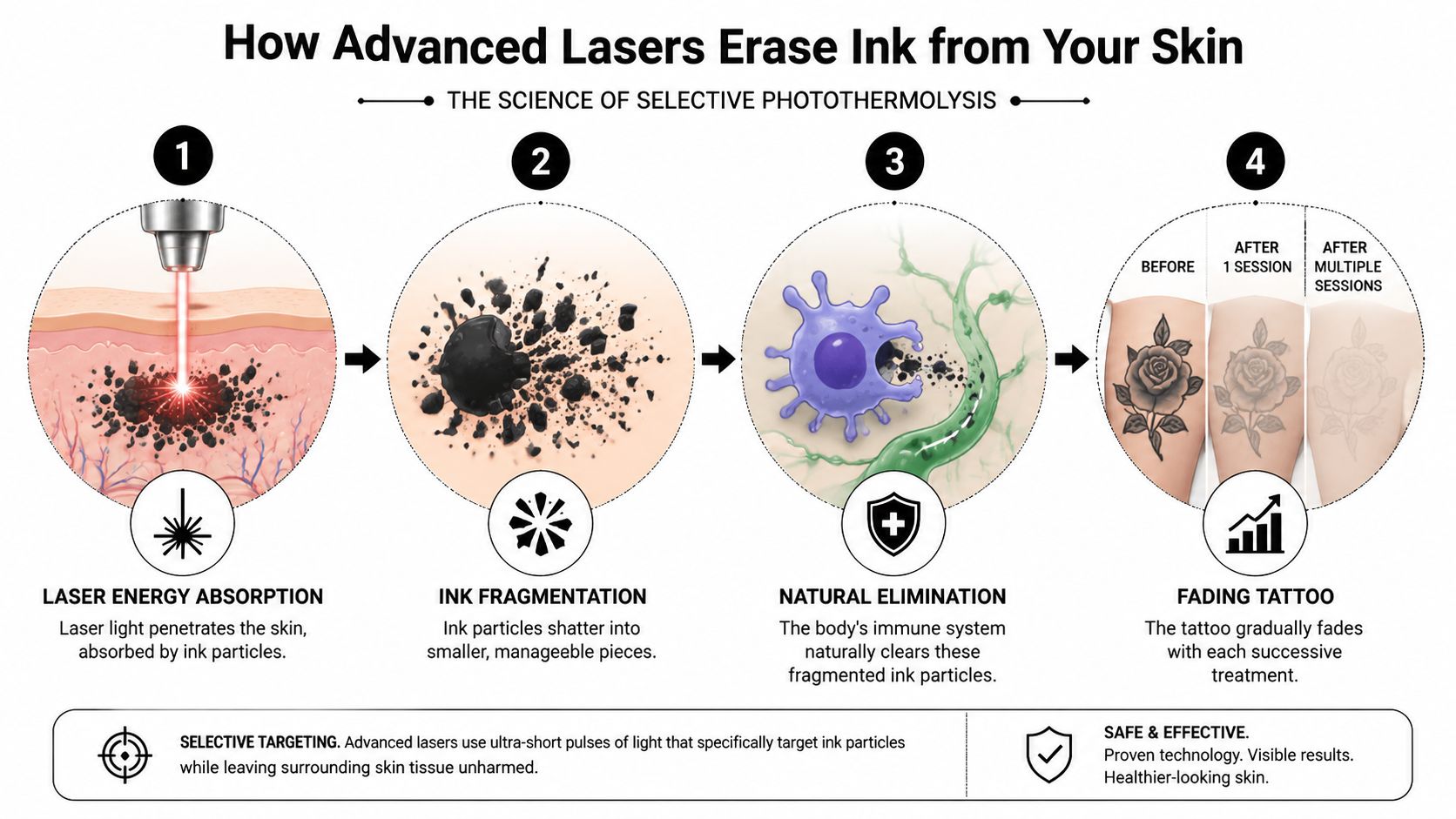
A tattoo stays visible because the ink particles are too large for your body to clear efficiently. Laser treatment hits those particles with very short bursts of light energy. That energy breaks larger pieces of pigment into much smaller fragments. Your immune system then clears those fragments gradually over time.
The process is akin to breaking a pile of rocks into fine gravel. The laser performs the breaking. Your body handles the hauling away.
What happens during the fade
Each appointment only moves the process forward part of the way. That surprises a lot of new clients.
You don't walk out with the tattoo erased because your body needs time after treatment to process the shattered pigment. Fading continues between sessions, which is one reason spacing matters. If you treat again too soon, you're not giving the skin and immune system enough time to do their part.
Here's the sequence in plain language:
- Laser light enters the skin and targets tattoo pigment.
- Ink particles break apart into smaller fragments.
- Your body clears the fragments gradually after the appointment.
- The tattoo looks lighter over time, then the cycle repeats at the next session.
Your laser session starts the work. Your body finishes it between appointments.
Why some colors are easier than others
Not all ink behaves the same way. Different colors respond to different wavelengths, which is why advanced systems matter. Black ink often responds well, while some brighter or mixed pigments can be more stubborn.
Clinical guidance says that modern lasers using shorter pulse durations in the 10–100 picosecond range are optimal for targeting ink, and a 755-nm alexandrite laser has shown at least 75% clearance of blue and green pigment in 1–2 treatments in cited clinical data, as summarized by Schweiger Dermatology's tattoo removal overview.
That doesn't mean every blue or green tattoo clears that quickly. It means modern picosecond technology has improved the ability to target pigments that used to frustrate patients and providers alike.
Why the machine is only part of the answer
Clients sometimes focus only on the brand or type of laser. The device matters, but so do treatment planning and operator judgment. The right tool still has to be matched to your skin and your tattoo.
If you want a more detailed look at picosecond technology, this PiQo4 laser tattoo removal guide explains how that platform approaches ink fragmentation and fading.
The key takeaway is straightforward. Advanced lasers don't “melt” tattoos out of the skin. They create controlled fragmentation that your body can deal with safely over time.
Mapping Your Tattoo Removal Timeline
You have a date on the calendar. A wedding in six months. A new job application window. A cover-up appointment your artist will not book until the old ink is lighter. That is usually the right place to start.
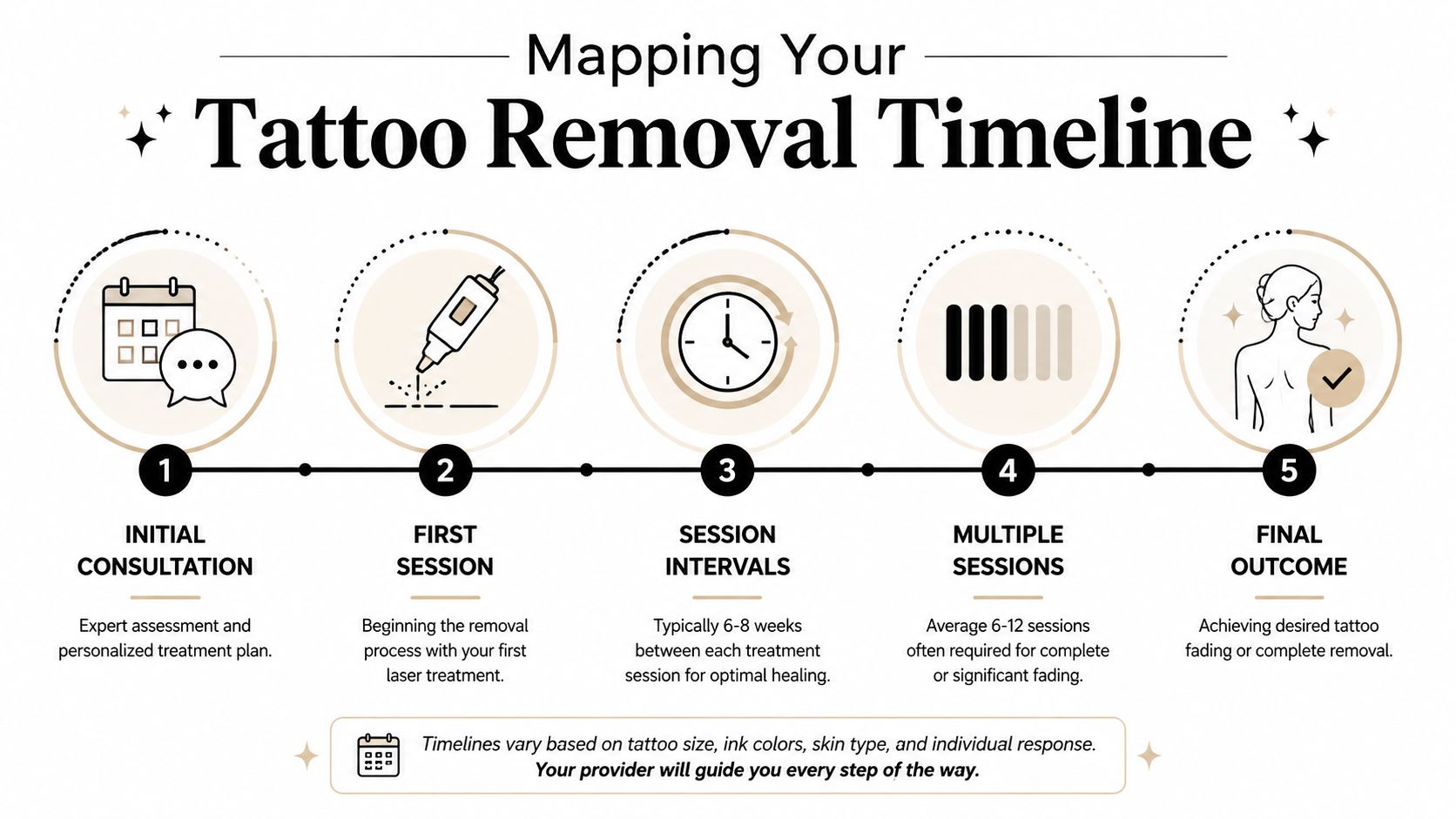
Tattoo removal works more like a construction schedule than a single appointment. You are planning for assessment, treatment sessions, skin recovery, and gradual fading between visits. The laser visit is only one checkpoint. Much of the visible change happens after the appointment, while your body clears the fragmented pigment.
Start with the date that matters
The clearest way to build a timeline is to count backward from the event that matters most. If your goal is to look better in photos, your last session should not sit right on top of the event. If your goal is a cover-up, your tattoo artist may only need the old piece softened and broken up, not fully erased.
As noted earlier in the article, removal is usually spaced out over months rather than weeks. The American Academy of Dermatology explains in its laser tattoo removal guidance that multiple treatments are needed and that tattoos cannot usually be removed in one session.
That timing catches people off guard.
Clients often ask for one number, but planning works better when you sort your goal into one of three categories:
| Goal | Planning approach |
|---|---|
| Look lighter by a specific event | Start early and leave time after the last session for the skin to settle and the fading to continue |
| Meet a work, policy, or enlistment deadline | Build in extra margin because response speed varies by tattoo, body area, and ink load |
| Prepare for a cover-up | Ask how much fading your artist needs, then plan removal around that target instead of full clearance |
A calendar-first way to plan
Here is the practical model we use when explaining timelines to new clients.
First, book the consultation as soon as the deadline becomes real. That visit helps set expectations about whether your tattoo is likely to lighten modestly, substantially, or only partially by your target date.
Next, leave room for a series of treatments rather than a rushed cluster of appointments. Laser removal is not a sprint. Skin needs recovery time, and the fading continues between visits.
Then, protect the final stretch. For weddings, travel, professional photos, interviews, and similar events, you want the area healed and calm, not freshly treated.
A simple way to picture it is to treat each session like planting a seed and the weeks after it like the growing season. You do not get the full result the day you plant it.
Real-world examples
A bride who wants a wrist tattoo lighter for spring photos usually does better starting months ahead and aiming for visible fading, not perfect disappearance.
Someone changing careers may need progress they can show by a certain date. In that case, the smart move is to start early, keep appointments consistent, and avoid assuming the most optimistic timeline.
A client planning a cover-up often has the most flexibility. If the artist only needs the old design faded enough to stop it from showing through, the timeline may be shorter than a full removal plan.
Why rushed scheduling usually backfires
Trying to compress visits too tightly rarely speeds things up in a useful way. The skin still has to recover, and the immune system still has to carry away the shattered ink particles. If sessions are stacked too close together, you can end up with more irritation without getting better fading.
Consistency matters more than intensity.
That is why the best schedule is usually the one you can keep. A realistic calendar, built around your event and your tattoo's complexity, gives you a clearer path than vague promises about how many sessions "most" tattoos need.
Are You a Good Candidate for Laser Removal
A good candidate is not someone who wants a tattoo gone. A good candidate is someone whose skin can be treated safely, whose tattoo can be approached with realistic expectations, and whose timeline fits the biology of removal.
That last part matters more than many clients expect. If you are planning around a wedding, military enlistment, a new job, or a cover-up appointment, candidacy includes scheduling discipline. The process works a lot like a construction project. The laser starts the demolition, but your body still has to clear the debris.
The tattoo can make the project easier or harder
Clients often start by asking about size. Size matters, but it is only one piece of the puzzle.
Dense, heavily packed ink usually takes more effort than a lighter, older tattoo of the same dimensions. Analysts in a CDC-linked field study document identified ink density as the strongest driver of session count in their predictive modeling, and the same report also described increased airborne particulate exposure during treatment plume in the clinical setting, which helps explain why treatment planning and room safety protocols both matter in a medical office (CDC/NIOSH field study document).
In plain terms, two tattoos that look similar from across the room may behave very differently once treatment starts.
What we assess before calling someone a strong candidate
At EradiTatt, we look at the tattoo and the skin together. The treatment plan has to fit both.
A black name on the upper arm may respond in a fairly predictable way. A layered cover-up near the ankle, with mixed colors and very saturated ink, usually needs a slower and more careful plan. That does not rule someone out. It changes the strategy.
Here are the factors we review during an assessment:
| Factor | Why it matters |
|---|---|
| Ink density | Dense pigment often needs more sessions and wider spacing between sessions |
| Tattoo location | Some areas clear more slowly, which affects planning for deadlines |
| Color and layering | Mixed pigments and cover-ups can make fading less straightforward |
| Skin tone | Settings must be chosen carefully to lower the chance of pigment changes |
| Healing history | Past reactions help predict how your skin may recover after each visit |
| Scar tendency | A history of keloids or abnormal scarring may call for extra caution |
| Sun exposure | Recent tanning or frequent sun can delay treatment timing |
Patient factors can change timing, not just eligibility
Some clients are medically appropriate candidates, but not good candidates for treatment right now.
For example, if the area is tanned, irritated, actively inflamed, or healing from another procedure, it may be smarter to wait. If you have a habit of missing follow-up care or cannot protect the area from sun exposure, the plan may need to be adjusted before starting. Good candidacy includes being able to care for the skin between sessions, not just tolerate the laser itself.
That is one reason we spend time explaining why aftercare matters after laser tattoo removal. The treatment session is short. The healing period is where a lot of the visible progress and skin protection happen.
A realistic goal also makes you a better candidate
Some clients need complete removal. Others only need enough fading to clear the way for a cover-up before a set appointment with their tattoo artist.
Those are different projects.
If your deadline is fixed, the strongest candidates are the ones who can match the goal to the calendar. A client who needs partial fading in time for a redesign may have a shorter path than someone seeking the cleanest possible clearance before a major life event. The consultation should sort that out early, so you are not planning around the most optimistic outcome.
A dermatologist-led assessment helps answer the question clients usually mean when they ask, "Am I a candidate?" They are really asking three things. Can my skin handle this safely? How difficult is my tattoo likely to be? Can we build a schedule that fits my life and still respects how healing works?
That is the standard a good consultation should meet.
Cost Estimates and Essential Pre and Post-Care
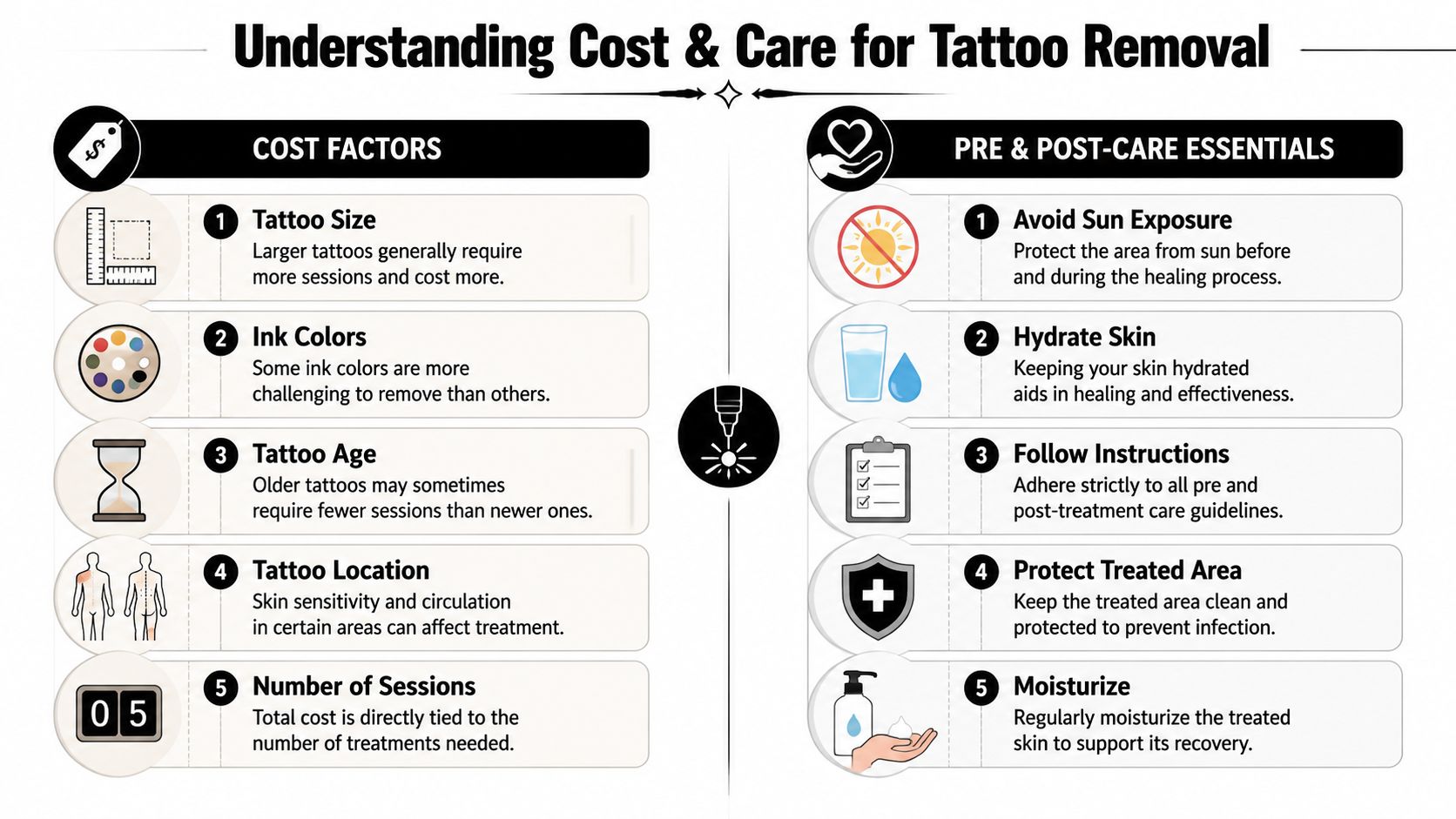
Most clients ask about price early, and that's reasonable. The honest answer is that cost depends on the treatment plan, not just the tattoo's size. A provider usually considers the tattoo's density, color mix, placement, and whether you want full removal or partial fading.
Because the number of sessions can vary widely, the most useful pricing conversation happens after an in-person assessment. That's when you can pair budget planning with timeline planning, instead of treating them as separate issues.
What affects the overall cost
Instead of chasing a generic quote online, focus on the variables that change the full project cost.
- Tattoo complexity: mixed colors, layering, and dense packing can add difficulty.
- Treatment goal: full removal usually requires a longer course than light fading for a cover-up.
- Body location: some areas can be slower to respond, which affects planning.
- Consistency: missed appointments can stretch the process and delay the result you're paying for.
If you're comparing options, ask for clarity on how the office estimates treatment scope and how they handle long-term planning.
The care steps that help your skin do its job
Good aftercare supports healing and keeps your treatment plan on track. I tell clients to think of it as active participation, not homework.
Before treatment, keep the area out of the sun and arrive with clean skin. After treatment, protect the skin, keep it clean, and follow the instructions your provider gives you for dressings and topical care.
A simple checklist helps:
- Protect from sun exposure before and after treatment.
- Keep the area clean while the skin settles.
- Use the recommended ointment or moisturizer if your provider advises it.
- Don't pick at blisters, scabs, or peeling skin.
- Keep your next appointment so the overall timeline doesn't slip.
Healing is part of the treatment, not a pause between treatments.
For a more detailed breakdown, this aftercare guide for laser tattoo removal walks through why post-treatment care affects both safety and final fading.
Clients sometimes worry when they see temporary redness, swelling, or whitening right after treatment. Those immediate skin responses are part of why you need clear instructions from the office. If something feels unusual, ask. Early communication is better than self-diagnosing.
Start Your Removal Journey with EradiTatt in Florida
Once you understand the timeline, the process gets less overwhelming. You stop asking for instant removal and start asking better questions. How dense is the ink? What level of fading do I need? How early should I start if my deadline is fixed? That's where a professional consultation helps most.
For Florida clients, accessibility matters too. If visits are spread across months, convenience affects whether you stay consistent. That's one reason local scheduling and location choice matter almost as much as the first appointment itself.
What a first consultation should give you
A good consultation should leave you with a plan, not just a promise.
You should walk away understanding:
- Your likely treatment path
- Whether your goal is full removal or strategic fading
- How your skin and tattoo characteristics affect the pace
- What kind of healing window to expect between visits
That first conversation is also where practical issues get solved. If you're coordinating around work, travel, or a ceremony, say that clearly. Deadline-driven planning only works when the provider knows the date that matters.
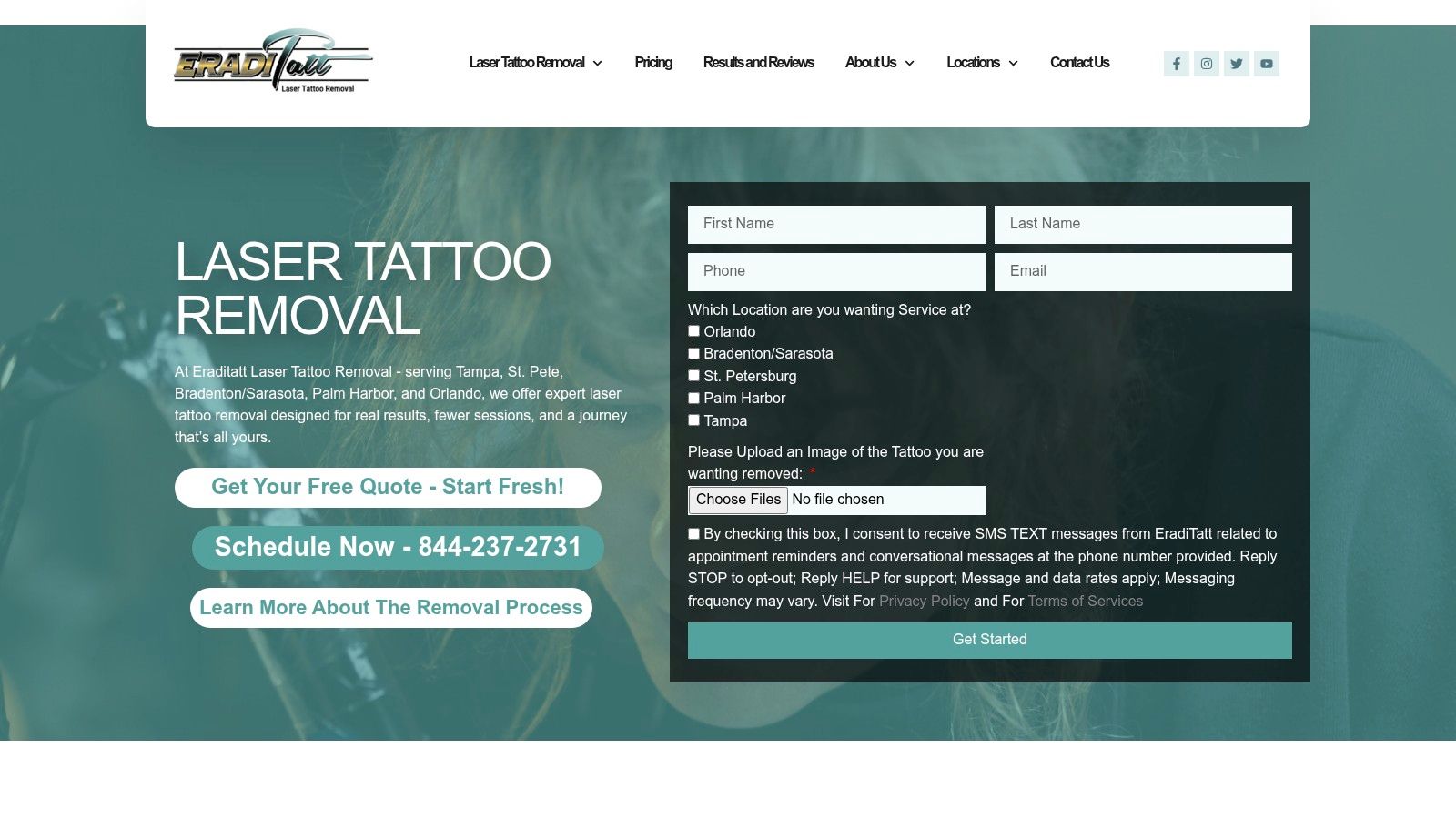
Here's what the site experience looks like before booking:
Florida locations and the next step
EradiTatt Tattoo Removal provides laser tattoo removal for clients seeking complete removal or fading for a cover-up, with Florida locations in Tampa, Orlando, St. Petersburg, Bradenton/Sarasota, and Palm Harbor.
If you're in Central or West Florida, that gives you options for building a treatment schedule you can maintain. And that's the point. The best plan is the one you can follow safely and consistently over time.
If you've been putting this off because the process sounded vague, start with the consultation. You don't need to commit to the entire journey in one phone call. You just need a clear read on your tattoo, your skin, and your timeline.
If you're ready to get answers about your tattoo, your deadline, and your treatment options, contact EradiTatt Tattoo Removal to schedule a consultation and build a personalized removal plan.