
You may be staring at a tattoo that no longer fits your life. Maybe it felt right years ago and now it doesn't. Maybe you're planning a cover-up, changing careers, getting ready for a major life event, or you want clear skin again.
If you're looking into tattoo removal in Kissimmee, the biggest frustration is usually the same. Most pages tell you laser removal is “simple,” but they don't explain the actual timeline, the actual cost structure, or what you need to do between sessions to get the safest outcome. That's where expectations often go sideways.
This guide is built to answer the questions people in Central Florida ask before booking. You'll get a practical look at how laser tattoo removal works, what modern technology can and can't do, what affects your treatment plan, how pricing usually works locally, and what to ask before choosing a provider. If you want a nearby starting point, you can review Florida tattoo removal locations that serve Central Florida clients.
Table of Contents
- Your Fresh Start Begins in Kissimmee
- Understanding How Laser Tattoo Removal Works
- The Advanced Laser Technology We Use
- Factors That Influence Your Removal Timeline
- Estimating Tattoo Removal Costs in Kissimmee
- Preparing for Your Sessions and Proper Aftercare
- Choosing Your Kissimmee Tattoo Removal Expert
- Frequently Asked Questions About Tattoo Removal
Your Fresh Start Begins in Kissimmee
Wanting a tattoo gone doesn't mean you made a bad decision. It usually means your life changed. That's normal. Tattoos mark a moment, and sometimes that moment has passed.
In Kissimmee, people often come in with one of three goals. They want full removal, they want fading for a cleaner cover-up, or they want a tattoo to be less visible for work or personal reasons. Each goal changes how treatment should be planned, because “removal” isn't one-size-fits-all.
What new clients usually need first
People don't need a sales pitch. They need straight answers about what will happen to their skin, how long the process may take, and whether their tattoo is likely to respond quickly or slowly.
That starts with a few practical questions:
- What kind of tattoo is it: A light black-line tattoo behaves differently than a dense, layered professional piece.
- Where is it located: Some body areas tend to clear more efficiently than others.
- What's your skin like right now: In Florida, recent sun exposure matters more than many people realize.
- Are you aiming for full clearance or just enough fading for a cover-up: Those are different treatment endpoints.
A good consultation should lower uncertainty, not increase it.
What realistic planning looks like
A proper tattoo removal plan in Kissimmee should cover the science, the device being used, the likely session pattern, the spacing between visits, and the aftercare that protects your skin between treatments.
The right approach is calm and methodical. Quick promises are usually a warning sign. Laser tattoo removal works, but it works through a series of controlled treatments and healing cycles, not through one aggressive appointment.
Understanding How Laser Tattoo Removal Works
Laser tattoo removal is a selective photothermolysis process. In plain language, the laser sends very short pulses of light into the skin, and the tattoo pigment absorbs that energy. The goal isn't to scrape the ink out or burn the skin. The goal is to break the pigment into much smaller fragments so your body can clear them over time.
A simple way to think about it is this. The tattoo ink starts as larger particles trapped in the skin. The laser hits those particles and breaks them into smaller pieces, more like dust than chunks. After that, your immune system does the slow part of the work.
What the laser does and what your body does
The laser treatment itself is only one part of the process. The body has to recognize and remove the fragmented pigment afterward. That's why fading continues between sessions instead of happening all at once in the room.
The FDA explains that laser tattoo removal requires multiple treatments because the skin needs time to heal and the body needs time to clear fragmented ink. It also notes that the interval matters because the limiting step is biological pigment elimination, not the laser pass itself, as described in the FDA's tattoo removal guidance for consumers.
Why spacing matters
Many people get impatient. They assume shorter gaps between appointments will speed everything up. In practice, that usually doesn't help. If the body hasn't had enough time to heal and process the shattered pigment, repeating treatment too soon can increase irritation without improving the result.
Practical rule: The laser breaks up ink fast. Clearance happens slowly.
That's also why session timing should be based on skin response, not calendar pressure. If you're planning around a wedding, vacation, enlistment date, or job change, start early. The process depends on healing cycles, and those can't be rushed by scheduling treatments closer together.
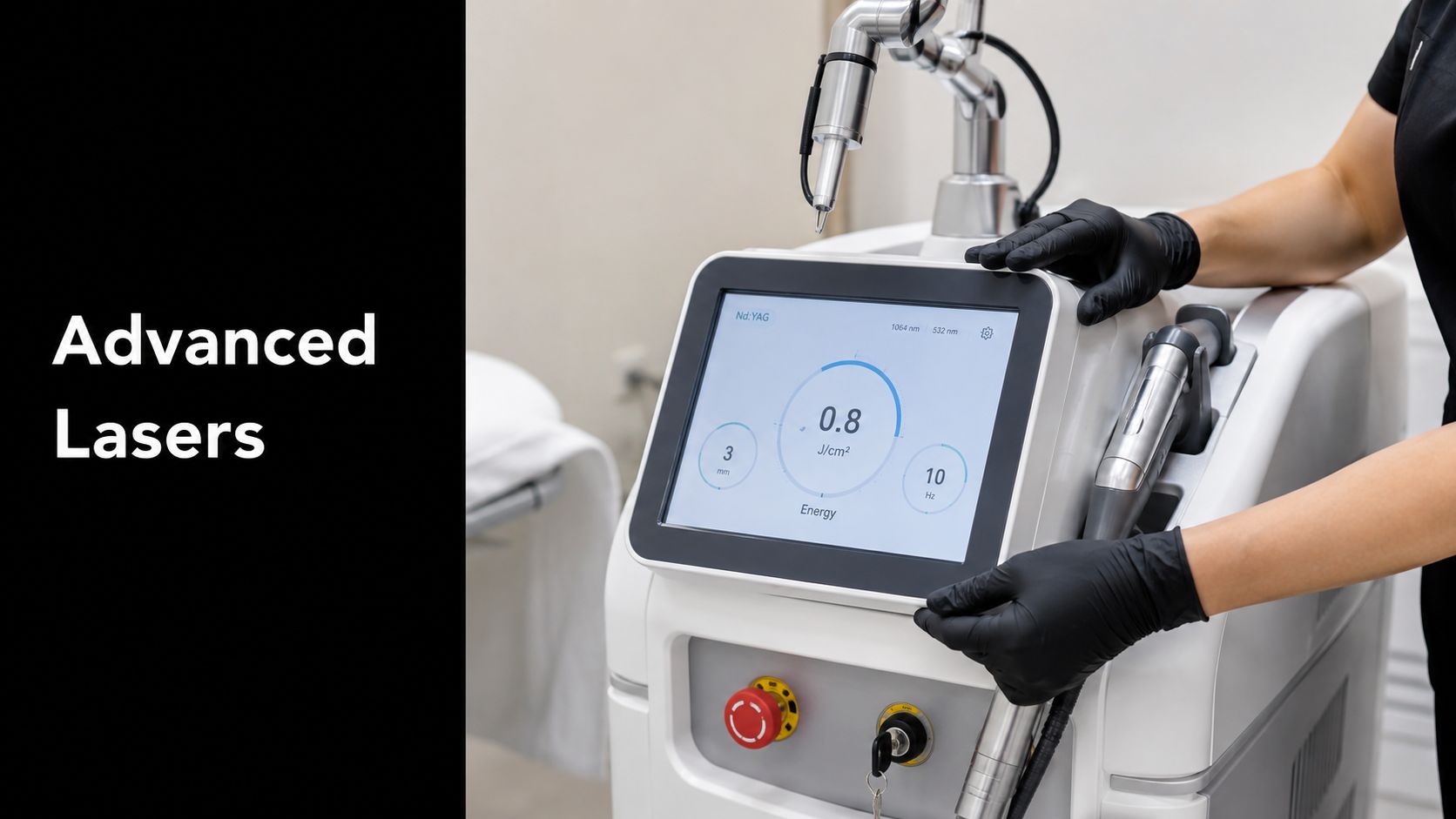
The Advanced Laser Technology We Use
Not all tattoo removal devices behave the same way. Older systems can still remove some tattoos, but modern platforms generally give technicians better control over pulse duration, wavelength selection, and how energy is delivered to different pigment colors.
That matters because tattoo ink isn't uniform. A black script tattoo, a blue-green design, and a multicolor sleeve don't present the same problem. A device that works reasonably well on dark pigment may struggle more with stubborn colors or layered work.
Why picosecond technology matters
Picosecond lasers deliver energy in an extremely short pulse. That creates a stronger photoacoustic effect, which means the pigment is shattered more efficiently with less spread of heat into surrounding tissue than older approaches.
For difficult colors, especially blue and green, picosecond systems around 755 nm have shown materially better clearance in some reports. One cited result showed 75% or greater clearance in one or two treatments for stubborn blue and green tattoos, according to this discussion of new tattoo removal technology and picosecond systems.
What better technology can and can't do
Better equipment can improve how efficiently certain inks respond. It can also expand the range of tattoos a clinic can treat thoughtfully. But advanced technology doesn't erase the need for individualized planning.
Some tattoos still need a long runway because of depth, saturation, color mix, and skin considerations. That's why the machine name alone shouldn't decide where you go. What matters is whether the provider knows how to match the right settings to your tattoo and skin.
If you want a technical overview of one current platform, this guide to PiQo4 laser tattoo removal explains how wavelength options and pulse speed affect treatment strategy.
Factors That Influence Your Removal Timeline
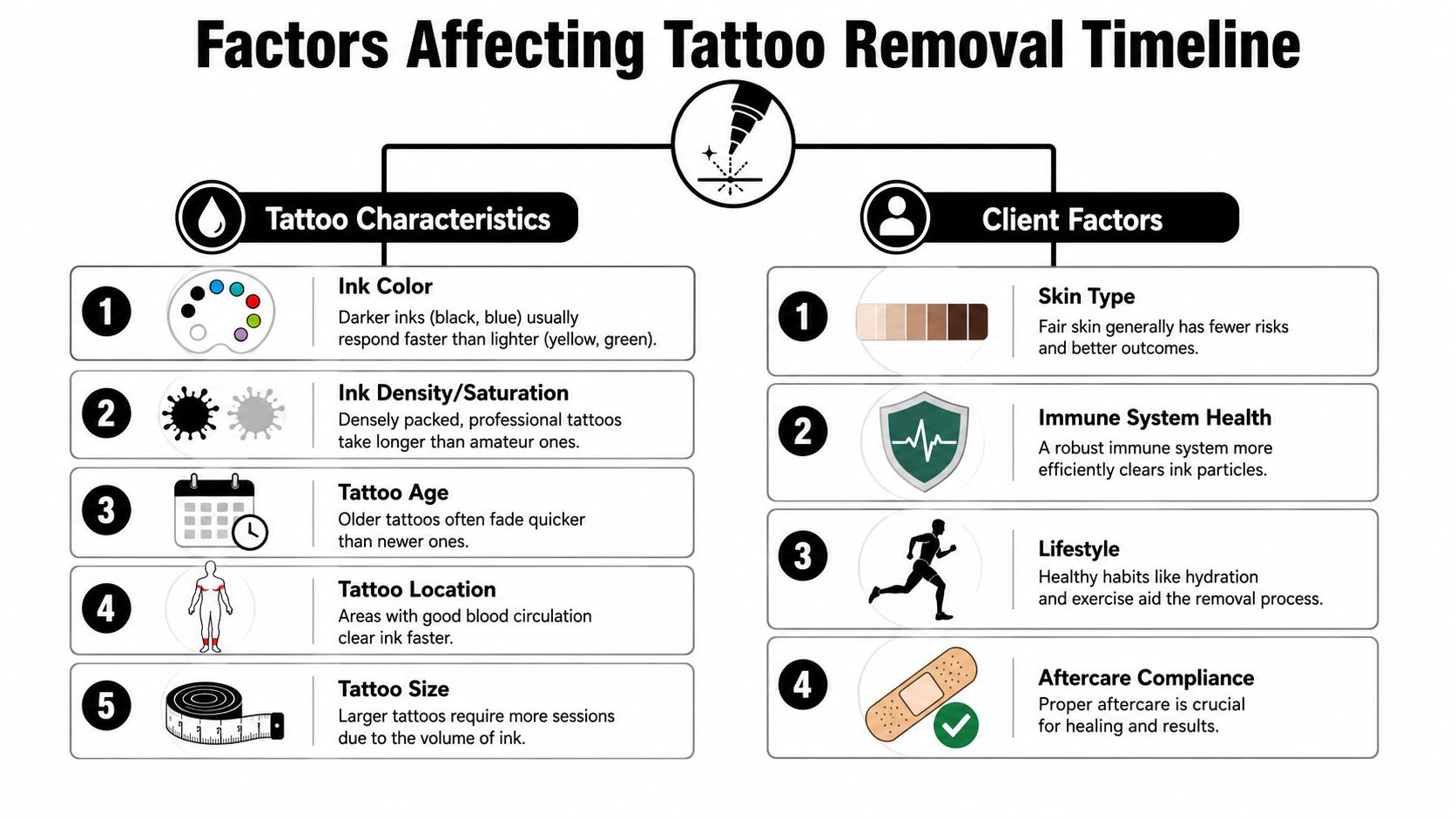
The most common mistake people make is assuming session count is based mostly on tattoo size. Size matters, but it's only one variable. Two tattoos that look similar at first glance can have very different treatment timelines.
Clinical evidence makes that clear. A prospective study of 116 patients treated between January 2020 and June 2024 found an average of 6 sessions, with a range from 2 to 20 sessions. The strongest predictor was ink density. Low-density tattoos averaged 3.2 sessions, while high-density tattoos averaged 9.0 sessions. Tattoo location, age, and design technique also significantly affected how many treatments were needed, according to the full study on predictors of tattoo removal session count.
The tattoo itself often drives the plan
A dense professional tattoo usually takes longer than a lighter amateur one because there's more pigment packed into the skin. Color matters too. Black ink often responds more predictably, while mixed-color work can be more stubborn.
Location also affects progress. Areas with stronger circulation often clear ink more effectively than areas farther from the body's core. Age matters as well. Older tattoos sometimes respond more readily because some fading has already happened before removal begins.
Your body matters too
Laser treatment is only the trigger. Your body still has to remove the fragmented pigment after each session. That means skin condition, immune response, and aftercare all influence how smoothly the process goes.
Here's how I'd frame timeline expectations for a new client:
- If the tattoo is light and simple: You may move through treatment more smoothly.
- If it's dense or heavily saturated: Expect a longer course.
- If the tattoo includes difficult colors: Planning has to be more careful.
- If your skin is irritated, tanned, or healing poorly between sessions: Delays may be necessary for safety.
Dense ink usually costs more time than people expect.
What doesn't work
Trying to “speed up” removal by treating too aggressively or too often usually backfires. It can leave the skin more reactive without giving the body enough time to do its part.
That's why honest tattoo removal in Kissimmee starts with a personalized estimate, not a universal promise. If a provider gives you the same timeline they give everyone else, they're skipping the variables that matter most.
Estimating Tattoo Removal Costs in Kissimmee
The pricing question is straightforward on the surface and more nuanced underneath. In the Kissimmee market, tattoo removal often starts at about $200 per session, and appointments are commonly described as lasting around 1 hour, even though the actual laser time may only be a few minutes. Local listings also commonly describe most removals as needing 3 to 7 sessions, spaced three or more weeks apart, as shown in these Kissimmee tattoo removal market listings.
That tells you two important things. First, pricing is usually per session, not one flat fee for the whole tattoo. Second, the full process is usually a multi-month commitment, even for smaller pieces.
What drives the total investment
The total cost depends less on the headline session price and more on the treatment plan. A tattoo that fades in fewer visits will naturally cost less overall than one that needs repeated passes because of heavy saturation or difficult colors.
A realistic budget should consider:
- Session pricing: Most clinics structure pricing one visit at a time.
- Tattoo complexity: Dense, layered, or multicolor tattoos often require more work.
- Treatment goal: Fading for a cover-up may cost less than aiming for maximal clearance.
- Healing intervals: Time between visits stretches the process even when each appointment is brief.
How to think about price without getting misled
The cheapest quoted session isn't always the lowest real cost. If a clinic underestimates the likely treatment course, the final total may end up feeling much higher than expected.
It's smarter to ask for a range and the reasoning behind it. If you want more context on the economics behind pricing, this article on why tattoo removal can be expensive gives a useful breakdown of the factors that shape treatment cost.
A consultation should leave you with a practical understanding of both the per-session price and the likely overall commitment. That's the number that matters.
Preparing for Your Sessions and Proper Aftercare
Good results don't come from the laser alone. Preparation and aftercare affect skin safety, comfort, and how reliably you move from one session to the next. In Central Florida, the biggest issue clients underestimate is sun exposure.
Before your appointment
Come into treatment with calm, healthy skin. If the area is freshly sun-exposed, irritated, or artificially tanned, that changes risk. Independent clinical guidance notes that treatment choices depend on skin color, tattoo features, and body area, and a Florida laser clinic specifically warns that sun-tanned or self-tanner or spray-tanned skin increases complication risk and may lead a clinic to avoid treatment until the tan has faded, as explained in this guidance on laser tattoo removal and skin safety.
Use this pre-treatment checklist:
- Protect the area from sun: If the skin is recently tanned, your provider may need to postpone treatment.
- Skip self-tanner on the treatment area: Artificial color can affect safety decisions too.
- Arrive with clean skin: Don't coat the area in heavy lotions or irritating products unless your provider tells you otherwise.
- Tell the clinic about skin changes: Rashes, irritation, recent peeling, or healing wounds matter.
- Plan your calendar: Don't book right before pool days, beach trips, or anything that makes aftercare harder.
Recently tanned skin can change whether treatment is appropriate that day.
After your appointment
Your skin needs quiet recovery time. The area may feel irritated, warm, or tender after treatment, and proper care helps reduce unnecessary friction and inflammation.
A simple aftercare routine usually includes:
- Keep the area clean and protected. Follow the instructions your provider gives you for washing and covering the site.
- Don't pick, scratch, or peel. Let the skin recover on its own timeline.
- Avoid extra heat and sun on the treated area. Freshly treated skin is more vulnerable.
- Watch for anything unusual. If healing doesn't seem typical, contact the clinic instead of guessing.
- Be consistent between sessions. Good healing habits support a smoother course.
What helps and what hurts
What helps is boring. Protecting the skin, following instructions, and letting the body recover. What hurts is trying home shortcuts, exposing the treated area to too much sun, or assuming the skin is “fine” before it has settled down.
For tattoo removal in Kissimmee, aftercare isn't a side note. It's part of the treatment.
Choosing Your Kissimmee Tattoo Removal Expert
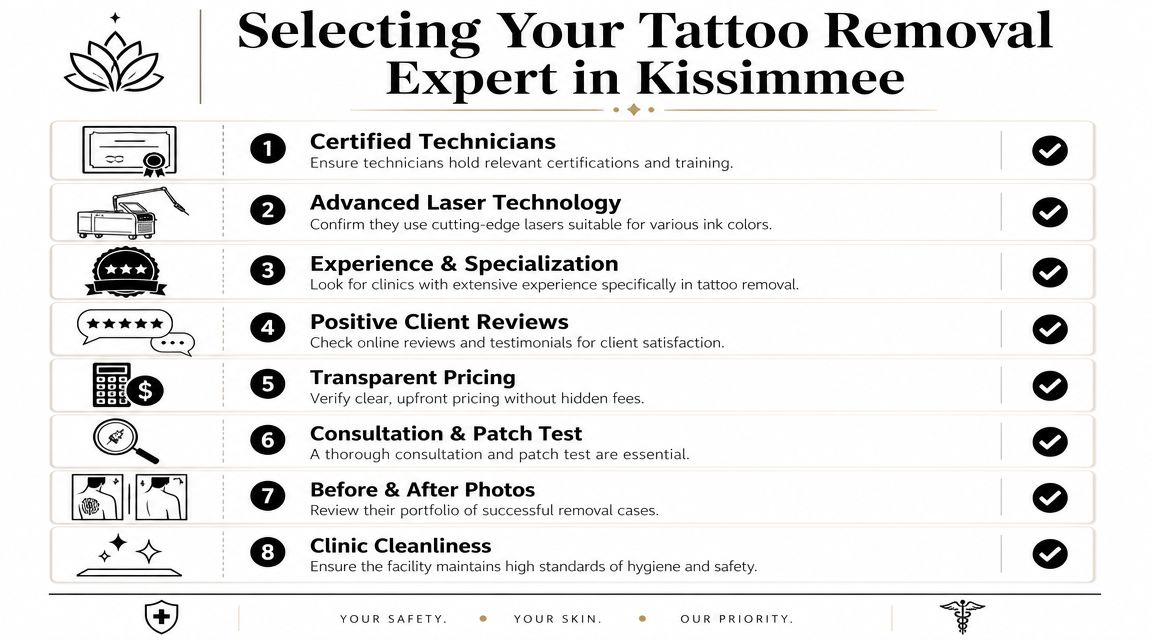
A removal provider should be able to explain your plan clearly, answer safety questions directly, and tell you when treatment should wait. In Florida, that last point matters more than many clients expect because sun exposure can change candidacy from one week to the next.
You're not just choosing a machine. You're choosing the judgment behind the settings, the screening process before treatment, and the support you'll get while your skin heals.
Questions worth asking in a consultation
Bring real questions, not just “How much is it?” The quality of the answers tells you a lot.
Ask things like:
- Who performs the treatment: You want clarity on training, oversight, and experience with tattoo removal specifically.
- What device is being used: The provider should explain why it fits your tattoo's colors and density.
- How do you handle tanned skin: In a sunny area like Kissimmee, this is not optional.
- Do you offer test spots or careful evaluation for uncertain cases: Caution is a good sign.
- Can you explain the expected endpoint: Full removal and cover-up fading are different plans.
- What aftercare instructions do you provide: Vague answers usually mean inconsistent support.
Red flags and green flags
A red flag is a provider who talks as if every tattoo clears the same way. Another is anyone who dismisses concerns about skin tone, recent sun, or pigment change.
A green flag is a clinic that discusses limits as openly as possibilities. If your skin is too tanned for safe treatment, a careful provider should say so. If your tattoo is likely to leave some residual shadowing, you should hear that before you begin.
The right provider doesn't just know when to treat. They know when not to treat.
One option for people seeking tattoo removal near Kissimmee is EradiTatt Tattoo Removal, which serves Central Florida clients through its Orlando location and offers consultations for laser tattoo removal planning.
Frequently Asked Questions About Tattoo Removal
Does tattoo removal hurt
Most clients describe it as uncomfortable rather than unmanageable. The sensation is often compared to repeated snapping against the skin, but the experience varies by location, ink density, and individual tolerance. Small tattoos usually feel brief because the actual laser portion can be fast.
Will laser tattoo removal leave a scar
Modern laser tattoo removal is designed to target pigment, not carve into the skin. That said, skin response still matters. Existing scar tissue within the tattoo, aggressive treatment, poor aftercare, or picking at the area can all affect how the skin looks afterward. A careful provider should evaluate the tattoo texture before starting so you understand whether the skin already has scarring from the original tattoo process.
Can you remove only part of a tattoo or fade it for a cover-up
Yes. Partial removal and strategic fading are common goals. Sometimes the smartest plan isn't complete clearance. It's creating enough space and lightness for a tattoo artist to build a cleaner cover-up. That decision depends on the design, placement, and how much contrast needs to be reduced.
If you're considering tattoo removal in Kissimmee, the best next step is a consultation that looks at your specific tattoo, your skin, and your timeline instead of giving you a generic promise.
If you're ready to talk through your options, EradiTatt Tattoo Removal is a practical place to start. A consultation can help you understand whether your tattoo is better suited for full removal or cover-up fading, what safety considerations apply to your skin, and how to plan your sessions around real healing time.