
Staring at a tattoo that no longer fits your life? You’re not alone. What once felt like a permanent mark is now completely reversible, thanks to huge leaps in laser technology. The old days of harsh, painful, and often ineffective treatments are finally over, replaced by a smarter, more precise way to clear unwanted ink.
The Future of Fading Your Ink Is Here
If you’re having second thoughts about a tattoo, you have more options today than ever before. This shift is fueling a massive demand for professional removal services.
The global tattoo removal market is projected to skyrocket from $1.29 billion in 2025 to an incredible $4.87 billion by 2034. The driving force behind this growth? New laser technology that makes the process safer and more effective for everyone. You can explore the full market analysis to see just how rapidly this industry is expanding.
Why Are More People Choosing Removal?
The reasons for wanting a tattoo removed are as personal as the ink itself. For some, it’s a professional need, while for others, it’s about closing one chapter to start another.
We see a few common motivations from our clients:
- Career Advancement: Many professions, like law enforcement and the military, have strict appearance policies that don’t allow for visible tattoos.
- Life Milestones: Getting married, starting a new relationship, or simply outgrowing a past decision often leads people to seek a clean slate.
- Fading for a Cover-Up: Not everyone wants to go back to bare skin. Many clients choose to lighten an old tattoo to give their artist a better canvas for incredible new artwork.
- Personal Evolution: The tattoo that felt right at 18 might not represent who you are at 30. Removing it can be an empowering step forward.
Understanding the Technological Leap
To really get how much has changed, think of it this way. Older nanosecond lasers were like a sandblaster. They used brute force and intense heat to chip away at ink particles, which increased the risk of burns, blisters, and scarring. It was a pretty blunt approach.
The new generation of picosecond lasers is entirely different. Instead of a sandblaster, imagine a tool that uses ultra-fast vibrations to turn a solid rock into fine dust. That’s the core of modern tattoo removal.
This is called a "photoacoustic" effect. Picosecond lasers deliver energy in pulses that are just a trillionth of a second long. They’re so incredibly fast that they shatter ink with immense pressure, not heat.
This new technology offers some major advantages for you:
- Greater Efficiency: The laser pulverizes ink into minuscule, dust-like particles that are far easier for your body’s immune system to grab and flush away.
- Fewer Sessions: Because the process is so much more effective, most of our clients see their desired results in significantly fewer treatments—often reducing the timeline by 40-50%.
- Enhanced Safety: With almost no heat transferred to the surrounding skin, the risk of burning, blistering, or scarring is dramatically reduced. It's a much safer option for all skin types.
At EradiTatt, we specialize in this exact technology. Our clinics across Florida are equipped with state-of-the-art picosecond lasers because we’re committed to giving you the safest, fastest, and most effective path to clear skin.
The Tech That Changed Everything: How Picosecond Lasers Work
To really get why modern tattoo removal is so much better, we need to talk about the engine behind it all: picosecond laser technology. This isn’t just a small tweak on old methods; it’s a total game-changer in how we erase ink. The secret is speed, and that speed changes everything for your skin, your timeline, and your final results.
Older nanosecond lasers were the best we had for a while. They worked by blasting ink particles with intense heat. Imagine trying to break up a boulder with a sledgehammer—it gets the job done, but it’s messy. You end up with big, jagged chunks and a lot of damage to the ground around it.
That’s what nanosecond lasers did to your skin. The brute-force heat often led to more blistering, scarring, and longer recovery times.
The Power of Pressure, Not Heat
Picosecond lasers work on a completely different level.
Instead of a sledgehammer, think of a high-frequency sonic wave that shatters that same boulder into fine dust. That’s a picosecond laser. It delivers energy in incredibly short bursts—we’re talking trillionths of a second. This mind-boggling speed creates a powerful "photoacoustic" shockwave instead of overwhelming heat.
This intense pressure wave smashes the tattoo ink into particles that are dramatically smaller than anything older lasers could manage. It's a process that's much gentler on your skin but way more destructive to the ink itself.
By pulverizing ink into microscopic "dust," picosecond lasers make it way easier for your body's immune system to do its job. Your natural cleanup crew can grab these tiny particles and flush them away much more efficiently.
This diagram perfectly shows the evolution from older methods to the far more effective picosecond technology we use today.
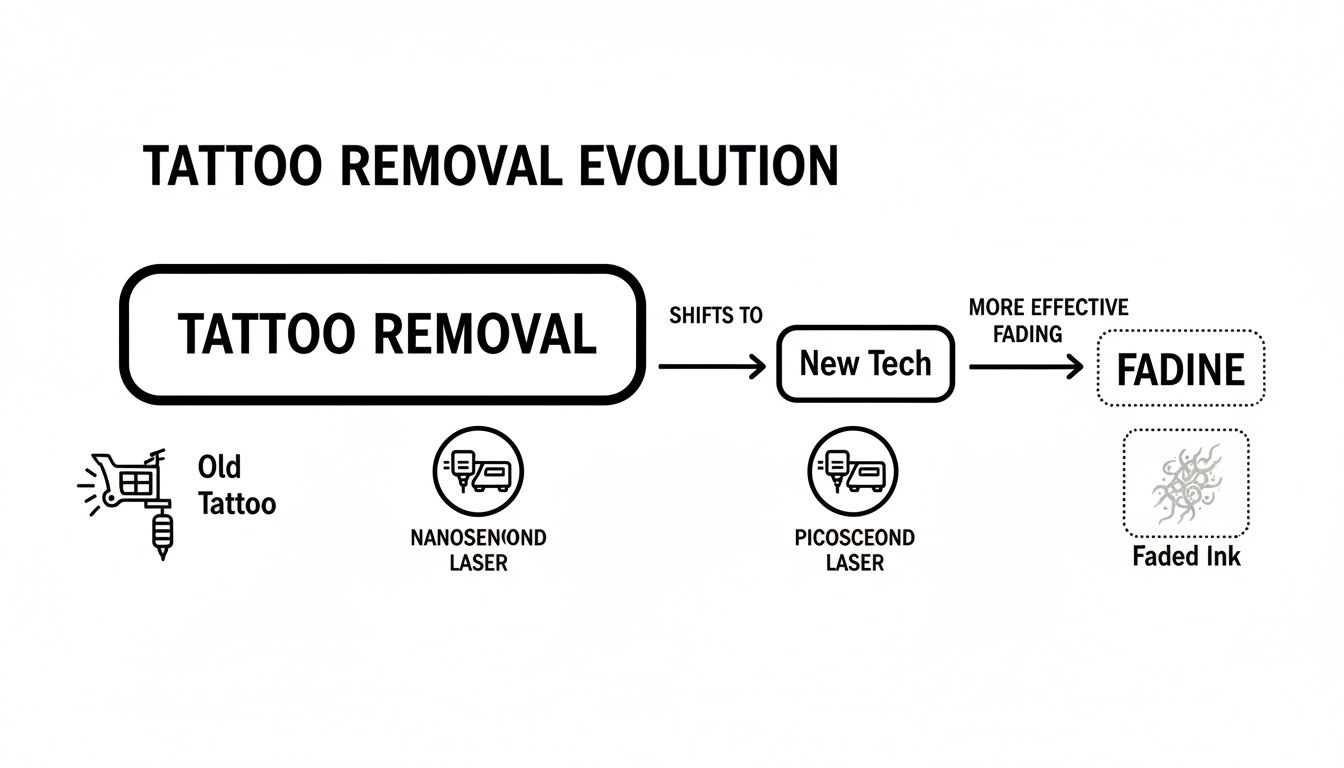
As you can see, breaking the ink into finer particles is the key to faster, more complete fading.
To give you a better sense of the practical differences, let's compare the two technologies head-to-head.
Nanosecond vs Picosecond Lasers A Head-to-Head Comparison
| Feature | Nanosecond Lasers (Older Tech) | Picosecond Lasers (New Tech) |
|---|---|---|
| Primary Mechanism | Photothermal (Heat) | Photoacoustic (Pressure) |
| Pulse Speed | Billionths of a second | Trillionths of a second (1000x faster) |
| Ink Particle Size | Breaks ink into small "pebbles" | Shatters ink into fine "dust" |
| Risk of Skin Damage | Higher risk of burns, scars, and blistering | Drastically lower risk; safer for all skin types |
| Number of Sessions | More sessions typically required | Fewer sessions needed for clearance |
| Effect on Stubborn Colors | Limited effectiveness on blues and greens | Highly effective on the full color spectrum |
The table makes it clear: the shift to picosecond technology provides a safer, faster, and more effective path to clear skin.
What This Means for Your Tattoo Removal
Switching from a heat-based to a pressure-based treatment brings some major real-world benefits. Here’s what you can expect with modern laser tattoo removal:
- Fewer Sessions Needed: Because the ink is shattered so thoroughly, your body clears it out faster. This almost always means fewer treatments to get the job done, whether you’re aiming for full removal or just fading for a cover-up.
- Greater Safety for Your Skin: With so little heat involved, the risk of burns, blisters, and scarring drops dramatically. It’s a much safer approach that targets the ink with incredible precision while leaving the surrounding skin unharmed.
- Effective on Stubborn Colors: For years, vibrant blues and bright greens were the toughest colors to remove. Picosecond lasers changed that, using specific wavelengths that are brilliant at shattering these stubborn pigments, leading to clearance we once thought was impossible.
One study really drove this point home. Using a 755 nm picosecond laser, researchers saw 75% or greater clearance of stubborn blue and green tattoos in just one or two treatments. Where clients used to sit through 15-20 sessions for those colors, many now see amazing results in just 8-10 sessions—saving time, money, and a lot of discomfort.
At EradiTatt, we use advanced systems like the PiQo4 laser, which actually combines both nanosecond and picosecond energies. This gives us the flexibility to create a truly custom treatment that can tackle dense, multi-colored tattoos with unmatched precision. To see why this hybrid approach is so effective, check out our ultimate guide to PiQo4 laser tattoo removal. Choosing a clinic with this level of technology is the most important step in getting the best and safest outcome.
What to Expect During Your Removal Journey
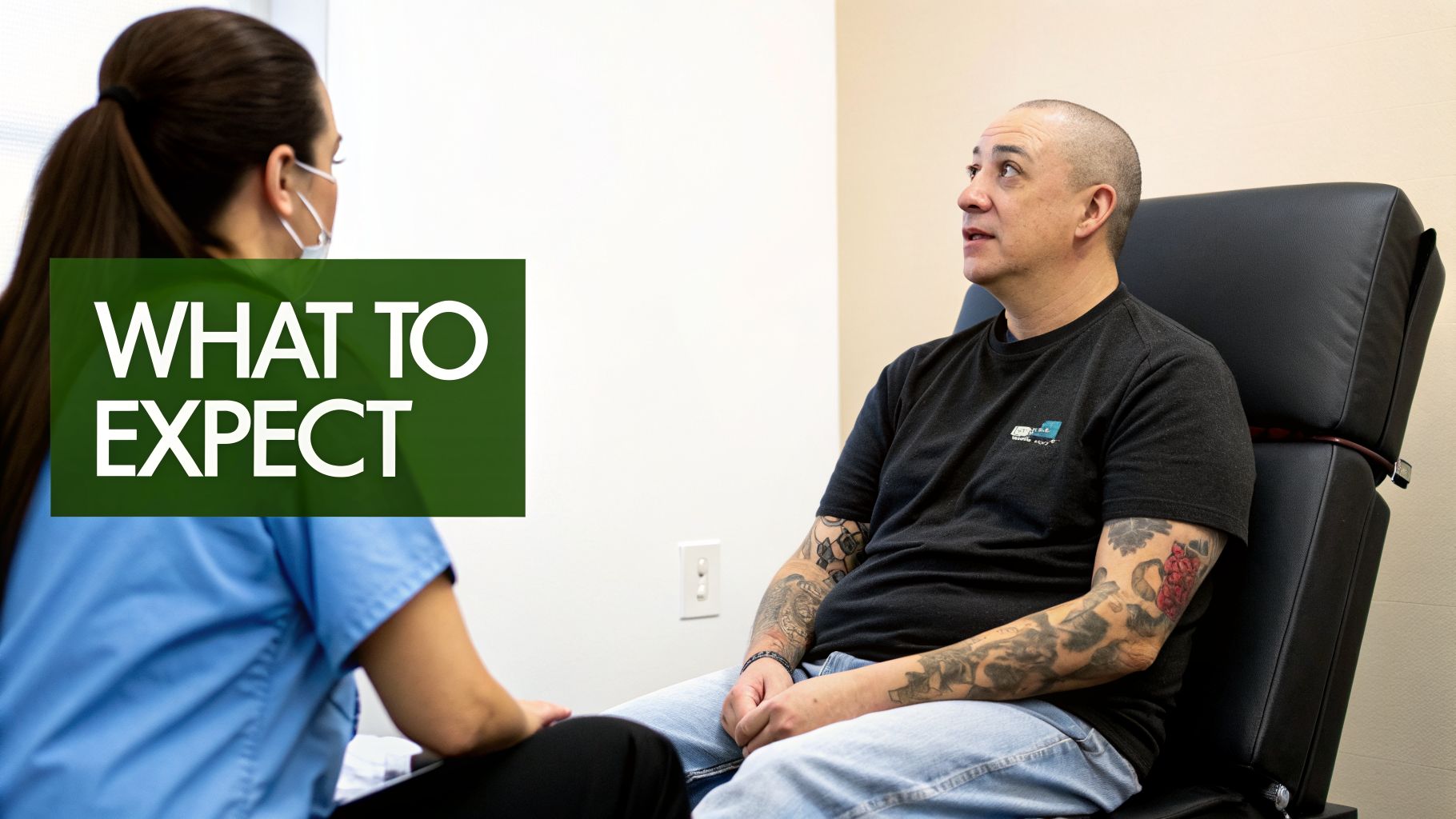
Deciding to remove a tattoo is a big step, but the journey itself doesn't have to be intimidating. When you know what’s coming—from your first chat with a technician to the final healing phase—you can move forward with total confidence.
Think of it as a partnership. Our advanced lasers do the heavy lifting, but your body’s incredible healing power is what truly finishes the job.
The First Step: Your Consultation
Everything starts with the initial consultation. This isn't just about getting a price; it's where we map out a treatment plan completely customized to your skin and your tattoo.
A specialist will take a close look at your ink and talk through your goals. Whether you’re aiming for a clean slate or just fading the ink for a cover-up, we’ll build a strategy based on a few key things:
- Tattoo Age and Ink Density: Older, more faded tattoos often clear up faster than fresh, heavily saturated ones.
- Ink Colors: Black ink is typically the quickest to respond. While our new technology is fantastic on a whole spectrum of colors, stubborn shades like bright blue or green might need a little extra attention.
- Tattoo Location: Areas with great blood flow, like your chest or back, tend to show results more quickly than your hands or feet.
- Your Skin Type: We’ll perform a professional assessment to make sure the laser settings are perfectly safe and effective for your unique skin tone.
This is your time to ask absolutely anything. We believe in being completely transparent so you know exactly what to expect from the timeline, the cost, and the final results.
What A Typical Session Feels Like
The number one question we get is, "Does it hurt?" Most of our clients say the picosecond laser feels like a quick, sharp snap—similar to a rubber band flicking against the skin. It’s a sensation, for sure, but most people find it far more tolerable than getting the tattoo in the first place.
The treatment itself is surprisingly fast. A small tattoo might only take a minute or two, while a larger, more complex piece could be done in 15-20 minutes. We use a special cooling device that blows chilled air directly onto the skin, which does a fantastic job of numbing the area and keeping you comfortable.
Right after the laser passes over the ink, you'll see a temporary "frosting" on the skin. It looks white and crystalized, and it’s a perfectly normal sign that the laser energy is doing its job breaking up the ink. This fades within a few minutes, leaving the area a little red and slightly swollen.
Want a full play-by-play of the process? Check out our complete first-timer’s guide on how tattoo removal works.
Healing and Aftercare Are Key
The laser session is just the beginning. The real magic happens as your body heals and your immune system flushes away the shattered ink particles. Following your aftercare instructions isn't just a suggestion—it’s absolutely essential for getting the best results and avoiding any complications.
Your technician will give you a full plan, but the fundamentals are simple:
- Keep it Clean and Covered: For the first few days, you'll apply an antibiotic ointment and keep the area protected with a sterile bandage.
- Manage Swelling: Using an ice pack during the first 24 hours can help calm any swelling and soothe the skin.
- Avoid Sun Exposure: The treated area is extra sensitive to UV light. Keep it covered or use a strong, high-SPF sunscreen to prevent any pigmentation issues.
- Do Not Pick: It's normal for blisters or scabs to form. Let them heal on their own schedule. Picking at them is the fastest way to cause scarring.
We schedule sessions about six to eight weeks apart, and there's a very good reason for that. This waiting period gives your skin plenty of time to heal completely and allows your body to get to work clearing out the ink. Rushing it won't get you faster results and can actually risk damaging your skin. Patience really does pay off.
Factors Influencing Removal Success And Cost
The journey to clear skin is different for every person and every tattoo. While the new technology tattoo removal we use at EradiTatt has made the process much faster and safer, a few key things will determine how quickly your ink fades and what the total cost will look like.
Think of it this way: no two tattoos are exactly alike, so no two removal plans are either. Everything from the ink itself to your own body's cleanup crew plays a part in the final result. Understanding these factors helps set a realistic roadmap for your timeline and budget.
Ink Color and Composition
The first big factor is the color of your tattoo. Different colors soak up different wavelengths of laser light, which is why our technicians fine-tune the laser settings for every shade in your design.
Black Ink: This is the easiest color to work with. Black ink absorbs all laser wavelengths—much like a black t-shirt absorbs sunlight—which lets the laser break it down powerfully and effectively.
Reds and Oranges: These warm tones also respond great to the most common laser wavelengths, usually fading without a hitch.
Blues and Greens: In the past, these were the toughest colors to get rid of. But modern picosecond lasers, like our PiQo4, come equipped with specific wavelengths designed just for these stubborn pigments. The clearance we can achieve now is worlds better than what was possible with older tech.
The ink’s makeup matters, too. Professional artists typically use dense, high-quality ink that settles deep and evenly in the skin. On the other hand, amateur or "stick-and-poke" tattoos often use less ink at different depths, which can sometimes make them faster to remove.
Tattoo Location on the Body
Where your tattoo is located has a huge impact on how fast it fades. It all comes down to blood flow. Your body’s circulatory and lymphatic systems are the "cleanup crew" responsible for carrying away the tiny, shattered ink particles after a session.
Think of your circulatory system as a highway. Areas with more "lanes" and faster traffic—major blood vessels—will clear out the broken-down ink much more quickly.
Tattoos in areas with great circulation tend to clear the fastest. This includes places like your:
- Chest
- Back
- Upper Arms
Conversely, tattoos on your extremities, where blood flow is naturally a bit slower, often require more sessions for full removal. These spots include the hands, feet, and ankles.
Skin Type and Tone
Your skin tone is another critical piece of the puzzle. Our technicians use the Fitzpatrick scale, a standard dermatological tool, to classify your skin tone and predict how it will react to the laser’s energy. While our new technology tattoo removal is safe for every skin type, treatments on darker skin require a more careful, conservative approach.
That’s because the laser is designed to target pigment—and it can't always tell the difference between tattoo ink and the natural melanin in your skin. For clients with darker skin (Fitzpatrick types IV-VI), a skilled technician will use specific laser wavelengths and lower energy settings. This minimizes any risk of side effects like temporary hyperpigmentation (darkening) or hypopigmentation (lightening). It’s the safest way to go, though it might add a few sessions to your overall plan.
Other Important Considerations
Beyond those big three, a few other things can influence your removal journey. The age of your tattoo is one—older ink has often already faded a bit on its own, giving the laser a head start. The ink’s density is also key. A heavily saturated, dark tattoo will naturally take more work to break down than a soft, shaded piece. To see how all these elements come together, check out our guide on the 6 factors that can affect tattoo removal progress.
Finally, your own health plays a role. A strong immune system, staying hydrated, and leading a healthy lifestyle all help your body do its job of flushing out ink particles more efficiently between your appointments. By understanding these factors, you and your technician can create a realistic and effective plan to get you to your goal of clear skin.
Choosing Your Expert Tattoo Removal Provider

The advanced picosecond lasers we’ve covered are amazing machines, but at the end of the day, they're just tools. The single most important decision you’ll make is choosing the expert operating that tool. Honestly, this choice matters more for your safety, comfort, and final results than anything else.
In a market flooded with options, it's easy to get overwhelmed. You’ll see med-spas offering tattoo removal right next to a dozen other services. While that might seem convenient, this "jack-of-all-trades" approach is often a red flag. Real expertise in new technology tattoo removal comes from total specialization.
The Specialist vs. The Generalist
Think of it this way: if you needed complex heart surgery, you wouldn't go to your general family doctor. You'd find a cardiac surgeon who does that one procedure, every single day. The same logic applies here. A clinic dedicated only to tattoo removal lives and breathes this science.
A specialist provider gives you clear advantages:
- Deep Experience: Their technicians perform hundreds of removal treatments, giving them an unmatched feel for how different inks and skin types react to the laser.
- Better Equipment: Specialists are far more likely to invest in the latest, most powerful laser systems because it's the heart of their business.
- Refined Safety Protocols: A dedicated clinic has safety and aftercare procedures built specifically for laser tattoo removal, which minimizes risks and promotes proper healing.
On the flip side, a general med-spa might use the same laser for hair removal, skin tightening, and tattoo removal. This usually means they’re working with older, less effective technology and staff who aren't exclusively trained on the nuances of erasing ink. Your skin deserves a specialist.
What to Look For in a Provider
When you’re ready to find your expert, there are a few non-negotiables you should look for. This checklist helps ensure you get the safe, effective treatment you’re paying for.
Here’s what you should ask:
- Do you specialize only in tattoo removal? A dedicated focus is the biggest sign of genuine expertise and experience.
- Do you use modern Picosecond laser technology? If they can’t confirm they have up-to-date picosecond or combination nano/pico lasers, they can't give you the best results possible in 2026.
- Are your technicians certified and experienced? The person behind the laser should be a certified laser technician with extensive, hands-on tattoo removal experience.
- Do you offer a thorough, no-pressure consultation? A quality provider will always offer a free consultation to assess your tattoo, explain the process clearly, set realistic expectations, and answer all your questions.
At EradiTatt, we are tattoo removal specialists. It’s not just one of the things we do—it’s the only thing we do. This unwavering focus is how we deliver a level of care and achieve results that generalist clinics simply can’t.
We built our entire practice on these principles. Our expert technicians are highly trained on state-of-the-art picosecond lasers, making sure every client gets a plan customized for their unique tattoo and skin. With convenient locations across Florida—including Tampa, Orlando, St. Petersburg, Palm Harbor, and Bradenton/Sarasota—expert care is never far away.
Taking the Next Step with Confidence
Whether you need a tattoo gone for a new career, a wedding, or just to get a fresh start, the path to clear skin begins with a conversation. Your goals are unique, and your treatment plan should be, too.
Don’t settle for a one-size-fits-all approach. Find a team of specialists who will partner with you, answer your questions honestly, and use the best technology out there to help you reach your goal safely.
Ready to see what a specialist can do for you? Schedule your free, no-obligation consultation with our EradiTatt team today. Let's talk about your tattoo and create a personalized plan to erase your ink for good.
Answering Your Top Questions About Modern Tattoo Removal
It's completely natural to have questions when you're thinking about removing a tattoo, even with today's amazing technology. We get it. To help give you the clarity and confidence you need, we’ve put together straightforward answers to the questions we hear most often from our clients.
Is New Laser Tattoo Removal Technology Painful?
This is always the first question people ask, and the answer is usually a relief. While everyone's pain tolerance is different, most clients say the sensation of a picosecond laser is like a quick, sharp snap—similar to a rubber band flicking against the skin.
Honestly, most people find it much more tolerable than getting the tattoo in the first place. Better yet, the sessions are incredibly fast, often lasting just a few minutes, so any discomfort is over before you know it.
To make sure you’re as comfortable as possible, we use a specialized cooling device that blows chilled air directly onto the skin before, during, and after the laser hits. This works wonders to numb the area and makes new technology tattoo removal a surprisingly manageable process.
Unlike older lasers that relied on intense, steady heat, the modern photoacoustic effect is far gentler on your skin, which really helps keep discomfort to a minimum.
How Many Sessions Will I Really Need With The New Technology?
Picosecond lasers have dramatically cut down the number of sessions required, but there’s no single magic number. How many treatments you'll need comes down to a unique mix of factors specific to you and your tattoo.
While older nanosecond lasers often took 15-20 sessions or even more, most of our clients using advanced picosecond technology see complete removal in about 8 to 12 sessions. A simple black ink tattoo on your chest, for example, might even clear up faster.
Here are the key factors that determine your timeline:
- Ink Colors and Density: Black ink is the easiest to break down. More stubborn colors like vibrant blues and greens, or very dark, saturated tattoos, will need a bit more work.
- Tattoo Location: Tattoos on your torso tend to fade faster because of the strong circulation. Ink on your hands or feet takes longer to clear since blood flow is slower there.
- Your Immune System: Your body does the heavy lifting! A healthy immune system is essential for flushing away the shattered ink particles between your sessions.
The only way to get a solid estimate is to come in for a professional consultation. A technician can assess your tattoo in person and map out a treatment plan just for you.
Will Laser Tattoo Removal Leave A Scar?
With modern picosecond lasers, the risk of scarring is extremely low. This holds true as long as your treatment is done by a trained, experienced technician and you follow the aftercare instructions perfectly.
This is one of the biggest wins for new technology tattoo removal. Older lasers used high heat (photothermal energy), which carried a much higher risk of burns and skin damage. Picosecond lasers use a photoacoustic effect—think of it as immense pressure—to shatter ink with minimal heat, which keeps your surrounding skin safe and sound.
It’s worth noting that sometimes, there’s already scarring left over from when the tattoo was first applied. Our laser can remove the ink from that scar tissue, but it won’t remove the pre-existing scar itself.
Proper aftercare is your best insurance against scarring. Following the post-treatment plan from your clinician is non-negotiable. This means keeping the area clean, staying out of the sun, and absolutely no picking at any blisters or scabs that might form as you heal.
Can I Just Fade A Tattoo For A Cover-Up?
Absolutely. Fading a tattoo to prepare for a cover-up is one of the most common reasons clients come to see us. Complete removal isn't always the end goal, and new technology tattoo removal gives us the precision to get you exactly what you need.
Just a few laser sessions can lighten an old, dark tattoo dramatically, creating a much cleaner canvas for your tattoo artist. By fading the old ink, you give your artist way more creative freedom and ensure the old design doesn't muddy or peek through your new artwork.
We can also do selective removal. If you only want a specific part of a larger tattoo gone—like a name or a date—we can target just that area while leaving the rest of your ink untouched. At EradiTatt, we work closely with you to hit your goal, whether that's a completely clean slate or the perfect foundation for your next piece.
Ready to take the first step towards erasing your ink? The expert team at EradiTatt is here to guide you with the safest, most effective technology available. We offer personalized consultations to answer all your questions and create a plan that fits your goals. Schedule your free consultation today by visiting us at https://eraditatt.com.
2 Responses