
About one in four tattooed U.S. adults has experienced tattoo regret, according to a 2023 Pew Research Center survey that found 24% had regretted one or more tattoos. The same survey found that 32% of U.S. adults have at least one tattoo, so the feeling behind “I hate my tattoos” is far more common than many people realize. Most tattooed Americans still don't regret their ink, but regret is clearly a mainstream reason to explore removal, fading, or concealment. Pew Research Center's tattoo findings put that decision in context.
You don't have to decide today that every mark must disappear. The right question is more practical: Do you want the tattoo gone, softened enough for new artwork, or hidden while you consider your options? Each route has different expectations, limitations, and timelines.
Table of Contents
- Understanding Why Tattoo Regret Is So Common
- Choosing Your Path Full Removal vs Fading vs Camouflage
- What to Expect During Laser Tattoo Removal
- How Tattoo Characteristics Affect Your Results
- Finding the Right Tattoo Removal Provider
- Taking the Next Step Toward Tattoo Freedom
Understanding Why Tattoo Regret Is So Common
Tattoo regret usually has less to do with one universal mistake and more to do with changing circumstances. A design connected to a relationship may feel wrong after the relationship ends. A tattoo that suited an earlier career, identity, or style may no longer represent the person you are. Some people become less comfortable with the size, placement, color, or quality of the artwork over time.
The emotional reaction can also intensify when the tattoo becomes a daily reminder of something that no longer fits. That doesn't mean you were foolish to get it. It means your preferences and life changed, which is normal. The decision to seek help is a form of taking control, not something to hide.
Regret is common, but it isn't universal
Pew found that 22% of U.S. adults with tattoos have more than one tattoo, a detail that matters because dissatisfaction may involve one design, several pieces, or an entire collection. Multiple tattoos can create several possible treatment goals, including removing one symbol, fading a section for a cover-up, or addressing different pieces at separate times.
Clinical literature also shows that regret and removal interest have been documented for years. A 2015 U.S. study reported that 16.2% of participants regretted a current tattoo, while 21.2% were interested in having one or more tattoos removed. A later review summarized earlier estimates ranging from 16% to 44% among tattooed people and reported that 26% of its sample regretted at least one tattoo. The PubMed record for this research provides the underlying clinical reference.
Feeling regret doesn't obligate you to pursue complete removal. It gives you a reason to assess your choices carefully.
Three practical ways forward
You can pursue complete laser removal, which suits someone who wants the area as clear as possible. You can choose partial fading, often to give a tattoo artist more flexibility with a new design. Or you can use cosmetic camouflage when immediate concealment matters more than changing the ink itself.
These options make tattoo regret more manageable because the decision doesn't have to be all or nothing. A thoughtful overview of tattoo culture, changing perceptions, and removal decisions is available in this tattoo and tattoo removal guide. For broader skincare context, the Skin Perfection tattoo guide can also help you think about how tattooed skin fits into your overall skin-care routine.
Choosing Your Path Full Removal vs Fading vs Camouflage
The best treatment plan starts with your desired endpoint, not with a particular laser. Someone who wants a blank area has different needs from someone who loves the tattoo concept but wants a new artist to redesign it. A person facing an event or workplace concern may prioritize concealment while making a longer-term decision.
| Approach | Typical Sessions | Timeline | Best For | Cost Range |
|---|---|---|---|---|
| Full laser removal | About 6 to 12 sessions, based on industry guidance | Usually a long process with healing intervals | People seeking the clearest possible result | Provider-specific |
| Fading for a cover-up | About 2 to 5 sessions, based on industry guidance | Often shorter than full removal, followed by additional healing before tattooing | People who want new artwork over the area | Provider-specific |
| Cosmetic camouflage | No laser sessions required for concealment | Immediate coverage, with maintenance depending on the method | People who need temporary or visual concealment | Provider-specific |
The U.S. Food and Drug Administration explains that laser removal generally requires multiple treatments, with a few weeks between sessions for healing, and notes that treatment may take 6 to 10 sessions. The FDA's tattoo removal guidance also makes clear that lighter colors such as yellow, green, and red are harder to remove than dark blue and black.
Full removal
Choose this route when the old design itself is the problem and you don't want another tattoo in its place. The goal is substantial lightening or clearance, but no ethical provider should promise that every tattoo will disappear completely. Professional ink density, color complexity, skin response, and location all affect the final result.
Fading for a cover-up
Fading is often the most efficient option when you still want body art. Industry guidance commonly places cover-up preparation at about 2 to 5 lightening sessions, with sessions spaced roughly 6 to 8 weeks apart to allow healing and pigment clearance. Many people should wait at least 6 weeks after their final session before tattooing over the area, while some artists recommend waiting as long as 6 months. This cover-up preparation guide explains why your laser provider and tattoo artist should coordinate.
A useful planning resource is this guide to preparing for a tattoo cover-up. It reinforces an important point: fading isn't a lesser version of removal. It's a separate strategy designed to restore creative options.
Camouflage
Camouflage can conceal the appearance of unwanted ink without breaking down the pigment. It may be useful for a short-term need, but it doesn't remove the tattoo, and the covering material may require upkeep or may not suit every body area. If you're unsure whether you want new artwork or a blank canvas, camouflage can offer visual relief while you consider laser treatment.
What to Expect During Laser Tattoo Removal
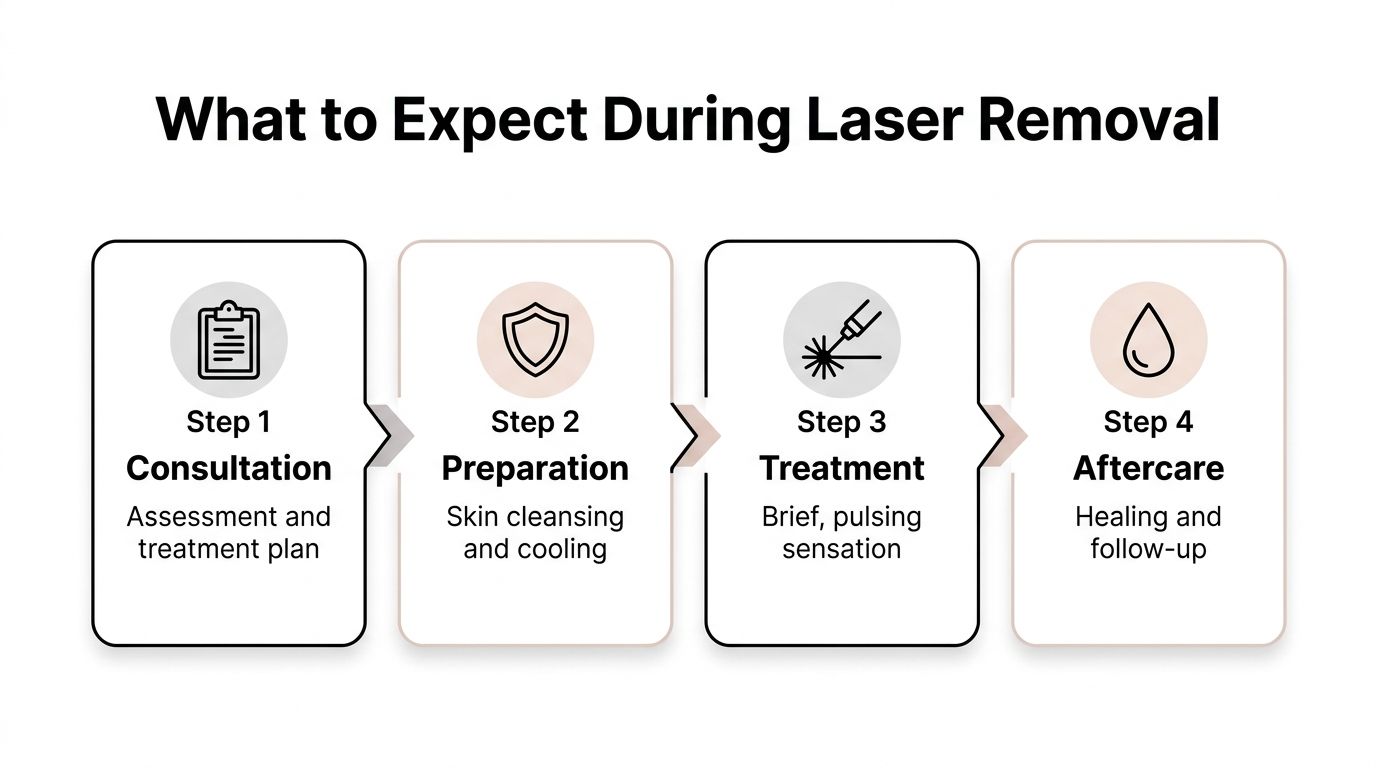
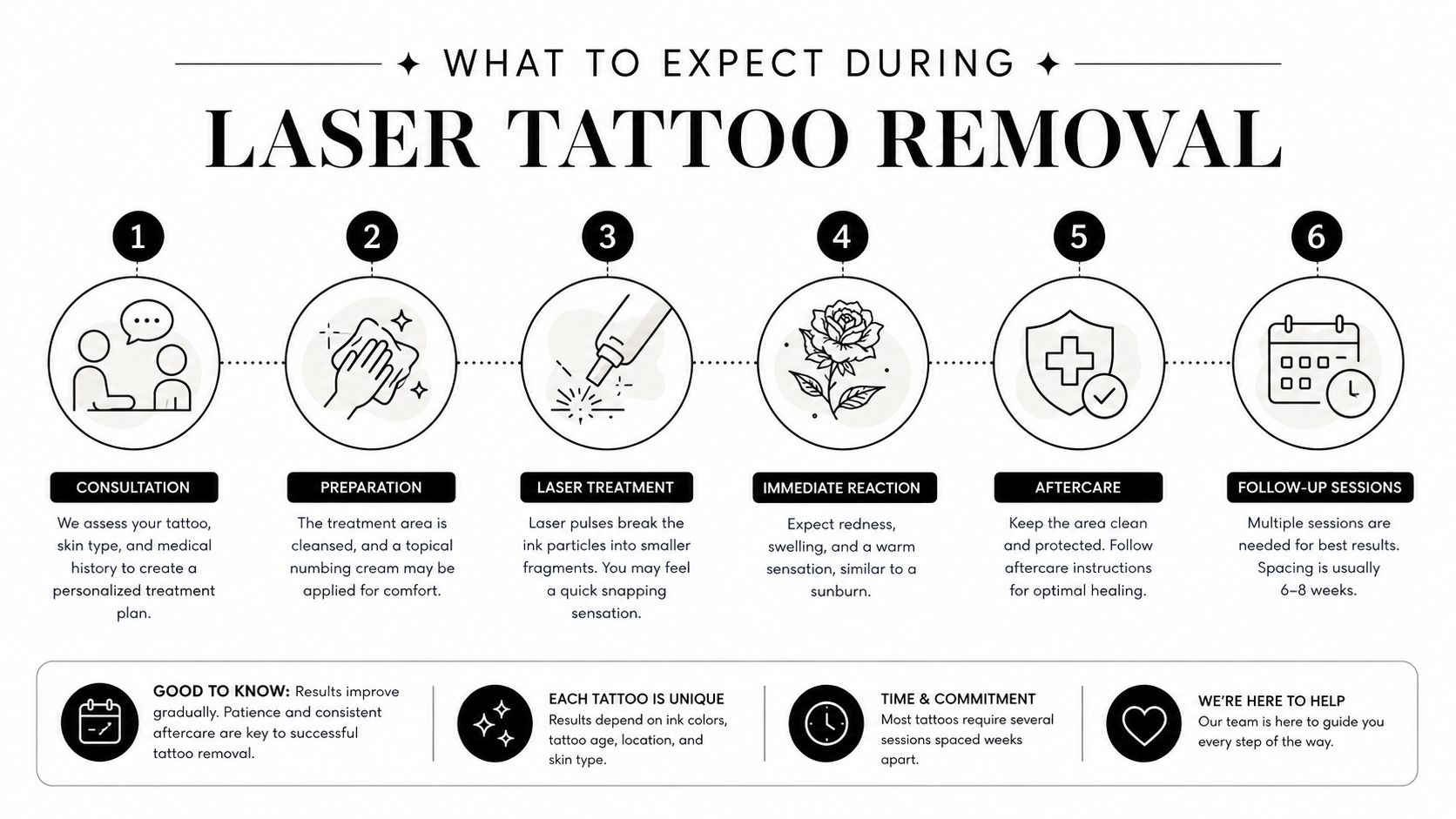
A consultation should feel like an assessment, not a sales pitch. The provider examines the tattoo and surrounding skin, asks about medical history and previous treatment, identifies the ink colors and density, and discusses whether your goal is removal or cover-up fading. You should leave understanding the likely process, possible limitations, aftercare, and how the provider determines treatment settings.
The appointment itself
During treatment, the laser delivers brief pulses of energy into the tattooed skin. The goal is to break ink into smaller particles that the body can gradually clear. Different colors and ink depths respond differently, so one tattoo may require a customized approach rather than a single universal setting.
Some patients describe the sensation as a quick snapping or pulsing feeling. The treated area may show temporary redness, swelling, and a frosted appearance immediately afterward. Those effects can be part of the normal treatment response, but your provider should explain what's expected for your skin and when to report a concern.
Healing determines the pace
Laser treatment isn't a one-visit eraser. The skin needs time to heal, and the body needs time to clear fragmented pigment before the next session. The FDA specifically advises leaving a few weeks between treatments, rather than repeatedly treating the same area before it has recovered.
Follow the clinic's aftercare instructions closely. Keep the area clean, avoid picking or peeling, protect healing skin from unnecessary sun exposure, and contact the provider if the reaction seems more severe than the instructions describe. Your own behavior between visits affects comfort and can influence whether the next session proceeds on schedule.
A systematic review of 36 studies found that Q-switched Nd:YAG and picosecond lasers are safe and effective for black tattoos, while picosecond devices appear more effective for blue, green, and yellow pigments. The review also discussed R20 and R0 techniques as ways to shorten total treatment time, while noting that stronger randomized evidence is still needed to establish the ideal protocol. The systematic review is indexed by PubMed.
How Tattoo Characteristics Affect Your Results
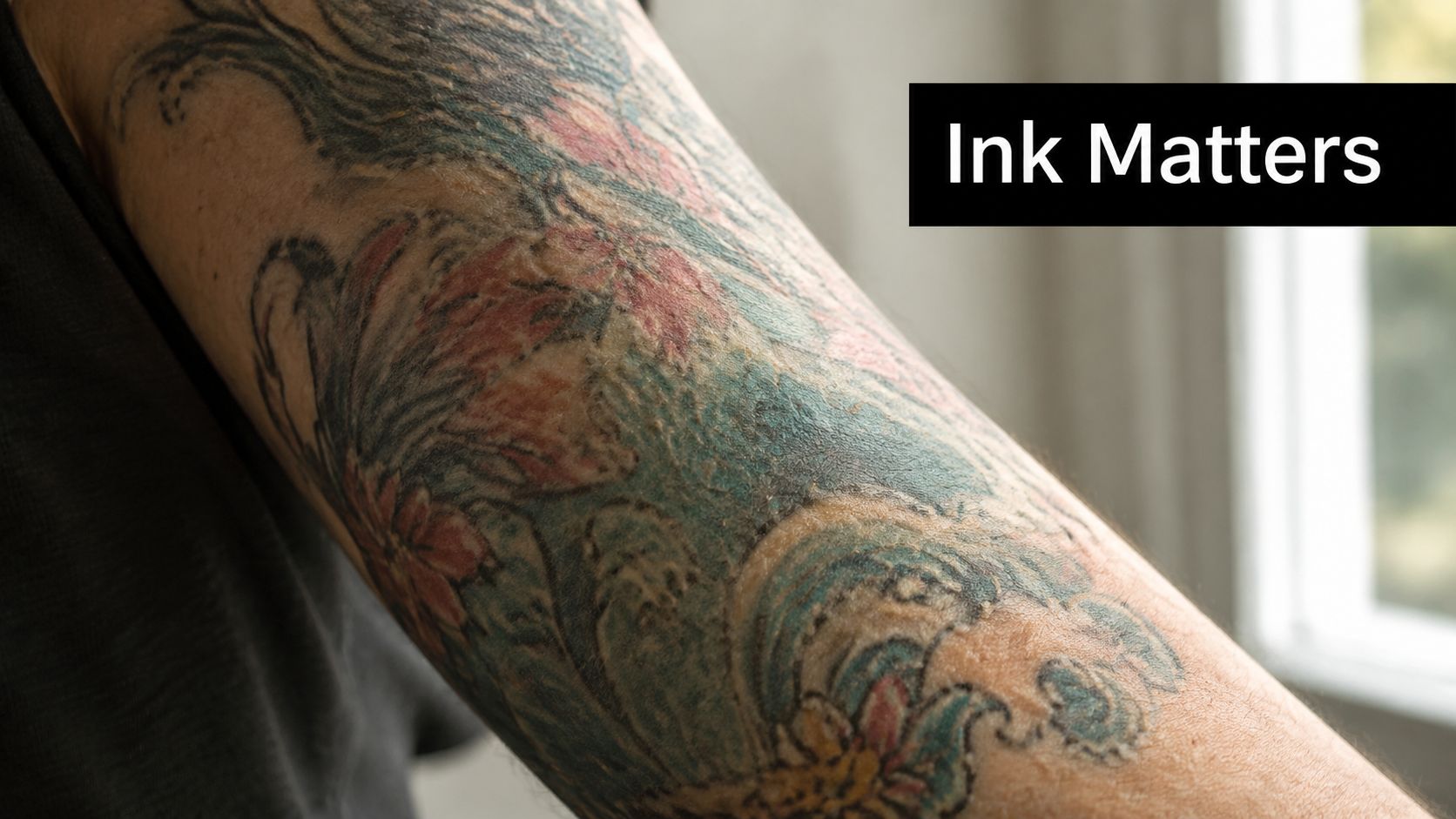
Two tattoos can look similar in a photograph and behave very differently under treatment. A small, older black text tattoo may respond more predictably than a dense, multicolored professional piece. That difference comes from pigment type, depth, saturation, skin response, and the amount of ink packed into the design.
Consider a small black tattoo that has been present for many years. It may be a straightforward candidate for laser assessment, although age alone doesn't guarantee complete clearance. Compare it with a newer professional tattoo containing saturated blue, green, yellow, and red areas. That piece presents more variables, and each color may respond at a different pace.
Color and wavelength matter
Dark blue and black generally respond more readily than lighter colors. The FDA's device review summaries identify 1064 nm for black and blue tattoo removal and 532 nm for red ink removal in a cleared Nd:YAG system, showing why a provider must match wavelength and settings to the pigment. The FDA device review summary offers a concrete explanation of that color-specific approach.
Yellow, green, and red may require more cautious planning because they can be more resistant or behave differently during treatment. A provider who treats every color identically isn't giving you a meaningful plan.
Density, skin type, and placement
Professional tattoos often contain heavier pigment than amateur tattoos, which can make clearance more demanding. Larger designs may also require more appointments because there's more treated surface area. Skin type matters too, particularly when the provider must reduce the risk of unwanted pigment changes and choose settings appropriate for your natural complexion.
Location can influence the process because circulation and individual healing vary across the body. A thorough consultation should account for all of these details rather than quoting a fixed outcome from a photograph.
Human trials of picosecond laser removal found that 69% to 100% of tattoos achieved more than 70% pigment clearance after 1 to 10 sessions, but complete clearance remained limited, especially for professional tattoos. One clinical series reported complete removal in just over 40% of patients overall, with about 30% complete clearance in some phototypes. The clinical findings are available through PubMed. For a practical checklist of variables, review these six factors that can affect tattoo removal progress.
Finding the Right Tattoo Removal Provider
The provider you choose affects more than convenience. A rushed assessment can lead to poor expectations, unsuitable settings, or unnecessary treatment. Look for a clinic that can explain why its chosen technology fits your tattoo rather than naming a machine.
Picosecond devices, including the PiQo4, are commonly discussed for their ability to deliver very short pulses, but the device name alone doesn't prove that a clinic is right for you. Ask who performs the treatment, what training and medical oversight are available, and how the provider handles your specific skin type, ink colors, and treatment goal.
Questions worth asking
- What is the target outcome? Confirm whether the plan is complete removal, lightening for a cover-up, or visual concealment.
- How will you treat each color? The provider should connect wavelength and settings to the pigments in your tattoo.
- What happens if progress slows? A responsible clinic will explain how it reassesses treatment rather than automatically adding sessions.
- What aftercare support is included? You should receive clear instructions for healing and a way to ask questions afterward.
- How is pricing calculated? Request an explanation of whether pricing depends on tattoo size, treatment area, session type, or other factors.
Red flags that deserve attention
Be wary of guaranteed complete removal, pressure to buy a large package before a proper assessment, and pricing that seems disconnected from the work involved. A provider who won't discuss limitations is not giving you informed consent.
A good consultation may leave you with more than one reasonable option. For example, the recommendation might be to fade only the darkest section before meeting a cover-up artist, rather than treating the entire tattoo toward full removal. EradiTatt Tattoo Removal offers laser tattoo removal and consultations that address complete removal or fading goals across its Florida locations, including Orlando, Bradenton and Sarasota, St. Petersburg, Palm Harbor, and Tampa.
Practical rule: Choose the provider who explains your choices clearly, not the one who promises the fastest answer.
Taking the Next Step Toward Tattoo Freedom
Start by writing down what you want from the area. If you want bare skin, ask about a full-removal plan. If you want a new design, speak with a skilled cover-up artist before laser treatment so you know how much fading the artist needs. If you need the tattoo hidden immediately, ask about camouflage while you evaluate longer-term treatment.
Bring useful information to your consultation, including when you got the tattoo, whether it was done professionally, any previous removal attempts, and relevant details about your skin or healing history. Take clear photographs if the clinic requests them, but don't expect a photograph alone to replace an in-person assessment.
Cost concerns, fear of discomfort, and uncertainty about the result are all reasonable. A consultation should address those concerns without forcing you to commit. You can ask whether the provider recommends treating one portion first, how the clinic monitors healing, and what outcome would be realistic for your tattoo rather than for an idealized example.
The most important decision is not whether you can tolerate the idea of full removal today. It's whether you're ready to replace frustration with information. Tattoo regret may feel permanent, but your next step can be gradual, informed, and matched to your goal.
If you hate your tattoos and want a clear plan, visit EradiTatt Tattoo Removal to explore laser removal or cover-up fading through a consultation. Their Florida clinics can assess your tattoo, discuss realistic treatment goals, and outline a personalized path without requiring you to decide on complete removal immediately.