
Most advice about laser tattoo removal white ink starts with the wrong question. People ask, “Can it come out?” The better question is, “Should I try to erase it, or is fading for a cover-up the smarter end point?” White ink behaves so differently from dark pigment that the treatment plan changes before the first pulse is ever fired.
That difference comes down to chemistry, optics, and risk. White tattoo ink often contains titanium dioxide, a reflective pigment that absorbs laser energy poorly, and the FDA warns that white ink, flesh-colored tattoos, and permanent makeup can oxidize and turn black when treated by laser, sometimes permanently (FDA tattoo removal options and results). In practice, that means white ink isn't just stubborn, it can be unpredictable. For a lot of patients, the win is controlled lightening, not a promise of perfect clearance.
Table of Contents
- Why White Ink Plays by Different Rules
- The Chemistry Behind Stubborn White Ink
- How Different Lasers Respond to White Pigment
- What Happens During and After Each Session
- Fading for a Cover-Up Versus Full Removal
- Risks, Side Effects, and the Darkening Problem
- Choosing a Clinic and Getting Ready for Your Consultation
- Your Next Steps Toward Erasing White Ink
Why White Ink Plays by Different Rules
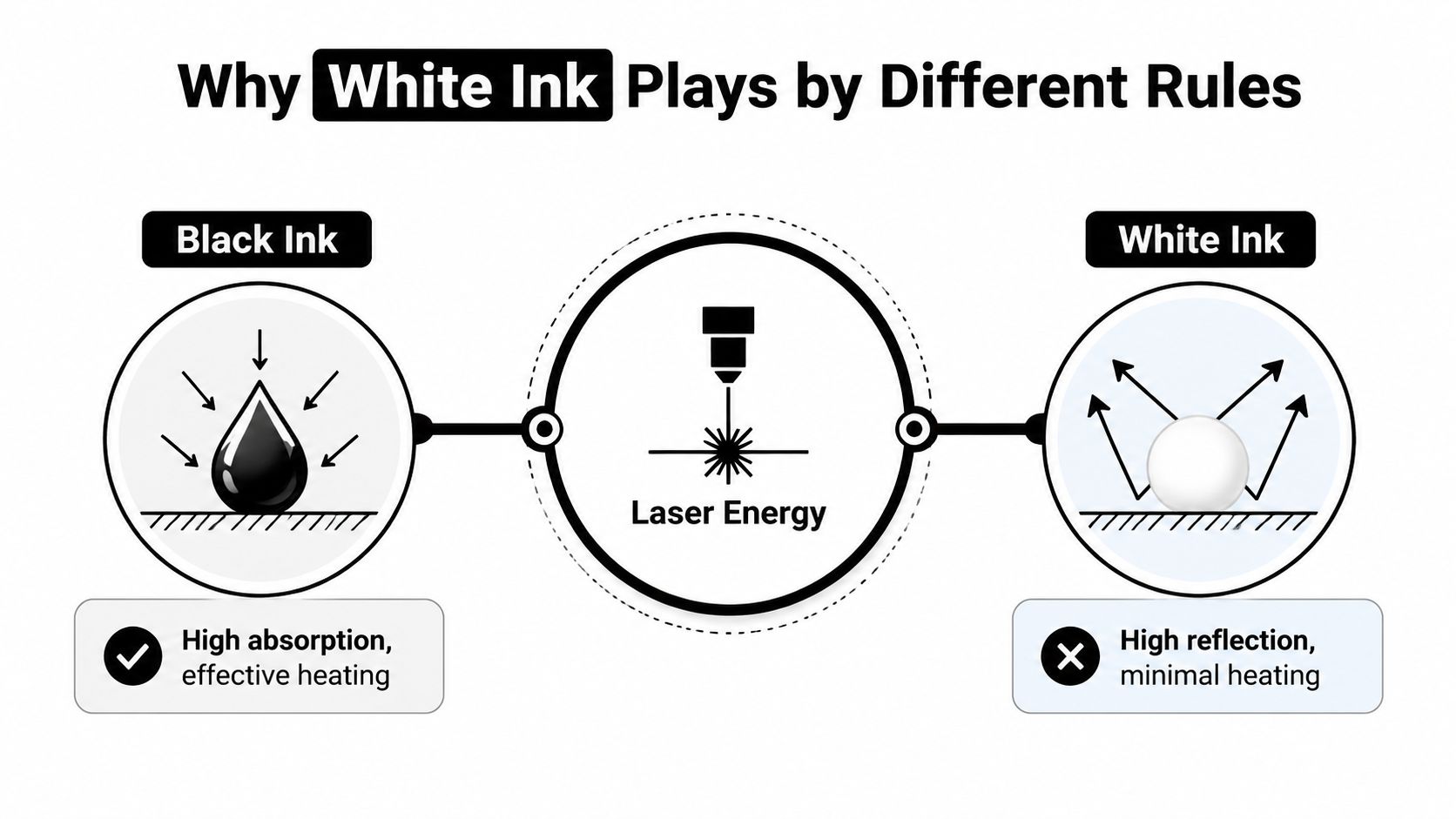
There is a common assumption that tattoo colors differ only in shade. They don't. Black ink absorbs laser energy well because it has strong absorption and smaller particles, while white ink has poor laser absorption and larger particle size, which is why a peer-reviewed analysis found that white tattoo ink had a poor response to Q-switched lasers even after laser darkening (PubMed analysis). That single difference changes everything about planning, timing, and the definition of success.
The practical split between black and white
Black tattoos often clear in a predictable pattern because the pigment responds to the beam instead of bouncing it away. White tattoos do the opposite. The energy tends to scatter, and the skin response can be frustratingly inconsistent. The result is that white ink is often treated as a special case, not just another color on the chart.
Practical rule: if a clinic talks about white ink like it behaves like black ink, the plan is too optimistic.
That's why the best consultation question isn't “What machine do you use?” It's “What outcome is realistic for this specific white tattoo?” In many cases, the answer is fading for a cover-up, not total erasure. That mindset shift matters because a good plan respects both the pigment and the skin.
Why the goal matters more than the slogan
Clinically, laser tattoo removal is already session-intensive. A review in PMC says amateur tattoos typically need 5 to 10 sessions, while professional tattoos often need 15 to 20 sessions, and in rare cases up to 25 sessions (PMC review). White ink sits outside the easiest part of that spectrum because it's less predictable from the start.
The mental model is simple. White ink doesn't just remove slowly, it behaves differently under light. That's why the conversation should start with desired end point, not machine branding. If the goal is a clean canvas, the expectation needs to be conservative. If the goal is to lighten enough for a cover-up, the plan may become much more practical.
The Chemistry Behind Stubborn White Ink
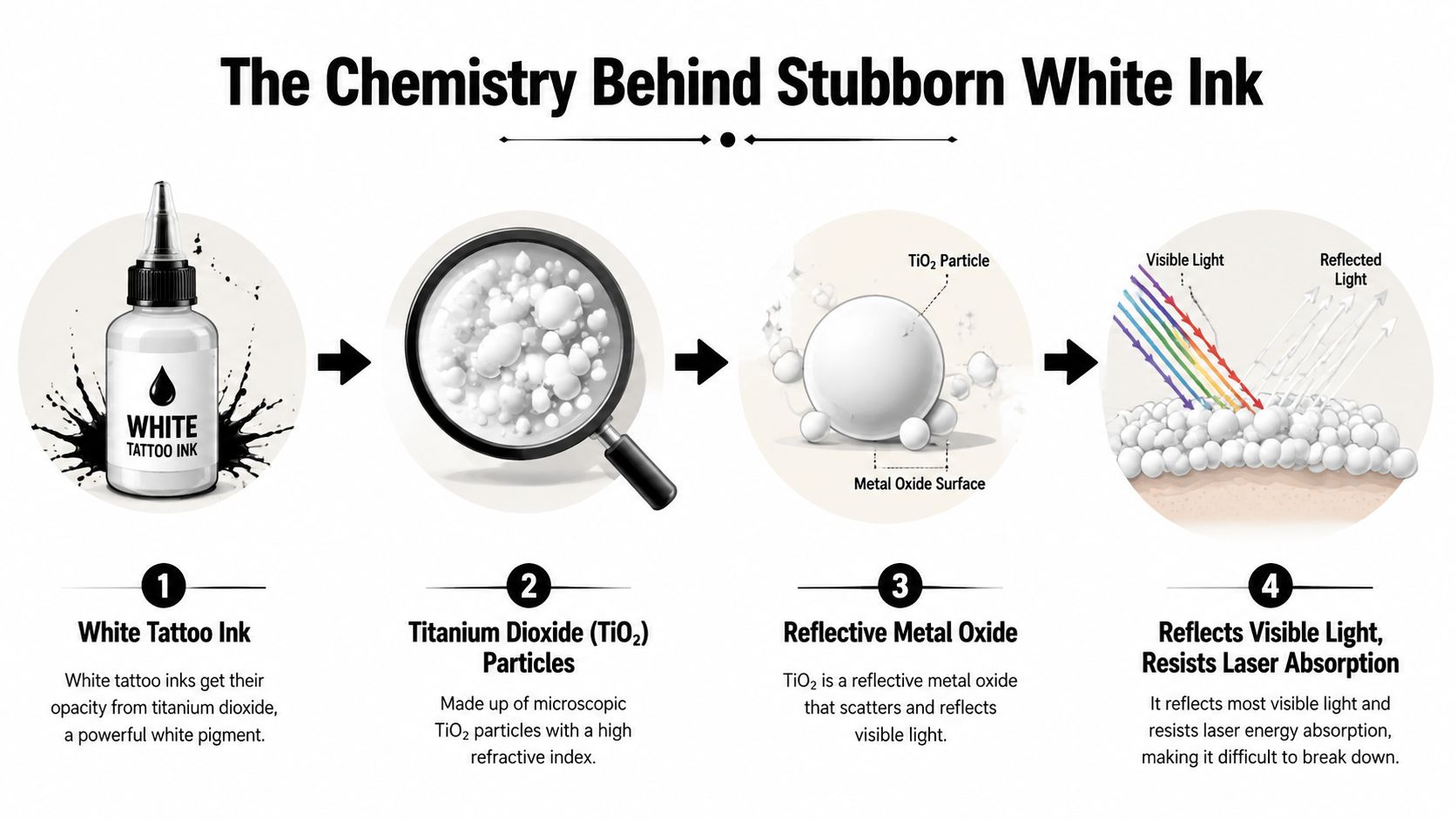
White ink usually is not “white” in the same way paper is white. It often relies on titanium dioxide, a highly reflective pigment that scatters laser energy instead of absorbing it efficiently (InkFadeLab). In practice, that means the beam has a harder time doing the job it does on darker pigment, because the target sends more of the energy back or spreads it out.
Step by step, what the laser is up against
First, the laser reaches the tattooed skin. Dark pigment tends to absorb that energy and convert it into heat and mechanical stress, which helps break the ink apart. White ink is different. A large share of the energy reflects or disperses, so the particle is harder to fragment and the result is often partial fading instead of clean removal.
The chemistry can also move in the wrong direction. Reviews note that white tattoo pigment may contain zinc or titanium oxides, and it can turn black after laser exposure because the pigment is chemically altered (PMC review of paradoxical darkening). That is the part patients rarely expect. A treatment meant to lighten the tattoo can create a darker target that is harder to treat than the original white ink.
Even the change people see during the session can be misleading. A Cutis review reports that immediate whitening, or frosting, can appear after Q-switched treatment and usually lasts about 20 minutes (Cutis review). That reaction can look like progress in the room, but it does not guarantee durable clearance once the skin settles.
Clinical takeaway: white ink needs a different success metric. The real question is whether it can be lightened safely enough to support the next step, usually a cover-up, without triggering darkening or excess skin injury.
The mechanism also explains why consultation language matters. A clinician who understands pigment behavior should talk about oxidation, reduction, and the chance of paradoxical darkening, not just “fading.” That tells you they understand white ink as a pigment-physics problem, not standard black-ink removal with a different color on top.
How Different Lasers Respond to White Pigment
White pigment forces a different question than standard tattoo removal. The better question is whether the goal is true removal, or controlled fading that leaves the skin usable for a cover-up. White ink often contains titanium dioxide, and that chemistry makes traditional laser protocols unpredictable. Some wavelengths barely move it. Others can trigger the opposite of what patients want, including oxidation and permanent darkening.
Comparing the main laser families
Q-switched nanosecond systems were the classic tattoo-removal tools. They are effective for darker pigments because those inks absorb laser energy more readily. White pigment is harder to treat because it tends to reflect, scatter, or otherwise fail to absorb that energy in the same way. In practice, that usually means limited fading rather than clean clearance.
Picosecond devices send energy in much shorter bursts. That can improve mechanical disruption of some tattoo particles, and in a few white-ink cases it may create a better response than older Q-switched systems. The limitation remains the same, though. If the pigment does not absorb the wavelength well, shorter pulse timing only goes so far.
Ablative systems, including carbon dioxide and erbium:YAG, work differently. They remove a thin layer of skin that contains the pigment, so they do not depend on the same absorption behavior as pigment-specific tattoo lasers. That can make them useful for selected white-ink tattoos, especially when the primary goal is fading for a cover-up. The trade-off is higher tissue injury, which raises the risk of scarring and more difficult aftercare.
Real-world rule: if a clinic promises full clearance of stubborn white ink with no mention of darkening risk, patch testing, or scarring trade-offs, the pitch is too clean.
The American Society for Laser Medicine and Surgery says white, pink, red, tan, and light-brown pigments can permanently darken with traditional laser tattoo removal, and that these colors are often better handled with ablative lasers such as carbon dioxide or erbium:YAG lasers (ASLMS tattoo removal guidance). It also says sessions are usually spaced 6 to 8 weeks apart and that 6 to more than 10 treatments may be needed for maximum lightening, with some tattoos never fully resolving.
Laser Response to White Ink at a Glance
| Laser Type | How It Interacts with White Ink | Realistic Outcome |
|---|---|---|
| Q-Switched Nanosecond | Limited absorption, energy often scatters | Modest fading, paradoxical darkening possible |
| Picosecond | Shorter pulse may create some mechanical disruption | Some lightening, but the pigment-physics limit remains |
| Ablative Carbon Dioxide or Erbium:YAG | Physically removes pigment-containing tissue | Can help in select cases, but with scarring risk |
The practical takeaway is simple. White ink does not give every laser the same chance to work, and the device alone never decides the outcome. A clinic has to choose between safer fading, more aggressive tissue removal, or accepting that the pigment may stay visible. For white ink, that is the decision point.
What Happens During and After Each Session
White-ink treatment often feels slow in the chair and more revealing over time. The first step is usually a patch test, because the main question is not only whether the pigment lightens, but whether it shifts color or reacts in a way that makes the area harder to treat. A small test spot gives the clinic a chance to see how your specific tattoo behaves before anyone commits to a full course.
The treatment day in plain terms
During the pulse, many patients notice a brief whitening or frosting response, and that change usually fades quickly. The skin may also feel hot, similar to a mild sunburn, and some pinpoint swelling is common. I also watch closely for any sign of darkening, because with white pigment, that is the outcome that can change the plan fastest.
Over the next day, small blisters can appear in some cases, and redness usually settles over a few days. That is why aftercare matters so much. The skin is not just holding a tattoo, it is recovering from a controlled injury.
Why the gap between sessions matters
Sessions are usually spaced 6 to 8 weeks apart. That spacing is not arbitrary. Your immune system clears fragmented pigment between visits, so rushing the next session does not speed that biology up. The skin also needs time to settle before anyone decides whether the last treatment helped or hurt.
- Patch test first: A small test spot is the safest way to see whether the white pigment darkens.
- Expect gradual change: Progress is usually measured in lightening, not sudden disappearance.
- Respect the interval: The gap between sessions is part of the treatment, not dead time.
- Watch the endpoint: If darkening starts, the plan may need to shift immediately.
Standard tattoo removal already tends to be session-heavy, and white ink can take longer to judge because early changes are not always straightforward. That is one reason patience matters more than aggression here.
The most useful mindset is patience without passivity. You want steady progress, careful documentation, and a clinic that knows when to pause. White ink rewards caution more than force.
Fading for a Cover-Up Versus Full Removal
The decision gets practical. Full removal sounds satisfying, but for white ink it's often the least realistic target. Fading for a cover-up is usually the more flexible goal because the new design can hide what the laser couldn't fully erase. That shift in objective changes the whole conversation from perfection to usability.
When fading is the smarter endpoint
White tattoos are usually light to begin with, so they often don't need to disappear completely to become workable. A skilled cover-up artist may only need the pigment lightened enough to stop it from competing with the new art. That can mean fewer sessions, less skin stress, and a better final result.
A lot depends on the design you want to place over it. Darker inks, richer shading, and larger compositions are easier to plan around than delicate linework. If you want a cover-up, the laser clinic and the tattoo artist should both know that before treatment starts, because the fading target is design-specific.
Best practice: if the new tattoo is the real goal, bring that reference art to the consultation. The laser plan should support the cover-up, not fight it.
What real planning looks like
A practical consult asks a few direct questions. How much white is present? Is the white mixed into other colors, or is it the dominant pigment? Would partial fading be enough for the new design, or is the artist expecting nearly full clearance? Those answers shape how aggressive the treatment should be.
White ink's unpredictability is why “more sessions” isn't automatically better. If the tattoo is already light enough for a cover-up, pushing farther can add risk without improving the final result. In that situation, stopping early can be the smarter call.
For readers in Florida who want a local option, EradiTatt Tattoo Removal offers laser tattoo removal and can be part of a fading-first plan when the goal is to prepare for new work. That kind of conversation is often more useful than a generic promise to erase everything.
Risks, Side Effects, and the Darkening Problem
The main hazard with white ink is the one many people do not expect, paradoxical darkening. The FDA warns that flesh-colored tattoos, white ink, and permanent makeup can oxidize and turn black under laser treatment, and once that happens the pigment may no longer respond in the usual way (FDA tattoo removal options and results). That is not a small side effect. It can change the entire treatment plan.
What darkening means in practice
White pigment often contains titanium dioxide. Under laser energy, that material can shift chemically and change appearance. The tattoo may come back gray, brown, blue-black, or fully black. In some cases the darkened pigment is harder to treat than the original white, which is why a patch test matters before anyone commits to a full series.
The PMC review on white and cosmetic tattoos also notes that white pigment can darken after laser exposure, and that destructive lasers can remove these pigments but carry a scarring risk. The decision is not just whether the tattoo can fade, it is what kind of skin outcome you are willing to accept.
Other risks worth taking seriously
- Scarring: More likely with aggressive or ablative approaches.
- Texture changes: Skin can heal unevenly after repeated treatment.
- Pigment shifts: White can darken, and nearby skin can lighten or darken.
- Infection: Poor aftercare raises the risk, especially if the skin is picked or irritated.
A careful clinic will photograph the tattoo before treatment, after the patch test, and again at each follow-up. That record helps catch darkening early instead of letting it spread across the tattoo. If darkening starts, the provider should stop and reassess, not keep firing.
The safest approach is straightforward. White ink is not a routine laser job. It is a risk-managed decision, and that decision should be made before the first full session, not after the skin has already changed color.
Choosing a Clinic and Getting Ready for Your Consultation
The right clinic should talk about white ink specifically, not just tattoo removal in general. Ask which device they'd use, whether they've treated white pigment before, and how they handle a pigment that darkens instead of fading. If they can't clearly describe their patch-test process, keep looking.
What to ask before you book
- Which laser do you use for white ink? Ask for the actual platform, not a vague “advanced laser” label.
- Do you patch test first? For white pigment, this shouldn't be optional.
- What counts as success? Make sure the answer matches your real goal, removal or cover-up fading.
- What happens if it darkens? You need a plan before treatment begins.
How to prepare your skin
Avoid sun exposure on the area for several weeks before treatment. Skip retinol and exfoliants, keep the skin hydrated, and wear loose clothing so the area isn't irritated before the session. Bring reference photos if you're planning a cover-up, because the laser endpoint should match the next artist's needs.
For people in Central and West Florida, scheduling convenience matters too. EradiTatt Tattoo Removal has locations in Orlando, Bradenton/Sarasota, St. Petersburg, Palm Harbor, and Tampa, and you can call the central 844 number or a nearby clinic directly to set up a consultation. The point is to get a plan, not just a price.
A good consultation should leave you with three things: a realistic endpoint, a patch-test decision, and a timeline you can follow. If you leave with only vague promises, you didn't get enough information.
Your Next Steps Toward Erasing White Ink
White ink is a different category of tattoo removal, not just a harder version of black ink. The safest approach is to treat it as a decision between meaningful fading, possible darkening, and limited true clearance. If your clinic doesn't talk in those terms, the plan probably isn't specific enough.
Book a patch test first. If you're thinking about a cover-up, ask for a fading plan that supports the new artwork instead of chasing total removal at any cost. Prepare your skin, document every stage, and don't rush the interval between sessions.
If you're ready to take the next step, contact EradiTatt Tattoo Removal, ask for a consultation, and bring the tattoo you want to end up with in mind. A careful plan now beats a correction later.
EradiTatt Tattoo Removal helps adults who want white ink lightened or removed with a consultation-first approach that fits the realities of stubborn pigment. If you're ready to find out whether fading or full removal makes more sense for your tattoo, visit EradiTatt Tattoo Removal to book a consultation and start with a patch test.