
You're probably reading this with one clear question in mind. Can laser tattoo removal in San Antonio get rid of the tattoo you're tired of seeing every day, and if so, how much time and money will it really take?
That's the part often not communicated early enough. They hear a per-session price, assume it's a quick fix, then realize later that tattoo removal is a staged medical process. Your skin has to heal, your immune system has to clear fragmented ink, and your result depends on the tattoo itself, your skin tone, and the laser being used.
For people in San Antonio, that last point matters more than many guides admit. A diverse population means skin type has to be part of the treatment plan from the first consultation, especially for Fitzpatrick IV-VI skin where the wrong wavelength or aggressive settings can raise the risk of pigment changes. Good tattoo removal is never just about making ink lighter. It's about doing it safely.
Table of Contents
- How Laser Technology Erases Tattoo Ink
- Key Factors That Determine Your Removal Success
- Mapping Your Removal Journey Timeline and Sessions
- The True Cost of Tattoo Removal in San Antonio
- Finding a Safe and Reputable Clinic in San Antonio
- Your Guide to Treatment Preparation and Aftercare
How Laser Technology Erases Tattoo Ink
Laser tattoo removal works because the laser doesn't “scrape off” the tattoo. It sends a very short burst of light energy into the skin, and that energy targets pigment in the ink.
The easiest way to understand it is this. Think of a tattoo ink particle as a large rock buried in the skin. The laser hits that rock and breaks it into tiny pebbles. Your body can't move the rock efficiently, but it can gradually clear away the smaller fragments through the immune system.
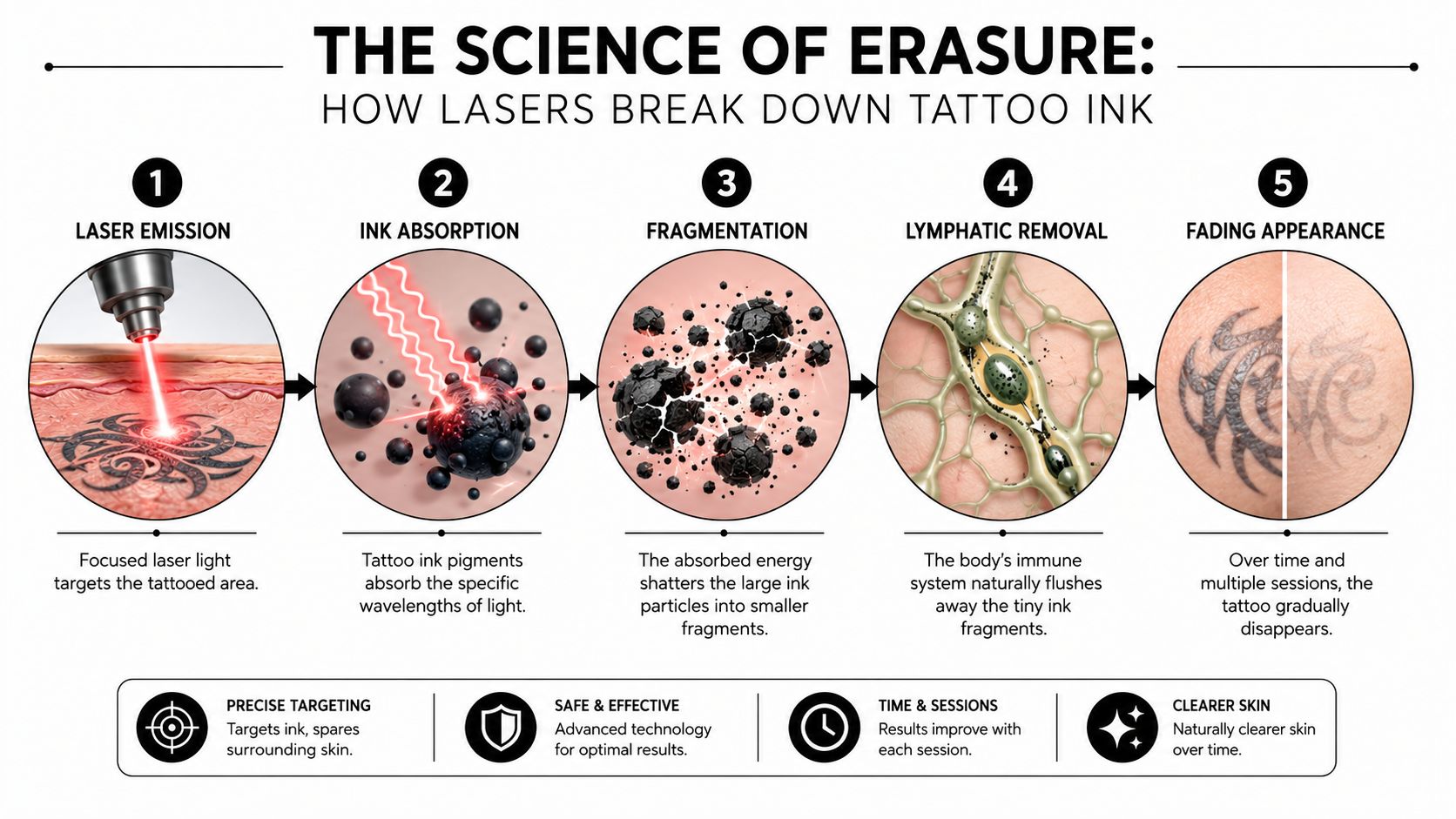
What the laser is actually doing
The clinical term is selective photothermolysis. In plain language, that means the laser is chosen and calibrated to target tattoo pigment while limiting injury to the surrounding skin.
A key technical point matters here. Q-switched lasers, especially Nd:YAG, are the foundation of modern treatment. According to the clinical review on Q-switched laser tattoo removal and selective photothermolysis, laser tattoo removal relies on Q-switched systems, including Nd:YAG at 1064 nm for black and blue ink and 532 nm for red and orange ink, delivering nanosecond-duration pulses that create photomechanical fragmentation of pigment. That same review notes that 1064 nm Nd:YAG is the global benchmark for safety in pigmented skin, including Fitzpatrick IV-VI.
That safety profile is one reason experienced providers lean heavily on Nd:YAG when treating darker skin tones. The laser has to reach the ink effectively without creating unnecessary competition with melanin in the skin.
Practical rule: The right laser doesn't just chase pigment. It has to match both the ink color and the patient's skin type.
Why different colors need different wavelengths
Tattoo colors don't all absorb light the same way. Black and dark blue usually respond better because they absorb a wider range of laser energy. Red and orange require a different wavelength. Some colors are more stubborn and need a slower plan.
This is why a consultation should include more than a glance at the tattoo. The provider should assess color mix, density, layering, and skin tone before choosing settings. If you want a deeper look at how newer systems improve targeting and comfort, this overview of new technology in tattoo removal is a useful companion read.
One more point that surprises patients. The laser session itself isn't the full treatment. The laser starts the process, but your body finishes it. After the session, macrophages and the lymphatic system gradually clear the shattered ink fragments over the following weeks. That's why fading happens between appointments, not just during them.
Key Factors That Determine Your Removal Success
Some tattoos clear beautifully. Others lighten a lot but stop short of complete erasure. The difference usually comes down to a handful of variables that a trained provider should identify before the first pulse.
Tattoo variables matter first
Tattoo composition drives difficulty. Black ink is usually the most responsive. Dense professional tattoos tend to take longer than lighter amateur work because there's more pigment packed deeper into the skin. Older tattoos often have some natural fading already, which can help.
Location matters too. Areas with better circulation generally clear more efficiently because the body's cleanup process depends on blood flow and immune activity.
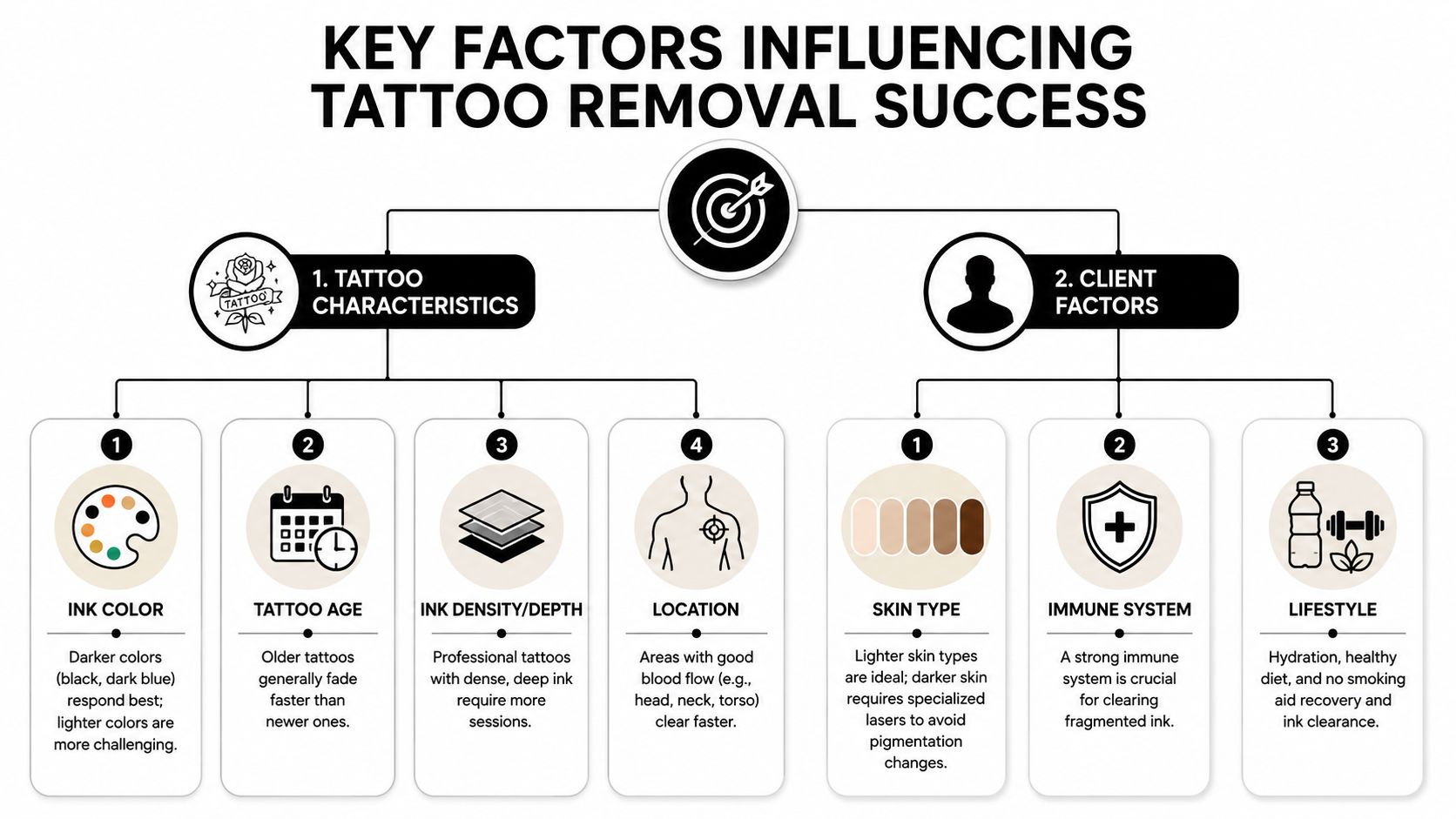
A useful way to frame results is this. Complete removal is possible for many patients, but not every tattoo behaves the same. The clinical benchmark summarized in the tattoo removal review in StatPearls notes that carbon-based black tattoos in fair-skinned individuals have over a 90% chance of complete clearance, while overall complete clearance across all tattoo types averages around 50%.
That gap matters. It's the difference between ideal candidates and real-world tattoos.
Skin type changes the treatment strategy
For San Antonio patients, skin type deserves more attention than it usually gets. Some local guides skip over this, but they shouldn't. The issue isn't whether darker skin can be treated. It can. The issue is that the plan has to be built more carefully.
The same body of reviewed material also highlights an often-missed local concern. For the 40%+ of San Antonio residents who are Hispanic or Latino, the risk of pigment changes after laser treatment deserves a more direct conversation, especially with Fitzpatrick IV-VI skin and colored tattoos, as discussed in this overview of treatment considerations for darker skin in San Antonio.
In practical terms, that means:
- Wavelength choice matters: Safer treatment often depends on selecting a laser that targets ink while minimizing melanin disruption.
- Colored tattoos need patience: Mixed-color designs can respond unevenly, especially in darker skin.
- Conservative settings are not weak treatment: They're often the reason a patient gets safer fading with fewer pigment complications.
- Patch testing and honest counseling help: A careful provider won't promise the same timeline or endpoint for every skin tone.
Patients with darker skin often do best when the provider aims for steady progress, not aggressive one-session drama.
For a broader breakdown of what changes removal speed and outcome, this guide on factors that affect tattoo removal progress covers the decision points patients should understand before starting.
Factors Affecting Tattoo Removal Difficulty
| Factor | Easier to Remove | More Challenging to Remove |
|---|---|---|
| Ink color | Black or darker tones | Mixed or lighter colors |
| Tattoo age | Older tattoos with some natural fading | Newer tattoos with fresh, dense pigment |
| Ink density and depth | Lighter, less saturated tattoos | Professional tattoos with heavy, deep ink |
| Location | Areas with stronger circulation | Areas with slower clearance |
| Skin type | Skin that allows wider treatment flexibility | Fitzpatrick IV-VI skin needing more cautious settings |
| Goal | Fading for a cover-up | Complete removal of a complex tattoo |
Mapping Your Removal Journey Timeline and Sessions
One of the biggest mistakes patients make is treating tattoo removal like a quick appointment series. It isn't. It's a paced process with built-in recovery periods that you can't safely rush.
What a realistic schedule looks like
In the San Antonio market, laser tattoo removal typically takes an average of 7 to 10 sessions for significant clearance, with sessions spaced 6 to 8 weeks apart, and fading for a cover-up averages 2 to 4 treatments, according to this San Antonio tattoo removal timeline guide.
That difference between removal and fading is important. If your goal is a cleaner canvas for a cover-up, you may not need to chase complete clearance. A strategic reduction in pigment can be enough for a tattoo artist to work over it more effectively.
Why waiting between sessions matters
The waiting period isn't a scheduling inconvenience. It's part of the treatment.
After the laser breaks apart the pigment, your body needs time to process and remove those fragments. Healing also has to happen at the skin level before the next pass. If someone tries to book sessions too close together, they're not speeding things up. They're often adding irritation while getting less value from the next treatment.
Here's the pattern most patients notice:
- Right after treatment: The area looks reactive. That's normal.
- Over the following weeks: The tattoo gradually softens or lightens.
- At the next visit: The provider evaluates what cleared, not just what looked lighter on day one.
The best treatment calendars respect biology. Skin heals on its own timeline, and ink clearance does too.
Session length also varies with tattoo size. Small tattoos can be treated quickly, while larger or multicolored pieces naturally take longer in the chair. That doesn't mean they're poor candidates. It means they require a more deliberate treatment plan and realistic pacing.
If you're planning around a wedding, enlistment, job search, or a cover-up appointment, don't book based on wishful timing. Build in enough months for multiple sessions and visible fade between them.
The True Cost of Tattoo Removal in San Antonio
A common question is, “What does one session cost?” That's understandable, but it's not the question that protects your budget. The better question is, “What will the whole removal project cost me by the time I'm done?”
What people usually hear first
In San Antonio, the average cost for a single laser tattoo removal session is $153, with prices ranging from $45 to $463, based on analysis of the local market in this San Antonio tattoo removal pricing overview. That's a wide spread, and there's a reason for it.
Price changes with tattoo size, color complexity, ink density, and the clinic's pricing model. A small black tattoo is usually at the lower end. A larger multicolored design costs more because it takes more treatment time and may require more precise technical work.
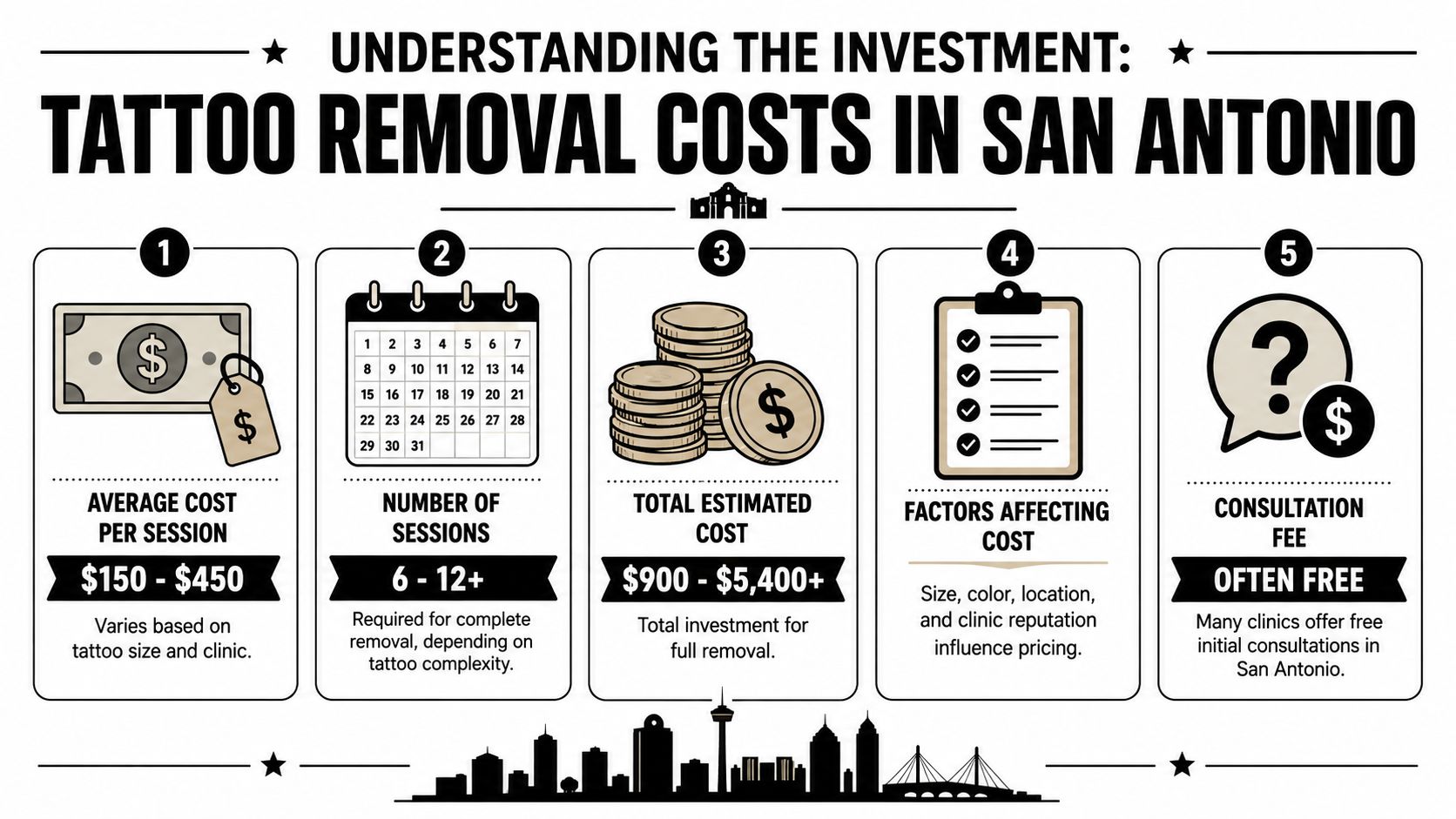
What the full project often costs
Sticker shock often accompanies the financial details. The same San Antonio pricing analysis states that, because most tattoos require 7 to 10 sessions, the realistic total financial commitment often ranges from $1,000 to $3,500 in the local market.
That total is what patients should plan around, not the starting session fee. A low quoted price can still lead to a substantial overall investment if the tattoo is dense, large, or slow to clear.
A practical way to think about budgeting is to separate your decision into three questions:
- What's my goal: Full removal or fading for a cover-up?
- How complex is the tattoo: Black script behaves differently than a layered multicolor piece.
- Can I commit to the full course: Not just one or two visits, but the likely sequence needed to get a meaningful result?
Budget insight: The cheapest session isn't always the lowest total cost if the treatment plan is poorly matched to your tattoo and skin.
There's also a local resource angle people often miss. Some community-focused options in the area offer much lower session pricing, and certain programs may help eligible residents with highly visible tattoo removal needs. That's worth asking about if cost is the main barrier.
The larger point is simple. Good financial planning for laser tattoo removal in San Antonio starts with the total arc of treatment. When a clinic only talks about the first session price and avoids the likely overall spend, patients don't get a realistic picture of the commitment.
Finding a Safe and Reputable Clinic in San Antonio
The provider you choose matters as much as the laser itself. A good clinic doesn't just own equipment. The staff should know how to match that equipment to tattoo color, depth, skin tone, and treatment goals without overselling the result.
What to ask before you book
Use the consultation to interview the clinic. Patients sometimes act like they're being evaluated, but this works both ways.
Ask direct questions such as:
- What laser platforms do you use: The clinic should be able to name the system and explain why it fits your tattoo and skin type.
- How do you treat darker skin safely: If you have Fitzpatrick IV-VI skin, the answer should be specific, not vague reassurance.
- Can I see before-and-after examples: Look for results on tattoos similar to yours and, when relevant, on skin tones similar to yours.
- How do you price treatment: You want clarity on session cost, likely session count, and whether the quote changes with size or color complexity.
- What should I expect if complete removal doesn't happen: Honest clinics talk about fading, residual ghosting, and realistic endpoints.
If you want an outside perspective to compare against what a clinic tells you, this resource offers expert tattoo removal advice San Antonio in a way that helps patients ask smarter questions.
Red flags worth taking seriously
A few warning signs should slow you down.
One is guaranteed language. No responsible provider can promise that every tattoo will fully disappear. Another is a one-size-fits-all treatment plan. If the consultation barely touches skin type, color mix, or your end goal, that's a problem.
Watch for these issues:
- Rushed assessments: A quick glance is not a proper evaluation.
- No discussion of pigment risk: That matters, especially for darker skin.
- Pricing that feels evasive: If you can't get a clear explanation, expect confusion later.
- Aggressive treatment promises: “We can blast it off fast” is not a sign of skill.
- No aftercare guidance: Good clinics know that outcome depends on what happens after the session too.
A careful clinic often sounds more measured than a flashy one. That's usually a good sign.
The best consultation leaves you feeling informed, not pressured.
Your Guide to Treatment Preparation and Aftercare
A strong result depends on more than what happens in the treatment room. Your prep and aftercare affect healing, comfort, and how smoothly the process moves from one session to the next.
What to do before your appointment
Keep it simple and consistent.
- Protect the area from sun exposure: Recently tanned or irritated skin is harder to treat safely.
- Shave if needed: If hair covers the tattoo, shaving helps the laser reach the target area cleanly.
- Arrive with clean skin: Skip lotions, oils, and anything that sits on the treatment area.
- Review medications with your provider: If something may affect sensitivity or healing, that conversation should happen before treatment.
- Hydrate and plan your day: Well-hydrated skin tends to recover better, and loose clothing helps if the area feels tender afterward.
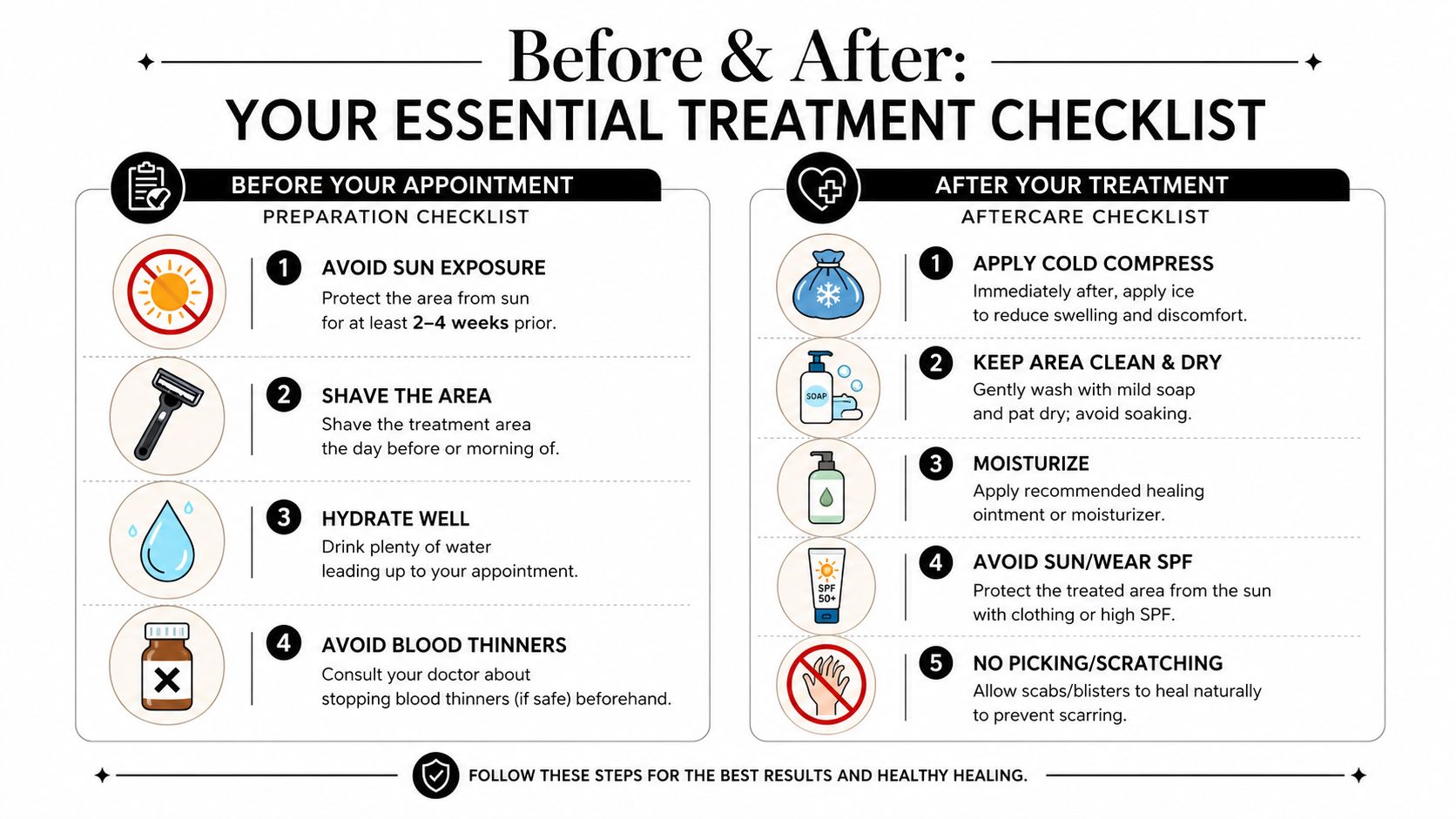
What to do after your session
Most patients can handle aftercare well if they know what's normal. The treated area may look red, feel warm, and become swollen or sensitive. Some people also see blistering or light scabbing. That doesn't automatically mean something went wrong.
A clean routine helps:
- Use a cold compress: This can reduce heat and swelling early on.
- Keep the area clean and dry: Gentle washing is fine. Soaking it usually isn't.
- Apply only what your provider recommends: Don't experiment with random creams.
- Leave blisters and scabs alone: Picking creates unnecessary risk.
- Keep the area out of direct sun: Sun exposure can make healing harder and increase the chance of pigment issues.
For a more detailed look at healing habits that support better outcomes, this article on why aftercare is important after laser tattoo removal is worth reading before your first appointment.
The patients who heal best usually aren't doing anything fancy. They're protecting the skin, following instructions, and giving each session time to work.
If you're ready to move forward with laser tattoo removal in San Antonio, start with a professional consultation that gives you a realistic timeline, a clear budget, and a treatment plan built around your skin and your tattoo, not a generic script.
If you're ready to take the first step, EradiTatt Tattoo Removal offers consultations for full removal and cover-up fading with a focus on clear expectations, safe treatment planning, and supportive guidance from start to finish.