Most advice about laser tattoo removal scars starts in the wrong place. It treats the laser as the main threat, when the bigger issue is usually a mix of pre-existing skin texture, provider technique, and what happens during healing.
That matters because fear pushes people toward the wrong questions. Instead of asking only, “Will the laser scar me?”, ask, “Was there already scar tissue in this tattoo, is the technology precise, and will I follow aftercare closely enough to let the skin heal cleanly?” Those are the questions that shape results.
Table of Contents
- The Surprising Truth About Tattoo Removal Scars
- How Modern Lasers Prevent Skin Damage
- Your Scar Prevention Playbook Before and After Treatment
- Managing and Treating Scars After Removal
- Assessing Your Personal Scarring Risk
- Frequently Asked Questions About Scarring
The Surprising Truth About Tattoo Removal Scars
The biggest myth around laser tattoo removal scars is that the laser usually creates them. In many cases, that's not what happened.
Data shows 75 to 90% of reported “removal scars” are pre-existing injuries from the original tattoo application that become visible only after ink fades, according to this patient FAQ review on tattoo removal scarring. That hidden damage can come from the tattoo being placed too deep, repeated passes over the same area, poor healing after the original tattoo, or scar-prone skin reacting during the tattooing process.
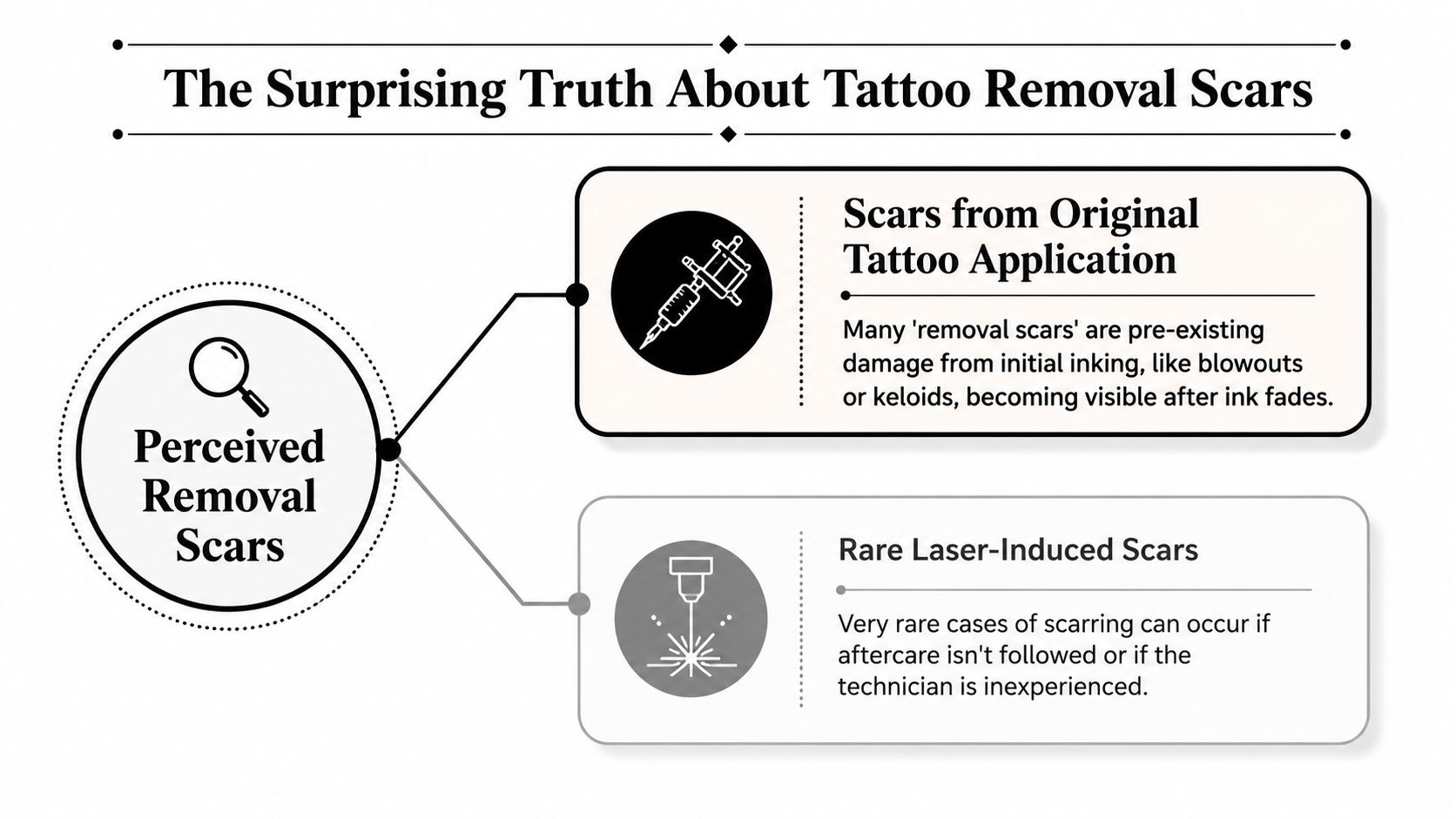
What people call a removal scar
Ink hides a lot. Dense pigment can mask raised texture, shallow indentations, uneven collagen, and blowout-related distortion. As the ink lightens, the skin's actual surface becomes easier to see. Patients often notice that texture for the first time during the removal process and assume the laser caused it.
That misunderstanding is common because tattoos don't sit like paint on a wall. They sit inside living skin that may already have been stressed years earlier.
Practical rule: If a tattoo felt raised before treatment, had patchy healing when it was applied, or always looked slightly uneven in texture, there's a real chance the scar tissue was already there.
Why that misunderstanding matters
This changes how you should choose a clinic. If you think lasers are scarring, you might focus only on pain or price. The better focus is technique, candid assessment, and honest skin evaluation before the first pulse.
A careful practitioner should look for signs of old trauma before promising perfectly smooth clearance. That includes raised lines, shiny areas, edge distortion, and parts of the tattoo that feel firmer than surrounding skin. When those signs are present, the goal is not to pretend the skin is flawless underneath. The goal is to remove or fade the ink while protecting the skin that remains.
Patients usually feel more confident once they understand this distinction. The conversation becomes more accurate. Instead of “Will the laser ruin my skin?” it becomes “What was already there, and how do we avoid making it worse?”
How Modern Lasers Prevent Skin Damage
The safety of modern tattoo removal comes from precision. A good laser treatment doesn't scrape, sand, or cut away the skin. It targets pigment.
How selective photothermolysis works
The core concept is selective photothermolysis. In plain language, the laser sends energy at a wavelength the ink absorbs more readily than the surrounding skin. That lets the treatment focus on pigment while minimizing injury to nearby tissue.
A simple way to think about it is this. The laser is designed to hit the ink, not the skin around it. That's why modern devices, especially Q-switched systems and newer picosecond platforms, are used instead of older destructive methods. According to NCBI Bookshelf on laser tattoo removal, when experienced practitioners use medical-grade Q-switched equipment, scarring is described as having a very low incidence and as “very rare” because the laser selectively targets ink and reduces damage to surrounding skin compared with excision or dermabrasion.
If you're also comparing laser technologies more broadly, this overview of advanced laser skin rejuvenation is useful because it shows how picosecond systems are designed to create less thermal spread in skin-focused treatments.
For a closer look at equipment advances in tattoo fading, this article on new technology in tattoo removal gives a helpful overview of how newer platforms changed treatment strategy.
Why older methods scarred more often
Older removal approaches were rough on skin because they relied on destruction. Dermabrasion physically removed layers. Excision cut the tattoo out. Salabrasion damaged the skin barrier to strip pigment. Those methods had a much higher scarring burden because skin injury was built into the treatment itself.
Modern laser work is different.
| Method | How it works | Scarring outlook |
|---|---|---|
| Excision | Cuts tattooed skin out | Higher scar potential because cutting is part of the method |
| Dermabrasion | Abrades skin surface | Higher scar potential due to surface trauma |
| Laser removal | Targets ink particles within skin | Lower scar potential when settings and aftercare are appropriate |
A well-chosen laser setting should challenge the ink, not punish the skin.
That doesn't mean lasers are foolproof. Aggressive settings, poor spacing between sessions, or using the wrong wavelength for the patient can still create problems. But the technology itself is built to avoid the kind of widespread tissue damage that older methods caused.
Your Scar Prevention Playbook Before and After Treatment
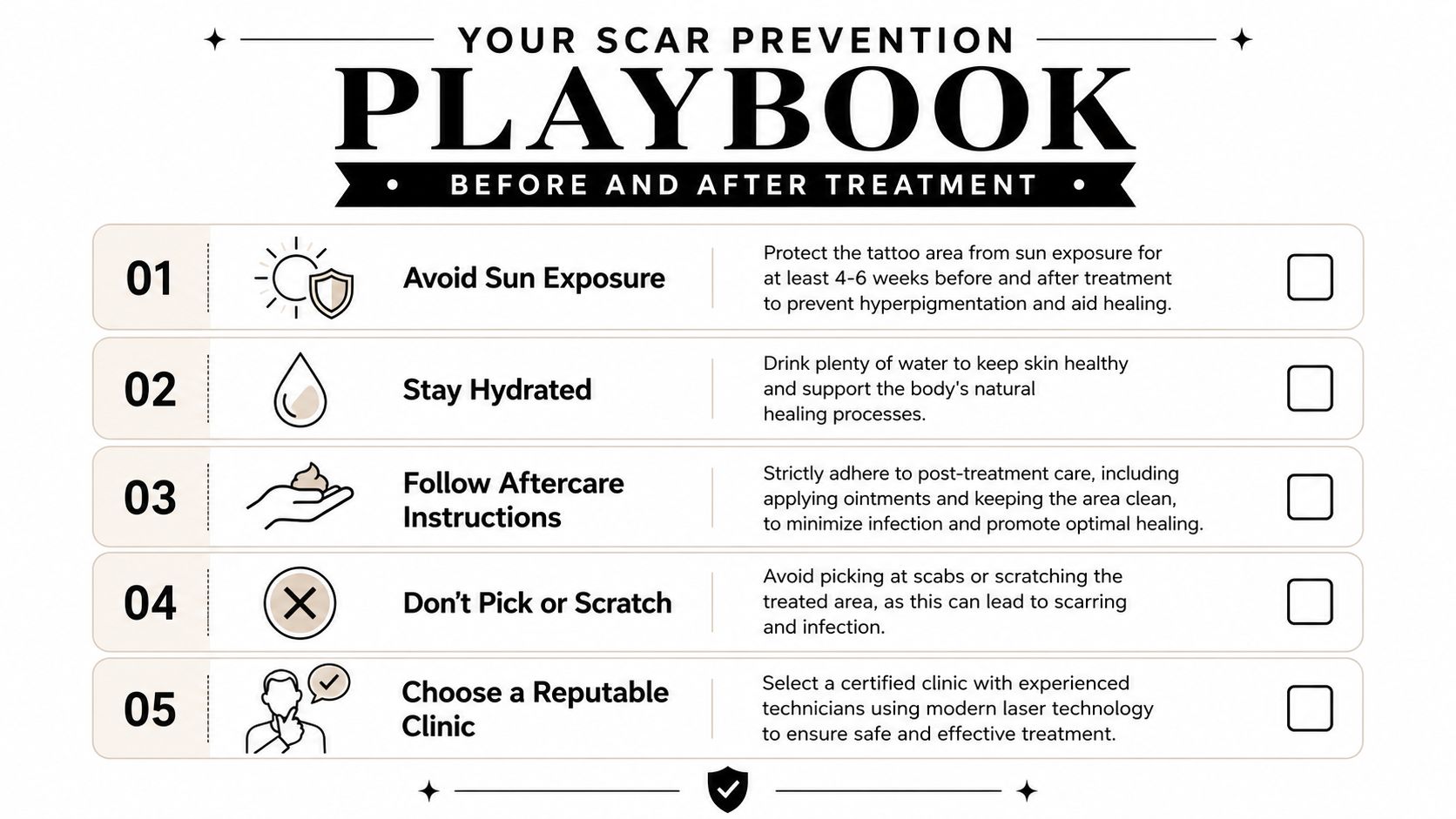
Here is the part many patients miss. Scars are rarely created out of nowhere during removal. In clinic, what we often see is pre-existing texture from the original tattoo process becoming easier to spot as the ink clears. Your job before and after treatment is to keep normal healing from turning that hidden texture into a more obvious scar.
Before your appointment
Good scar prevention starts before the laser fires.
Come in with untanned, unbroken, non-irritated skin. Recent sun exposure, scratching, harsh exfoliation, and active rashes all make the skin less predictable under treatment. If the area looks angry on the day, healing usually gets harder, not easier.
Tell your provider how the tattoo was done and how it healed. I pay close attention when a patient says the tattoo was heavily worked, touched up several times, stayed raised after it healed, or formed thick lines that felt ropy from the start. Those details often point to scar tissue that already existed under the ink.
Also disclose your own healing history. If you have formed thick scars after cuts, surgery, piercings, or cosmetic procedures, that changes how cautious your treatment plan should be. Patients who have looked into scar care after other procedures, including resources on San Antonio tummy tuck scar care, usually understand this trade-off well. Skin memory matters.
After your appointment
Aftercare decides whether the skin recovers cleanly or gets irritated enough to leave a mark.
Follow the clinic instructions exactly. Gentle cleansing, a simple healing ointment if recommended, and sun protection do more good than a drawer full of random products. If you want a clearer routine, this guide on why aftercare matters after laser tattoo removal explains the healing priorities well.
A few rules prevent most avoidable problems:
- Do not pick scabs or peel loose skin. That is one of the fastest ways to turn surface trauma into lasting texture.
- Leave blisters alone unless your provider tells you otherwise. Small blisters can be a normal response.
- Keep friction low. Tight clothing, gym equipment rubbing the area, and scratching in your sleep can all slow repair.
- Protect the area from UV exposure. Sun can worsen pigment change and make any texture stand out more.
- Space sessions properly. Skin needs time to recover fully before the next treatment. Rushing sessions raises the chance of inflammation-related complications.
What goes wrong in real life
The mistakes are usually practical, not mysterious.
Patients scrub flaky skin because they think it is dead tissue that should come off. They use retinoids, acids, or exfoliants too early because the area looks closed on the surface. They book the next session based on impatience instead of healing. Each of those choices increases irritation, and irritated skin scars more easily.
The goal is controlled treatment followed by quiet healing. If you remember one thing, remember this. The laser does not need help after the appointment. Your skin needs time, protection, and restraint.
Managing and Treating Scars After Removal
If you already have visible texture after a tattoo fades, don't assume nothing can be done. The first step is figuring out what kind of scar or surface change you're seeing.
Start with the scar type
Two patterns show up often in practice. Atrophic scars look slightly indented or thinned. Hypertrophic scars sit raised above the surrounding skin. Some patients also have pigment change that reads like a scar from a distance but is a color issue rather than a texture issue.
That distinction matters because treatment choices differ. Raised scars may respond better to flattening strategies, while indented scars usually need collagen remodeling approaches.
| Skin change | What it tends to look like | Common next step |
|---|---|---|
| Raised texture | Firm or elevated area | Medical evaluation, often silicone-based care first |
| Indented texture | Slight depression or uneven contour | Texture-focused treatment plan |
| Color mismatch | Lighter or darker patch with little texture change | Pigment-focused observation and sun avoidance |
At-home care and when to escalate
For mild, stable scarring, start simple. Silicone sheets or silicone gel are often the most practical first step for raised scars. Scar massage may help some mature scars once the skin is fully healed, but don't do that on fresh or fragile skin. Sun protection also matters because color contrast can make any scar more obvious.
If the scar is thick, itchy, growing, or clearly raised, it makes sense to involve a dermatologist or medical scar specialist. They may consider options such as steroid injections for hypertrophic or keloid-type scars, microneedling for selected texture issues, or fractional resurfacing when the skin is ready.
For readers who want a practical example of how scar care principles apply across procedures, this resource on San Antonio tummy tuck scar care is useful because the same basics apply. Protect the scar, support remodeling, and don't judge the final appearance too early.
Early scar care is usually conservative. The mistake is waiting too long to get help when a raised scar keeps thickening.
One more point matters here. If the tattoo was scarred before removal began, removing the ink won't erase that underlying structure. In those cases, scar treatment and ink removal are two separate conversations. Patients do better when those goals are kept separate from the start.
Assessing Your Personal Scarring Risk
Scarring risk isn't the same for every patient. Some people heal cleanly from almost anything. Others form thick scars after minor trauma. A smart consultation should sort that out before the first session.
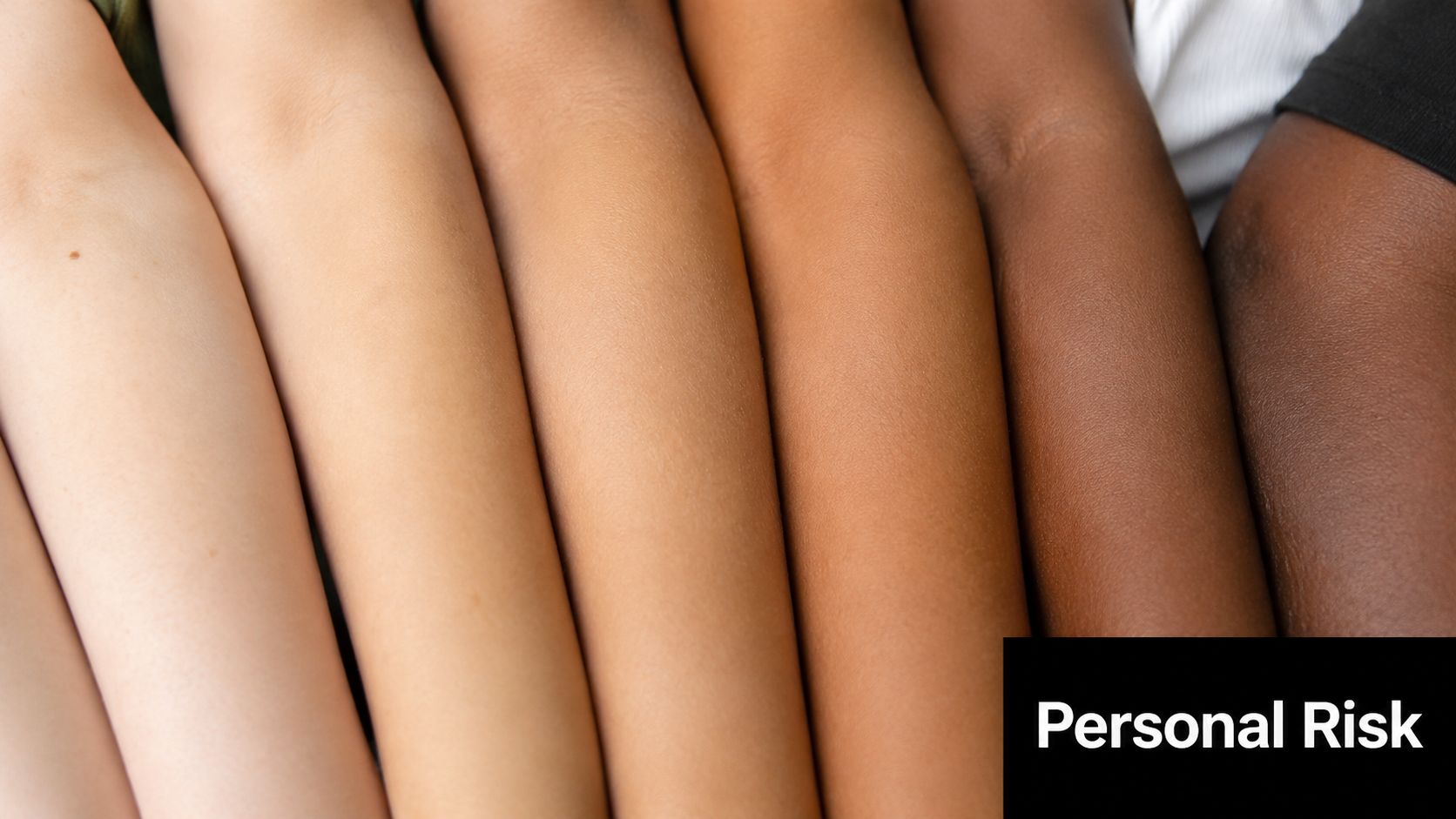
Skin tone healing history and tattoo variables
According to a 2013 survey of laser tattoo removal patients, 24% reported slightly visible scars and 8% reported significant scarring. The same survey found that nearly half experienced hypopigmentation and 25% reported UV exposure after treatment, which is a useful reminder that healing behavior and pigment response often shape what patients later describe as scarring.
Several personal factors deserve attention:
- Skin type: Darker skin tones often need more careful wavelength selection and stricter pigment-focused aftercare.
- History of raised scars: Past keloids or thick scars after piercings, acne, surgery, or cuts should always be discussed.
- Tattoo location: Areas with thinner skin or more movement may heal differently than fleshy, stable areas.
- Tattoo density: Dense blackwork, layered cover-ups, and uneven amateur ink often require more caution than lighter, more uniform tattoos.
- Sun habits: If you spend a lot of time outdoors, that changes the aftercare conversation.
For a broader look at variables that affect treatment progress, this guide to factors that can affect tattoo removal progress gives a useful framework.
Questions worth asking in consultation
A strong consult isn't just “How many sessions will I need?”
Ask questions like these:
- Do you see any pre-existing scar tissue in this tattoo?
- How will you adjust treatment if my skin tends to pigment easily?
- What healing signs are normal for me, and what signs mean I should call?
- Will my skin tone affect wavelength choice or aftercare?
Those questions usually lead to better planning than asking for quick guarantees. Good providers don't promise perfect skin to everyone. They assess, explain, and adapt.
Frequently Asked Questions About Scarring
Can laser tattoo removal cause keloids
It can in people who are already prone to them. Patients with a history of keloid formation are at a small but present risk and may need different protocols, including prioritizing Nd:YAG wavelengths, according to this overview of laser tattoo removal considerations for keloid-prone and darker skin patients.
If you've formed a keloid from a piercing, surgery, or acne lesion, say that early. That history matters more than a general fear of scarring.
Does darker skin mean I will scar
No. Darker skin doesn't automatically mean you'll scar. It does mean pigment changes are more common and can be mistaken for scars if healing isn't managed carefully.
Patients with skin types 4 through 6 need thoughtful laser settings and disciplined aftercare, especially around sun exposure and irritation. The main goal is to reduce unnecessary inflammation so temporary darkening or lightening doesn't become the thing patients later interpret as permanent damage.
Can I remove a tattoo that is already scarred
Yes, but expectations need to be accurate. Laser treatment can target the ink in a scarred tattoo, but it doesn't function as a scar eraser. If the original tattooing process left raised or uneven skin behind, removing the pigment may make that texture easier to see.
That's not a reason to avoid treatment. It just means the endpoint may be “less ink with visible old texture,” not “untouched skin.”
What looks like scarring but isn't
Several things can be mistaken for laser tattoo removal scars:
- Temporary hypopigmentation: The skin looks lighter than the surrounding area.
- Temporary hyperpigmentation: The area looks darker after inflammation.
- Post-treatment dryness: Flaking can exaggerate texture for a while.
- Residual raised tissue from the original tattoo: This is often blamed on removal even when it existed beforehand.
If the skin color is changing but the surface feels mostly smooth, you may be dealing with pigment shift rather than a true scar.
The best approach is to judge results slowly and with good light. Freshly healed skin often looks more dramatic than mature healed skin.
If you want a clear plan for fading or full removal, EradiTatt Tattoo Removal offers consultations across Florida with a practical, supportive approach. Whether you're preparing for a cover-up or ready to remove unwanted ink completely, the team can help you understand your skin, your tattoo, and the safest path forward.