
You may be looking at a red tattoo right now and wondering whether it's removable at all. Maybe it was bright and intentional when you got it, and now it feels loud, dated, or tied to a version of your life you've moved past. Red ink tends to draw the eye even after the rest of a tattoo starts to dull, which is why people often notice it first when they decide they're ready for a change.
That's also where frustration starts. Many clients assume all tattoo ink behaves the same under a laser, then learn that red follows different rules than black. The good news is that red ink can often be treated successfully. The catch is that results depend on the pigment itself, the wavelength used, your skin, and how the tattoo was originally applied.
Table of Contents
- That Stubborn Red Tattoo You Want Gone
- The Science Behind Why Red Ink Is So Tricky
- Matching the Right Laser to Your Red Tattoo
- Setting Realistic Expectations for Your Removal
- Potential Risks and Essential Aftercare
- How to Choose a Clinic and Start Your Journey in Florida
- Frequently Asked Questions About Removing Red Ink
That Stubborn Red Tattoo You Want Gone
A common scenario looks like this. Someone had a red rose, a bright script piece, or a red-heavy traditional tattoo that once felt bold and personal. Years later, the black outline may have softened, but the red still flashes through shirts, work clothes, wedding photos, and everyday moments in a way that keeps pulling attention back to it.
That's why red ink removal usually starts with a practical question, not a cosmetic one. Can this fade enough to stop being the first thing people see?
In clinic conversations, the answer is rarely a simple yes or no. Some red tattoos fade steadily with the right wavelength and spacing between sessions. Others contain mixed pigments, layered ink, or dense packing that make the process slower than clients expect.
Why this feels different from removing black ink
Black tattoos have trained people to think tattoo removal is straightforward. Red changes that expectation fast. It often responds, but not in the same way, and not with the same level of predictability.
If you're still getting familiar with the basics before focusing on color-specific issues, this primer on understanding tattoo removal gives helpful context on how the process works overall.
Red ink isn't impossible. It just asks for better matching between the pigment, the laser, and the treatment plan.
What most clients need at the start
People don't need hype. They need a clear explanation of what's going on and what to watch for.
- A realistic assessment: You want to know whether you're aiming for full clearance or enough fading for a cover-up.
- A reason for the difficulty: Red can be stubborn for specific chemical and optical reasons, not because your tattoo is uniquely “bad.”
- A treatment path that fits your skin and ink: The right approach depends on more than the color you can see on the surface.
Once you understand why red ink behaves differently, the rest of the process makes a lot more sense.
The Science Behind Why Red Ink Is So Tricky
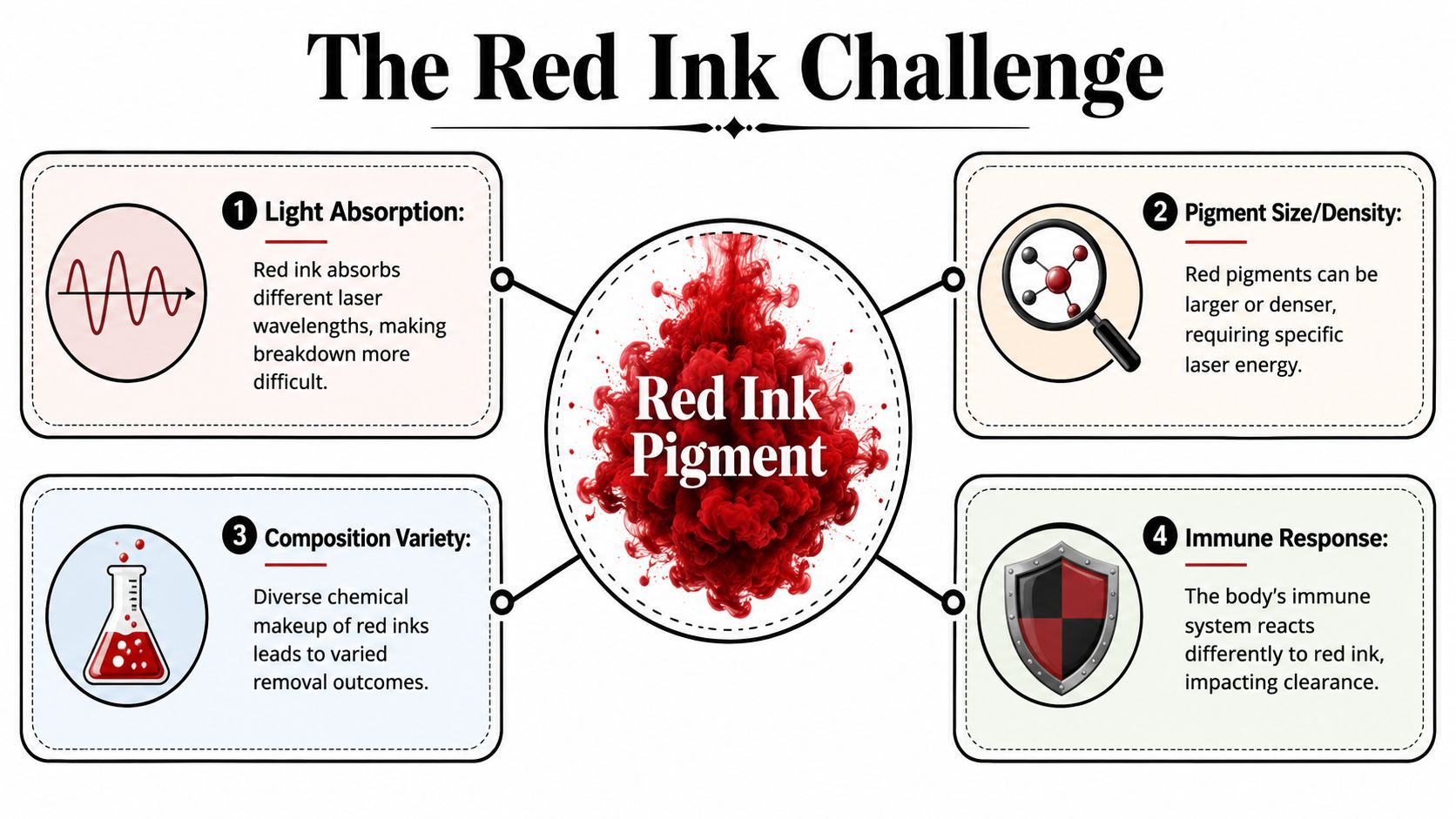
Red tattoo pigment can be difficult because “red” isn't one single substance. It's a visual category that can include different formulas, different particle structures, and different additives. Some red inks have historically included compounds such as iron oxide, and red pigments may also be associated with other metallic or mineral-based components. That variation is one reason two tattoos that look similar can respond very differently.
Why black and red don't behave the same
Black ink is easier to picture, similar to charcoal. It tends to behave more like a simple dark target. Red is closer to a dense paint blend. It may contain pigments that hold onto their color differently, reflect light differently, and break apart less cleanly when treated.
A useful way to think about it is this:
- Black ink acts like a broad absorber: it takes in light across a wider range.
- Red ink acts like a selective absorber: it reacts best when the laser wavelength is closely matched.
- Metal-containing pigments can add unpredictability: some formulas don't fragment as neatly and may even shift in appearance before they fade.
That last point matters. When clients hear “red is hard,” they often assume it's just a strength issue, as if more power solves the problem. It doesn't. The issue is matching the laser energy to the pigment in a way that breaks particles efficiently without creating avoidable heat in the surrounding skin.
For clients who want a clearer look at how newer devices approach difficult pigments, this overview of new technology in tattoo removal helps connect the hardware to the treatment outcome.
Why the body matters after the laser fires
The laser doesn't “erase” the tattoo in one pass. It disrupts the pigment so your body can gradually clear what's been broken down. That means red ink removal depends on two stages working together.
First, the laser has to fragment the pigment well. Second, your body has to process what the laser created.
Practical rule: A technically strong treatment can still look slow if the pigment is dense, the location heals sluggishly, or the immune response clears fragments more gradually.
This is also why session timing matters. Treat too aggressively or too frequently, and you don't give the skin and body enough room to do their part. Treat too conservatively with the wrong wavelength, and the red may barely move.
Matching the Right Laser to Your Red Tattoo
When tattoo removal red ink is the focus, the laser choice isn't a detail. It's the job. Red pigment responds best when the device can deliver a wavelength that the pigment will absorb, and when that energy is delivered in a way that breaks ink efficiently without relying too heavily on heat.
Why wavelength match matters
Red appears red because it reflects red light and responds better to its complementary range. In practical terms, that's why devices using a green-targeting wavelength are often chosen for red pigment. If the wavelength doesn't match well, the laser energy spends too much effort in the wrong place.
Older systems can still treat red, but the treatment feel and the treatment result may not be as consistent on stubborn or mixed pigments. That's where pulse duration starts to matter.
Picosecond platforms shorten the pulse so dramatically that the effect becomes more photomechanical than purely thermal. Instead of leaning mainly on heat, they create a stronger pressure-based shattering effect. For red inks with denser or more complex chemistry, that difference can be meaningful.
Laser Technology for Red Ink Removal Compared
| Feature | Q-Switched Laser | Picosecond Laser (e.g., PiQo4) |
|---|---|---|
| Pulse style | Longer pulse delivery | Ultra-short pulse delivery |
| Primary effect on ink | More heat-dependent fragmentation | Stronger photoacoustic fragmentation |
| Precision on stubborn red pigment | Can work, but may be less efficient on difficult formulations | Better equipped for selective breakdown of resistant pigment |
| Heat spread to surrounding skin | Typically broader thermal impact | Typically less reliance on heat spread |
| Use on mixed-color tattoos | May require compromises depending on system capability | Multi-wavelength platforms are more flexible |
| Clearance expectations | Useful, but can plateau on certain reds | Often better for pushing past stubborn residual color |
| Treatment planning | May require more caution when progress slows | Often allows more refined targeting session to session |
A modern system like the PiQo4 stands out because it combines picosecond pulse delivery with multiple wavelength options. That matters for red tattoos because many “red” areas aren't pure red. They may include orange, pink, brown, white modifiers, or deeper outline pigments sitting beside them.
For a closer look at how that platform is used in practice, this PiQo4 laser tattoo removal guide explains the device in more depth.
What works and what usually doesn't
What works is matching wavelength correctly, using a device that can fragment tough pigment, and adjusting settings based on skin response.
What doesn't work is assuming every red tattoo should be hit the same way just because it looks similar on the surface. I've seen tattoos with bright red sections react quickly while darker brick-red areas in the same piece lag behind. That's often a clue that the pigment blend isn't uniform.
If a clinic talks about red ink as if it behaves exactly like black ink, that's a sign to ask better questions before starting.
Setting Realistic Expectations for Your Removal
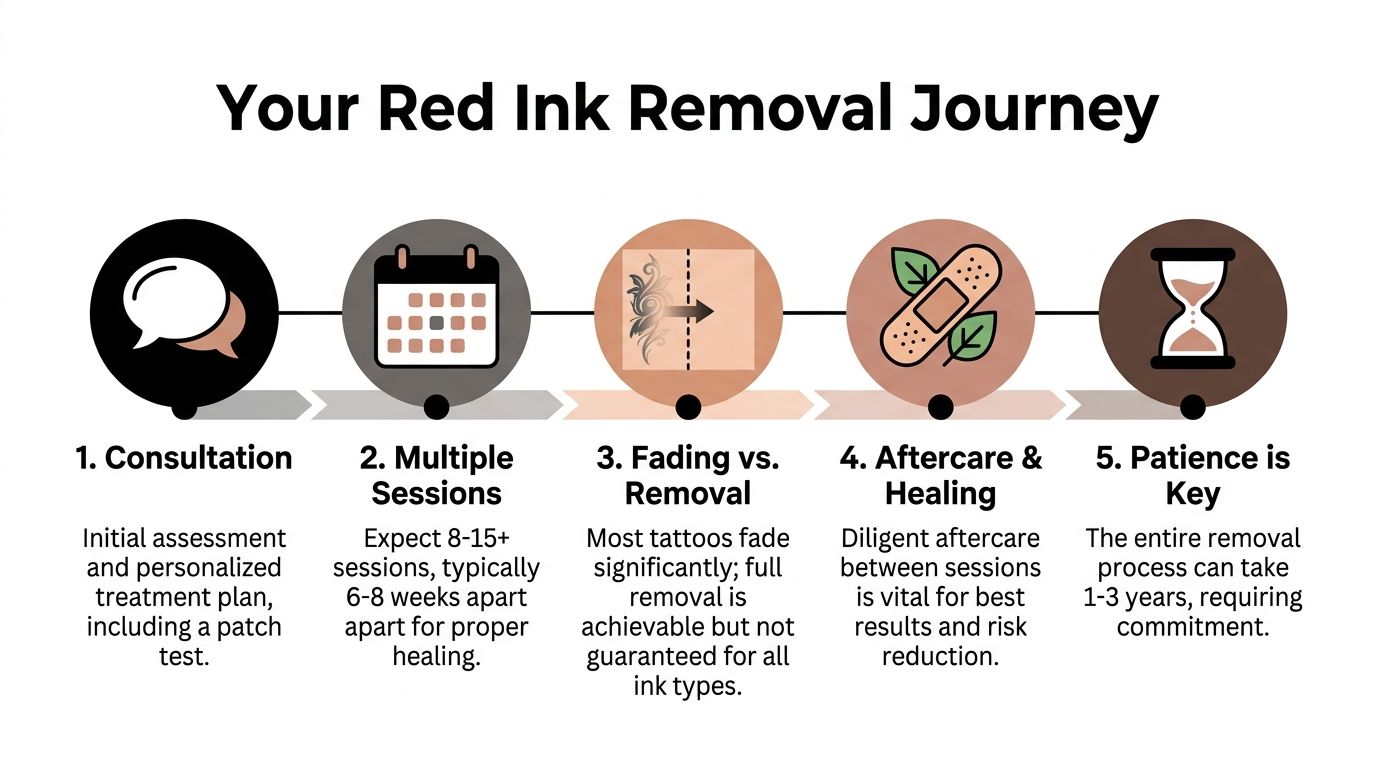
This is the part people appreciate later, even if they don't love hearing it at the start. Red ink removal often goes well, but it rarely moves in a perfectly straight line. Some sessions produce a visible jump in fading. Others look subtle, especially once you're working on the last traces.
What success usually looks like
Success doesn't always mean “nothing was ever there.” In real treatment plans, success may mean one of three outcomes:
- Clear enough for normal viewing: the tattoo no longer catches attention in everyday life.
- Faded enough for a cover-up: the artist has room to work without the old red showing through.
- Removed as far as the skin and pigment allow: the remaining trace is minimal, but not always completely absent.
That's an honest framework because red pigment can leave behind a faint residual tone even after strong improvement. The skin may look dramatically better long before the last hint disappears.
What changes the pace of fading
Here's what to prepare for. The timeline depends on the tattoo, not just your motivation.
Several factors shape the result:
- Ink density: packed, saturated red usually takes more patience than lighter shading.
- Tattoo age: older tattoos may break down differently than fresh, heavily set work.
- Body location: areas with slower circulation often fade more slowly.
- Skin tone and sun history: settings may need to be adjusted to protect the surrounding skin.
- Pigment blend: if the red includes other compounds, the endpoint may shift.
A lot of disappointment comes from expecting each visit to produce the same visible change. That isn't how removal works. Early sessions may create obvious breakup, while later sessions are about chasing finer remnants that clear more gradually.
Most people do better when they judge progress by the overall trend, not by the last appointment alone.
If your goal is total removal, go in hoping for excellent clearance but understanding there can be a difference between complete removal and successful fading. If your goal is a cover-up, tell the clinic and the future tattoo artist early. That changes the target.
Potential Risks and Essential Aftercare
Red ink treatment is manageable, but it deserves respect. The same factors that make red pigment harder to remove also make professional oversight more important, especially when the pigment includes compounds that can behave unpredictably under laser exposure.
What's normal after treatment
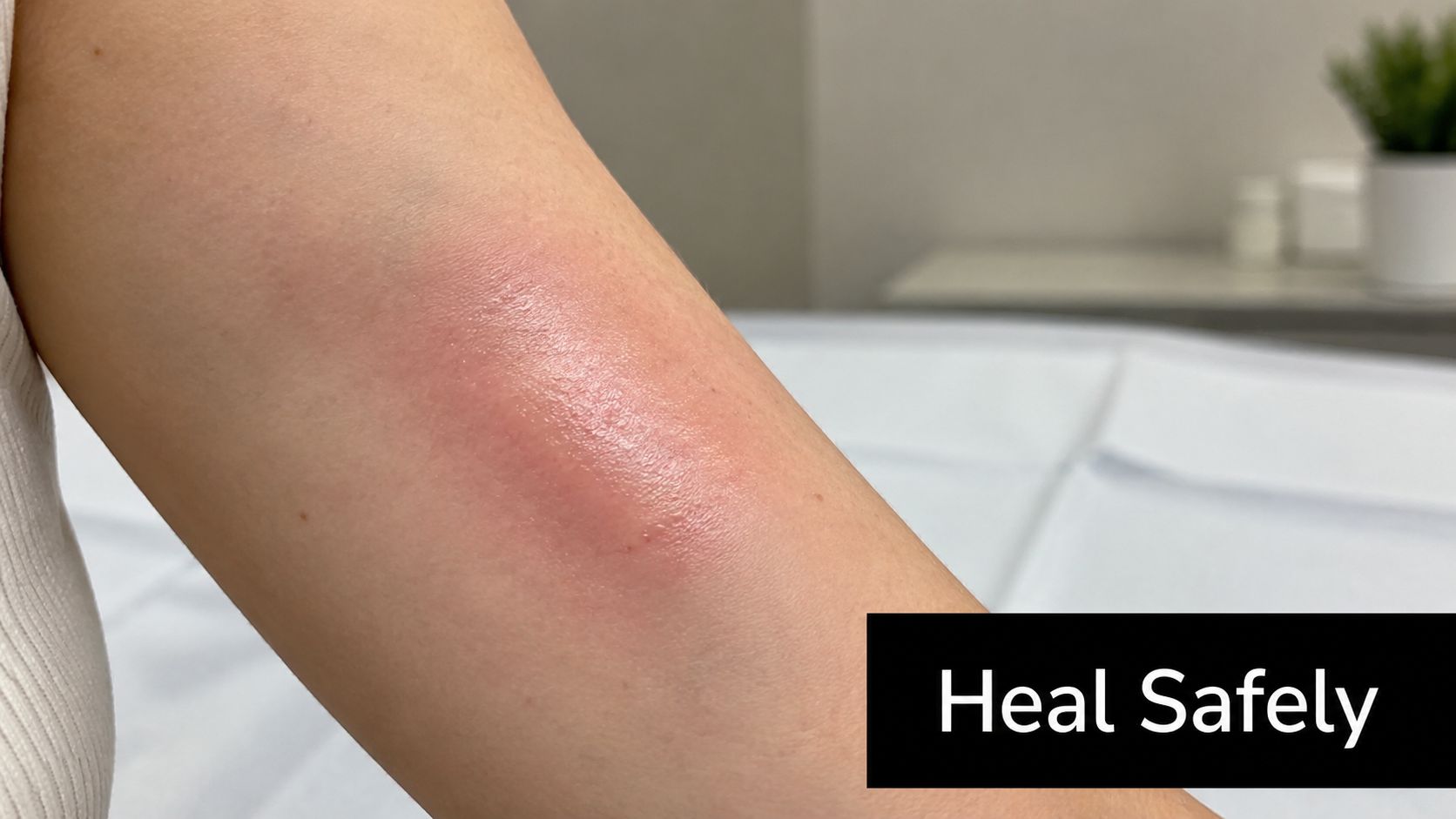
Temporary reactions are common. The area may look red, feel warm, swell, or develop blistering and crusting as it heals. That can look alarming if you weren't warned, but it's often part of the expected recovery pattern.
One red-ink-specific issue worth discussing upfront is paradoxical darkening. Some pigments, especially those with certain metal-containing components, can temporarily darken instead of immediately lightening. That's one reason test spots and cautious parameter selection matter.
- Short-term irritation: redness, tenderness, swelling, and itching can happen.
- Surface healing changes: blistering or scabbing may appear if the skin reacts strongly.
- Pigment shifts: some red areas may turn darker or brownish before further treatment decisions are made.
- Tone changes in skin: lighter or darker skin changes can occur if aftercare is poor or sun exposure interferes.
Aftercare that actually helps
Good aftercare isn't extra credit. It directly affects healing quality and how safely you move into the next session. This aftercare guide for laser tattoo removal covers the reasoning in more detail.
Keep the routine simple and consistent:
- Keep it clean: wash gently with mild soap and water once your provider says it's appropriate.
- Protect the skin barrier: use the recommended ointment or dressing, not random active skincare products.
- Leave blisters alone: don't pick, peel, pop, or scrub the area.
- Stay out of direct sun: tanned or irritated skin is harder to treat safely.
- Pause friction: tight clothing, gym equipment rubbing, and abrasive fabrics can slow recovery.
Healing is part of treatment. The laser session is only the first step.
How to Choose a Clinic and Start Your Journey in Florida
A red tattoo consultation should feel specific. If the conversation sounds generic, the treatment plan probably is too. You want a clinic that can explain what kind of red you appear to have, how they'd test response, and what they'll do if the pigment behaves differently than expected.

What to ask before you commit
Bring these questions into the room:
- Do you have before-and-after examples of red ink removal? Not just black or linework.
- What laser platform do you use for red pigment? Ask about wavelength options and why they matter.
- Will you patch test if the pigment looks unusual? That's especially relevant for cosmetic reds or older mixed inks.
- How do you handle darkening or slow response? The answer should sound clinical, not improvised.
- Who performs the treatments? Experience with color tattoo removal matters.
A solid consultation should also cover your skin type, tattoo age, placement, sun exposure habits, and whether you want removal or just enough fading for a cover-up.
A practical next step in Florida
For Florida clients, convenience matters because tattoo removal is a process, not a one-time visit. EradiTatt Tattoo Removal offers consultations and treatment across Tampa, Orlando, St. Petersburg, Bradenton/Sarasota, and Palm Harbor, using the PiQo4 platform for multi-color work, including red-heavy tattoos.
If you're comparing clinics, start by choosing a location you can realistically return to for follow-up care and spaced sessions. Then call the central number or use the website to schedule a free consultation, bring clear photos if the tattoo is old or layered, and ask for an honest read on whether your goal is full removal or strategic fading.
Frequently Asked Questions About Removing Red Ink
Does red ink hurt more to remove
Not always. Pain varies more by body location, skin sensitivity, tattoo density, and the settings used than by the color alone. Dense red areas can feel sharper during treatment if they require focused targeting.
Can red ink be removed completely
Sometimes, yes. But complete clearance isn't guaranteed for every red tattoo. Pigment chemistry, depth, mixing agents, and skin response all affect the endpoint, so many clients are better served by thinking in terms of excellent fading rather than perfection.
Why did my red tattoo turn darker after treatment
That can happen when certain pigments react chemically to laser exposure. It doesn't automatically mean the treatment failed, but it does mean the tattoo needs reassessment before more passes are done the same way.
Is cosmetic red pigment different from body art red pigment
It can be. Cosmetic inks may contain different blends and can behave less predictably, especially if they include lightening agents or iron-based compounds. That's why test spots are often a smart first move.
Can darker skin tones still treat red tattoos safely
Yes, with the right settings, spacing, and sun avoidance. The main issue is protecting surrounding melanin while still delivering enough energy to affect the pigment.
What if I only want it faded for a cover-up
That's a common goal and often a very practical one. If you say that upfront, the provider can aim for enough reduction to help your tattoo artist work cleanly rather than chasing every last trace.
If you're ready to get a clear opinion on your red tattoo, schedule a consultation with EradiTatt Tattoo Removal. A good consult should tell you what pigment challenges may be present, whether a test spot makes sense, and whether your goal is better served by full removal or targeted fading for a cover-up.