When someone searches for Ink Network, are they looking for a blockchain, a tattoo community, or a way to rethink the ink already on their skin?
That confusion matters more than it seems. The same phrase can point to a fast-moving digital system online or to a very human web of artists, trends, memories, and identity offline. If you've ever gone from scrolling tattoo inspiration to questioning an old piece on your arm, you've already felt how connected those worlds can be.
A digital network moves value and information. A personal ink network moves influence. It shapes what designs you notice, which artists you trust, what styles feel current, and when a tattoo that once felt right starts to feel like it belongs to an earlier version of you. If you're also wondering how permanent body art really is, this guide to how permanent tattoos are and whether they can be removed gives useful background before you think about next steps.
Table of Contents
- Decoding the Term Ink Network
- The Digital Frontier The Blockchain Ink Network
- The Human Connection Your Personal Ink Network
- Navigating the World of Tattoos and Trends
- Fading for a Fresh Start Cover-Ups and Removal
- Your Path to a Clean Slate with Laser Tattoo Removal
Decoding the Term Ink Network
The term Ink Network sounds simple, but it carries two very different meanings. In the tech world, it refers to a blockchain product. In everyday life, especially around tattoos, it can describe the connected circle of artists, studios, trends, online communities, and personal decisions that shape what ink means to you.
That overlap trips people up because both versions involve connection. One connects transactions, wallets, and apps. The other connects people, images, stories, and identity. Same phrase. Different systems.
Two meanings that share one idea
Think of a network as a set of linked points. In a blockchain, those points are digital accounts and transactions. In tattoo culture, those points are people and influence.
A few examples make this easier:
- Digital Ink Network: A user sends assets, interacts with a decentralized app, or moves value through a blockchain system.
- Personal ink network: Someone finds an artist through social media, saves references, asks friends for feedback, gets tattooed, then posts the final piece back into the community.
- Emotional network: A tattoo can connect to a breakup, a career shift, military service, parenthood, recovery, or a phase of life that no longer fits.
Practical rule: If the conversation includes wallets, tokens, gas fees, or Layer-2 scaling, it's the blockchain meaning. If it includes artists, styles, cover-ups, fading, or regret, it's the tattoo meaning.
Why this phrase matters to tattoo decisions
Tattoo choices are not commonly viewed as part of a network. Instead, the focus is often on one artist, one appointment, one design. But tattoos rarely happen in isolation. They grow out of trends, recommendations, algorithms, friend groups, and moments of self-definition.
That's why the phrase becomes useful. It helps explain how a tattoo can feel perfect at one point, then feel disconnected later. Your skin didn't change. Your network did. The people around you changed. Your job changed. Your taste matured. The symbols that once felt sharp can start to feel crowded, dated, or too tied to an old chapter.
The Digital Frontier The Blockchain Ink Network
For people searching the technical meaning first, Ink Network refers to a blockchain project tied to Kraken. More specifically, Kraken's Ink network launched as an Ethereum Layer-2 blockchain on the OP Stack. A simple way to understand Layer-2 is to picture Ethereum as a busy highway and Ink as an express lane built to move traffic faster and more cheaply while still connecting back to the main road.

That explanation isn't just branding language. According to Eco's explanation of Kraken's Ink blockchain, Kraken's Ink network surged in Total Value Locked from $7 million in October 2025 to nearly $450 million by early 2026, which placed it among the fastest-growing networks on the Optimism Superchain.
What Layer-2 means in plain English
If Ethereum is secure but crowded, a Layer-2 network tries to keep the usefulness while reducing friction for users. People usually care about three practical things:
- Speed so actions don't feel delayed.
- Lower cost so small transactions still make sense.
- Better app experience so using DeFi tools feels less clunky.
In other words, the blockchain Ink Network is infrastructure. Most users don't need to understand every technical layer any more than drivers need to understand road engineering. They just want the route to work.
Why tattoo readers should care at all
At first glance, a blockchain and a tattoo article don't belong together. But they share one important idea. Both use the word ink to describe something that marks identity.
In the digital space, that identity might involve wallets, tokens, and onchain participation. In the physical world, identity gets expressed through skin, symbols, and style choices. One lives in code. One lives on the body. Both can become part of how a person presents themselves to a community.
Digital ink records participation. Physical ink records personal meaning.
That shared language is why people often land on the phrase "ink network" from different directions. Some want the technical answer and stop there. Others start with the tech term and realize it also describes the social web behind tattoo decisions surprisingly well.
The Human Connection Your Personal Ink Network
A tattoo doesn't begin with a needle. It usually begins with influence.
Someone sees a healed sleeve on a friend. They save a blackwork design on social media. They follow a studio, compare styles, ask questions in comment threads, and build confidence from what other people share. That's a network, even if nobody calls it one.
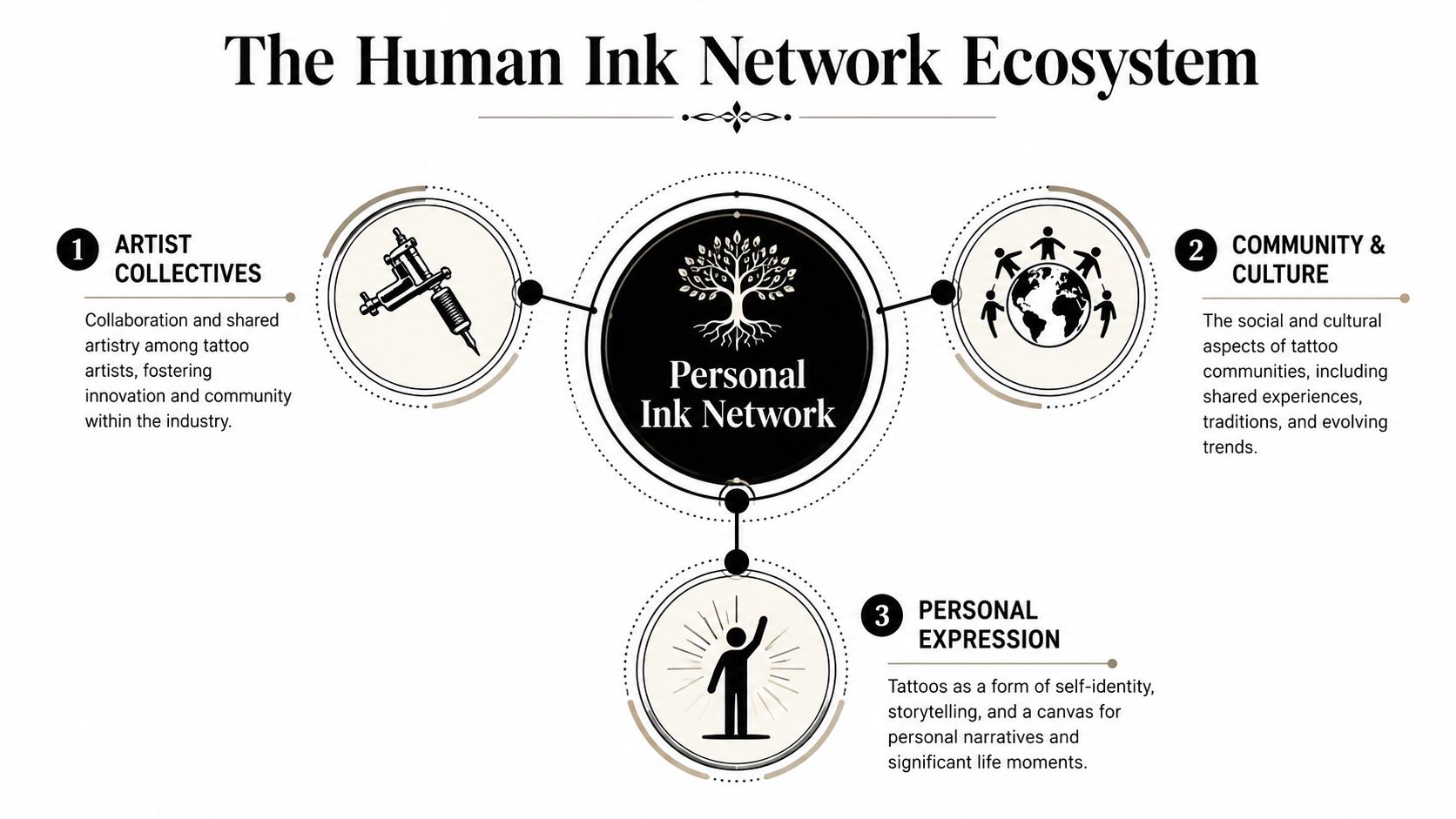
Three parts of a personal ink network
Your personal ink network usually sits on three pillars.
| Pillar | What it does | Why it matters |
|---|---|---|
| Artist collectives | Connects you to tattooers, studio styles, and creative standards | The artist's approach shapes the final result more than the original idea alone |
| Community and culture | Feeds trends, norms, and opinions through online and offline spaces | What feels meaningful or fashionable often comes from the group around you |
| Personal expression | Turns a design into a marker of memory, identity, or transition | The tattoo becomes part of how you tell your story |
A good way to picture this is as a living ecosystem. An artist doesn't work in a vacuum. Clients don't choose designs in a vacuum. Style, symbolism, and confidence all move through shared spaces.
Why some tattoos age differently than expected
People often assume tattoo regret means the original idea was a mistake. That's too simplistic. Sometimes the tattoo was right for who you were then, and wrong for who you are now.
A few common shifts inside that network can change how a tattoo feels:
- Taste evolves: Fine line, script, blackout, patchwork, micro-realism, and nostalgic flash all rise and fade in visibility.
- Meaning changes: A symbol tied to a relationship, band, belief, or friend group can lose relevance.
- Context changes: A design that worked in one season of life may feel misaligned in another.
- Community changes: The people whose approval mattered before may no longer shape your choices.
A tattoo can stay technically the same while feeling emotionally different.
The bridge between online culture and skin
The concept of an ink network is useful, not just catchy. Online communities don't only inspire tattoos. They also influence whether someone keeps, reworks, fades, or removes one later.
A person might join a tattoo forum to get aftercare advice, then later return to ask about fading an old piece for a cleaner cover-up. Someone else may follow artists for years and slowly realize their old tattoo doesn't match their current style at all. The network keeps moving, and people move inside it.
That doesn't make tattooing shallow. It makes it human. Identity isn't static. Personal style isn't fixed. What you choose to wear on your skin can change for the same reason your haircut, wardrobe, or home changes. You're still you. You're just editing the visual language.
Navigating the World of Tattoos and Trends
Most tattoo journeys don't follow a straight line. They move through curiosity, research, excitement, second thoughts, and then a decision that feels permanent in the moment. The ink network shapes each stop along the way.
A common path starts with inspiration. Someone saves reference images for months, notices one artist's linework is cleaner than another's, and starts comparing healed results instead of just fresh tattoos. That shift matters because it turns impulse into selection.
How people move through the tattoo ecosystem
The process often looks something like this:
- Finding a visual language: One person is drawn to soft shading and botanical forms. Another wants heavy black patterns or illustrative pieces with strong outlines.
- Choosing an artist: Style fit matters as much as technical ability. A great realism artist may not be the right match for delicate ornamental work.
- Testing placement: People ask how a design will age on the wrist, ribs, shoulder, or ankle, and whether visibility fits their work and daily life.
- Sharing the result: Friends react. Followers comment. Strangers ask where it was done. The tattoo enters the community and starts generating influence of its own.
This is one reason trend cycles hit tattoos differently than clothes. A shirt can be retired to the back of a closet. A tattoo keeps showing up in mirrors, photos, relationships, and job settings.
Why trends can create distance from old tattoos
A tattoo doesn't have to be bad to feel out of sync. Sometimes it belongs to another era of your taste. Social attention can amplify that feeling. Styles become more visible, more normalized, then less exciting. Designs that once felt original can start to feel common, or they can clash with newer work you're planning.
For a broader look at how social attitudes, fashion cycles, and public perception shape tattoo choices, this discussion of tattoo stigmas, trends, and fads adds useful context.
Trends don't only affect what people get tattooed. They affect how people feel about tattoos they already have.
A practical way to read your own reaction
If you're unsure whether you're dealing with a passing mood or a real mismatch, ask simpler questions than "Do I hate it?"
Try these instead:
- Does it still match how I present myself now?
- Would I choose this same design and placement today?
- Do I want to build around it, hide it, or clear space for something new?
Those questions usually reveal more than an emotional yes or no. They turn regret into a design problem, which is easier to solve.
Fading for a Fresh Start Cover-Ups and Removal
When a tattoo no longer fits, people usually want one of two outcomes. They want to transform it, or they want to erase it. That leads to the practical decision between a cover-up and laser removal.
Neither option means the original tattoo was a failure. It means your priorities changed. For many people, that shift is healthy. A tattoo marked one chapter. The next step marks another.
Cover-up or removal
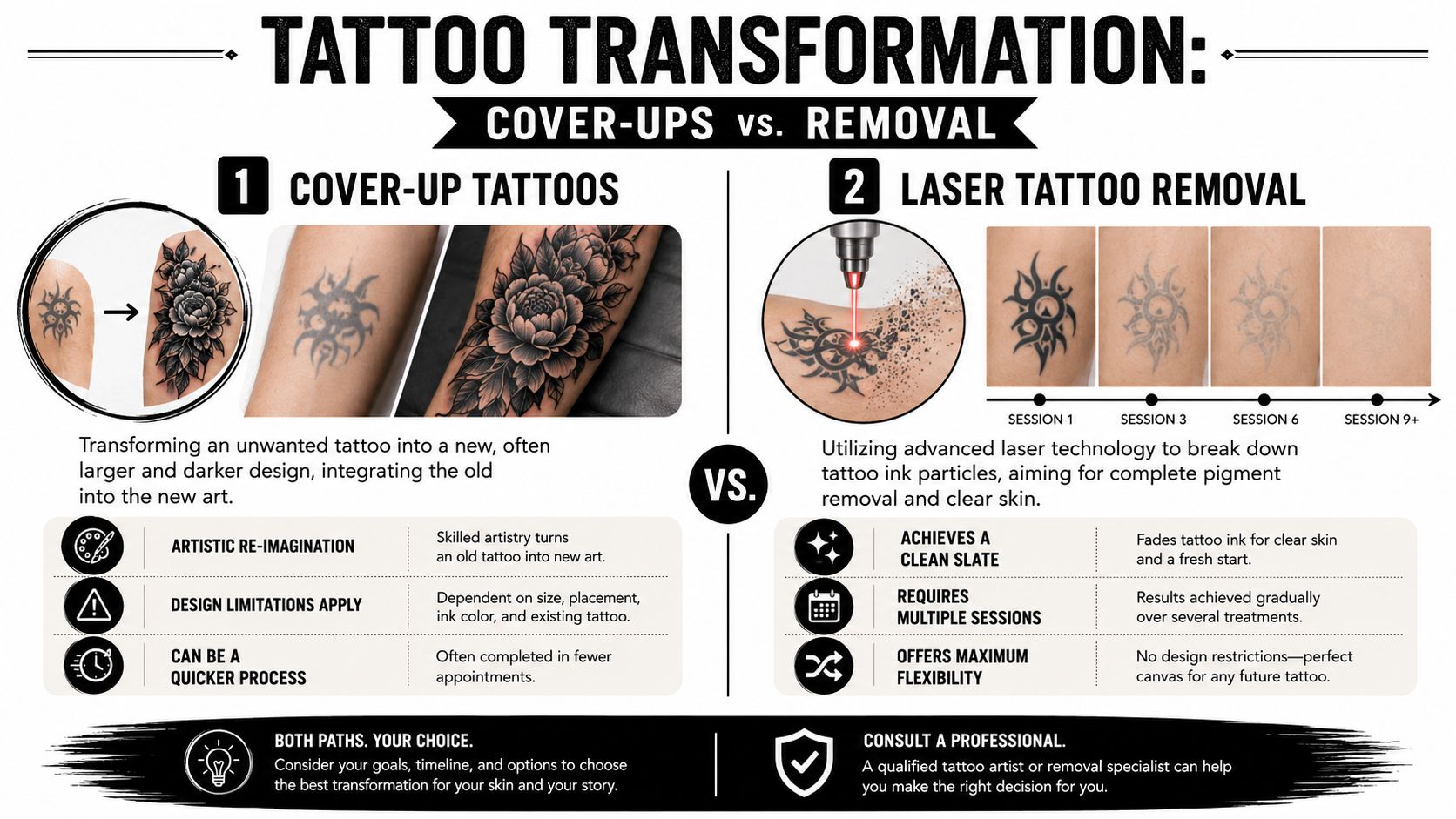
A cover-up works when you still want tattooed skin, but not the current design. Removal works when you want a cleaner slate, either for no tattoo at all or for more freedom later.
Here's the simplest comparison:
| Option | Best for | Main tradeoff |
|---|---|---|
| Cover-up tattoo | People who want new art over old art | The new design often needs to work around the old pigment |
| Laser removal | People who want maximum flexibility or full clearance | It takes multiple treatment sessions over time |
A lot of people combine the two. They don't remove every trace. They lighten the old tattoo enough that a new artist has more room to work. That's often the smartest middle path.
Why fading helps cover-ups look better
Old ink limits what the new design can do. If the original tattoo is dark, dense, or poorly placed, the cover-up artist may need to use heavier shapes, deeper tones, or a larger composition than you'd prefer. Fading reduces that pressure.
According to Zapp Laser Studio's explanation of tattoo fading for cover-ups, clients seeking to fade a tattoo for a cover-up typically need an average of 2 to 6 laser sessions, while complete removal often needs 6 to 10 sessions. That difference is why fading is often a strategic first move rather than an all-or-nothing commitment.
If you're exploring design possibilities before deciding, Think Tank Tattoo's cover up guide is a useful visual resource because it shows how artists think about shape, darkness, and reworked composition.
The best cover-up plans start by asking not "How do I hide this?" but "How much freedom does the next artist need?"
Signs fading may be the better first step
Some tattoos can be covered directly. Others benefit from laser prep first.
- Very dark sections: Dense black areas can force the new design to become bigger and heavier than you want.
- Multiple old passes: Layered or reworked tattoos may resist a clean visual reset without some fading.
- Style mismatch: If you want a softer or more open design next, lighter underlying ink gives the artist more options.
- Placement limits: Small spaces don't leave much room to disguise an old design with something larger.
For many people, fading is less about erasing the past and more about giving the future design enough breathing room.
Your Path to a Clean Slate with Laser Tattoo Removal
Laser tattoo removal works because the laser changes the ink, then your body does the clearing. That's the part many people miss. The laser doesn't make pigment vanish on contact.
When modern systems target tattoo pigment, they break larger ink particles into smaller fragments. Your immune system then carries those fragments away over time. According to YouBaby Skin Spa's explanation of why tattoo removal takes time, the body's immune system expels fractured ink particles gradually, each session reduces particle size incrementally, treatments need 6 to 10 weeks between sessions, and modern picosecond systems still average 8 to 12 sessions for complete removal.
Why spacing matters more than most people think
People often focus on the machine, but timing is part of the treatment. Skin may look recovered before the body has finished clearing what the laser disrupted. That's why rushing sessions usually isn't the smartest move.
A helpful way to think about it is demolition and cleanup. The laser handles the demolition of larger pigment clusters. Your lymphatic system handles the cleanup. If cleanup is still underway, another treatment can be poorly timed.
A separate practitioner overview that many readers find useful is Timebomb's Bournemouth tattoo removal info, which gives a straightforward consumer-facing explanation of the process and expectations.
What affects the pace of removal
Not all tattoos respond in the same way. Removal speed often changes based on factors such as:
- Ink color and chemistry: Some pigments respond more readily than others.
- Depth of placement: Ink placed deeper can be harder to clear.
- Tattoo density: Heavy saturation usually needs more gradual treatment.
- Your body's response: Immune function plays a real role in how efficiently fragmented particles leave the area.
If you want a grounded overview of the full process, this laser tattoo removal guide explains what to expect from consultation through progressive fading.
Clear skin is usually a process of repetition, spacing, and patience, not a one-session event.
For people who want a genuine blank canvas, laser removal remains the most direct path. For people planning a future cover-up, it can also create a much better starting point than trying to work around old, dominant pigment.
If you're ready to talk through your options with a team focused on tattoo removal and fading, EradiTatt Tattoo Removal offers consultations across Florida. Whether you want to clear a tattoo completely or lighten it for a cover-up, their clinics can help you map out a practical treatment plan based on your skin, ink, and goals.