
Complete tattoo removal in St. Petersburg typically takes 1 to 2 years, with 5 to 12 sessions spaced about 6 to 8 weeks apart. That means it isn't a one-visit fix. They're working through a staged process that unfolds over months as the skin heals and the body clears fragmented ink.
If you're staring at an old tattoo and trying to figure out whether this can fit into your life, that's the right question to ask first. The timeline matters for work plans, cover-up plans, weddings, enlistment goals, and plain peace of mind. It helps to stop thinking of removal as an unknown and start thinking of it as a project with phases, checkpoints, and a realistic finish line.
Table of Contents
- Your St Petersburg Tattoo Removal Timeline Starts Here
- The Anatomy of a Tattoo Removal Timeline
- Key Factors That Influence Your Removal Speed
- What to Expect at Your St Petersburg Consultation
- Aftercare and Tracking Your Visible Progress
- Fading for a Cover-Up vs Complete Removal
- Frequently Asked Questions About Removal Timelines
Your St Petersburg Tattoo Removal Timeline Starts Here
You look at the tattoo in the mirror, check your calendar, and want to know one thing. How long is this going to take?
At our EradiTatt clinic in St. Petersburg, I tell clients to treat the timeline like a schedule they can map out, not a guessing game. Removal usually takes months, and complete removal often takes longer. The exact pace depends on the tattoo, your skin, and how your body clears fragmented ink between visits.
That sounds like a long process until it is broken into clear phases. First, we assess the tattoo and set the goal. Then we move through a treatment cycle with planned spacing between sessions. After the last session, your skin still needs time to settle and your body may continue clearing leftover pigment.
A realistic timeline starts with the right question
The better question is not, “How fast can this come off?” The better question is, “What schedule gives me the safest and cleanest result for this tattoo?”
That shift matters. Fast treatment is not always better treatment. If sessions are packed too closely, the skin has less time to recover and the body has less time to do the clearing that happens after the laser work is done. A steady plan usually gives better fading, fewer setbacks, and a clearer idea of what to expect at each stage.
One practical rule stays true in almost every case. Your timeline comes down to two moving parts: how many sessions the tattoo needs, and how much healing time your body needs between them.
If you want a broader overview before booking, this client guide for tattoo removal is a useful resource for understanding planning, healing, and the questions worth asking before you start.
For local clients, that planning mindset lowers a lot of anxiety. Once the process is laid out in phases, the timeline feels less open-ended and much easier to work with.
The Anatomy of a Tattoo Removal Timeline
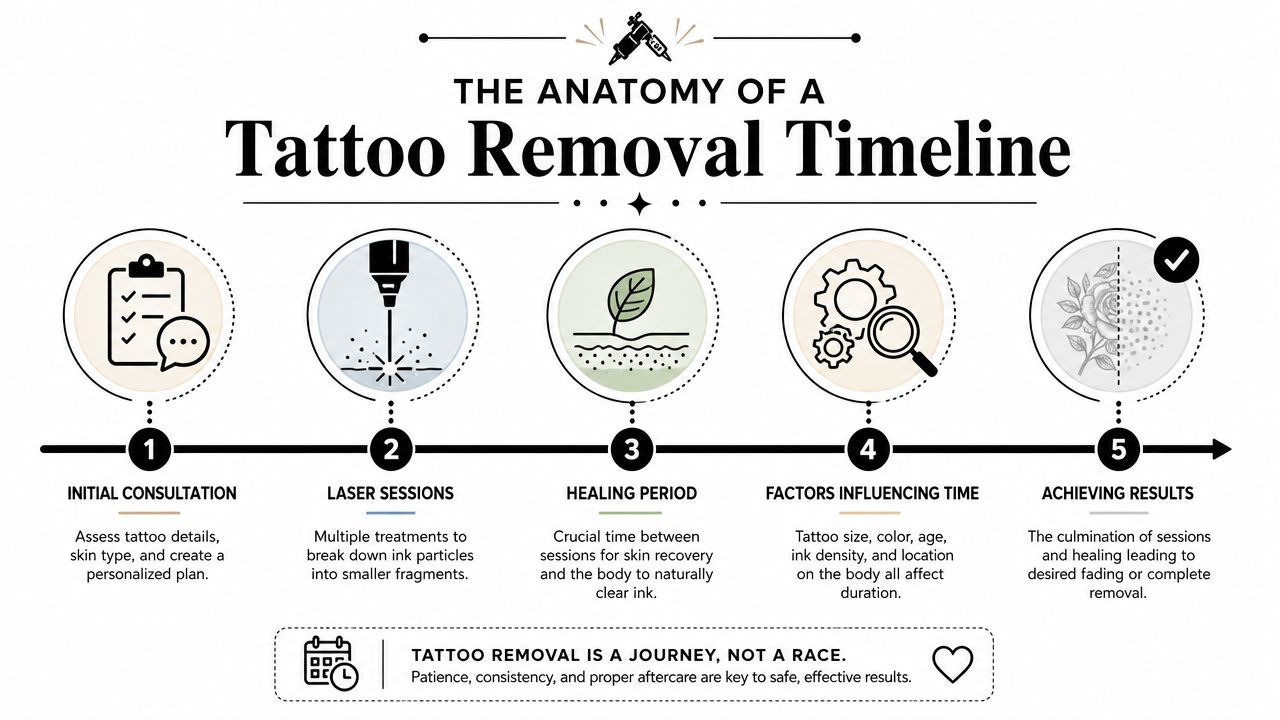
Tattoo removal follows a sequence. Once you understand the phases, the timeline feels much less open-ended. The laser session is only the active treatment step. The visible fading happens between visits, while your skin heals and your body clears broken-up ink.
What the laser does and what your body does
The laser targets tattoo pigment and breaks it into smaller particles. After that, your immune system gradually removes that material over the following weeks. That is why the calendar matters. If sessions are scheduled too close together, the skin may still be inflamed and the body may not have finished the clearing work from the last treatment.
In practice, removal usually unfolds over months rather than days. Some tattoos lighten in a fairly straightforward way. Others need a longer plan because certain areas hold dense ink, respond unevenly, or heal more slowly. At our clinic, we map this out as a treatment project with checkpoints, not a guessing game. If you are comparing providers, this guide on choosing a tattoo removal clinic in St. Petersburg can help you see what a clear treatment plan should include.
The timeline has clear phases
Most tattoo removal plans move through five predictable phases:
Assessment and planning
We review the tattoo, your skin, the location on the body, and your goal. Full removal and fading for a cover-up do not follow the same schedule.Treatment sessions
Each visit breaks up another portion of the pigment. Progress is usually gradual, not dramatic all at once.Healing and clearing time
Much of the progress occurs during this time. The skin settles down, and the body continues processing fragmented ink after the appointment ends.Progress checks and adjustments
Response is not always uniform across the whole tattoo. Some sections fade faster, so the plan may need small adjustments as we go.Final settling
After the last session, the result can still improve while the skin finishes recovering and any remaining haze continues to lift.
This phased approach helps clients plan around work, travel, events, and cover-up deadlines.
Why waiting helps results
A shorter gap between sessions does not automatically shorten the full project. It can do the opposite. Treating skin that is still recovering raises the chance of irritation and can make the next session less productive.
A steady schedule usually gives better fading and a safer result. The goal is not to force the process. The goal is to give each session time to do its job, then let the body finish the rest before the next round begins.
Key Factors That Influence Your Removal Speed
Two tattoos can start on the same day and finish on very different timelines. That isn't unusual. The pace depends on how the ink was put in, where it sits, what colors were used, and how your skin responds over time.
Some of these factors tend to help. Others tend to slow things down. What matters is the full picture, not any single feature in isolation.
Tattoo removal timeline influencers
| Factor | Impact on Timeline | Reason |
|---|---|---|
| Ink color | Can speed up or slow down progress | Some colors generally respond more readily than others, while multicolor work often needs a more careful, staged approach. |
| Ink density | Often slows removal when heavy | Dense packing gives the laser more pigment to break up and the body more material to clear. |
| Professional vs lighter work | Professional tattoos often take longer | Professionally applied tattoos are often more saturated and placed more consistently in the skin. |
| Tattoo size | Larger tattoos often require a longer project window | Bigger pieces involve more overall ink and may need a longer treatment plan to reach the goal safely. |
| Placement on the body | Some areas fade faster than others | Circulation and skin characteristics vary by body area, which can affect how efficiently pigment clears. |
| Age of the tattoo | Older tattoos may behave differently | Some older tattoos have already faded somewhat, but age alone doesn't determine the finish line. |
| Skin response and healing | Strongly affects scheduling | The skin has to recover well after each session before another treatment makes sense. |
| End goal | Fading for a cover-up is usually shorter than full removal | Stopping once the tattoo is light enough for new work takes less time than chasing complete clearance. |
What usually makes a tattoo take longer
The slowest projects often involve a combination of heavy saturation, multiple colors, and an ambitious goal of complete removal. A large professional piece on a slower-clearing body area tends to require more patience than a small, older tattoo with lighter ink.
Healing pattern matters too. A tattoo that responds evenly and calms down well after each appointment is easier to keep on track. A tattoo that stays irritated longer may need more spacing and a more conservative pace.
What clients can do and what they can't
Clients can help by protecting the skin, following aftercare, and showing up consistently. Clients can't safely force the body to clear ink on command. That part happens gradually.
A realistic self-check looks like this:
- Color complexity: If your tattoo has several colors, expect a less linear fade.
- Saturation level: If the tattoo looks bold and packed, the timeline may stretch.
- Placement: If it sits on an area that tends to heal more slowly for you, your schedule may need flexibility.
- Goal: If you only need enough fading for a cover-up, the project may end sooner than full removal.
- Skin behavior: If your skin tends to stay inflamed longer after procedures, spacing becomes more important.
The fastest schedule isn't always the smartest one. The smart schedule is the one your skin can actually tolerate and your tattoo can respond to.
When people ask how long does tattoo removal take in St. Petersburg, the honest answer isn't vague. It's individualized. The process follows known phases, but your tattoo's characteristics decide how quickly you move through them.
What to Expect at Your St Petersburg Consultation
The consultation is where the project gets mapped out. That's when the general timeline stops being a broad estimate and starts becoming your plan.

What gets evaluated
A good consultation isn't just a quick look at the tattoo. The provider checks the visible traits that affect removal, asks about your goal, and talks through what kind of pacing makes sense. If your goal is full removal, the plan will differ from a cover-up fade from the start.
This is also the point where many clinics use tools like the Kirby-Desai scale to guide a session estimate. That estimate isn't a promise. It's a planning tool that helps turn “it depends” into something useful.
What the conversation should feel like
The best consultations feel collaborative. You should leave knowing what the likely path looks like, what can change that path, and what the body needs between treatments.
For people comparing options, this overview of tattoo removal in St. Petersburg shows what a clinic-based removal process can include, from assessment through treatment planning. In practice, EradiTatt Tattoo Removal offers consultations for both complete removal and fading for a cover-up, which is often the most practical first step if you want a real timeline for your specific tattoo.
Questions worth asking at the visit
Bring the practical questions, not just the emotional ones. Useful examples include:
- Goal clarity: Do I need full removal, or would fading get me where I want to go?
- Scheduling reality: Based on my skin response and tattoo features, what kind of spacing is likely?
- Visible milestones: When should I expect to see changes after each session?
- Cover-up planning: If I want new work later, when is the treated skin likely to be ready for that conversation?
You don't need to walk in knowing everything. You just need to walk in ready to talk openly about the tattoo, your timeline, and what result would feel like a real win.
Aftercare and Tracking Your Visible Progress
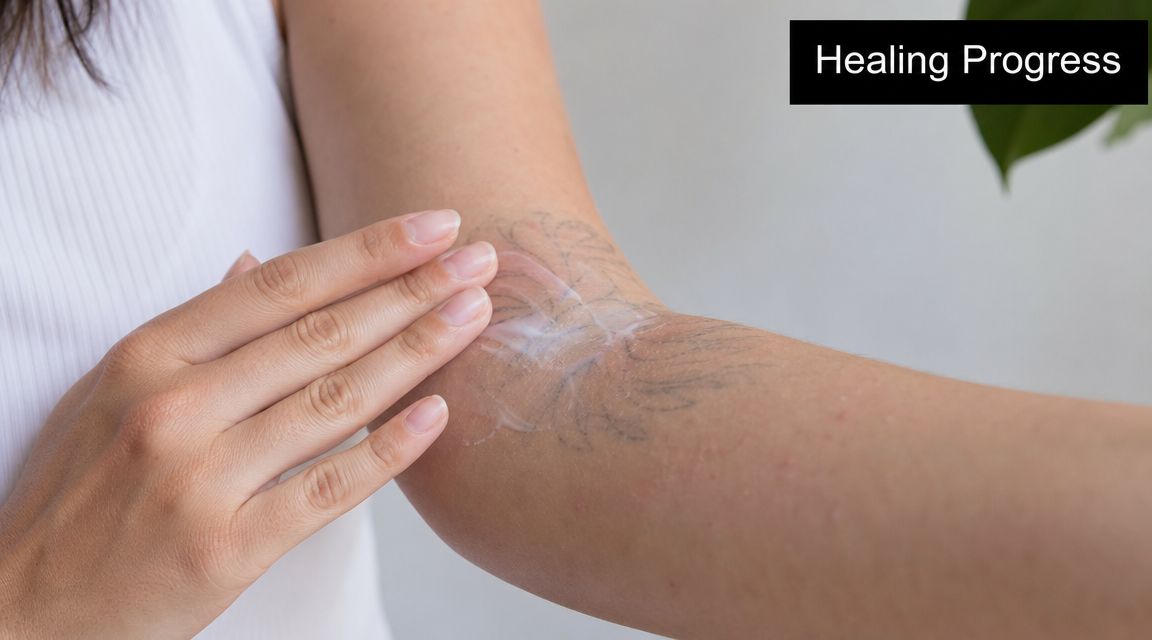
A lot of the progress happens after you leave the treatment room. The appointment is active, but the weeks that follow are productive too. That's when the skin repairs itself and the body works on clearing the fragmented pigment.
Normal healing signs after a session
Right after treatment, it's common to see temporary whitening of the area, often called frosting, along with redness, warmth, or swelling. Those early effects can look dramatic, but they aren't the same thing as final fading. Visible change unfolds more gradually.
One local removal provider notes that the minimum time between treatments is 8 weeks, that spacing can increase by 2 weeks with every treatment when healing is progressing, and that post-session skin recovery commonly takes 2 to 4 weeks for scabs to fall off and visible results to appear. The same source also advises waiting 4 to 6 months after the final session before getting a new tattoo over the treated area, according to this St. Petersburg treatment timing page.
Aftercare that actually helps
The basics matter. Clean skin, low friction, and patience do more for results than over-managing the area.
- Keep it clean: Follow the provider's instructions for gentle cleansing and avoid harsh products.
- Protect the surface: Don't pick, scratch, or peel healing skin.
- Reduce irritation: Wear clothing that won't rub the treated area.
- Stay consistent: If your provider gives you a healing routine, stick to it instead of switching products repeatedly.
- Watch the timeline: Judge progress over weeks, not the same evening or the next morning.
If you want a deeper overview of healing habits between sessions, this guide on why aftercare is important after laser tattoo removal is a helpful reference.
Some clients also like to read about skin-calming ingredients during recovery. For general background, this article on the soothing properties of aloe vera gel explains why aloe is commonly associated with comfort-focused skin care.
Healing is not dead time. It's active treatment time happening inside the skin.
How to track progress without overthinking it
Take photos in the same lighting. Compare them session to session, not day to day. Tattoos rarely fade in a perfectly even pattern, so don't panic if one section lightens before another.
The most useful mindset is steady observation. You're looking for overall reduction, not instant transformation.
Fading for a Cover-Up vs Complete Removal
Not everyone wants a blank patch of skin. Plenty of clients just want the old tattoo light enough that a new design can sit over it cleanly.
That changes the project right away. Full removal and strategic fading are not the same destination, so they shouldn't use the same expectations.
What artists usually need for a cover-up
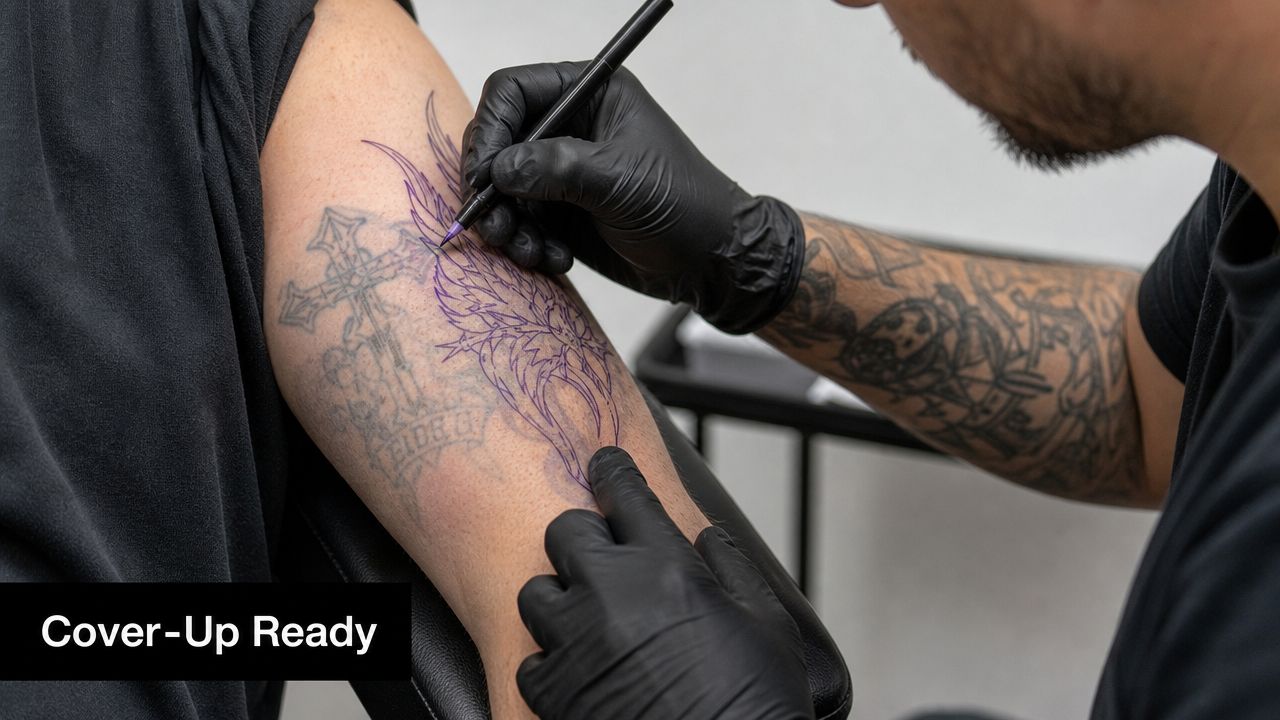
A cover-up doesn't require every trace of the old tattoo to disappear. It requires the old tattoo to stop dominating the skin. The remaining pigment has to be light enough that the new design, shading, and contrast can control the final look.
That's why fading projects often end earlier than full removal projects. The provider and the tattoo artist are aiming for a workable canvas, not total absence of ink.
How the planning differs
For complete removal, the plan keeps going until the remaining pigment is reduced as far as practical. For a cover-up, the stopping point is functional. Once the tattoo is faint enough for your artist's design approach, more sessions may not be necessary.
This decision works best when the removal side and the tattoo side are aligned. If you already have an artist in mind, bring their input early. If you don't, ask what level of fade would usually give the most flexibility.
A useful local resource for this specific path is preparing for a tattoo cover-up with fading support. It helps frame fading as a targeted step, not an all-or-nothing commitment.
A successful cover-up fade isn't about removing everything. It's about removing enough of the right areas to give the new design room to win.
Which option makes sense for you
Choose complete removal if you want the tattoo gone without replacement. Choose fading if your real goal is a new piece and you don't need total clearance.
That distinction saves time, frustration, and unnecessary sessions. It also leads to a plan that fits your actual outcome, not someone else's.
Frequently Asked Questions About Removal Timelines
How long does tattoo removal usually take in St. Petersburg
A typical course is measured in multiple appointments over many months. Neutral dermatology sources report 5 to 10 sessions on average, with 6 to 8 weeks between sessions, and at that pace a typical course often spans roughly 9 to 16 months from first treatment to completion, according to this laser tattoo removal overview from a dermatology clinic.
Can I speed it up by booking sessions closer together
Usually, no. The waiting period exists because the skin needs time to recover and the body needs time to clear fragmented pigment. Trying to force a faster schedule often works against the process.
When will I see fading
You may notice changes as healing develops over the weeks after a session, but visible fading usually arrives gradually. It's better to judge progress by comparing one treatment cycle to the next than by checking the tattoo every day.
Do older tattoos remove faster
Sometimes they can be easier to fade than newer, denser work, but age alone doesn't decide the timeline. Ink load, color mix, placement, and your healing response all matter.
Is fading for a cover-up faster than full removal
Often, yes. The endpoint is different. If the goal is only to lighten the tattoo enough for new artwork, the project can stop once the area becomes workable for the artist.
What should I ask if I'm worried about skin tone changes during healing
Ask about aftercare, sun protection, and how your provider wants you to monitor the area between sessions. If you're curious about broader skin-care discussions around discoloration support ingredients, you can learn about Eucerin's Thiamidol for general educational context.
The main takeaway is simple. Tattoo removal follows a timeline for a reason. The most successful clients don't treat that as bad news. They treat it as a plan.
If you're ready to turn uncertainty into a real schedule, EradiTatt Tattoo Removal can help you map out the next steps based on your tattoo, your skin, and whether you want full removal or fading for a cover-up.