
Tattoo removal in Sarasota usually takes 9 to 16 months, with 6 to 10 sessions spaced about 6 to 8 weeks apart. If you're looking at an old tattoo and hoping it can be gone quickly, the hard truth is that removal works on a biological schedule, not a rush schedule.
That timing surprises many because each laser visit is short, but much of the work happens after you leave. The laser breaks up the ink. Your body has to do the rest. For those considering how long the tattoo removal process takes in Sarasota, the most useful answer isn't just the number of visits. It's understanding why the calendar matters, what can slow things down, and what kind of result you're aiming for.
Table of Contents
- Your Guide to Tattoo Removal in Sarasota
- The Typical Tattoo Removal Timeline
- Why Your Body Sets the Pace for Removal
- Key Factors That Influence Your Removal Timeline
- Realistic Results Fading for Cover-Ups vs Full Removal
- Planning Your Removal at EradiTatt Sarasota
Your Guide to Tattoo Removal in Sarasota
You might be in a familiar spot. The tattoo isn't terrible, but it no longer fits your life. Maybe you're preparing for a career change, a wedding, military enlistment, or you want your skin back without explaining old decisions every time someone asks about the ink.
Many individuals start with one question. How long is tattoo removal process Sarasota? The practical answer is that this is usually a long series of treatments, not a one-time fix. That doesn't mean it's unmanageable. It means the smartest approach is to treat it like a planned project with checkpoints, healing time, and realistic expectations.
A lot of frustration comes from expecting the laser to do everything in one pass. It doesn't. The laser starts the process. Your body continues it over time.
If you're still deciding whether you want fading or full clearance, this guide on how to get rid of tattoos in Sarasota helps frame the bigger decision before you commit to a treatment plan.
Practical rule: Tattoo removal usually takes longer than getting the tattoo did. That's normal, and it's one of the first mindset shifts that makes the process easier.
In Sarasota, the people who handle removal well are usually the ones who stop asking, "Can this be done fast?" and start asking, "What timeline fits my tattoo, my skin, and my goal?" That's the question that leads to better planning and better outcomes.
The Typical Tattoo Removal Timeline
The most grounded timeline for Sarasota is straightforward. Neutral clinic guidance for the local market says 6 to 10 sessions are typically needed, spaced about 6 to 8 weeks apart, which puts the total process at roughly 9 to 16 months from first treatment to last scheduled session, according to Sarasota tattoo removal timing guidance.
What the calendar usually looks like
That doesn't mean you're in treatment every week. It means you're in a cycle of short laser visits followed by recovery and ink clearance.
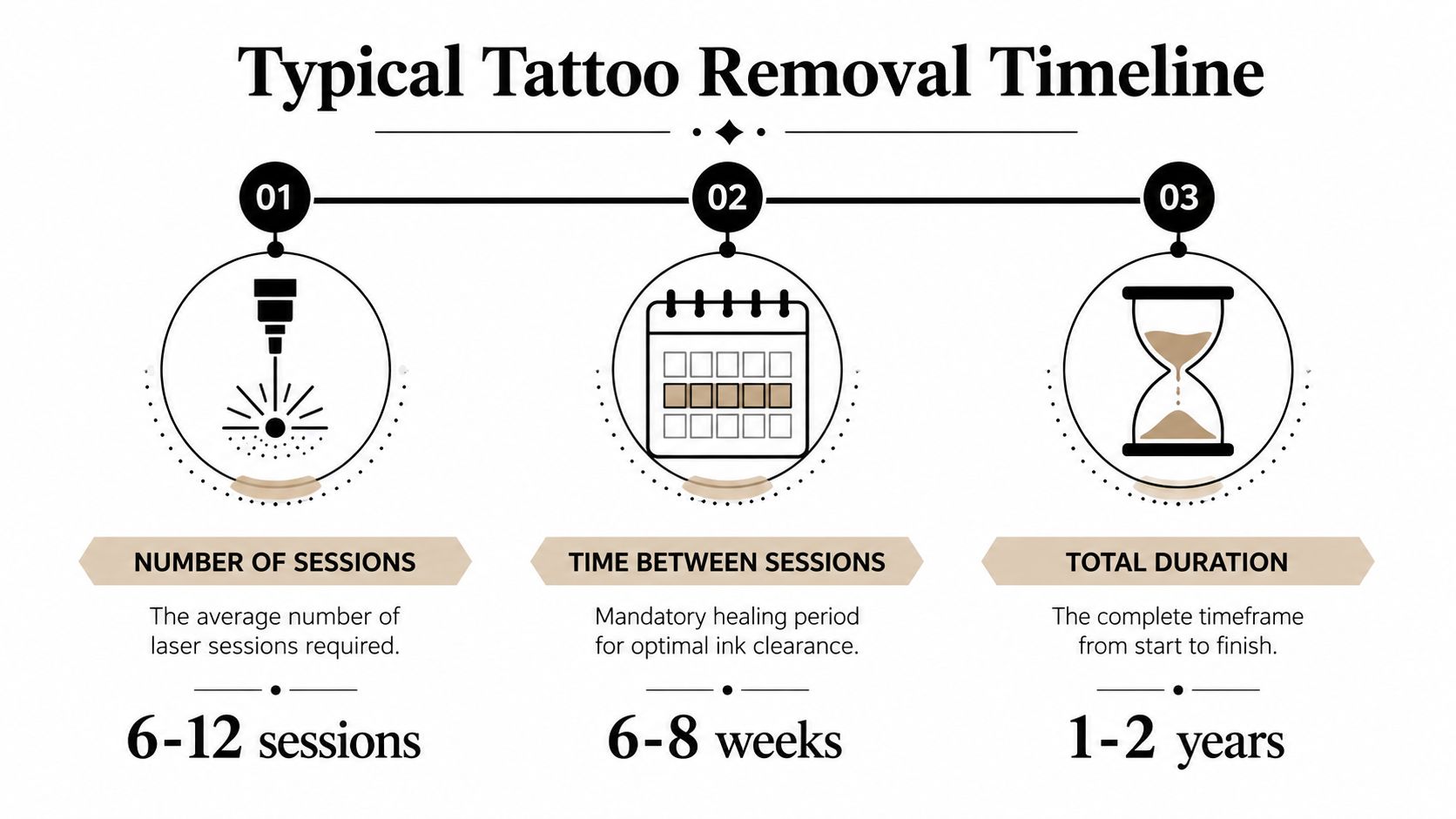
A typical plan often includes:
- An initial treatment visit: The first session establishes how your skin reacts and how the tattoo responds.
- A healing interval: You wait several weeks before another pass. This is part of the treatment, not downtime to ignore.
- Repeated sessions over months: The fading builds gradually, not all at once.
- A final settling period: Even after the last laser session, skin and pigment can continue changing as healing finishes.
If you want a more detailed breakdown of session planning, this overview of how many laser tattoo removal sessions people often need is useful background.
Why the gaps matter
People often focus on the number of appointments and miss the more important number, which is the spacing. The 6 to 8 week interval isn't there to slow you down. It's there because treatment too close together can work against the biology of removal.
The skin needs time to recover from the laser exposure. At the same time, the body needs time to move fragmented ink away from the treated area. If you schedule too aggressively, you may only be treating tissue that's still healing instead of taking advantage of a completed clearance cycle.
The laser appointment is the trigger. The weeks after it are where much of the visible change happens.
This is why "faster" claims deserve context. A device may reduce the number of sessions for some tattoos, but if each treatment still needs meaningful spacing, your calendar doesn't suddenly shrink to a few weeks. In practice, tattoo removal is measured in phases, not in a sprint from appointment one to done.
Why Your Body Sets the Pace for Removal
A laser can target ink, but it can't carry that ink out of the skin. That's your body's job. The easiest way to understand the timeline is this: the laser is the breaker, and your immune system is the cleanup crew.
The laser breaks the ink
Laser tattoo removal works by breaking tattoo ink into smaller fragments that the body can clear through the lymphatic system. Sarasota-area dermatology guidance also notes that a typical appointment can take less than 5 minutes, that many patients see visible fading after the first or second session, and that more substantial change often appears around session four or five, as explained in this guide to laser tattoo removal and immune clearance.
That short appointment length throws people off. They think, "If the treatment only takes a few minutes, why does the whole process take so long?" Because the appointment is only the mechanical part. It's the first move, not the whole game.
Your immune system clears the debris
Once the laser has disrupted the ink, your body has to recognize those smaller particles and move them out gradually. That clearance doesn't happen instantly. It unfolds over weeks, and it depends on healing, circulation, inflammation control, and individual immune response.
Some fading can show up early. That's encouraging, but it isn't the finish line. The more meaningful shifts often happen later because your body is still processing what the laser started.
A simple way to think about it:
- Laser energy hits the pigment.
- Ink particles break into smaller pieces.
- Your immune system begins clearing the fragments.
- The tattoo lightens over time, not overnight.
This is also why rushing appointments doesn't usually improve the result. If the cleanup crew hasn't finished one round, starting the next round too early may not give you the payoff you're expecting.
For a deeper look at the biology behind recovery, this explanation of why tattoo removal healing comes from within captures the idea well.
A good removal plan respects two things at the same time: the skin's need to heal and the immune system's need to clear ink.
Patients tend to do better emotionally when they understand this. Instead of judging progress session by session, they watch the trend over months. That's the right lens.
Key Factors That Influence Your Removal Timeline
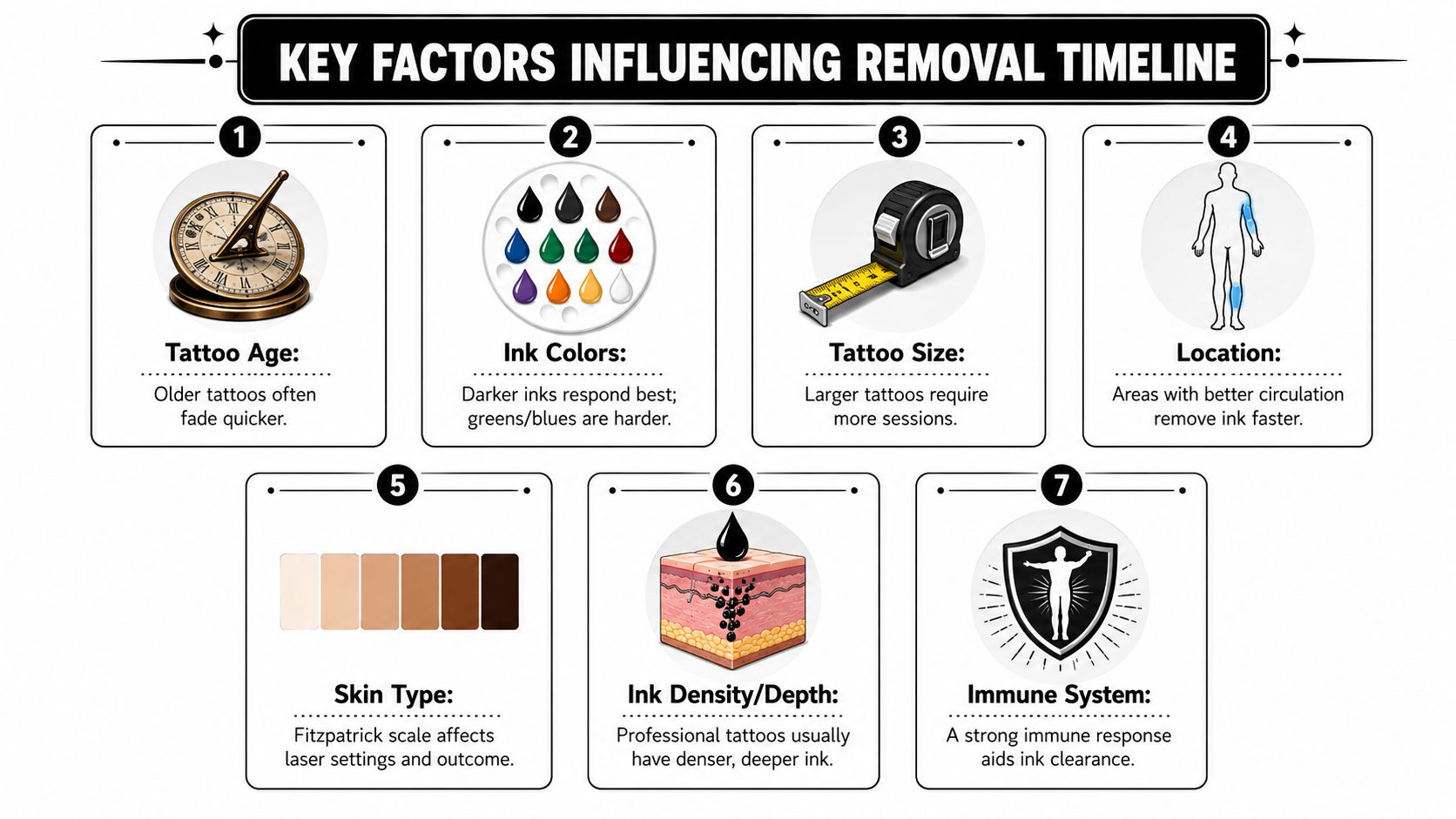
No technician can look at every tattoo and give the same answer, because not every tattoo behaves the same way. Some clear more easily. Others take patience because the ink, the placement, or the skin creates a tougher removal path.
Tattoo characteristics matter first
The tattoo itself is usually the biggest starting variable.
At EradiTatt, one technology used for treatment planning is the PiQo4 Laser System, which is designed to be highly effective and often requires 8 to 12 sessions to achieve optimal results across a wide spectrum of ink colors and skin tones, based on PiQo4 tattoo removal guidance.
Here are the main tattoo-related variables:
- Size: Larger tattoos usually take longer because there's more pigment to target and more area for the body to clear.
- Color mix: Dark ink often responds differently than brighter blends. Multicolored tattoos can require a more nuanced plan.
- Ink density: Heavily packed professional ink can be more stubborn than lighter, more uneven saturation.
- Depth: Ink placed deeper in the skin can be slower to break up and clear.
- Age of the tattoo: Older tattoos often fade naturally over time, which can work in your favor.
Your body and skin affect the pace
Two people can have similar tattoos and still move through removal at different speeds.
Some of that comes down to skin type, placement, and circulation. Areas with stronger circulation often behave differently than areas where the body doesn't move material as efficiently. Skin tone also affects how conservative laser settings need to be, because safety matters as much as speed.
The body's role shows up here again. A person with solid healing habits often stays on track more smoothly than someone whose aftercare or recovery is inconsistent.
| Factor | Tends to Be Faster | Tends to Be Slower |
|---|---|---|
| Tattoo age | Older, already-faded ink | Newer, crisp saturated ink |
| Ink colors | Simpler dark ink profiles | Multicolored designs |
| Tattoo size | Smaller treatment area | Larger treatment area |
| Location | Areas with better circulation | Areas with slower circulation |
| Skin type | Skin that allows efficient, safe settings | Skin that requires more caution |
| Ink density and depth | Lighter, less dense pigment | Deep, concentrated professional ink |
| Immune response | Strong healing and steady aftercare | Slower clearance patterns |
Clinical insight: Session count is only part of the estimate. The harder question is how your tattoo and your biology interact over time.
This is why a consultation matters. Good planning isn't just "big tattoo equals more sessions." It's reading the full picture.
Realistic Results Fading for Cover-Ups vs Full Removal
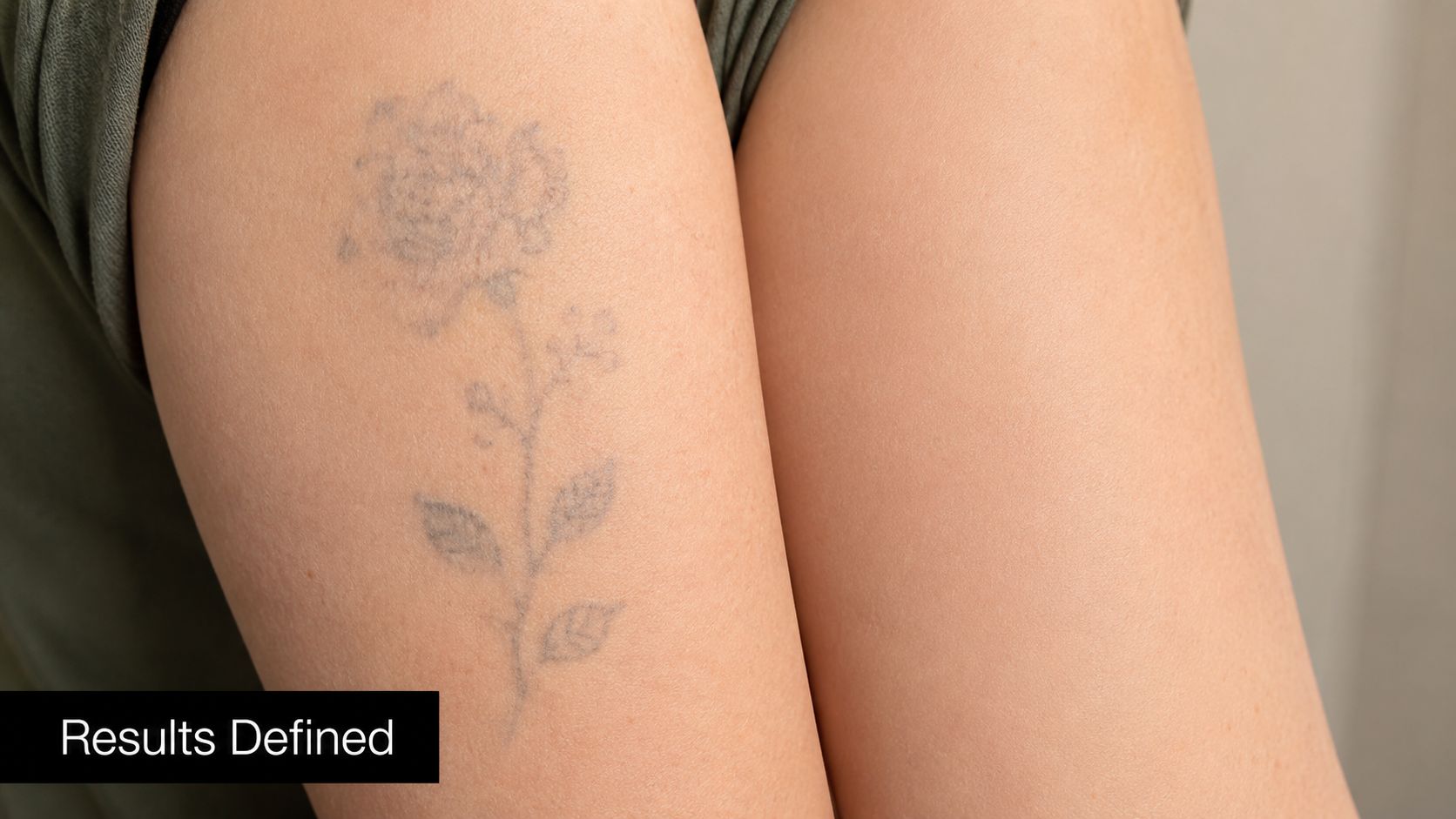
Not everyone needs a tattoo completely erased. That's one of the biggest reasons timelines vary in real life. The end point changes the plan.
If your goal is a cover-up fade
A cover-up client usually wants the old tattoo light enough that a new artist can work over it cleanly. That goal often feels more manageable because you're not trying to chase every trace of pigment. You're trying to create space for new design work.
A typical cover-up path looks like this in practice:
- The original tattoo softens enough to stop dominating the skin
- Dark outlines become less controlling for the new design
- The tattoo artist gains more freedom with shape, contrast, and color choices
That kind of fading can be emotionally satisfying because the tattoo starts getting out of the way before it's gone.
If your goal is full removal
Full removal is a different mindset. You're waiting for the tattoo to continue fading well beyond the point where a cover-up client might stop. That takes more patience because late-stage progress can feel slower and more incremental.
The difference usually comes down to what "done" means:
- For cover-up fading: Done means the old tattoo no longer limits the new artwork too much.
- For full removal: Done means the remaining pigment is faint enough that you feel comfortable leaving the skin uncovered.
If your true goal is a cover-up, don't plan emotionally for complete erasure. If your true goal is bare skin, don't stop at the first stage that looks "better."
Disappointment often starts with these scenarios. A person wanting full removal may get encouraged by early fading and assume the rest will happen at the same pace. A person wanting a cover-up may wait longer than necessary because they think they have to reach near-total clearance first. Neither assumption helps.
A better approach is to decide your endpoint early and judge progress against that endpoint, not against someone else's before-and-after expectations.
Planning Your Removal at EradiTatt Sarasota
You sit down for a consultation hoping for a clear answer, then realize the primary question isn't just how many sessions it might take. A more significant consideration is how your tattoo, your skin, and your immune response are likely to behave over time.
That is what a useful consultation should answer.
At EradiTatt Sarasota, planning starts with a close read of the tattoo itself and an honest discussion about your endpoint. Ink density, color variation, placement, age of the tattoo, and your skin characteristics all affect how the laser can break pigment apart. Your body then has to clear that fragmented ink through its normal immune processes. The laser creates the opportunity for fading. Your body does the actual clearing between sessions.
That biological pace matters more than people expect. A session can be quick. The waiting afterward is where much of the progress happens.
What happens at the consultation
A strong consultation should feel specific to you, not scripted. The technician should examine the tattoo carefully, ask about your medical history and skin behavior, and clarify whether you want enough fading for a cover-up or you want to keep going toward full removal.
The treatment plan should account for practical limits you will live with:
- Your end goal: Cover-up preparation or full removal
- Your schedule: Work demands, travel, workouts, sun exposure, and upcoming events
- Your skin recovery: How your skin responds after treatment and how much healing time it needs
- Your aftercare consistency: Because healing habits affect how well each session sets up the next one
I always tell clients the same thing. A realistic timeline is more useful than an optimistic one.
How to make a long process easier to manage
The clients who stay on track usually build removal into normal life. They do not treat each session like a one-time event. They plan for the healing window, keep spacing consistent, and judge progress over months instead of week to week.
A few habits make that easier:
- Book the next session before you leave: Consistent spacing gives your skin time to recover and gives your immune system time to clear disrupted pigment
- Plan around sun and major events: Freshly treated skin and heavy sun exposure are a poor combination
- Take progress photos in the same lighting: Fading is gradual, and photos often show progress more clearly than memory
- Match expectations to the goal: Cover-up clients may be ready sooner than full-removal clients, especially once the old design stops competing with new artwork
Support from the clinic matters here. You should be able to ask why progress slowed, whether your spacing still makes sense, and whether your current response is normal for the stage you are in. Sometimes the right move is to wait longer, not treat sooner. That can be frustrating, but pushing the schedule does not force the immune system to work faster.
If you are considering EradiTatt Tattoo Removal, the most useful next step is a consultation focused on your tattoo, your healing pattern, and a schedule you can realistically maintain.
If you're ready to start with a clear plan instead of guesswork, EradiTatt Tattoo Removal offers consultations focused on realistic timelines, fading goals, and full-removal planning for Sarasota-area clients. A good first visit should leave you knowing what to expect, how the spacing works, and what your next few months will look like.