
The most popular advice about tattoo removal for a small tattoo is also the most misleading: small means quick and easy. A compact design may take only a short time to treat during an appointment, but the ink still sits in the skin, and your body needs time to clear the fragments after each laser pass. A tiny, densely packed professional tattoo can be more stubborn than a larger, lightly inked amateur design.
The useful question isn't just, “How big is it?” It's, “What ink is present, how densely was it placed, where is it located, and what result do you want?” Complete erasure, visible fading, and preparation for a cover-up can each require a different plan.
Table of Contents
- Why Small Tattoos Are Not Always Quick to Remove
- What Happens During Your Initial Consultation and Assessment
- Laser Protocols and Session Timelines for Small Tattoos
- Full Removal Versus Fading for a Cover-Up
- Pre-Treatment and Post-Care Essentials for Optimal Results
- Common Questions and When to Book Your Consultation
Why Small Tattoos Are Not Always Quick to Remove
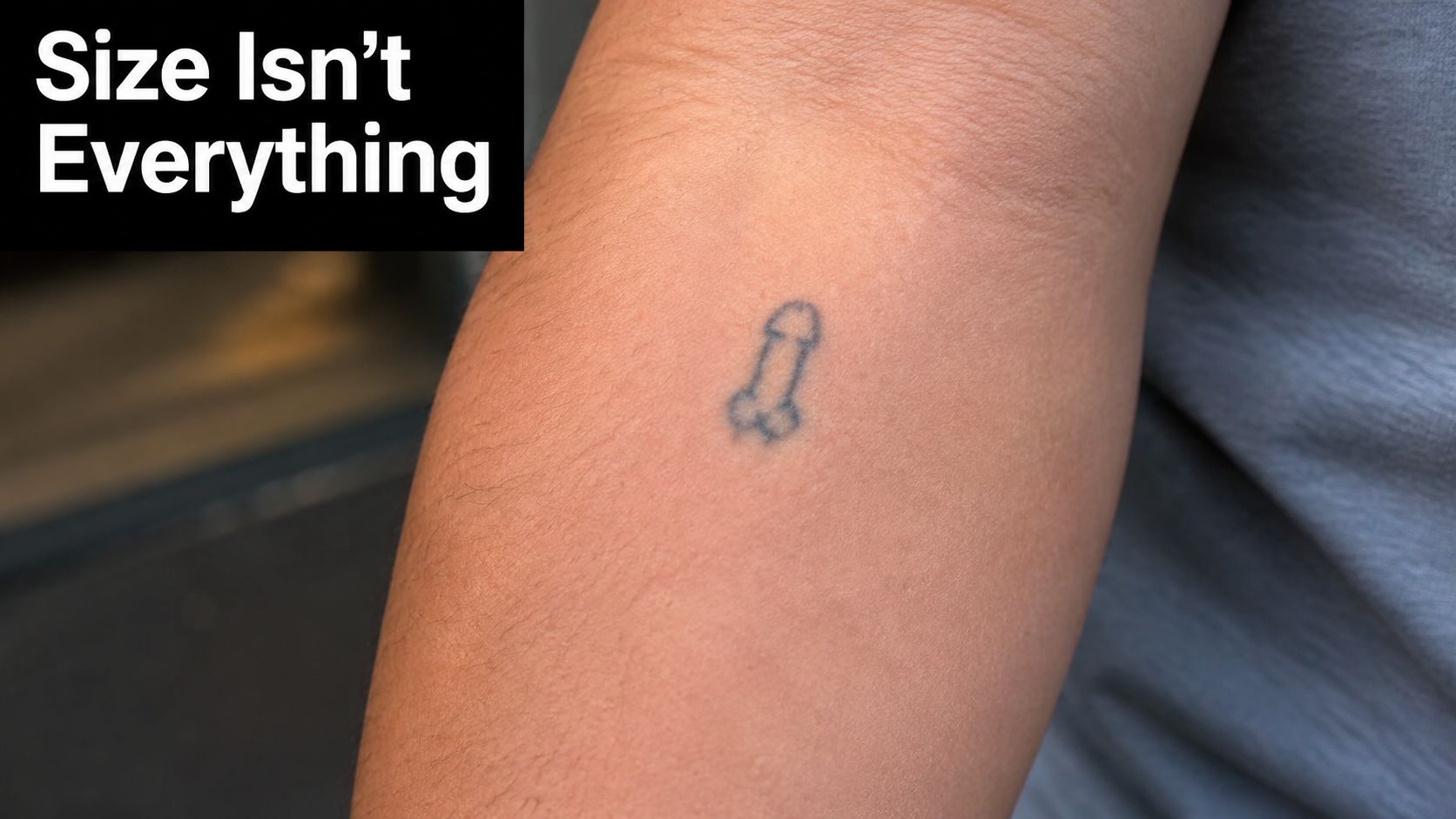
Size affects the amount of skin treated, but it doesn't tell you how much pigment the laser must break down. Ink density, pigment color, depth, tattoo age, and placement often matter more than the tattoo's surface area. A fine-line amateur tattoo may respond relatively quickly, while a saturated professional mark with heavy black pigment can retain a substantial amount of ink despite its small footprint.
Clinical evidence supports a broad range rather than a guaranteed shortcut. Amateur tattoos usually require about 5 to 10 sessions, while professional tattoos often need 15 to 20 sessions, with rare cases reaching 25 sessions. The estimate depends more on tattoo type, pigment color, density, depth, age, and location than on the laser type alone, as outlined in this clinical guide to small tattoo removal. A predictive model classified tattoos under 2 cm² as very small, yet reported an average of 6 sessions overall, with individual results ranging from 2 to 20 sessions.
The pigment matters more than the ruler
Black and dark ink generally gives a laser a clearer target than many lighter colors. Red and orange pigments need a different wavelength, while blue, green, and yellow can be more resistant depending on their formulation. Multicolored light inks, nonblack or deep blue pigment, tattoos larger than 30 cm², and tattoos older than 36 months have all been identified as factors that can make removal more difficult in clinical reviews (clinical review of tattoo-removal factors).
Location also changes the outlook. Tattoos on feet and legs have shown weaker responses in cohort data, especially when combined with other difficult characteristics such as high density or multiple colors. Smoking and treatment intervals of 8 weeks or less were also associated with reduced response in that cohort (tattoo-removal outcome dataset).
Practical rule: A small tattoo is a small treatment area, not necessarily a small removal project.
Modern protocols are evolving, too. Picosecond systems may help with some blue, green, and yellow inks, while newer approaches are testing ways to accelerate pigment clearance. The right consultation should therefore examine the tattoo rather than promise a fixed session count based only on its dimensions. You can also review these factors that affect tattoo removal progress before your appointment.
What Happens During Your Initial Consultation and Assessment
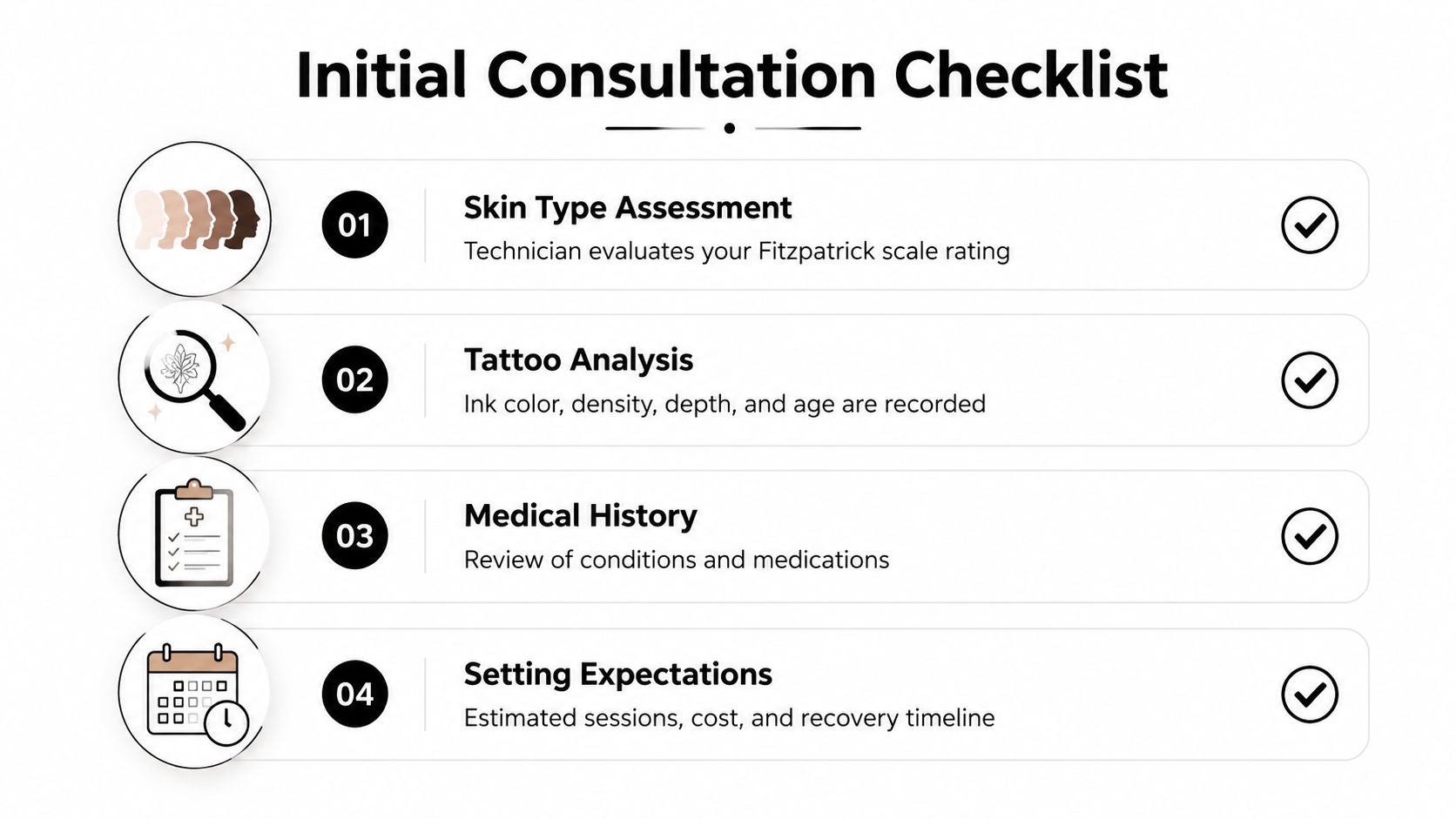
A responsible consultation begins before any laser fires. The technician should examine your skin and tattoo under good lighting, document the design, and ask what “removed” means to you. Someone preparing for a cover-up needs a different endpoint from someone seeking the faintest possible residual trace.
Four assessments shape the plan
Skin type comes first. A technician may assess your Fitzpatrick skin type, which helps guide wavelength selection, energy decisions, and the pace of treatment. The aim is to target tattoo pigment while reducing unnecessary interaction with the melanin in your skin.
The tattoo gets mapped in detail. Expect questions about whether it was professionally applied or done by an amateur, when it was created, whether it has been altered, and whether it contains black, red, orange, blue, green, yellow, white, or mixed pigment. Density and depth matter because a solid, saturated mark presents a different challenge from a light outline.
Health and medication history also matter. Tell the provider about conditions, medications, prior reactions, tanning, recent sun exposure, and smoking. The body clears fragmented ink after treatment, so your general healing circumstances form part of the planning conversation.
Your desired endpoint determines the strategy. A technician may recommend fading rather than full removal if a cover-up artist only needs the old design lightened. That can prevent unnecessary treatment after the canvas is already workable.
Questions worth asking before treatment
Ask which wavelengths the clinic expects to use, how the provider will protect your surrounding skin, and what signs would cause them to adjust the protocol. You should also ask how long the clinic recommends waiting between treatments, what aftercare it provides, and whether it has experience treating your skin type and ink colors.
A cookie-cutter plan sounds like a guaranteed number of sessions before anyone has examined the tattoo. A customized plan explains uncertainty, identifies the difficult variables, and gives you a realistic range instead of a promise. For additional technical background on picosecond systems, this Omega Lasers removal guide offers useful context about how those devices are used in tattoo treatment.
Laser Protocols and Session Timelines for Small Tattoos
Laser removal works by delivering concentrated light into tattoo pigment. The energy breaks larger particles into smaller fragments, and the body gradually clears those fragments through its natural immune and lymphatic processes. That's why a session can be brief while the visible result continues developing for weeks afterward.
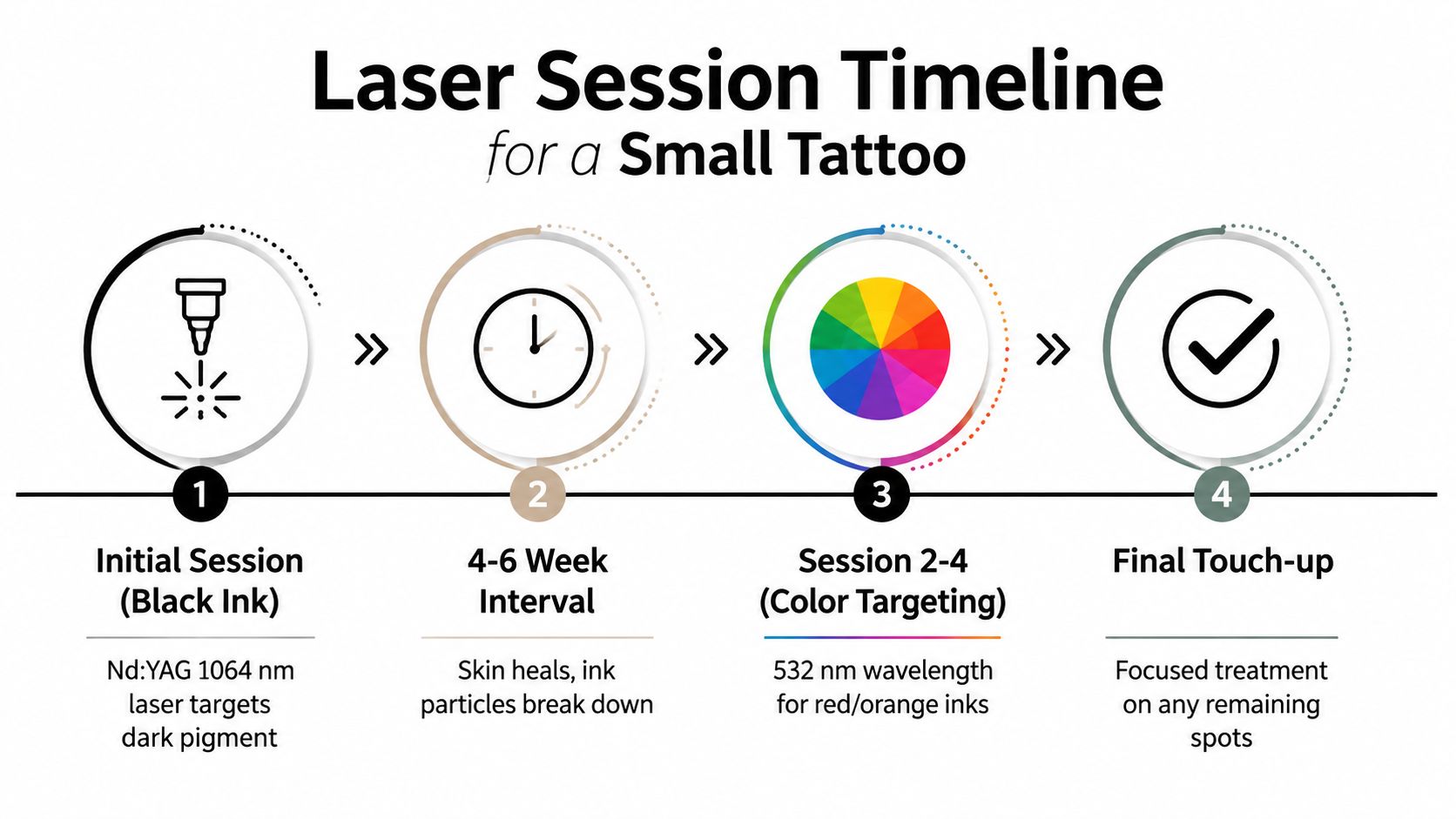
For black or dark ink, technicians commonly consider Nd:YAG 1064 nm. Red and orange pigment may be approached with 532 nm. Picosecond systems deliver very short pulses and may improve results for selected colors, but the literature still has limited evidence proving long-term superiority over nanosecond systems in every situation.
Why the interval is part of the treatment
Small tattoos are commonly scheduled at 4 to 8 week intervals. One clinical study applied treatments at regular 4-week intervals for up to eight treatments, while broader reviews found that black-ink tattoos often reached about 75% clearance in 4 to 8 sessions. The same review reported 69% to 100% of tattoos achieving more than 70% clearance after 1 to 10 sessions, depending on ink type and device (clinical review of laser tattoo removal).
A separate clinical source describes many practices spacing sessions around 6 to 8 weeks, allowing skin recovery and pigment clearance (treatment-planning guidance). Treating too soon doesn't force the immune system to work faster. It can expose healing skin to unnecessary stress before the previous treatment has finished producing its effect.
What realistic planning looks like
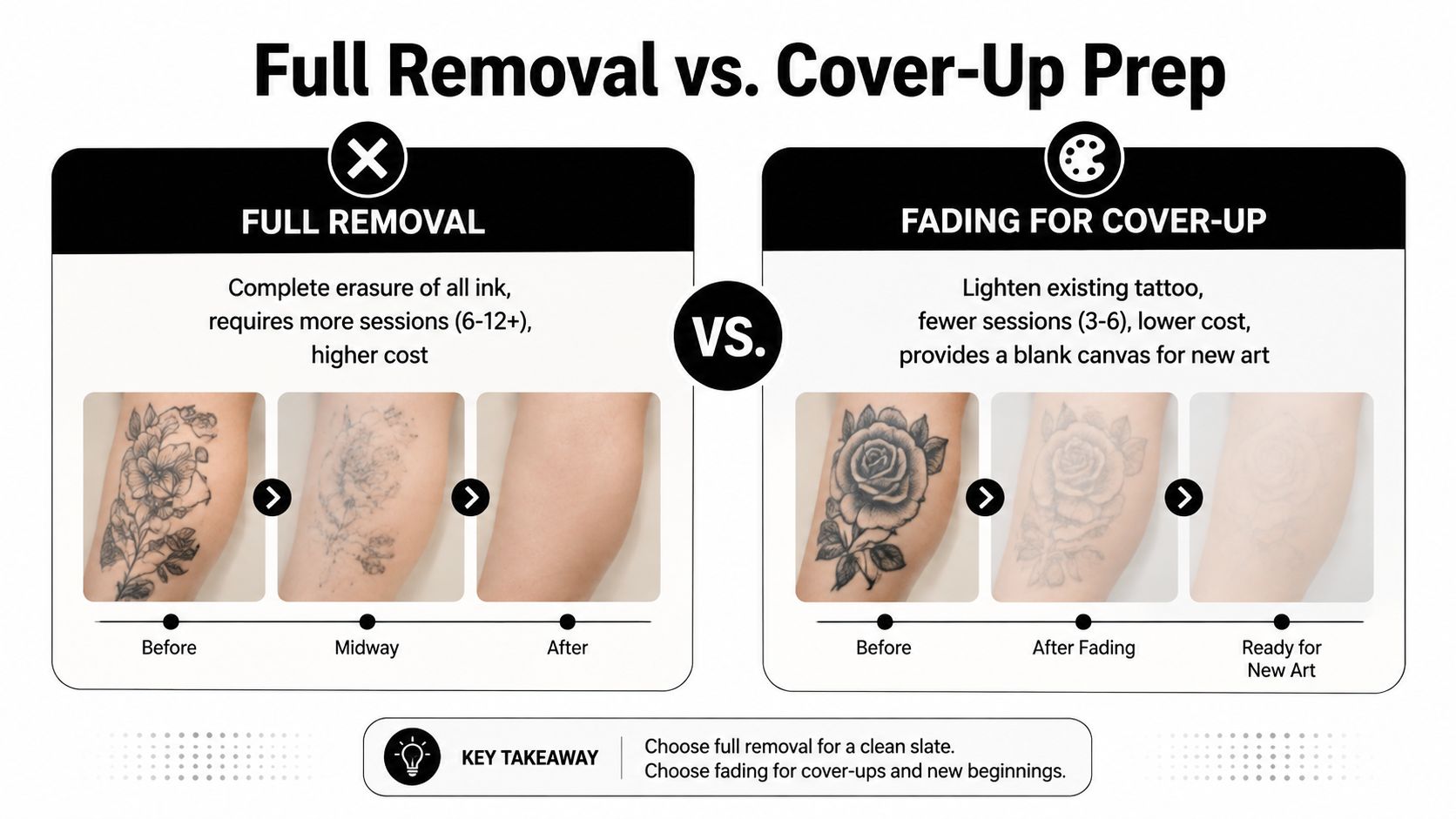
Modern guidance often places small black tattoos around 3 to 6 sessions for significant fading, particularly when the goal is cover-up preparation rather than complete removal. Amateur designs generally clear faster than dense professional tattoos, but no responsible technician should convert that pattern into a guarantee.
A cautious protocol usually includes:
- Assessment first: Skin type and pigment color guide the wavelength and energy choice.
- Conservative fluence: The technician starts at an appropriate energy level rather than chasing instant results with an aggressive pass.
- Biological clearing time: The treated area is allowed to heal while the body processes fragmented pigment.
- Progressive adjustment: Later sessions respond to how your skin and tattoo behaved, not just to a preset schedule.
The R20 method is among the newer protocols changing expectations. A 2025 case series found picosecond R20 produced the strongest clinical and histopathologic improvement among the tested protocols, while a 2025 study combining acoustic shock waves with laser reported good or excellent results in 68.2% of tattoos after 2 to 4 sessions, with no adverse effects reported in that study (PubMed case-series and protocol evidence). These findings are promising, but they don't make one protocol appropriate for every tattoo. For broader laser context, this guide to laser age spot removal explains why wavelength and target selection matter in light-based treatments. You can also read about why tattoo removal takes multiple sessions.
Full Removal Versus Fading for a Cover-Up
The right endpoint may not be total erasure. If you're planning a cover-up, your tattoo artist may only need the existing design lightened enough that the new composition can control the old lines and shadows. Treating beyond that point can add time without improving the finished artwork.
Full removal aims to reduce the visible tattoo as far as your skin and pigment allow. Even after substantial clearance, some clients see a faint shadow, residual pigment, or a “ghost image.” Laser treatment is generally less invasive than cutting the tattoo out, but it still requires repeated sessions and cannot promise that every trace will disappear.
Choosing between the two goals
| Goal | What the plan prioritizes | Main trade-off |
|---|---|---|
| Full removal | Continued treatment until remaining pigment is minimal or no longer visible | More sessions, more waiting, and no absolute guarantee of perfect erasure |
| Cover-up fading | Lightening the design enough for a tattoo artist to work over it | The original shape may remain faintly visible beneath the new artwork |
| Surgical excision | Removing the small tattooed section directly | Practical only for small tattoos, and it leaves a scar |
Surgical excision can be practical for a very small tattoo, but the trade-off is permanent scarring. Laser treatment avoids cutting out the skin and is usually the safer route for people who want to preserve the skin's surface, though it takes patience and may leave residual pigment. The Mayo Clinic overview of tattoo removal also emphasizes this basic choice between a scar from excision and the repeated sessions associated with laser treatment.
Coordinate with the cover-up artist
Bring photographs of the tattoo, or arrange a consultation with the artist before beginning removal. A skilled artist can tell you whether the design needs broad fading, targeted lightening, or removal of only certain lines. That conversation helps the laser technician focus treatment where it will make the greatest difference.
Don't let an online session estimate decide the endpoint for you. The useful question is whether the remaining pigment will interfere with the new design, not whether the old tattoo has reached an abstract idea of perfection.
Pre-Treatment and Post-Care Essentials for Optimal Results
Preparation protects the skin you're asking the laser to treat. Tell the clinic about recent sun exposure, tanning products, medications, and any history of unusual healing or pigmentation changes. A technician may delay treatment if your skin is not in a suitable condition, because avoiding complications matters more than preserving an arbitrary appointment date.
Keep the treatment area clean and avoid applying products that could irritate it before the visit. Follow the clinic's medication guidance rather than stopping any prescribed medicine on your own. Your provider should explain whether topical numbing or cooling will be used and what sensation to expect.
What you may notice after treatment
The skin can feel warm, tender, or tingly. Temporary redness, swelling, and blistering may occur, and the treated pigment can appear temporarily frosted immediately after the laser. These reactions don't automatically indicate a problem, but you should follow the clinic's instructions for dressings, ointments, and cleansing.
- Protect blisters: Don't puncture or peel them unless your provider specifically instructs you to do so.
- Leave crusts alone: Picking can increase the chance of scarring or pigment changes.
- Keep it clean: Use the cleansing and topical-care routine supplied by the clinic.
- Limit irritation: Avoid friction from tight clothing and postpone activities that expose the area to avoidable heat, rubbing, or contamination.
- Protect from sunlight: Follow strict sun-protection instructions during healing to reduce unwanted pigment changes.
Aftercare principle: Healing skin needs protection, not experimentation. Don't add acids, scrubs, bleaching products, or home remedies unless your provider approves them.
When to contact the clinic
Call the clinic if pain, swelling, drainage, redness, or other symptoms appear more severe or persistent than the provider described. Bring clear photographs if the team asks you to document healing. Between appointments, the body continues clearing fragmented ink, so consistent care supports the process even though aftercare can't replace the waiting period.
For a practical explanation of why these steps matter, see why aftercare is important after laser tattoo removal. Good aftercare doesn't guarantee a specific number of sessions, but poor care can complicate healing and interfere with the next treatment decision.
Common Questions and When to Book Your Consultation
Does tattoo removal hurt? The laser sensation is often described as a series of sharp snaps or stings. Cooling and appropriate numbing options can make the appointment more manageable, but sensitivity varies by location and individual tolerance.
Can a small tattoo be removed in one visit? Usually, no. Small tattoos often still require multiple sessions, and the number depends on pigment, density, depth, location, skin type, and response. Focused ultrasound has been described as a possible first-line option for smaller tattoos, with 1 to 3 sessions in the cited review, and it may also be considered when Nd:YAG treatment fails or creates problems (focused-ultrasound review).
What if the tattoo stops fading? A plateau deserves reassessment, not automatically more energy. The provider may review the wavelength, fluence, interval, pigment composition, smoking, placement, and whether a different protocol, including picosecond treatment or an adjunct, makes sense.
Is there a standard price for a small tattoo? No reliable universal price applies. Clinics may price by size categories, such as XX-Small, X-Small, and Small, while the total cost depends on the number of sessions and your chosen endpoint. Ask for the per-session fee and the estimated range separately.
How do I choose a provider? Look for a consultation that evaluates skin type and ink rather than selling a fixed package. Ask who performs treatment, which devices and wavelengths are available, how the clinic handles adverse reactions, and whether appointments are available at a location convenient for your schedule. EradiTatt Tattoo Removal is one Florida provider offering personalized laser removal plans for complete removal or cover-up fading.
Book a consultation when you're ready to have the tattoo assessed rather than guessed at. Bring its approximate age, information about whether it was professionally applied, a list of relevant medications or health conditions, and a clear statement about whether you want full removal or fading.
EradiTatt Tattoo Removal offers personalized laser treatment plans for small tattoos, including complete removal and targeted fading for cover-ups. Visit EradiTatt Tattoo Removal to request a consultation and discuss the ink, skin, location, and timeline that apply to you.