
Most tattoos require 8 to 12 sessions spaced 6 to 8 weeks apart, and the full process often takes 12 to 24 months because your body clears fragmented ink gradually between visits. Some tattoos finish sooner, some take longer, and the timeline depends on the tattoo itself as much as the laser treatment.
You might be staring at an unwanted tattoo right now and trying to figure out whether removal is a few appointments or a long project. The honest answer is that tattoo removal time is measured in months, and sometimes years, because the laser starts the process but your immune system finishes it.
Table of Contents
- Why Tattoo Removal Takes Time and What to Expect
- How Your Body Clears Tattoo Ink Between Sessions
- Your Typical Tattoo Removal Timeline and Session Count
- What Factors Change Your Personal Removal Timeline
- Week by Week Healing Between Your Tattoo Removal Sessions
- Complete Removal versus Cover-Up Fading Timelines
- Getting Started With Tattoo Removal at EradiTatt
Why Tattoo Removal Takes Time and What to Expect
A tattoo removal consultation often starts with the same question, can this be finished quickly, or is it something that has to fit into a longer plan. The honest answer is that tattoo removal usually takes months rather than days, because the laser only starts the process. Your body does the slower part afterward, clearing the fragmented ink through its normal cleanup pathways StatPearls clinical reference.
The appointment itself is brief. The biological response is not. A tattoo may look lighter soon after treatment, but that change reflects what happens after the session, not how long the laser was on the skin.

What “slow” really means in tattoo removal
The pause between sessions is part of the treatment, not wasted time. Clinical guidance commonly places tattoo removal at 4 to 15 treatments, depending on the tattoo's age, color, quality, and placement mechanism StatPearls clinical reference.
That range exists because tattoos are not all built the same. Fine lines, dense shading, layered ink, and tattoos in different body areas behave differently, almost like different materials under the same tool. A small, lightly inked design may respond differently than a heavy multicolor piece, even if both were treated with the same laser settings. Independent clinical data also show how variable the process can be, with one 2025 model reporting an average of 6 sessions and a range of 2 to 20 PMC predictive-model study.
The practical takeaway is simple. The laser can break the ink apart, but the skin still needs time to clear those fragments before another pass is useful. If treatment is repeated too quickly, the skin may be asked to do two jobs at once, breaking down fresh pigment while still processing the last round.
What you should expect emotionally and practically
Planning matters here. If your goal is complete removal, the process is usually measured over months to years, especially for dense, professional, or multi-color tattoos StatPearls clinical reference. If your goal is cover-up fading, the target is different, since the aim is to lighten the tattoo enough for new artwork rather than erase every trace. That difference changes how you think about work schedules, travel, weddings, and other events that are easier to plan around than to reschedule.
The reassuring part is that the process is understandable once you know how it works. You should expect gradual fading, not overnight disappearance. That slower pace is normal, and it reflects the way your body handles ink that has been broken into smaller pieces.
How Your Body Clears Tattoo Ink Between Sessions
The laser doesn't vacuum ink out of the skin. It breaks the pigment into tiny fragments, and then your body has to do the cleanup work over the following weeks. The PiQo4 laser system delivers ultra-short pulses of light energy that shatter ink particles into microscopic fragments, which the body's immune system gradually absorbs and eliminates through the lymphatic system over the following weeks.
That's why session spacing isn't just an office scheduling choice. It's tied to biology. If the skin hasn't finished clearing the ink from the last treatment, another session can be less efficient and can be harder on the tissue.
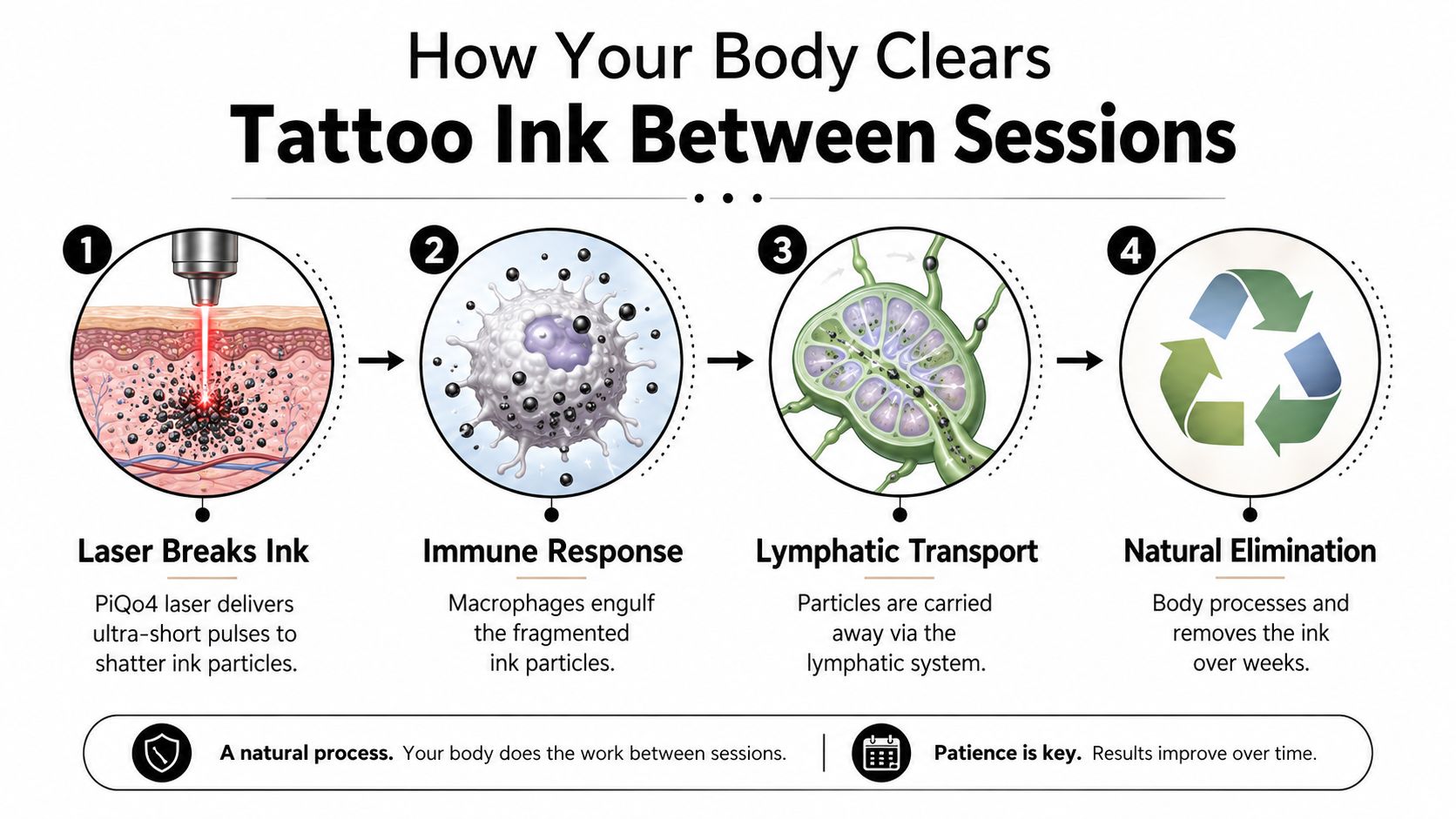
The laser breaks, the body clears
A simple analogy helps here. Think of the laser as a wrecking crew and your immune system as the cleanup team. The laser knocks the building apart, but the debris still has to be hauled away piece by piece. Until that cleanup happens, the site doesn't look fully finished.
That is also why session time is a poor way to judge the process. A treatment may take only minutes, but the clearing phase runs for weeks. The visible result comes later, after macrophages and lymphatic pathways have done their work.
Why some ink comes out faster than others
Some pigments fragment and clear more easily than others. Black ink usually responds more predictably than stubborn color blends, and older, denser, or placed ink can take longer to move out. The key point is not that one tattoo is “good” and another is “bad,” it's that each one gives the laser and the immune system a different job.
The appointment is the starting point, not the finish line.
That's also why rushing can backfire. Booking too early can leave the body with unfinished cleanup from the prior session, which means the next treatment may not have the full benefit of the last one. Most of the actual progress happens between visits, when the immune system is clearing the shattered pigment at its own pace.
Your Typical Tattoo Removal Timeline and Session Count
A tattoo removal plan starts to make sense once you separate what happens in the chair from what happens afterward. One visit may be quick, but the full process usually unfolds across many appointments, because each treatment only moves the process forward a little at a time. For that reason, the number of sessions and the calendar length both matter when you are planning around work, travel, or a visible change you want to reach by a certain date.
The most useful way to set expectations is to look at the plan in layers. Some tattoos fade steadily and predictably, while others need a slower rhythm so the skin can recover and the body can clear loosened pigment. If you are trying to fit removal around an event, a summer schedule, or a future cover-up, the timeline should be treated like a project schedule, not a single appointment.
Tattoo Removal Timeline by Goal
| Goal | Typical Sessions | Total Timeline |
|---|---|---|
| Complete removal | 8 to 12, sometimes more | 12 to 24 months, often longer |
| Cover-up fading | Fewer than complete removal, often several fewer sessions | Usually shorter than full removal |
That table gives the broad shape of the process, but the practical meaning is different for each goal. Complete removal asks the body to keep clearing pigment until very little remains, which is why it usually takes longer and can be harder to finish than simple fading. Cover-up work is more flexible. The target is not invisible skin, it is a lighter canvas that lets a new design sit over the old one with less distraction.
This is the point where planning matters. If you are hoping to be finished before a wedding, a move, a new job, or another life change, you want to count backward from that date and leave room for healing between visits. That buffer is what keeps the schedule realistic, especially when the tattoo is dense, colorful, or in a spot that does not clear as quickly.
A useful way to compare clinic guidance is to look at how different practices frame the same journey. The Beverly Hills laser treatment timeline shows how one clinic explains session planning in everyday terms, and the EradiTatt session guide gives another practical view of how appointment counts are translated into a treatment plan. Those references help because they turn a vague range into something you can map onto real decisions.
The biggest takeaway is simple. Session count is only part of the picture, and the full removal timeline is shaped by recovery time between visits as much as by the visits themselves. A tattoo that needs a moderate number of treatments can still take a long calendar period, so the safest expectation is to plan for a process rather than a quick series of procedures.
What Factors Change Your Personal Removal Timeline
A tattoo removal timeline can look straightforward on paper, yet two people rarely move through it at the same pace. The tattoo's age, color, size, placement, and how heavily it was applied all shape how quickly it fades, and your skin's own response adds another layer of variation.
Age, color, and application style
An older tattoo and a very fresh one do not always behave the same way. In the PMC predictive-model study, the model found that very fresh tattoos averaged fewer sessions than tattoos that were slightly older, which helps explain why two pieces of similar size can still follow different timelines. The lesson is simple. A laser plan is not based on appearance alone, it also depends on how the ink has settled into the skin.
Color matters too. Darker pigments usually respond more predictably, while brighter shades and mixed colors can be harder to break down evenly. Professional tattoos often have denser ink placement in deeper layers, so they may take longer than light amateur work. If you are comparing machines or protocol styles, a laser treatment comparison guide can help you see why technology is discussed alongside tattoo characteristics.
Bottom line: the key question is not just “how big is it?”, it is “what is the depth and density of the ink application?”
Location and skin response
Placement affects circulation and lymphatic drainage, and that affects how quickly the body moves shattered ink away. Areas with better blood flow tend to clear more efficiently, while tattoos farther from the body's core often take longer. Skin type matters too, because treatment has to stay more conservative where pigmentation risk is higher.
You can sort your own timeline by looking at a few practical variables.
- Age of the tattoo: newer work may respond differently from older ink.
- Ink mix and color: black usually behaves more predictably than layered color blends.
- Application quality: dense professional work often takes longer than light, uneven work.
- Body location: circulation and lymphatic drainage vary by region.
- Aftercare habits: good healing supports smoother progress between visits.
For a fuller breakdown of these variables, the EradiTatt factor guide covers the main drivers in more detail. The useful part for patients is not memorizing every variable. It is recognizing which ones you can control and which ones depend on your body's biology.
Week by Week Healing Between Your Tattoo Removal Sessions
Right after a session, the treated area usually looks more dramatic than it will a day later. Redness, swelling, and a temporary frosting effect can show up right away, and that frosting often fades within about 30 minutes. The first few days can include tenderness, darkening, and sometimes blistering, which can feel unsettling even when the healing is normal.
What the first month usually feels like
The skin is doing two jobs at once. It is recovering from the laser pulse, and it is starting the slow cleanup process that helps clear fragmented ink. That is why the area can look different from one day to the next, even when nothing is wrong.
A practical recovery rhythm often looks like this.
- Week 1: redness, swelling, and sensitivity are common.
- Week 2: light scabs may form and shed on their own.
- Week 3: fading often becomes easier to see.
- Week 4: the skin may be approaching readiness for the next appointment, depending on healing.
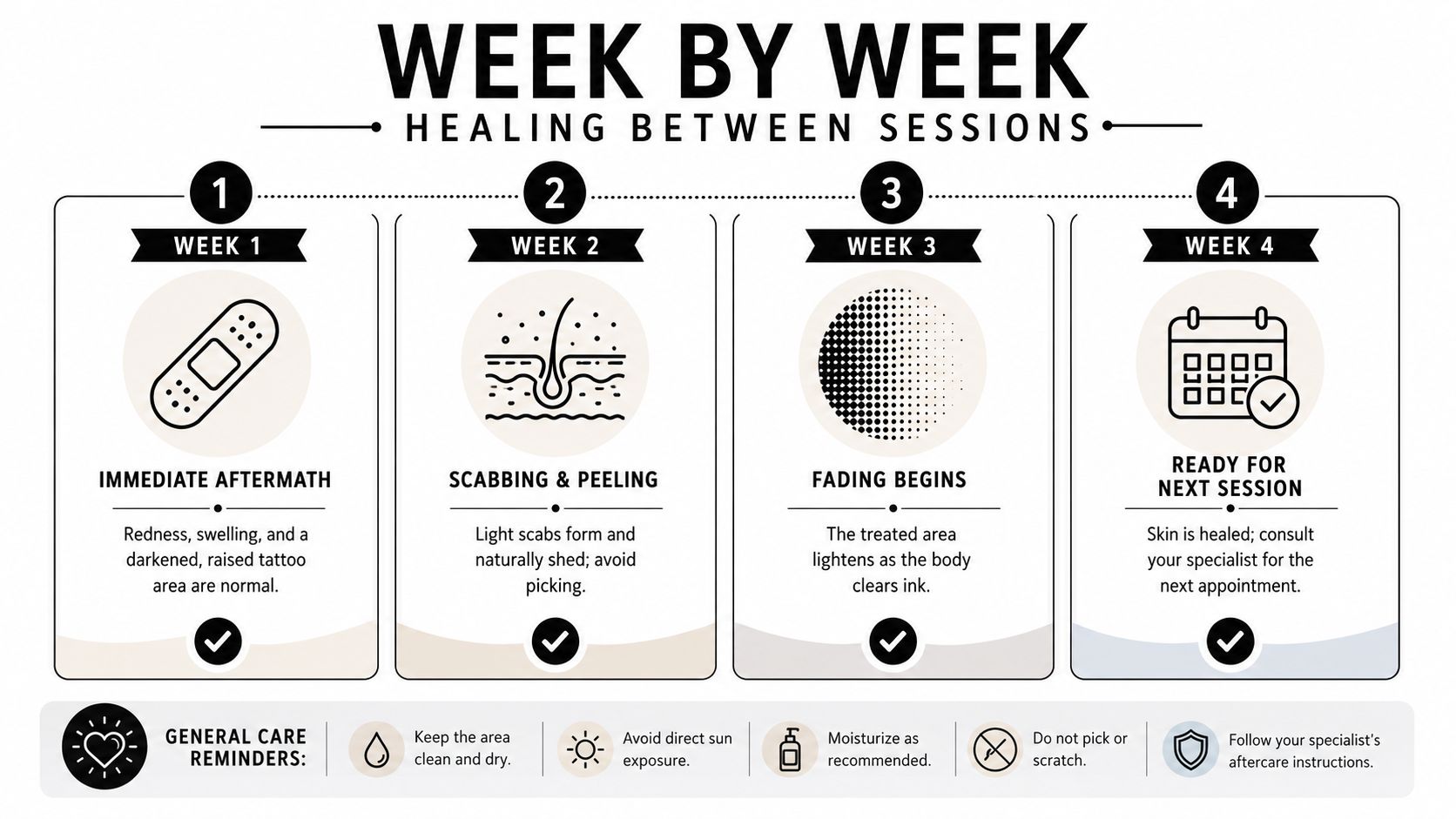
Why the waiting period matters
The body can keep clearing ink for weeks after treatment, which is why spacing matters. A shorter gap can mean the skin is still repairing while the next pulse arrives, while a longer gap gives the immune system more time to move broken pigment away. Published discussions describe different interval approaches, from early shorter scheduling to more conservative spacing in other settings timing review session-spacing guide.
Don't pick scabs, and don't rush the calendar.
That advice sounds simple because it is. The small choices between visits, gentle cleansing, sun protection, avoiding irritation, and letting scabs fall naturally, are some of the few parts of tattoo removal time you can influence. The body still controls the pace, but your aftercare can help it work without extra setbacks.
If you are deciding between full removal and lightening for a new design, the practical differences are explained in the EradiTatt cover-up fade plan. That choice changes how you should think about healing time, because the goal is either to clear as much ink as possible or to soften the old tattoo enough for a better cover-up result.
Complete Removal versus Cover-Up Fading Timelines
The goals of complete removal and cover-up fading require different approaches and timelines. Full removal asks the body to clear as much pigment as possible. Cover-up fading asks for enough lightening to give a new design cleaner contrast.
If your goal is full removal
Full removal usually takes the longer path. The commonly discussed 8 to 12 session range fits here, and the 12 to 24 month timeline becomes realistic because each layer of visible ink has to be broken down and cleared. Some tattoos need more time still, especially when the ink is dense, layered, or made with complex color mixes.
That timing is tied to biology, not wishful thinking. The laser breaks pigment into smaller pieces, then your immune system carries those fragments away over repeated healing cycles. You can help by protecting the skin between visits, but you cannot force the body to clear ink on command.
If your goal is a cover-up
Cover-up fading usually moves faster because the target is different. You do not need the old tattoo gone completely. You need it light enough that a new design can cover it with better contrast and less visual interference.
A cover-up fade plan from EradiTatt is a useful reference if you are deciding between the two. It frames the practical question clearly, whether you want skin that looks as clear as possible or a better canvas for a new tattoo.
Ask for the result you want, not the most extreme version of removal.
That distinction prevents a lot of frustration. Some clients begin by wanting full removal, then find that cover-up fading fits their goals and timeline better. Others already know they want every trace reduced as much as possible. Either way, the timeline follows the goal you choose, and your body sets the pace from there.
Getting Started With Tattoo Removal at EradiTatt
The first step is a consultation that looks at the tattoo, your skin, and your realistic timeline. EradiTatt offers tattoo removal across Florida locations in Orlando, Bradenton, Sarasota, St. Petersburg, Palm Harbor, and Tampa, so patients can choose a site that fits their schedule and drive time. The consultation is where the team can estimate the number of sessions, discuss spacing, and map out a plan based on your tattoo's size, color, and placement.
EradiTatt uses the PiQo4 laser system, which breaks ink into tiny fragments so your body can clear them over time. That makes the conversation about time honest from the beginning. You're not signing up for a one-visit fix, you're signing up for a guided process with realistic checkpoints.
If you want to talk through your options, you can call the central 844 number or contact a local clinic directly. The point of that first call is simple, get a plan that fits your tattoo and your calendar, not someone else's.
EradiTatt Tattoo Removal helps people who want complete removal or fading for a cover-up by building a plan around the tattoo's color, size, placement, and healing pace. If you're ready to see what your timeline may look like, visit EradiTatt Tattoo Removal to schedule a consultation and take the first step toward a clearer result.