
You're probably looking at your hand right now, turning it palm up, then over, and wondering what tattoo removal on hand before and after really looks like in real life. Not the polished marketing version. The practical version. How many sessions might it take, why do hand tattoos fade so unevenly, and which clinics show useful photo evidence instead of a vague promise.
Hand tattoos are different from tattoos on the arm, shoulder, or back. Clinical guidance consistently shows they're among the harder locations to clear because circulation is poorer at the body's edges, the skin is thinner, and artists often place hand ink to a significant depth so it stays visible. That's why full removal on the hand often takes longer than other body areas, and why fading for a cover-up is sometimes the more realistic goal.
If you're still choosing a design rather than removing one, you can discover hand tattoos on TattoosAI. If you're already focused on removal, the clinics below are worth studying because they help you compare expectations, photo transparency, and whether they support full removal or staged fading.
Table of Contents
- 1. EradiTatt Tattoo Removal
- 2. EOS Tattoo Removal
- 3. Kryptonite Laser Professionals
- 4. Lasercare Tattoo Removal
- 5. Houston Tattoo Removal Clinic
- 6. Atlantic Laser Tattoo Removal
- 7. VIVAA (Virginia Mason Franciscan Health affiliate)
- Hand Tattoo Removal Before & After, 7 Providers
- Final Thoughts
1. EradiTatt Tattoo Removal
You book a hand tattoo removal session, then realize the hard part is not the first appointment. It is the repeat visits, the healing gaps between sessions, and the reality that hand skin often clears more slowly than people expect. EradiTatt is useful for that kind of long process because it has several Florida locations, including Orlando, Bradenton/Sarasota, St. Petersburg, Palm Harbor, and Tampa.
That practical detail matters on the hand. Removal usually happens over months, not weeks, and hands often need more patience than larger, fleshier areas like the upper arm. A clinic network can make the process easier to keep up with if work, school, or traffic make long return trips harder.
Why hand tattoos need a different plan
The hand is a high-movement area. Skin bends, rubs, washes often, and gets more sun exposure than covered body parts. All of that affects healing, aftercare, and how you should judge progress from one session to the next.
A good consultation should sort your goal into one of two buckets early. The first is full removal. The second is fading for a cover-up. That distinction sounds basic, but it changes almost everything, including how aggressive the treatment plan needs to be, how long you may be willing to continue, and what a successful before-and-after result looks like.
For example, someone trying to soften a small black symbol near the thumb may be satisfied once the lines are light enough for a new design. Someone removing old finger lettering for a clean, bare-skin result may need more sessions and more tolerance for slow progress. Those are different projects.
EradiTatt appears set up for both paths. If you want a better sense of how staged progress can look in real cases, its laser tattoo removal image gallery with before-and-after examples is more useful than a single final photo, because hand removal is closer to peeling away layers of marker than flipping a switch.
Practical rule: Ask the clinic to define success before the first session. “As light as possible for a cover-up” and “complete clearance” should not be treated as the same endpoint.
The website does not publish online pricing or a simple session calculator, so a consultation carries more weight here than it does with clinics that post standard ranges. Still, the site makes basic contact steps clear, with a central phone number, location pages, and clinic-specific details.
Who EradiTatt fits best
EradiTatt makes the most sense for Florida clients who want a clinic option that is easier to revisit over time.
- Best for people planning multiple visits: Hand tattoo removal usually requires follow-up sessions, so location flexibility helps.
- Best for clients deciding between removal and cover-up fading: The service framing supports either goal.
- Best for people who want clear contact paths: A central number plus individual clinic details makes scheduling more straightforward.
The tradeoff is simple. If you do not live in Florida, convenience drops fast. You also need to ask more questions during consultation because the website gives only limited detail on price and expected treatment range.
2. EOS Tattoo Removal

EOS Tattoo Removal is useful if your biggest question is, “Show me real hand cases, not generic arms and shoulders.” Its gallery explicitly includes hand and ring-finger examples, which is rarer than it should be.
The most helpful detail is how the clinic frames its photos. EOS notes that some after images are taken before the final treatment. That sounds small, but it prevents a common misunderstanding. People often assume an “after” image means finished forever, when in reality it may mean “current progress at this stage.”
What makes the gallery useful
For tattoo removal on hand before and after, realistic staging matters because hand tattoos often leave residual pigment longer than clients expect. Verified clinical data notes that complete clearance on hands often drops closer to the 50% range reported in broader picosecond laser studies, because residual pigment is more likely to remain in the dermal layer of the hand. That's exactly why transparent photo labeling matters.
EOS also works well for people comparing full removal with cover-up fading. Verified data shows that approximately 86% of tattoos smaller than 10 cm² can be sufficiently faded for a cover-up in under 6 sessions with modern pico lasers, while significant fading is often visible after 3 to 4 sessions. On a hand, that difference can be the deciding factor between chasing perfection and choosing a practical reset.
A useful companion read is EradiTatt's collection of laser tattoo removal images, which helps you compare how progress photography is presented across clinics.
Some of the best gallery photos aren't dramatic. They're honest. A hand tattoo that's only partly faded but clearly improving often tells you more than an aggressively cropped "perfect" result.
EOS is a single-market option in San Antonio, so location is the obvious limit. Pricing detail also appears limited online, so plan on a consultation if you want treatment specifics.
3. Kryptonite Laser Professionals
Kryptonite Laser Professionals is a strong pick for people who want progression, not just endpoints. Its hand and finger cases are often shown as a series, which helps you judge fading speed, skin response, and whether the clinic documents the in-between phase experienced during the journey.
That matters because the hand doesn't behave like the upper arm. Verified data notes that hands and feet are among the most challenging locations for clearance and can extend treatment from the standard 8 to 10 sessions to 12 to 15 or more for complete removal. The same guidance highlights the dorsal hand's thin skin and minimal subcutaneous fat, which raises the risk of textural change or scarring if treatment is too aggressive.
Why step-by-step images matter
When a gallery labels images by treatment count or elapsed time, you get a better planning tool. You can estimate whether your own tattoo might be better suited for staged lightening rather than chasing a complete erase.
That's especially true if you have dense ink, smoking history, a larger tattoo, or color-packed work. Those variables are proven to negatively influence outcomes in tattoo removal planning, according to the JAMA Dermatology study on variables affecting treatment response.
If you want a broader explanation of what can slow progress, EradiTatt's article on factors that affect tattoo removal progress gives practical context in plain language.
- Best visual strength: Multi-session series instead of one dramatic before-and-after.
- Best for realistic planners: Helpful if you want to compare hand and finger fading over time.
- Main downside: Quotes and treatment costs appear consultation-based rather than clearly posted online.
Kryptonite is based in Colorado Springs, so convenience depends on where you live. But for educational value, this style of gallery is one of the more useful ones to study.
4. Lasercare Tattoo Removal
Lasercare Tattoo Removal is easy to understand at a glance. Its gallery includes labels such as ring tattoo and hands tattoo, which helps if your concern is narrow placement rather than a large palm-side or forearm-adjacent piece.
That directness is useful because finger and ring tattoos often look small but can still be stubborn. Placement drives difficulty, not just size. Verified evidence from a large cohort study found that tattoo location significantly influences treatment response, and tattoos on the feet or legs showed poorer response, a finding often used clinically to explain why other low-circulation areas like the hands also require more sessions for clearance, as discussed in the PMC review on factors influencing laser tattoo removal sessions.
Best use case for this clinic
Lasercare makes sense for someone who wants a narrow, low-friction booking experience and wants to inspect hand-specific photos before making a call. The site also emphasizes comfort and a gentle approach to skin, which matters on the hand where over-treatment is a real concern.
On the hand, "gentle" isn't just a comfort word. It often reflects good judgment. Thin skin and constant motion make conservative treatment more important here than in thicker body areas.
The tradeoff is depth. Compared with larger galleries, the number of examples appears more limited. If you're the kind of person who wants to compare many hand cases across many stages, you may want to use this site as one reference point rather than your only one.
Its Alaska location is also highly regional, so this is most practical for clients in the Eagle River or Anchorage area.
5. Houston Tattoo Removal Clinic
Houston Tattoo Removal Clinic has a simpler gallery style than some of the more image-heavy clinics on this list. That can still be useful. You're able to look across body areas, including a labeled tattooed hand image, and compare how different placements tend to fade.
This kind of broad gallery helps one point land quickly. Hand tattoos aren't hard only because of color. They're hard because location changes healing and clearance. Verified guidance notes that hand tattoos may require 15 to 25% more sessions than tattoos on the torso, and healing intervals may be stretched to 10 to 12 weeks instead of the standard 8 to help reduce scarring and hypopigmentation, as summarized in Glamour's reporting on tattoo removal timelines and hand-specific risks.
What to look for in simpler galleries
When a gallery doesn't list treatment counts under every image, focus on what the skin itself is telling you. Check whether the after image shows even fading, whether linework is breaking apart, and whether the skin surface looks calm or stressed.
Houston Tattoo Removal Clinic also makes contact details easy to find, which matters when you want a fast answer on scheduling or candidacy. The drawback is that image-by-image treatment detail appears limited. If you care about knowing exactly how many sessions a specific hand case took, this gallery may leave you wanting more.
- Useful for placement comparison: You can compare hand results against other body areas.
- Useful for first-pass research: The gallery is easy to browse.
- Less useful for data-heavy shoppers: Session counts and treatment specifics aren't always visible per image.
6. Atlantic Laser Tattoo Removal
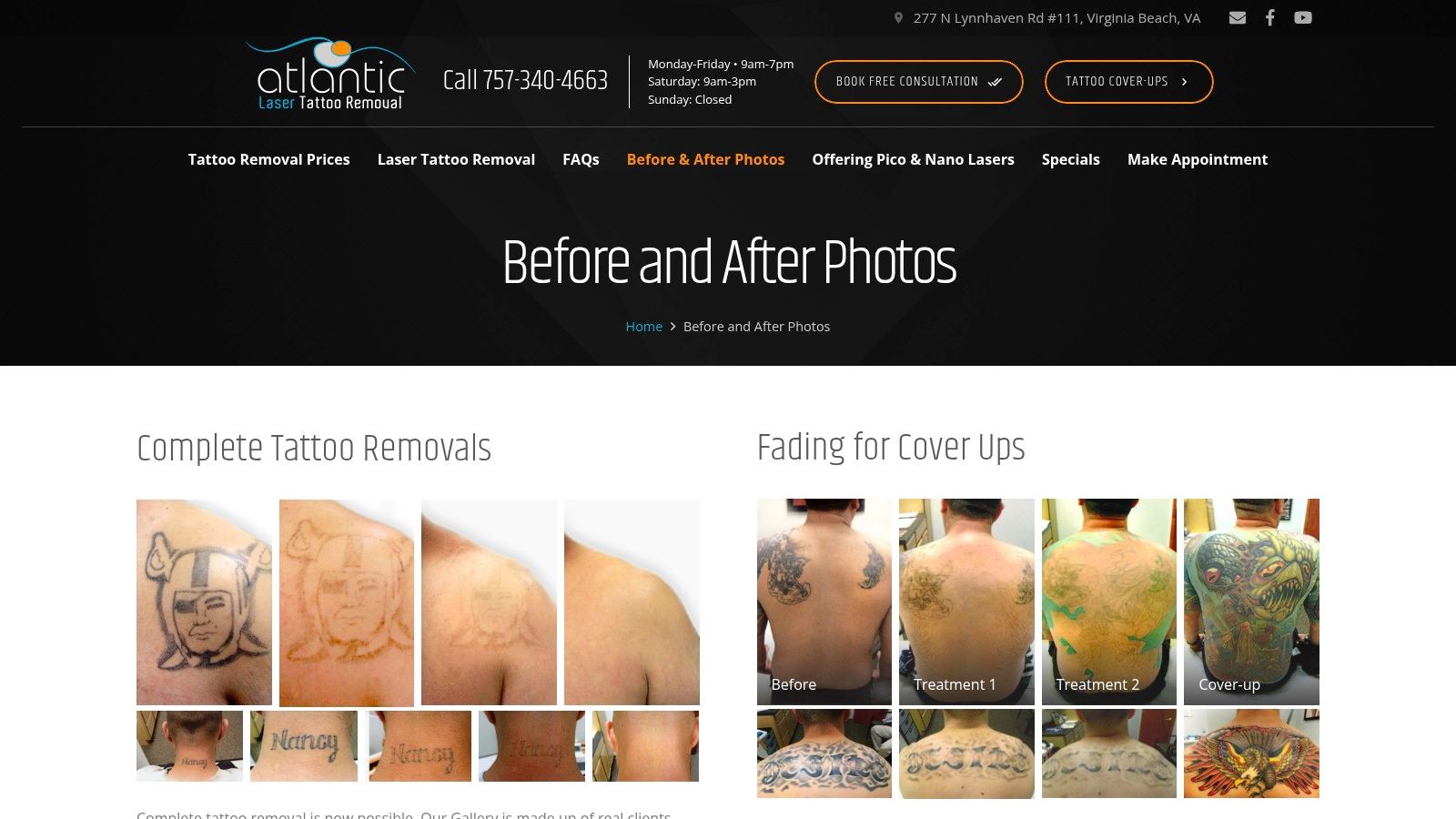
Atlantic Laser Tattoo Removal is a good clinic to study if you're comparing laser platforms rather than just photo galleries. It operates both Pico and Nano technologies and presents both complete removals and staged fading for cover-ups.
That matters on the hand because ink color changes the odds. Verified data shows black ink usually responds best, with an 85 to 90% clearance rate, while colorful inks such as red, green, or blue often show lower clearance in the 70 to 80% range and may leave a ghost image even after extensive treatment. On hands, that ghosting risk is especially relevant because the area is so visible and the skin is thin.
Why technology questions matter on the hand
If your tattoo is mostly black or dark blue, wavelength selection is often more straightforward. Verified data notes that the Q-switched 1064 nm Nd:YAG laser remains a benchmark modality for black or dark blue pigment, while green and light blue inks may require different wavelength approaches. The same source notes that hand tattoos typically achieve only 50 to 60% clearance after 4 sessions for blue or green pigments because immune-mediated clearance is slower in low-circulation zones, according to the NCBI overview on laser tattoo removal modalities and outcomes.
Atlantic's educational framing is useful if your tattoo has stubborn mixed colors or if you're deciding whether fading is the more sensible path.
Clinical reality: A hand tattoo can look "mostly gone" in a mirror and still interfere with a cover-up because leftover pigment changes how new ink saturates.
The gallery doesn't always tag hand and finger examples distinctly, so you may need to browse more carefully. Pricing also appears to require a consultation, even though the site offers some general pricing context.
7. VIVAA (Virginia Mason Franciscan Health affiliate)
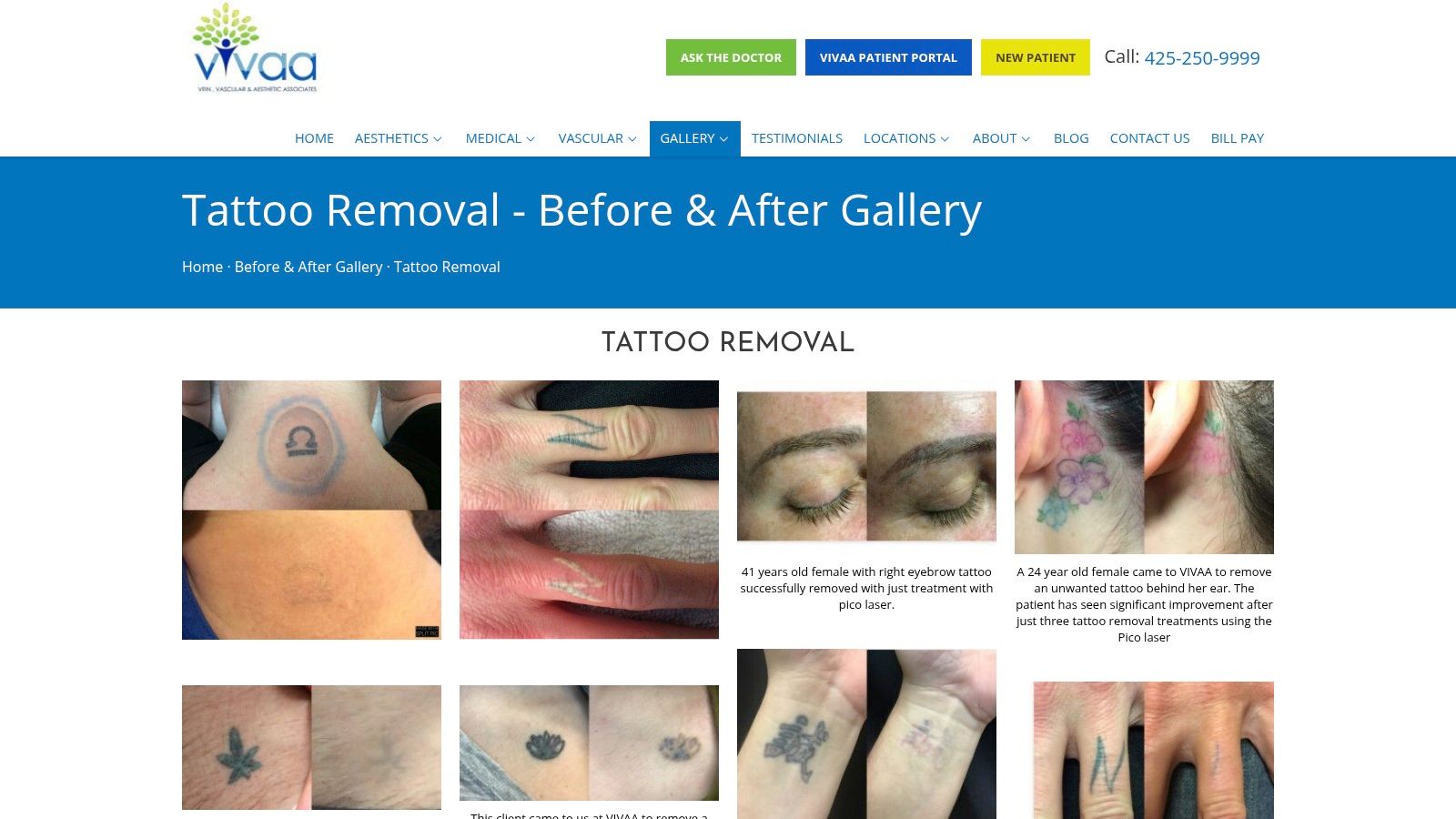
VIVAA brings a more medical framing to tattoo removal. If you prefer a clinic environment tied to a broader medical aesthetics practice, that context may matter as much to you as the gallery itself.
Its before-and-after pages are useful because they show both early-stage and series-based progress. That helps anchor expectations. Tattoo removal on hand before and after often looks incremental, and medically supervised settings tend to be more direct about that.
Why medical framing helps
One of the biggest expectation problems in tattoo removal is assuming every tattoo can be fully erased with no trace. That isn't guaranteed. Verified data notes that near-complete tattoo clearance occurs in roughly 50% of all clinical cases, and the FDA states that complete erasure without any textural trace can't be guaranteed across all patients regardless of session count, as summarized in this overview of real tattoo removal results.
That's especially relevant on the hand, where clients often notice any residual light patch, textural change, or faint outline immediately because the area is always visible.
VIVAA is also a sensible benchmark if you want to compare dedicated tattoo-only clinics against a medical aesthetics setting.
- Best for medically cautious clients: The surrounding clinical context may be reassuring.
- Best for expectation setting: The gallery shows variability between short-term and series-based outcomes.
- Main limitation: Dedicated tattoo-only clinics often publish larger galleries, and hand-specific labels may not always be present.
Hand Tattoo Removal Before & After, 7 Providers
| Provider | Location / Access | Process Complexity 🔄 | Resources ⚡ | Expected Outcomes ⭐ | Ideal Use Cases 💡 | Key Advantages 📊 |
|---|---|---|---|---|---|---|
| EradiTatt Tattoo Removal | Multiple Florida clinics (Orlando, Bradenton/Sarasota, St. Petersburg, Palm Harbor, Tampa); central 844 line | Moderate, personalized multi‑session plans; consult required | Local clinics and staff; standard laser platforms; flexible scheduling | ⭐⭐⭐, effective for full removal or controlled fading; results vary by tattoo/skin | Busy professionals, cover‑up prep, local FL patients | Multi‑site convenience; centralized support; safety‑focused plans |
| EOS Tattoo Removal | San Antonio (single clinic); extensive online gallery | Moderate, documents multi‑session progress clearly | Strong visual resources (unedited gallery); online booking | ⭐⭐⭐⭐, transparent visible progress across sessions | Users wanting realistic before/after evidence and progress tracking | Unedited hand/finger cases; clear expectation setting |
| Kryptonite Laser Professionals | Colorado Springs (single metro clinic) | Moderate, stepwise multi‑session documentation | Robust photo gallery; broader laser aesthetics services | ⭐⭐⭐, realistic stepwise fading shown with treatment counts | Those who want detailed session‑by‑session timelines | Multiple hand/finger series; labeled treatment counts for timelines |
| Lasercare Tattoo Removal | Eagle River / Anchorage (Alaska) | Low, simple, comfort‑focused workflow; small deposit booking | Small studio resources; focused tattoo‑removal tools | ⭐⭐, gentle care with clear ring/hand examples but fewer cases | Local patients prioritizing comfort and straightforward booking | Comfort emphasis; easy online booking and modest deposit |
| Houston Tattoo Removal Clinic | Houston (established clinic) | Low‑Moderate, core tattoo‑removal process, gallery of varied sites | Established clinic infrastructure; clear contact info | ⭐⭐, shows variability across body areas; session details often unspecified | Patients comparing outcomes across body areas | Accessible clinic; straightforward gallery navigation |
| Atlantic Laser Tattoo Removal | Virginia Beach | Moderate, dual‑platform workflows (Pico + Nano) | Pico and Nano laser platforms; active educational content | ⭐⭐⭐⭐, stronger option for stubborn inks; staged fading and full removals | Patients researching technology options for resistant inks | Dual‑platform tech; educational resources and active updates |
| VIVAA (Virginia Mason affiliate) | Bellevue (medical clinic/derm affiliate) | Moderate, medically supervised, education‑framed sessions | Medical‑grade oversight; patient education materials | ⭐⭐⭐, medically framed outcomes; early vs multi‑session examples | Patients seeking medical oversight and clearer safety standards | Medical standards and patient education; clinic benchmarking for care |
Final Thoughts
You look at your hand every day. That simple fact changes how tattoo removal feels. A faint leftover shadow on a shoulder can be easy to ignore. A faint leftover shadow on the hand stays in view during work, driving, texting, and handshakes, so expectations need to be more precise from the start.
That is why hand tattoo removal before and after photos need a closer reading than photos from easier body areas. The hand often responds more slowly, and the result that matters most depends on the person. One patient wants the tattoo gone as fully as possible. Another only needs the ink light enough for a clean cover-up. In practice, that difference shapes the treatment plan almost as much as the tattoo itself.
The most useful clinic comparisons are usually the least flashy. A single dramatic after photo can hide the complete story. A staged set of photos, session by session, works more like a time-lapse than a movie poster. It shows whether the black ink is lifting first, whether colored areas are lagging behind, and whether the clinic is documenting steady progress or only its best endpoint.
A good consultation should do the same kind of work. It should sort the tattoo into parts: ink color, line density, age of the tattoo, skin reaction, daily sun exposure, and your end goal. Hand tattoos need that level of planning because the margin for disappointment is smaller. Even a decent result can feel underwhelming if you expected full clearance and the realistic target was cover-up fading.
Published medical summaries support a patient, measured approach. The NHS evidence summary document describes encouraging clearance outcomes in clinical reporting, while also underscoring that results vary by tattoo and treatment course. That matches what hand cases tend to show in practice. Progress is often visible before the final result is clear.
If you are comparing providers, ask questions that get past marketing. Do they show real hand cases, not just arm or shoulder removals? Do they label photos as early fading, cover-up prep, or final clearance? Do they explain how many sessions a result took, or at least make clear that the photo is one stage in a longer process?
As noted earlier, EradiTatt is a strong starting point for readers in Florida who want both full removal and controlled fading options. That is especially useful for hand tattoos, where the right goal matters as much as the laser itself.