
You may be looking at a blue tattoo right now and thinking you picked one of the hardest colors to remove. That's a common fear. Blue looks bold, saturated, and stubborn on skin, so it feels like it should be stubborn under a laser too.
The surprise is that blue ink tattoo removal is often more manageable than people expect. In many cases, blue sits much closer to black than to difficult colors like yellow or certain reds and greens. With the right wavelength, the right settings, and enough time between sessions for your body to clear the fragmented ink, blue can fade very well.
That doesn't mean every blue tattoo behaves the same way. Navy blue, turquoise, faded cerulean, and mixed-color designs can respond differently. Skin tone matters. Ink depth matters. The laser platform matters a lot. But if you've been assuming blue means hopeless, the science says otherwise.
Table of Contents
- Why Blue Ink Tattoo Removal Is More Straightforward Than You Think
- The Science of Erasing Blue Why This Color Responds So Well
- Matching the Laser to the Ink Your Technology Options
- Your Removal Journey What to Expect Session by Session
- Planning Your Outcome Full Removal vs Fading for a Cover-Up
- How to Choose a Qualified Clinic and Start Your Journey with EradiTatt
- Frequently Asked Questions About Blue Tattoo Removal
Why Blue Ink Tattoo Removal Is More Straightforward Than You Think
You may be looking at a bright blue tattoo and assuming it will be one of the hardest colors to treat. Many clients assume blue is a "problem color" for that reason. In practice, blue often responds better than people expect, especially when the ink is a darker blue and the clinic is using technology designed to target color precisely.
That surprises people because blue looks bold on the skin. Bold does not always mean stubborn. In laser tattoo removal, what matters is not just how vivid the tattoo looks to your eye. What matters is how that pigment interacts with specific wavelengths of light.
A useful way to frame it is this. Blue often sits in a more favorable category than many other colors, even though it does not get the same reputation as black. At EradiTatt, we spend a lot of time correcting that misunderstanding during consultations, because clients often arrive prepared for a more difficult process than their tattoo requires.
Color name alone does not predict difficulty
"Blue" is a broad label, not a single pigment formula. A deep navy script, a royal blue fill, and a pale turquoise accent can all behave differently under laser treatment because they may contain different pigment blends and different concentrations.
That is why a visual exam matters. Two tattoos that both look blue in a photo may respond very differently in real life.
Darker blue shades often give us a clearer starting point. Lighter or more mixed blue tones can still be treatable, but they may need a more specific plan. If your tattoo includes blue alongside green or teal, it also helps to understand how neighboring colors may respond differently. Our guide to green ink laser tattoo removal explains why those color families can behave differently even when they appear similar at first glance.
Blue can be vivid and still be a strong removal candidate.
Why blue gets misjudged
Blue is easy to overestimate for a few practical reasons.
- It keeps its contrast well. A blue tattoo can look saturated for a long time, which makes people assume the ink is not responding even when progress is underway.
- It is often part of multi-color work. If someone has seen a slow result on a colorful tattoo, they may blame blue when the bigger issue was the overall mix of pigments.
- The device matters. A clinic needs the right wavelength options and pulse profile to treat colored ink well. With older or less flexible systems, blue may look harder than it really is.
This is one reason advanced platforms such as PiQo4 can change the conversation. A system with multiple wavelengths gives the clinician more than one way to match the treatment to the pigment rather than forcing every tattoo into the same narrow approach.
A more realistic expectation
Blue ink removal is usually a process of good matching, good timing, and patience between sessions. It is less like scrubbing off paint and more like cracking a rock into smaller and smaller pieces until your body can carry the fragments away. Some blue tattoos fade faster than clients expect. Others take steady, staged treatment.
The main point is simple. Blue is not automatically bad news, and in many cases it is more straightforward to remove than its bright appearance suggests.
The Science of Erasing Blue Why This Color Responds So Well
Blue ink doesn't disappear because a laser “melts” it away. The process is more precise than that. Think of your tattoo like a stained-glass window, not a wall painted with house paint. The color you see depends on which light the pigment absorbs and which light it reflects.
Blue pigment is selective, not invincible
Black ink behaves like a blackout curtain. It absorbs a broad range of light, which is why it's famously laser-friendly. Blue behaves more like blue glass. It doesn't absorb everything. It absorbs certain wavelengths better than others.
That selectivity is useful. When the laser wavelength lines up well with the pigment's optical behavior, the energy gets delivered where it's needed. The pigment particles fracture into smaller pieces, and those smaller pieces are easier for the body to process.
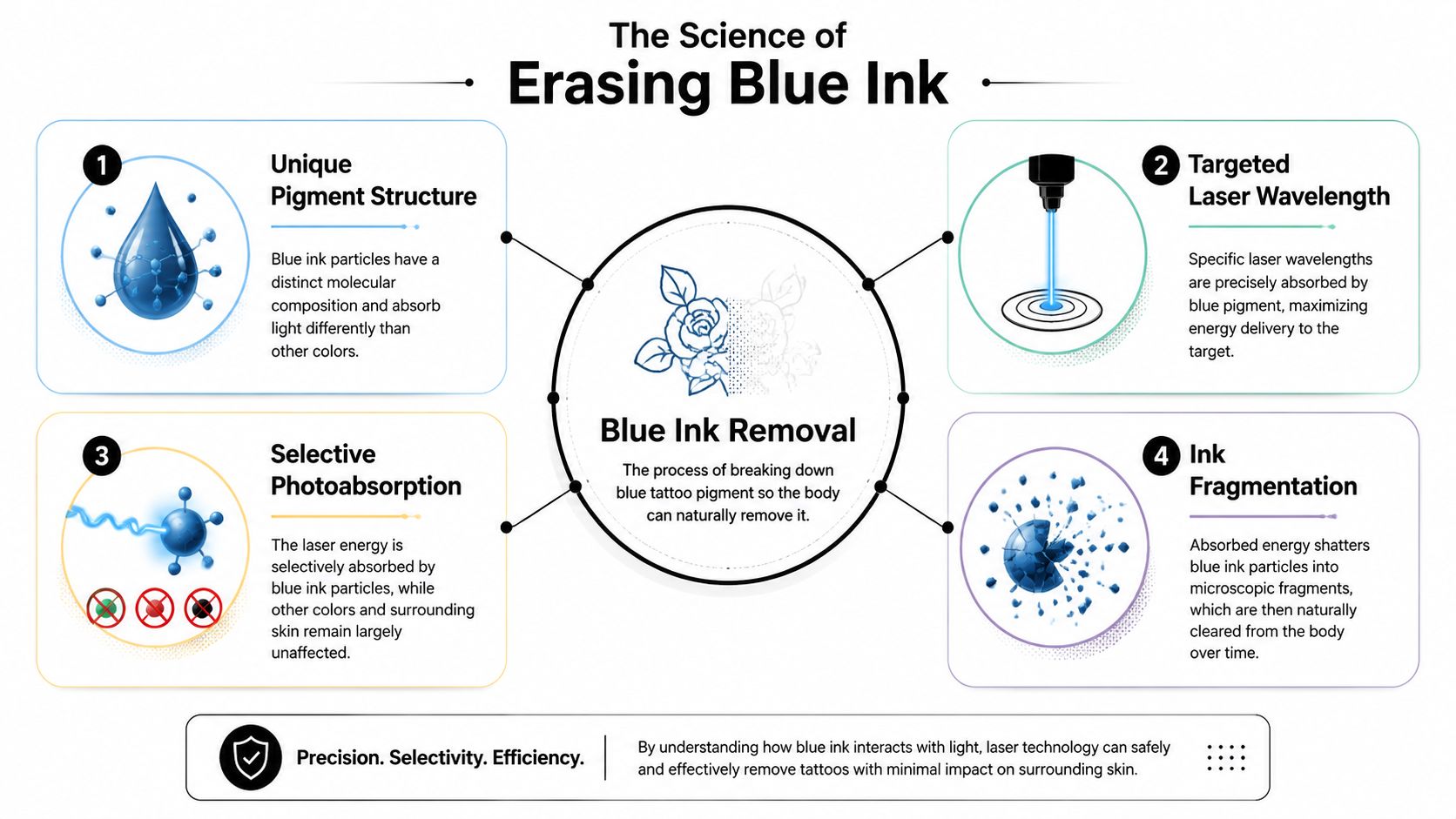
Clinical findings support that idea. A Scientific Reports study on a 150 ps Nd laser found that blue tattoo ink reached 65.04% clearance after three treatments using a 2 mm beam size, 532 nm wavelength, and 120 mJ pulse energy. The same study reported that 532 nm showed the strongest effect for blue, green, red, and yellow pigments, while 1064 nm showed some efficacy for blue and green.
If your tattoo also includes green tones, our guide to laser tattoo removal for green ink helps explain why neighboring colors can need different settings even within the same design.
Your immune system finishes the job
The laser starts the process. Your body completes it.
This review in the National Library of Medicine explains that phagocytosis is the biological mechanism triggered during laser tattoo removal where fragmented tattoo particles are packaged for lymphatic drainage and scavenged by dermal macrophages, fibroblasts, and mast cells. In plain language, your body sends in a clean-up crew.
A simple way to picture it is this:
| Stage | What happens |
|---|---|
| Laser pulse | Energy hits the blue pigment |
| Fragmentation | Ink breaks into smaller particles |
| Immune response | Cells collect the fragments |
| Gradual fading | Lymphatic drainage clears what the cells carry away |
Practical rule: The laser breaks the ink apart. Your body removes it over time. That's why spacing matters.
Why this creates an “aha” moment for patients
Once people understand that laser tattoo removal is a partnership between technology and biology, the process feels less mysterious. It also explains why two people with similar tattoos can fade at different rates. The device matters, but so does how efficiently each body clears the shattered pigment.
That's also why patience is part of good treatment, not a sign that something is going wrong.
Matching the Laser to the Ink Your Technology Options
A blue tattoo can look stubborn because the color is bold. In practice, the bigger question is whether the clinic has a device that can target that pigment precisely.
That is why laser choice matters so much. Two clinics can treat the same blue tattoo and get very different fading patterns if one has only a limited wavelength range and the other can adjust both wavelength and pulse duration.
Older Q-switched platforms versus picosecond systems
Traditional Q-switched lasers have been used for tattoo removal for many years, and they can work well on selected blue tattoos. They deliver energy in nanoseconds, which is fast enough to disrupt pigment, but they rely more heavily on heat and often break particles less efficiently than newer systems.
Picosecond lasers fire in even shorter bursts. A helpful way to understand that difference is to compare cracking a rock with a hammer versus striking it with a sharp, focused snap. The shorter pulse creates a stronger photoacoustic effect, meaning the energy behaves more like a pressure wave and less like slow heat buildup. For blue pigment, that often translates into finer fragmentation and cleaner fading.
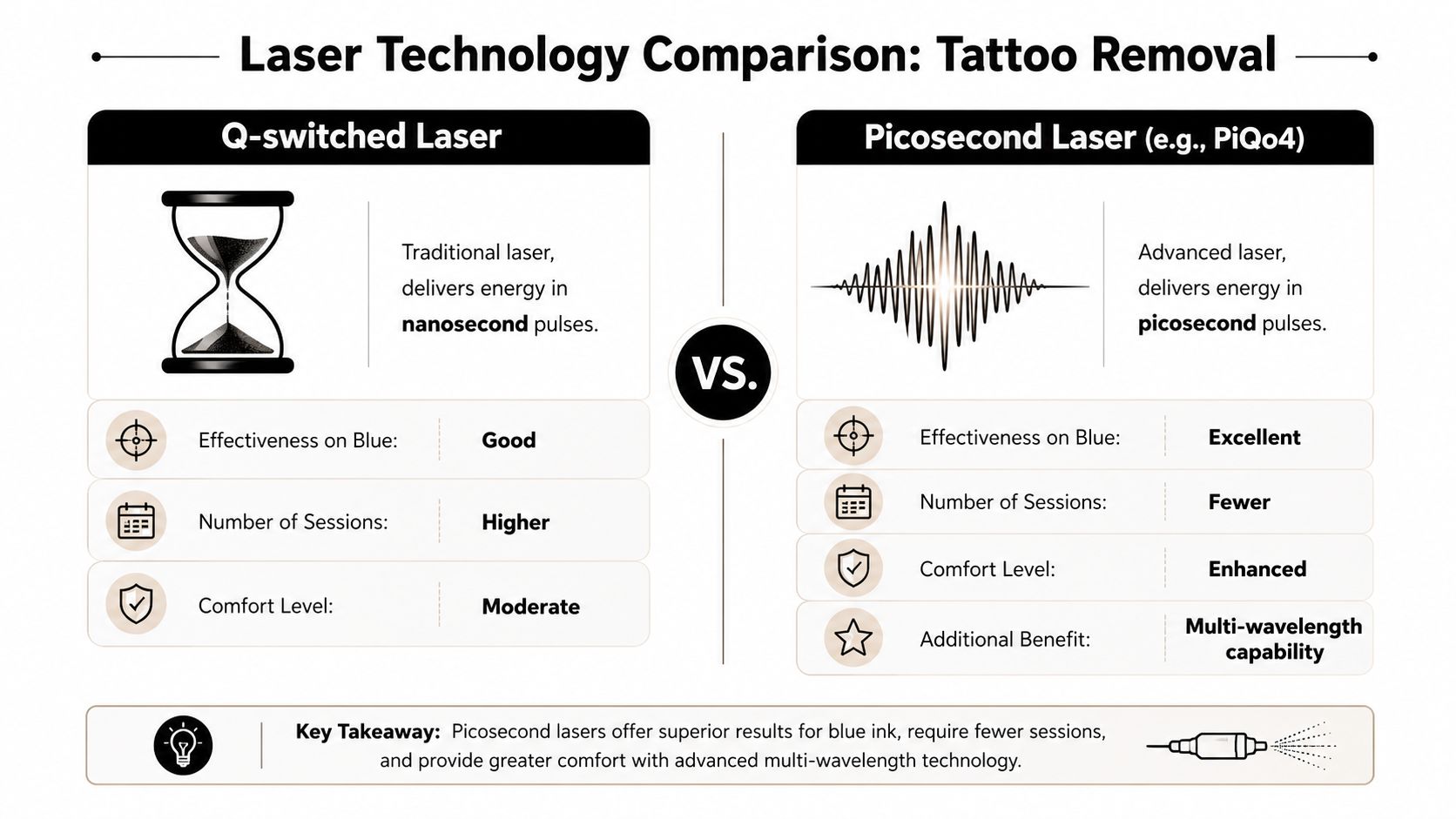
That difference helps explain the counter-intuitive part of blue ink removal. Blue is vivid to your eye, but it can respond very well when the laser parameters are well matched. The problem is usually not that blue is impossible. The problem is using a platform that cannot target it flexibly enough.
Why wavelength choice changes the result
Pulse duration affects how the ink breaks apart. Wavelength determines which pigment the laser can target in the first place.
You can picture wavelength as the color-specific key. If the key is a poor match, the treatment may heat the area without disrupting much ink. If the key is a good match, the laser energy is absorbed more selectively by the pigment you want to treat.
Here is the plain-English version:
- 1064 nm: Commonly used for black and very dark ink. It can help with some darker blue tattoos, especially when the shade is deep.
- 532 nm: Better known for reds, oranges, and some brighter tones, so it is usually not the main workhorse for blue.
- 785 nm: Often discussed for blue and green pigments because it can match those tones more directly in certain tattoos.
This is why one blue tattoo may clear steadily while another slows down after a few sessions. “Blue ink” is not a single substance. One tattoo may contain a straightforward blue pigment. Another may include teal, violet undertones, black shading, or layered passes from a touch-up. The clinician needs enough options to treat what is in the skin, not just what the tattoo looks like from across the room.
The strongest laser is not automatically the right one. The right laser is the one that matches the pigment, the skin, and the treatment goal.
Where PiQo4 fits
A multi-wavelength picosecond platform gives the provider more than one way to approach a blue tattoo. That matters because real tattoos are rarely as simple as a color chart. One area may need a different wavelength than the section right beside it.
At EradiTatt, that is one reason PiQo4 is useful for blue ink work. It combines picosecond delivery with multiple wavelengths, which gives the clinician room to adjust treatment instead of forcing every tattoo through one setting. If you want a technical overview, this guide to PiQo4 laser tattoo removal and wavelength selection explains how that flexibility helps with multi-color and blue-dominant tattoos.
For a new client, the main takeaway is simple. Blue ink often responds well, but only if the technology can see it clearly and hit it in the right way. That is the difference between steady progress and a tattoo that fades partway, then seems to stop.
Your Removal Journey What to Expect Session by Session
You leave your first appointment, glance at the tattoo that night, and wonder whether anything happened. The blue ink is still there. The area looks white in spots, a little red, maybe puffy. That can feel confusing if you expect the tattoo to fade in real time.
Blue tattoo removal rarely works like wiping ink off paper. It works more like breaking a stained-glass window into tiny pieces, then letting your body carry those pieces away over the next several weeks. The laser does the shattering. Your immune system does the clearing.
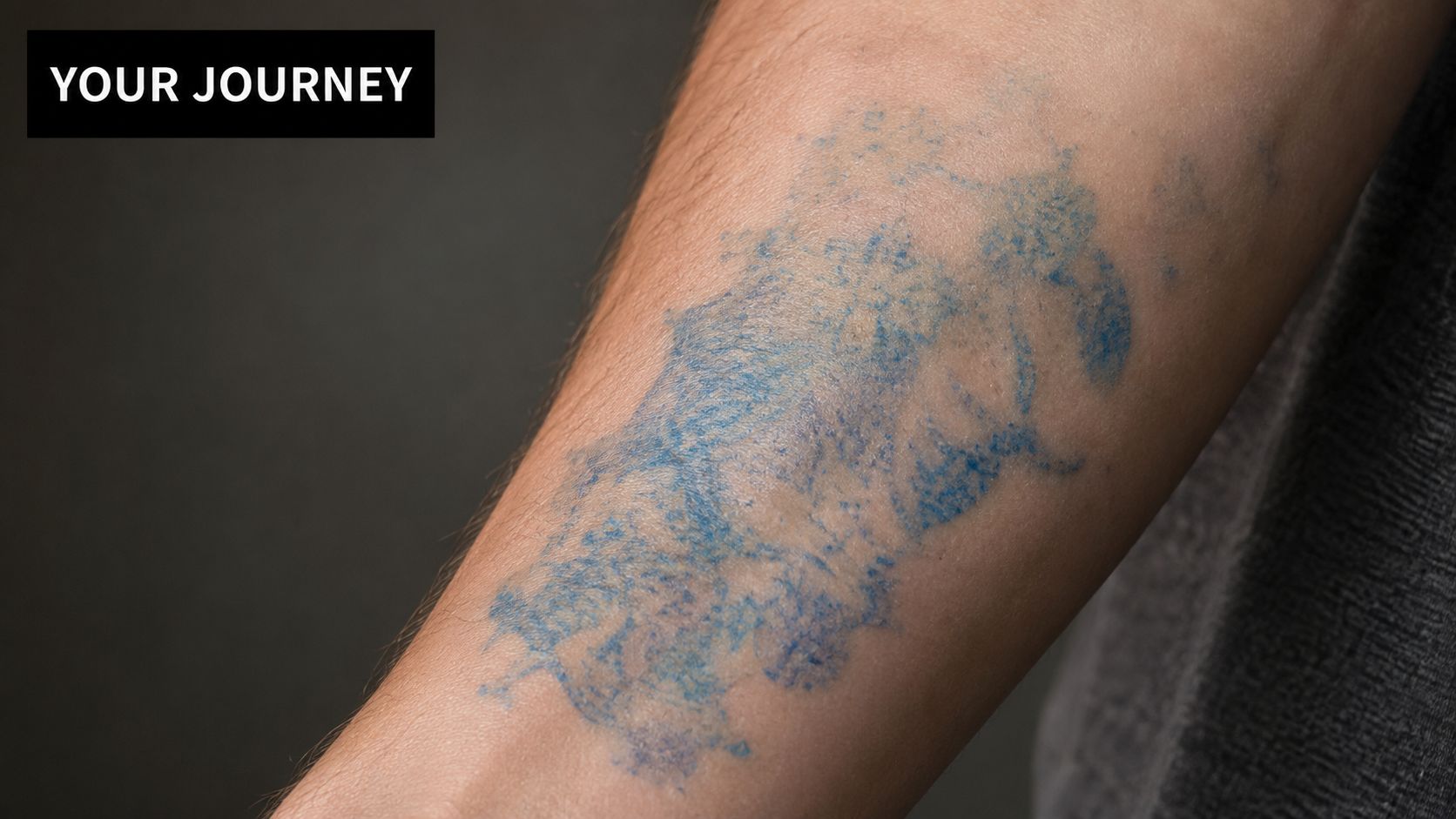
At consultation and your first treatment
Your first visit is part assessment, part treatment planning. A clinician studies the actual tattoo in skin, not just the color you see in a photo. Shade matters. Ink density matters. Placement matters. So does your skin tone and your goal, whether that is full removal or partial fading for new artwork.
That is why two blue tattoos can have very different timelines.
During the session, the sensation is often described as quick rubber band snaps against the skin. Small tattoos usually move fast. The appointment itself is often much shorter than the healing phase that follows.
Right after treatment, many clients notice whitening, sometimes called frosting, plus redness and mild swelling. That reaction is a sign that laser energy interacted with the pigment and the surrounding skin. It is an early response, not the finished result.
What happens in the days and weeks after
The skin usually settles before the tattoo finishes fading. That detail surprises a lot of people.
A helpful way to picture it is a cleanup crew after demolition. The laser breaks larger pigment particles into smaller fragments. Then your body gradually removes those fragments through normal healing and immune processes. So fading primarily happens between visits, not while you are sitting in the chair.
This is one reason spacing matters so much. If sessions are done too close together, the skin may not have enough recovery time and the body may not have finished clearing what the last treatment already broke apart. At EradiTatt, timing is based on how your skin responds, how quickly the tattoo is fading, and whether the goal is complete removal or controlled lightening for a cover-up.
Blue ink can be encouraging here. Because it often responds well to the right wavelength and pulse duration, clients may see early changes that help confirm the process is working, even if the tattoo is far from gone after one session.
What progress usually looks like, session by session
There is no fixed script, but the pattern is often predictable.
After session one, the main result is usually proof of response. You may see some softening, patchiness, or a slight drop in saturation once healing finishes.
After the next few sessions, the tattoo often starts to look less solid. Lines can lose their sharp edge. Dense blue areas may break up into lighter islands. Photos help here because gradual change is easy to miss in the mirror.
Later in the process, progress can slow down. That does not always mean the treatment stopped working. It often means the remaining pigment is deeper, denser, or mixed with other tones that need an approach better suited.
That slower middle or late phase is common in tattoo removal. It is one reason realistic expectations matter from day one.
What you can do between treatments
Good aftercare gives your skin the best chance to recover cleanly and keeps the plan on track.
A sensible routine usually includes:
- Keep the area clean: Follow your clinician's washing and ointment instructions.
- Protect it from sun: Tanned or irritated skin is harder to treat safely.
- Leave blisters or scabs alone: Picking can increase irritation and raise the risk of unwanted skin changes.
- Stay on the right schedule: Earlier is not better. Your body needs time to clear fragmented ink.
- Track your progress with photos: Month-to-month comparison is often more useful than day-to-day checking.
If your goal is a future cover-up rather than bare skin, the strategy may be different from the start. A tattoo artist often needs the old blue ink faded to a manageable level, not erased completely. If that is your plan, this guide on fading a tattoo properly before a cover-up explains how to aim for the right amount of lightening.
Some tattoos fade in a dramatic, obvious way early on. Others improve subtly, then look much lighter when you compare photos taken a few months apart. Both patterns can be normal.
Planning Your Outcome Full Removal vs Fading for a Cover-Up
A client comes in convinced they want their blue tattoo completely gone. Ten minutes into the consultation, their true objective becomes clearer. They are booking with a tattoo artist in a few months and only need the old design light enough to stop showing through.
That distinction matters.
Blue ink often responds well to the right laser, so people sometimes assume full removal is the obvious choice. But the best endpoint is not always bare skin. Sometimes the smarter plan is controlled fading that gives your next artist room to work.
When full removal makes sense
Full removal fits people who want the tattoo cleared as much as possible and do not plan to place new ink over it. It also makes sense if the tattoo sits in an area where even a faint leftover shadow would bother you, such as the wrist, hand, or neck.
A useful way to picture it is to compare two renovation goals. One person wants the wall stripped back to plain paint. Another just needs the old color muted enough to repaint over it. Laser treatment can support either goal, but the stopping point is different.
Full removal usually asks for more sessions, more patience, and a longer timeline. Blue can still be more cooperative than many people expect, especially with technology that can target it well, but complete clearance is still the longest version of the plan.
When strategic fading is the smarter goal
Fading is often the better option for a cover-up because a tattoo artist rarely needs perfectly blank skin. They need the old design softened so the new lines, shading, and color palette can take control.
That is especially relevant with blue ink. Because blue often breaks up predictably under the right wavelength, you may be able to reduce its visual dominance without chasing every last particle. In plain terms, you are turning down the volume, not removing the speaker.
A simple framework helps:
| Goal | Better fit |
|---|---|
| You want clear skin | Full removal |
| You want a new tattoo over the area | Strategic fading |
| The old blue design is very dark | Fading may create more cover-up choices |
| You want the quickest visible change before new ink | Fading often reaches that point sooner |
If your next step is new artwork, this guide to fading a tattoo properly before a cover-up explains how to lighten the old piece to a level a tattoo artist can use.
Success is not always complete removal. Success is reaching the result that fits what you want next.
What changes the plan
The decision is not only about preference. It is also about how your tattoo was built.
A simple blue outline may fade to cover-up range fairly quickly. A saturated blue fill, blue mixed with black, or a design with several shades can need a more specific approach because different parts of the tattoo may respond at different speeds. Your skin tone, placement, healing pattern, and timeline matter too.
At EradiTatt, this is the part of the consultation where we get practical. We look at what your tattoo artist needs if a cover-up is the goal. We estimate whether fading is likely to be enough or whether fuller removal would give you a better cosmetic result. That keeps the plan customized instead of chasing sessions you may not need.
One point people often miss
Cover-up fading should stop at the right moment, not the palest moment.
If you continue treating longer than necessary, you may spend extra time and money without improving the final cover-up much. If you stop too early, the old blue may still compete with the new design. The sweet spot is the point where the remaining pigment is faint enough for the new tattoo to dominate.
That is why a real assessment matters more than a generic session estimate.
How to Choose a Qualified Clinic and Start Your Journey with EradiTatt
You sit down for a consultation expecting one simple answer, "How many sessions will this take?" A good clinic usually starts somewhere else. It first asks what kind of blue is in the tattoo, how densely it was packed, where it sits on the body, how your skin heals, and whether you want the tattoo gone or only light enough for new artwork.
That may sound like a lot for one color. It is a sign that the clinic understands how removal works. Blue ink often responds better than people expect, but good results still depend on matching the device, settings, and treatment spacing to the tattoo in front of you. Laser removal is less like using an eraser and more like using the right key for the right lock.
What to verify before you book
A short checklist helps you separate a careful medical-style assessment from a sales pitch.
- Ask which laser wavelengths they use: Blue pigment can respond very well, but not every machine handles every shade equally well.
- Ask who performs the treatment: Experience matters because settings must be adjusted to your skin tone, tattoo depth, and healing response.
- Ask how they assess mixed tattoos: Blue beside black, green, or layered cover-up ink may not fade at the same speed.
- Ask how they plan sessions over time: Your skin needs recovery time, and your immune system needs time to clear fragmented ink.
- Ask how they define success: Full removal and strategic fading are different goals and should be treated that way.
- Ask for plain-language expectations: A qualified clinic should explain the plan clearly enough that you can repeat it back.

Cost should be explained the same way. A trustworthy clinic tells you what affects price, what may change the estimate, and why one blue tattoo may move faster than another. Blue can be a favorable color to treat, which surprises many clients, but no ethical provider should turn that into a blanket promise.
For readers in Central and West Florida, EradiTatt Tattoo Removal provides consultations and treatment planning in Tampa, Orlando, St. Petersburg, Bradenton/Sarasota, and Palm Harbor. The central booking number is 844-ERADITATT.
Before you call, gather four details. They help the consultation become specific right away.
- Your goal: complete removal or fading for a cover-up
- Your ink profile: navy, light blue, turquoise, mixed-color, or reworked tattoo
- The body area: circulation and healing differ by location
- Your timeline: artist appointment, work requirement, travel, or event date
A strong consultation should leave you with a clear treatment path, a realistic range of outcomes, and a reason for each recommendation. That kind of clarity builds confidence because you understand both the science and the plan.
Frequently Asked Questions About Blue Tattoo Removal
| Question | Answer |
|---|---|
| Is blue ink harder to remove than black? | Usually, black is the easiest overall, but blue often responds much better than people expect. Dark blue can behave very favorably, while lighter blue shades may need a more tailored approach. |
| Does blue tattoo removal hurt more than getting the tattoo? | Most people describe laser treatment as quick, sharp snapping sensations. It's different from tattooing. The sensation is brief, and the appointment is usually short. |
| Can light blue or turquoise be removed? | Yes, but lighter blue shades can be trickier than darker navy tones. Shade variation matters, which is why consultation and wavelength selection are so important. |
| Will the laser erase the tattoo immediately? | No. The laser fragments the ink. Your immune system then clears those fragments gradually over time. Fading happens over the weeks after treatment. |
| Is scarring common with modern laser removal? | Good technique, proper spacing, and careful aftercare all help reduce risk. The goal is to target ink while protecting surrounding skin. |
| Can I remove only enough blue ink for a cover-up? | Yes. Many clients choose fading instead of complete removal so their tattoo artist has a cleaner base to work with. |
| Why do clinics wait between sessions? | Because your body needs time to process the shattered ink particles and your skin needs time to recover. Faster scheduling is not always better treatment. |
If you're ready to talk through your options for blue ink tattoo removal, book a consultation with EradiTatt Tattoo Removal. A personalized assessment can help you understand whether your tattoo is a good candidate for full removal, strategic fading for a cover-up, or a staged plan based on your skin, ink color, and timeline.