
You're probably here because Reddit gave you two completely different pictures of tattoo removal. One thread says it's quick and manageable. Another makes it sound endless, expensive, and impossible for certain tattoos. Then there are the healing photos, the pain comparisons, the “is this normal?” posts, and the debates about whether fading for a cover-up is smarter than full removal.
That confusion makes sense. Tattoo removal is common enough that people talk about it constantly online, and it's a big market. Over $4.34 billion per year is spent in the industry, and 11% of people with tattoos have either already removed one or plan to remove one, according to tattoo removal statistics compiled here. Reddit reflects that demand. People aren't just sharing regret. They're trying to make practical decisions about time, skin, pain, and money.
What follows is the clinic-side version of those conversations. Not hype. Not scare stories. Just what tends to hold up when online anecdotes meet real treatment plans.
Table of Contents
- Sorting Through Tattoo Removal Reddit Threads
- Reddit Claims Versus Clinical Reality
- The Science Behind Professional Laser Removal
- What Really Affects Your Removal Results
- A Step-by-Step Guide to Starting Your Journey
- Navigating Aftercare and Real-World Healing
- Booking Your Consultation in Florida
- Frequently Asked Questions About Tattoo Removal
Sorting Through Tattoo Removal Reddit Threads
If you've spent time on tattoo removal Reddit discussions, you've probably noticed that the advice swings hard from one extreme to the other. One person says the process was simple. Another says they'd never do it again. A third posts progress photos that look dramatic, but leaves out the variables that matter, like ink density, skin type, treatment spacing, or whether the goal was full clearance or just enough fading for a cover-up.
That's where Reddit is useful and where it becomes risky.
Why Reddit feels convincing
Reddit works because it's personal. You're hearing from people who sat through treatment, dealt with healing, and paid for appointments. If you want to understand the emotions around removal, it's one of the most honest places online.
But honesty isn't the same as clinical accuracy. A user can describe their experience perfectly and still give advice that doesn't apply to your tattoo.
A tattoo on one person's forearm with mostly black ink can behave very differently from a layered multicolor tattoo on someone else's ankle.
If you're trying to research the conversation itself, a tool for finding Reddit audiences can help you locate the communities where these questions come up most often. That's useful because tattoo removal concerns don't only show up in one subreddit. They also appear in cover-up discussions, military prep conversations, wedding planning threads, and skincare communities.
A common problem is that people treat the most upvoted answer as the most medically useful one. It usually isn't. Strong opinions travel faster than nuanced ones. That's also why it helps to read something grounded in clinic-side mistakes and misconceptions, like these common things people get wrong about laser tattoo removal.
What Reddit is good for and what it isn't
Use Reddit for pattern recognition. It's good for spotting recurring fears:
- Pain questions: People want to know if the discomfort is tolerable.
- Timeline anxiety: They want to know when fading becomes visible.
- Money concerns: They're deciding between removal, cover-up, or doing nothing.
- Healing photos: They're checking whether redness, blistering, or crusting looks normal.
Don't use Reddit as your treatment plan. A real plan has to account for your tattoo, your skin, your schedule, and your endpoint.
Reddit Claims Versus Clinical Reality
The biggest gap between tattoo removal Reddit posts and real treatment planning is that Reddit tends to flatten everything into a single question: “Does it work?” In clinic practice, that's too broad. A better question is, “What outcome are you trying to get, and what will it realistically take?”
Why Reddit feels convincing
Some Reddit claims are based on real experience, but they often leave out the conditions behind the result. A post about a “cheap” removal may not mention the tattoo was small and mostly black. A post about “barely any fading” may involve resistant colors or a heavily saturated professional piece.
Clinical data gives a firmer starting point. Based on over 1.6 million treatments, the average tattoo removal course is 8–12 sessions, usually spaced 6–8 weeks apart, and small tattoo removal can average $1,500–$2,000, according to laser tattoo removal facts published here.
That doesn't mean every tattoo follows that exact path. It means quick, one-session expectations are usually disconnected from how removal works.
Tattoo Removal Reddit vs. Reality
| Topic | Common Reddit Claim | Clinical Reality |
|---|---|---|
| Sessions | “Mine was almost gone fast, so yours should be too.” | Treatment count varies widely by tattoo characteristics and skin response. Many removals take multiple sessions over an extended period. |
| Cost | “It's cheaper than people say.” | Price depends on tattoo size, complexity, and the number of treatments needed. Small tattoo pricing can still add up over time. |
| Pain | “It's unbearable” or “it's nothing.” | Pain is real, but it's brief and highly individual. Tolerance depends on placement, skin sensitivity, and comfort measures used by the clinic. |
| Colors | “Laser removes all colors the same way.” | Some pigments respond much better than others. Certain colors are more stubborn and less predictable. |
| Results | “If you use the right laser, it all disappears.” | Good technology matters, but clearance still depends on ink, skin type, and treatment goals. Full removal is less predictable than many online posts imply. |
| Healing | “Just put ointment on it and don't touch it.” | Aftercare is more than basic wound care. Scheduling, sun avoidance, exercise, and visible downtime all matter. |
A good rule is to trust Reddit most when it describes feelings, not outcomes. People are usually reliable narrators of what hurt, what worried them, and what surprised them. They are less reliable when they try to generalize session counts, pricing, or final clearance.
Practical rule: If a Reddit comment gives a hard promise without seeing your tattoo, ignore the promise and keep the question.
Another recurring issue is the word “worth it.” For one person, worth it means complete clearance. For another, it means enough fading to let a tattoo artist build a cleaner cover-up. Those are different endpoints, and they change the treatment strategy.
The Science Behind Professional Laser Removal
A lot of tattoo removal Reddit confusion starts with one basic misunderstanding. People know lasers “break up ink,” but they don't know what that really means, so it's easy for bad advice to sound plausible.
What the laser is actually doing
Professional tattoo removal uses Q-switched or picosecond lasers. These devices deliver extremely short energy pulses that create a photoacoustic effect, which fragments tattoo pigment into smaller particles so the body can gradually clear them.
A simple way to think about it is this: the laser doesn't scrub the tattoo out of your skin. It hits the pigment with very fast energy so larger ink deposits break into smaller fragments your immune system has a better chance of removing over time.
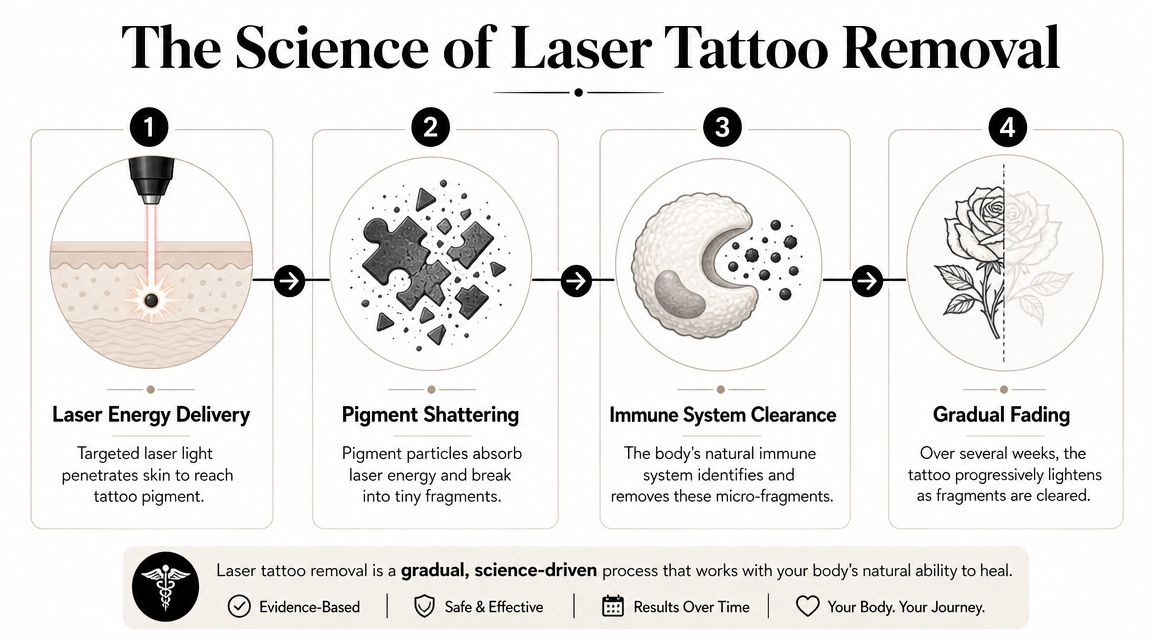
That's why removal is gradual. The laser session is only one part of the process. Your body handles the cleanup between visits.
Here's the basic sequence:
- Laser targets pigment: Specific wavelengths are selected to hit tattoo ink.
- Ink fragments: The energy breaks pigment into smaller pieces.
- Healing begins: The treated skin reacts and starts recovering.
- Immune clearance continues: Over the following weeks, the body gradually removes fragmented ink.
Why creams and DIY methods don't solve the same problem
Removal creams come up constantly online because they promise an easier path. The problem is simple. Tattoo ink sits deeper than a topical product can realistically remove in the way a laser can target it.
DIY methods also tend to ignore the main safety issue. Effective treatment has to separate pigment disruption from unnecessary skin injury. Professional laser systems are designed for that task. Random abrasion, acids, or unproven topical products are not.
The right question isn't whether a home method is cheaper. It's whether it can reach the pigment in a controlled way without trading ink for skin damage.
This is also why multiple sessions are normal. The goal isn't to blast everything in one appointment. The goal is to treat pigment safely, let the skin recover, and repeat based on response.
What Really Affects Your Removal Results
Two people can use high-quality lasers and still get very different outcomes. That's normal. Results aren't controlled by one factor. They're shaped by the tattoo itself, the patient's skin, and the treatment goal.
Your tattoo matters as much as the machine
The easiest example is color. Black ink responds best because it absorbs a broad range of laser wavelengths. Green, blue, and yellow pigments are often more resistant and may require different wavelengths or more sessions for effective clearance.
That difference alone explains a lot of the mixed results people post online.
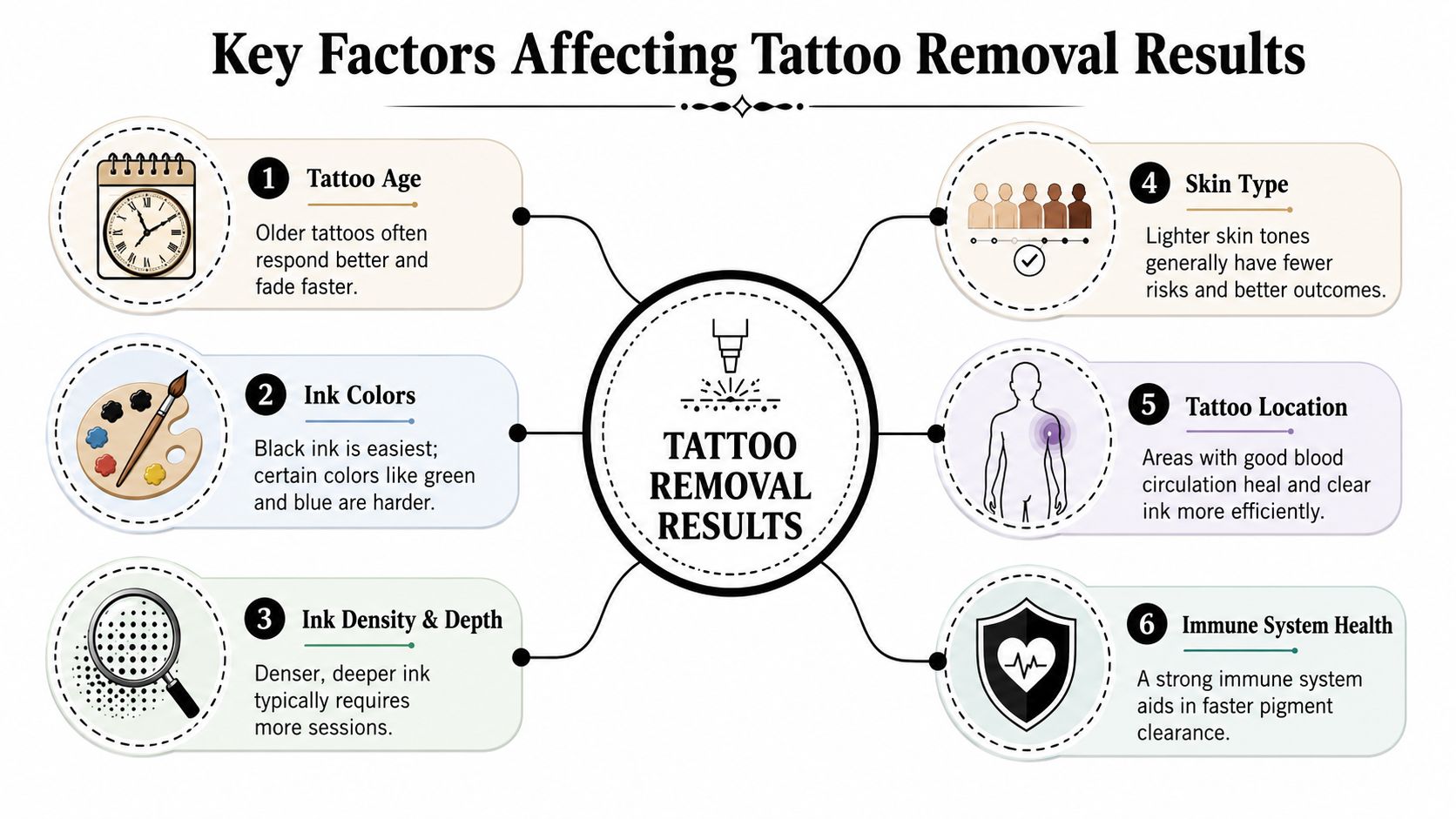
Other major variables matter too:
- Ink density and layering: Heavy saturation usually takes longer than lighter work.
- Ink depth: Professional tattoos often sit more uniformly and more densely than amateur tattoos.
- Tattoo location: Some body areas tend to clear more efficiently than others.
- Skin type: Darker skin generally requires more conservative settings to reduce pigment change risk.
- Immune response: The body's clearing process is part of the outcome, not just the laser pulse.
If you want a breakdown of variables that change progress from one person to another, this guide to factors that can affect tattoo removal progress is worth reviewing before you compare your skin to anyone else's Reddit photos.
Removal and fading are not the same goal
A lot of online advice gets less confusing once you separate complete removal from fading for a cover-up.
Complete removal asks the skin and laser to keep going as far as your tattoo will safely allow. Fading for a cover-up is more strategic. The objective is to lighten enough ink that a tattoo artist has room to redesign the area.
That distinction changes expectations:
- For full removal: You're looking for maximum clearance, with less certainty on the final finish for complex or multicolor tattoos.
- For cover-up fading: You may stop earlier if the old design is light enough to support cleaner new work.
- For layered tattoos: Expectations should stay conservative, because predictability drops when pigment has been packed in multiple times.
The practical takeaway is simple. Don't judge your plan by someone else's endpoint if your endpoint isn't the same.
A Step-by-Step Guide to Starting Your Journey
Once you're done reading tattoo removal Reddit threads, the next challenge is choosing a clinic without getting distracted by marketing language or horror stories. A good consultation should make the process clearer, not more emotional.

How to screen a clinic well
Start with the basics. Ask what laser technology the clinic uses, who performs the treatment, how they assess skin type, and how they decide whether a tattoo is a better candidate for full removal or staged fading.
Then look for the quality of the conversation. A solid clinic won't promise a perfect outcome from a photo alone. They'll talk about trade-offs, resistant colors, healing, and what could slow progress.
Use this checklist when you call or book:
- Ask about the device: Clinics should be able to explain whether they use Q-switched or picosecond laser technology and why that matters.
- Ask who treats darker skin types: Conservative settings and pigment-change risk should be part of the conversation, not an afterthought.
- Ask how they handle cover-up goals: Fading for a new tattoo isn't the same as chasing total clearance.
- Ask about aftercare support: You want clear guidance for healing, not a vague handout.
- Ask what visible downtime to expect: This matters if your tattoo is on the hand, forearm, neck, or another area you can't easily hide.
What to ask at the consultation
The best consultations are specific. Bring photos if the tattoo looks different now than when it was fresh. Mention any upcoming travel, outdoor work, workouts, weddings, or professional deadlines.
Questions that usually lead to better planning include:
- What result is realistic for my tattoo? Not “can you remove it,” but “what endpoint makes sense here?”
- Is this better for full removal or fading first?
- Which colors are likely to be stubborn?
- What healing reactions should I plan around?
- How should I time treatment if I live an outdoor Florida lifestyle?
If you're comparing local options, EradiTatt Tattoo Removal is one Florida provider that offers consultations for complete removal and fading plans based on tattoo size, color complexity, skin type, and schedule. That kind of individualized planning matters more than before-and-after photos alone.
Navigating Aftercare and Real-World Healing
Reddit aftercare advice often gets reduced to one sentence. Keep it moist, don't pick, stay out of the sun. None of that is wrong. It's just incomplete.
What healing usually looks like
Laser tattoo removal commonly causes temporary redness, swelling, blistering, crusting, and pigment changes. Those effects can interfere with work, workouts, social plans, and travel for days to weeks, especially when the treated area is visible or exposed to friction.
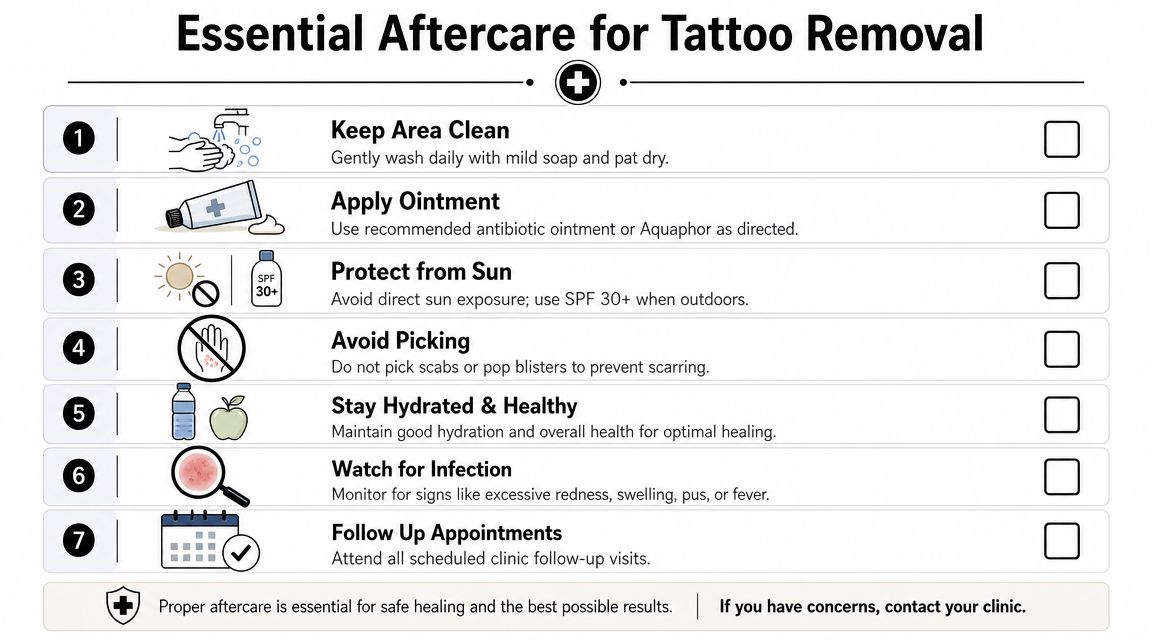
The practical side of aftercare usually matters more than people expect:
- Clothing friction: Tight sleeves, waistbands, or sports gear can irritate a fresh treatment site.
- Exercise timing: Sweat and rubbing aren't ideal when the skin is inflamed.
- Work presentation: If your tattoo is in a visible area, healing may affect when you want to book.
- Sun exposure: Florida lifestyle can complicate treatment timing more than people realize.
The basic wound-care instructions still matter, of course. This overview of why aftercare is important after laser tattoo removal is useful if you want a focused reminder of the skin-healing side.
How to schedule around real life in Florida
In practice, many people aren't limited by laser effectiveness. They're limited by logistics.
Scheduling insight: The worst time for a treatment isn't always when you're busiest. It's when you can't avoid heat, sun, friction, or a public-facing event during healing.
If you have a wedding, beach trip, cruise, job interview cycle, military prep timeline, or a period of heavy outdoor activity, book around those commitments. Don't assume you'll want a visible, irritated treatment area during that window.
A simple planning approach works well:
- Before major events: Leave enough room for visible skin reactions to settle.
- Before vacations: Be realistic about swimming, sun, and beach exposure.
- During sports-heavy weeks: Expect friction and sweating to affect comfort.
- During summer in Florida: Be stricter than you think about UV management.
A lot of tattoo removal Reddit advice falls short on this point. People talk about whether the laser works. They don't always talk about whether the timing works.
Booking Your Consultation in Florida
If you live in Central or West Florida, convenience matters almost as much as treatment quality. Removal requires repeat visits and thoughtful timing, so choosing a location you can realistically return to makes the process easier to stick with. EradiTatt serves clients in Tampa, Orlando, St. Petersburg, Bradenton/Sarasota, and Palm Harbor, which makes ongoing scheduling more practical for many Florida residents.
When you book, have your tattoo photos ready, know whether you want complete removal or fading for a cover-up, and mention any deadlines tied to work, travel, weddings, or appearance policies. That information helps the clinic give you a more useful consultation from the start.
If you're a business owner researching local visibility at the same time, this guide on selecting a Florida marketing partner is a separate resource worth keeping handy.
Frequently Asked Questions About Tattoo Removal
Does tattoo removal cream work
Not in the way professional laser treatment works. Tattoo pigment sits deeper in the skin, and laser systems are designed to target that pigment with short energy pulses. Creams may irritate the skin surface, but that's not the same as controlled pigment fragmentation.
Is fading for a cover-up easier than full removal
Often, yes. Fading has a different goal. You may not need the tattoo gone. You may only need enough lightening to give a tattoo artist room to design over it more cleanly. That can make the endpoint more achievable, especially for dense or multicolor work.
Is black ink easier to remove than color
Yes. Black ink generally responds best to laser treatment. More resistant colors can require different wavelengths and can be less predictable, especially in complex or layered tattoos.
Can Reddit photos predict my result
Not reliably. They can show what's possible, but they don't show every variable behind the photo. Ink type, saturation, body location, skin type, treatment spacing, and the person's actual goal all affect what you're seeing.
A better way to use tattoo removal Reddit content is as a list of questions to bring into a consultation. That's where anecdote becomes useful.
If you're ready for answers based on your tattoo instead of someone else's Reddit thread, EradiTatt Tattoo Removal can help you evaluate whether full removal or fading makes more sense, what trade-offs to expect, and how to plan treatment around real life in Florida.