
Tattoo removal in St. Petersburg usually takes 1 to 2 years over 5 to 12 sessions, and many complete-removal plans locally fall into a 5 to 10 session range with treatments spaced 6 to 8 weeks apart. If you're looking at a tattoo right now and wondering how soon it can realistically be gone, the honest answer is that the exact timeline depends on your ink, your skin, and how your body clears pigment between appointments.
That can feel frustrating at first, especially if you're hoping for a fast reset before a job change, a cover-up, or just because you're done with the tattoo. But a longer timeline doesn't mean the process is unclear. It means the right next step is getting a personalized estimate instead of relying on generic guesses online.
Table of Contents
- Your Tattoo Removal Timeline in St Petersburg Explained
- How Laser Tattoo Removal Works Session by Session
- Factors That Influence How Long Removal Takes
- Mapping Out Your Tattoo Removal Journey
- Getting Your Personalized Plan at EradiTatt St Petersburg
- Aftercare Tips and Signs of Successful Fading
Your Tattoo Removal Timeline in St Petersburg Explained
A realistic tattoo removal timeline in St. Petersburg usually plays out over months, and sometimes longer. For many people, the process lands in the range of several treatments spread out over healing intervals, not a quick series of back-to-back visits.
That is why averages only help so much.
Two tattoos can look similar in a photo and still fade on very different schedules once I see the ink density, body placement, age of the tattoo, and how the skin has healed around it. A forearm tattoo with older black ink may move along steadily. A newer, layered ankle piece with mixed colors can take more time and more patience.
If you want a better estimate than a generic online answer, the useful starting point is a consultation. We look at the tattoo in person, check the details that change the pace of fading, and build a plan around your skin and your goal, whether that is full removal or enough lightening for a cover-up. For a closer look at what affects session count, this guide on how many laser tattoo removal sessions different tattoos may need gives helpful context before you book.
A practical timeline estimate comes from three things:
- how complex the tattoo is
- how your body clears fragmented ink between visits
- how consistently you can stay on schedule
Most appointments are short. Waiting primarily occurs between them, while the body does the clearing work that the laser starts.
This is the part many people do not expect. The session itself is only one stop in the process. Your timeline is shaped more by response between visits than by time spent in the treatment room.
Here is a simple way to frame it:
| Situation | What it usually means for timing |
|---|---|
| Older black ink with lighter saturation | Often fades more predictably |
| Layered, heavily packed, or multicolor ink | Often needs a longer plan |
| Areas with good circulation and healthy skin | Often show steadier progress |
| Scar tissue or very dense ink | Can slow fading and change the estimate |
A good consultation turns "how long does tattoo removal take in St. Petersburg" into a personal timeline you can use. That gives you a clearer calendar, more realistic expectations, and fewer surprises once treatment starts.
How Laser Tattoo Removal Works Session by Session
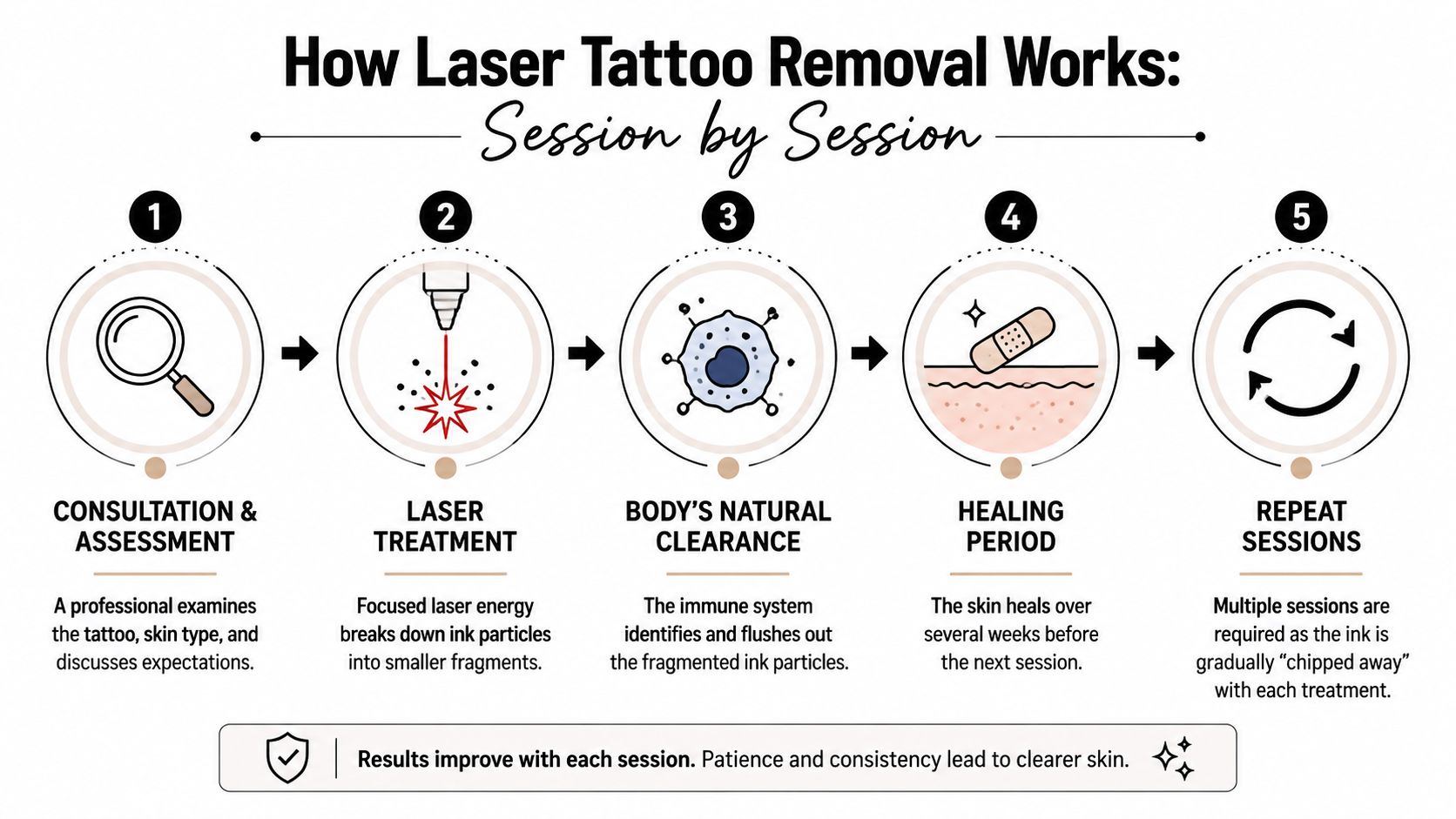
Laser tattoo removal works by breaking ink into smaller fragments. Your body then clears those fragments gradually over the following weeks. That's why removal can't be rushed into back-to-back visits, even when someone is eager to finish quickly.
What the laser does
The easiest analogy is chipping away at stone. One pass doesn't remove the whole tattoo. It breaks apart some of what's there so your body can start processing it.
A clinical review reports an average of 7 to 10 treatments for laser tattoo removal, with treatments repeatable at about every 8 weeks, and that spacing alone puts many complete-removal journeys in the 14 to 20 month range before extra delays from healing or tattoo complexity are added. The same review also supports the idea that complete removal commonly takes 1 to 2 years, with 5 to 12 sessions often needed and 6 to 8 weeks between treatments, which lines up with what clients typically need in real practice according to this clinical review of laser tattoo removal timelines.
That matters because the laser isn't doing all the work on the appointment day. It starts the process. Your body finishes much of it afterward.
What your body does after the session
Once the ink fragments are smaller, your immune system begins clearing them out over time. That clearing phase is why patience matters so much. If sessions are placed too close together, the skin may not be ready and the body may not have had enough time to process the last treatment.
The session is only one part of removal. The weeks after treatment are where much of the visible fading happens.
This is also why the total journey depends less on how long you're in the treatment room and more on what happens between visits. If you want a more detailed look at session planning, this guide on how many laser tattoo removal sessions are typically needed gives useful context.
Why waiting helps instead of hurting
A lot of people assume faster scheduling means faster removal. Usually, it doesn't. Better results come from giving the skin time to recover and the body time to clear disrupted pigment.
A session-by-session pattern usually looks like this:
- Assessment and treatment: The tattoo and skin are evaluated, then laser energy targets the ink.
- Immediate skin response: The area reacts to treatment and begins the healing phase.
- Gradual fading: Over the next several weeks, fragmented pigment starts to lighten.
- Reassessment: At the next visit, the remaining ink is checked and the next treatment is adjusted.
- Repeat as needed: Each round removes more, but not all, of the visible tattoo.
People do best when they treat tattoo removal like a process, not a one-time event. That's what keeps expectations realistic and results on track.
Factors That Influence How Long Removal Takes
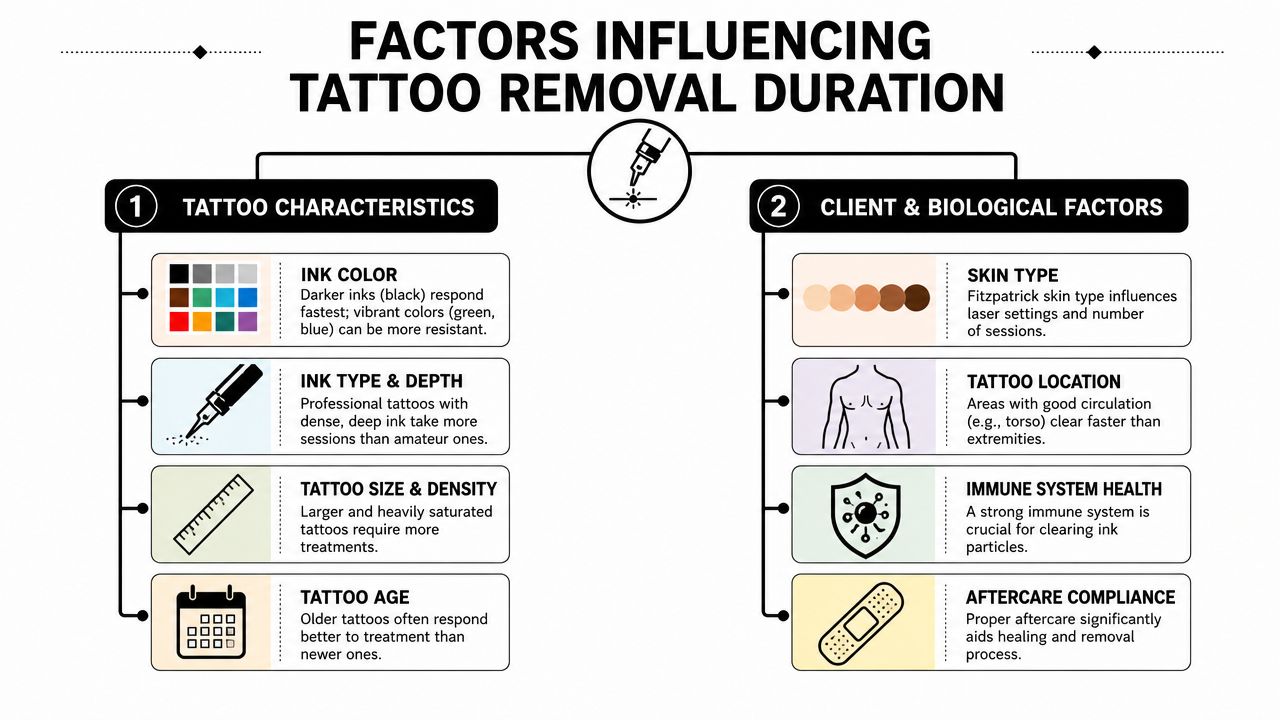
Two tattoos can look similar in a photo and still follow very different removal timelines. In consultation, I may see one fade on a fairly standard schedule while the other needs extra sessions because of ink layering, color choice, skin response, or old scar tissue.
That is why a useful estimate comes from an in-person exam, not a quick online guess.
Ink color and color mix
Black and very dark inks usually respond more predictably. Lighter shades and mixed-color tattoos often fade at different speeds, so the tattoo can look patchy before it looks clean.
That uneven fading is normal. Different pigments react differently to laser wavelengths, so the plan may need more sessions and more patience.
Tattoo age and layering
Older tattoos sometimes have a head start because the body has already broken down a small amount of pigment over time. Newer work is often denser and more sharply packed.
Cover-ups and touch-ups usually take longer. There is more ink in the skin, and that extra pigment changes how quickly each session can reduce what is left.
Practical rule: Dense, layered tattoos usually fade in stages. They rarely disappear on a fast timeline.
Placement on the body
Body location matters more than many people expect. Tattoos on areas with stronger circulation often clear more steadily than tattoos on the hands, feet, ankles, or lower legs.
I routinely see this difference in practice. A shoulder tattoo and an ankle tattoo can be the same size, same age, and same color, but the ankle often lags behind.
Skin type and skin condition
Skin type affects how aggressively treatment can be performed. Safer settings sometimes mean a more measured pace, especially when the goal is steady fading without creating unnecessary skin injury.
Skin condition matters too. If the tattooed area has textural changes, old scarring, or signs of trauma from the original tattoo process, removal can be less predictable and may require a more cautious treatment plan.
Earlier in the article, the general session range was covered. What matters here is why that range shifts from person to person. At consultation in St. Petersburg, the estimate is built around the tattoo in front of us, not a generic average.
Ink amount and tissue change
Professional tattoos often contain heavier, more even saturation. Amateur tattoos can fade faster if the ink is lighter or more shallow, but there are plenty of exceptions.
Tissue change can slow progress. If the skin is raised, shiny, uneven, or thickened, the laser still may be appropriate, but the timeline often gets longer because the skin and ink are not behaving in the simplest way.
A good consultation usually focuses on a short set of practical questions:
- Which colors are in the tattoo: Black-only work is usually different from multicolor work.
- Has it been reworked, touched up, or covered: Layering often adds time.
- Where is it on the body: Placement affects clearance speed.
- How heavy is the saturation: Dense packing usually means more sessions.
- What does the skin feel and look like now: Texture changes can affect settings and pacing.
This is how personalized timelines are built at EradiTatt. We examine the tattoo up close, look at the skin, ask about its history, and then give you a realistic range with the trade-offs explained clearly.
Mapping Out Your Tattoo Removal Journey
General ranges are helpful, but many individuals want to know what the process feels like on an actual calendar. The easiest way to answer that is with a realistic example.
A practical example
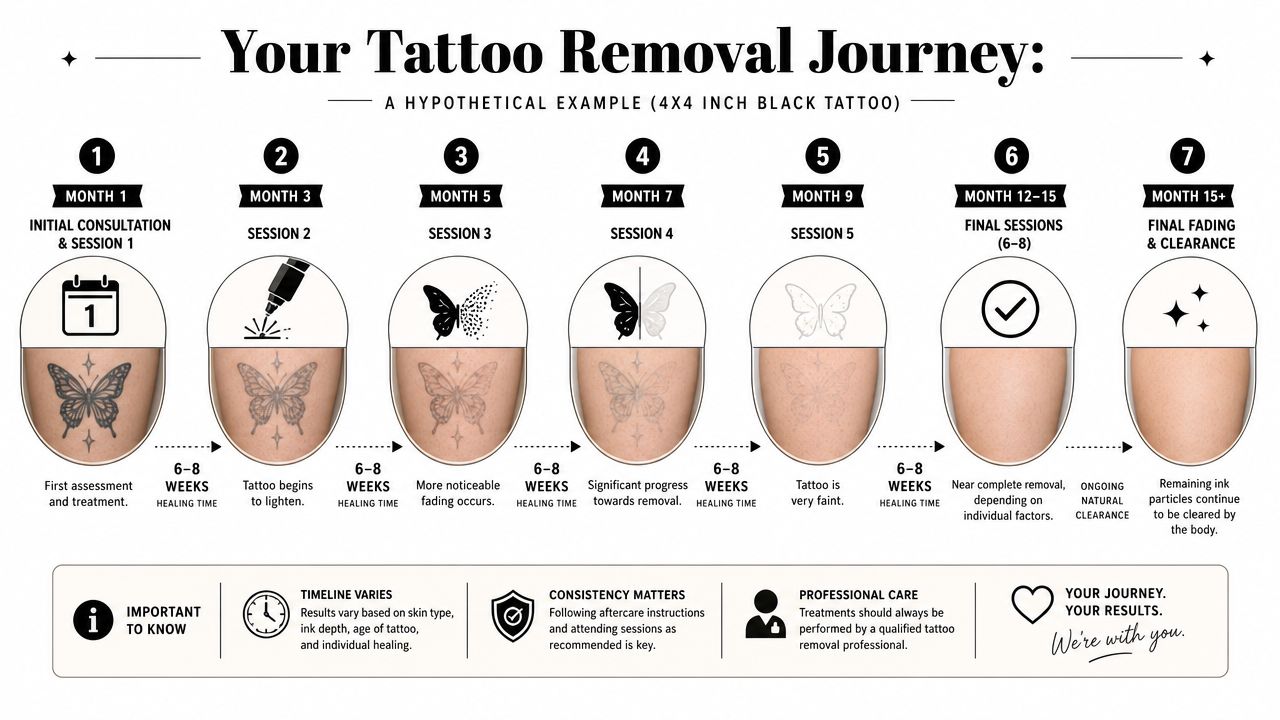
Say someone in St. Petersburg wants to remove a medium-size tattoo on the upper arm. The design has dark linework, some shading, and a second pass from an old touch-up. It's not the hardest tattoo to remove, but it isn't the fastest either.
A typical complete-removal plan in the local market is 5 to 10 sessions spaced about 6 to 8 weeks apart, so the full treatment timeline commonly extends to roughly 10 to 20 months before the last session, with continued fading afterward as the body clears fragmented pigment, according to this St. Petersburg laser tattoo removal timeline overview.
That means this person might come in for an initial consultation, have a first session, and then spend the next several weeks watching for gradual lightening. The second and third sessions often bring more visible change because the tattoo is already starting to break up.
What this looks like on your calendar
By the middle of the process, the tattoo usually looks patchier and less solid rather than evenly erased. That's normal. Fading often happens in stages.
A common journey feels something like this:
- Early phase: The tattoo still looks recognizable, but the edges or darker sections start softening.
- Middle phase: Some sections fade faster than others, especially if the tattoo has varied density.
- Late phase: Remaining ink can look stubborn even though progress is still happening.
Most people don't see a perfectly smooth fade from dark to gone. They see a steady reduction over time, with some areas clearing faster than others.
It is important to manage expectations. The calendar includes treatment dates, but the visible progress happens in between those dates. If you're planning around a wedding, enlistment, a cover-up, or a professional deadline, that lag time matters just as much as the number of sessions.
Getting Your Personalized Plan at EradiTatt St Petersburg
If you want a real answer to how long does tattoo removal take in St. Petersburg, the consultation is where that answer starts to become specific. This is the point where a general time range gets translated into your likely session plan.

What happens at the consultation
At EradiTatt Tattoo Removal, the consultation is used to assess tattoo color, saturation, layering, placement, and skin response so a technician can map out a realistic fade or removal plan. If you're comparing options locally, this page on tattoo removal in St. Petersburg gives a practical overview of what to expect.
The useful part of a consultation isn't just hearing a session estimate. It's understanding why that estimate makes sense for your tattoo. People feel more confident when they know whether the main challenge is color mix, density, placement, or previous cover-up work.
Why a consultation matters more than an online estimate
Online guesses tend to miss the details that determine timing. Photos flatten depth. They don't show tissue texture well, and they don't tell you how much layered ink is sitting under the surface.
A good consultation helps answer questions like:
- Is full removal realistic: Or is fading for a cover-up the better goal.
- What will probably slow this down: Dense pigment, layering, or resistant color.
- How should you schedule it: Especially if you have a deadline in mind.
- What should progress look like: So you know what counts as normal fading.
That clarity is what makes the next step easier. Instead of wondering how long tattoo removal takes in St. Petersburg in general, you leave knowing what your own path is likely to look like.
Aftercare Tips and Signs of Successful Fading
The time between sessions matters as much as the treatment itself. Good aftercare supports healing, protects the skin, and gives the body the best chance to clear fragmented pigment well.
What to do between sessions
After treatment, keep the area clean, follow your technician's instructions, and avoid doing anything that irritates healing skin. If the area feels tender or looks reactive, that's a reminder to protect it, not to pick at it.
These habits usually help the process stay on track:
- Keep the area clean: Clean skin is less likely to run into healing setbacks.
- Leave blisters and scabs alone: Picking slows healing and can interfere with the cosmetic result.
- Protect it from sun exposure: Irritated or sun-stressed skin isn't ideal for laser work.
- Show up fully healed: Don't rush the next session if the skin still looks unsettled.
If you want a more detailed breakdown, this guide on why aftercare matters after laser tattoo removal is a useful next read.
Healing well is part of removing well. The body needs calm, healthy skin to do its part between appointments.
What successful fading usually looks like
Right after a session, the tattoo may not look dramatically lighter. That's normal. Some tattoos show an immediate surface reaction, then spend the next several weeks changing more gradually.
Successful fading often looks like:
- Softening at the edges: Lines don't look as crisp as before.
- Patchy lightening: One section fades ahead of another.
- Reduced density: The tattoo looks less solid and less saturated.
- Slow continued clearing: The area keeps changing after the appointment is over.
Progress isn't always dramatic from one week to the next. It often shows up when you compare photos from session to session. That's one reason I always tell clients to judge removal over months, not days.
If you're ready for a real timeline instead of a rough guess, book a consultation with EradiTatt Tattoo Removal. A personalized assessment can show whether you're looking at a shorter fading plan, a longer full-removal process, or a strategy that gets you ready for a cover-up on a schedule that makes sense.