
You look at the tattoo for a few seconds longer than usual.
Maybe it is an old name. Maybe it is work you outgrew. Maybe you have a job opportunity, military plans, a wedding coming up, or you are tired of explaining a piece you no longer want on your skin. The first question is almost always the same. How many sessions will this take?
That question deserves a straight answer. Not a vague average, and not a promise that every tattoo behaves the same way.
Laser removal works in stages, and your timeline depends on what is in the skin, how deep it was placed, where it sits on the body, and how your body clears fragmented ink between visits. If you want a useful general primer before you book anywhere, Understanding Tattoo Removal gives a solid overview of the process from a practical angle.
The Big Question How Long to Erase Unwanted Ink
Many individuals searching how many sessions for tattoo removal Tampa want one of two things. They want a number they can plan around, and they want to know whether that number applies to their tattoo.
A Tampa client might walk in with a small black amateur tattoo on the upper arm and have a very different path than someone with a dense professional sleeve section with layered color. Both are asking the same question, but they are not asking about the same treatment problem.
That is where frustration starts. Online answers often flatten everything into one average.
Why the answer is rarely one number
Laser tattoo removal is not a one-visit process because the laser does not “erase” the tattoo in a single pass. It breaks ink into smaller particles. Your body then clears those particles gradually over time.
So the question is not just how many appointments you need. It is also how your tattoo responds after the first few sessions.
A realistic estimate should feel personal. If it sounds identical for every tattoo, it probably is not based on enough information.
What a useful estimate should tell you
A good estimate should account for:
- Your goal: Full removal and cover-up fading are not the same endpoint.
- Your ink profile: Black-only work behaves differently than mixed-color designs.
- Your skin and placement: Healing, sensitivity, and circulation matter.
- Your schedule: You cannot safely compress removal into back-to-back appointments just because you are in a hurry.
If you understand those variables before your consultation, you walk in with better questions and better expectations. That usually leads to better decisions.
The Typical Number of Tattoo Removal Sessions
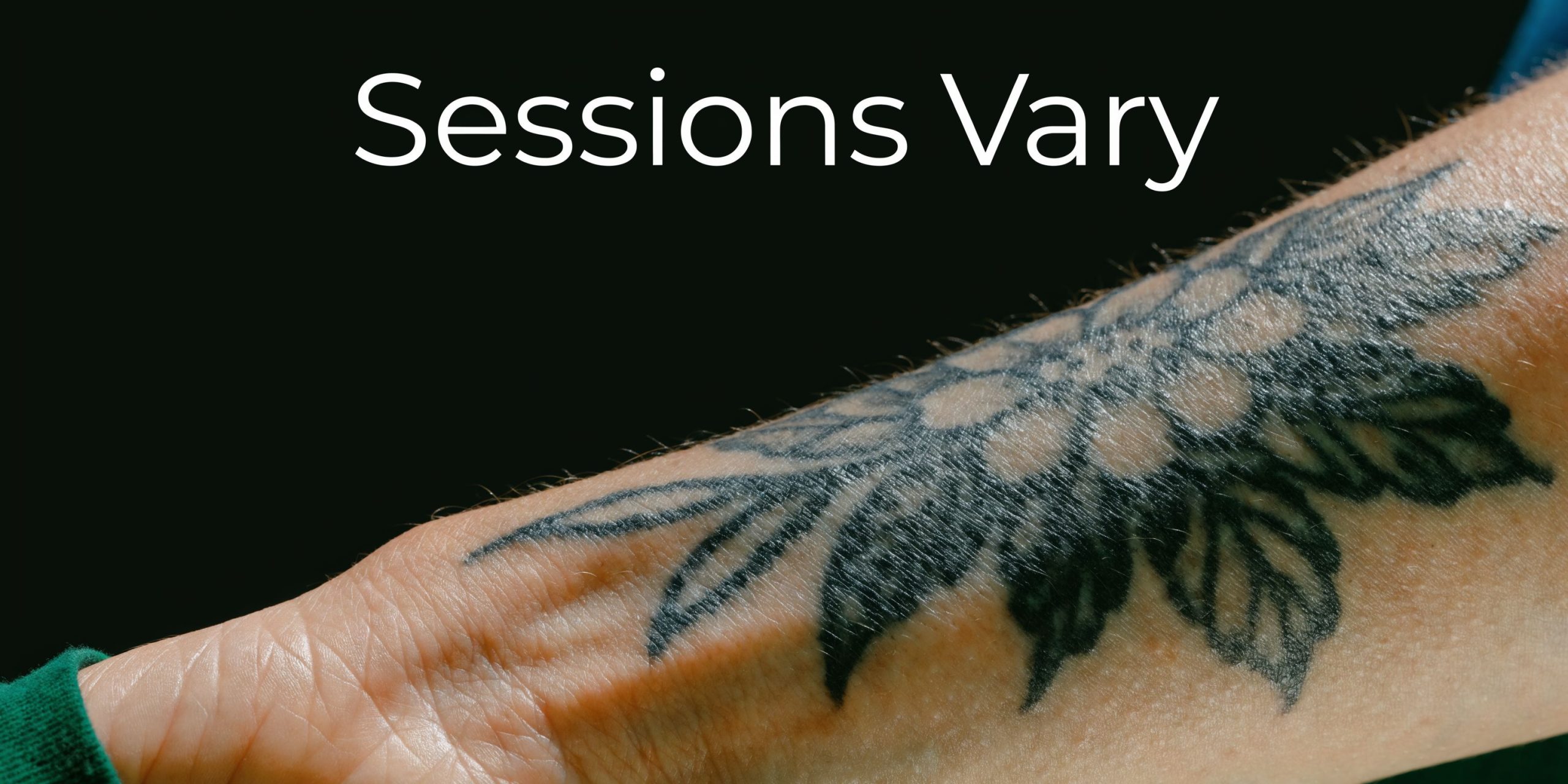
The short answer is this. Laser tattoo removal in Tampa typically requires 5-12 sessions, with small, simple tattoos often needing 5-8 sessions, medium-sized tattoos 6-10 sessions, and large or multi-colored tattoos 8-12 or more sessions. Professional tattoos with denser ink often take longer than amateur tattoos because the ink is usually placed deeper in the skin, as noted in this guide on laser tattoo removal session ranges in Tampa.
That gives you a baseline. It should not be treated like a guarantee.
A practical way to read those numbers
If your tattoo is:
| Tattoo type | Typical expectation |
|---|---|
| Small and simple | 5-8 sessions |
| Medium-sized | 6-10 sessions |
| Large or multi-colored | 8-12 or more sessions |
Those categories help, but they still leave out the details that change real treatment plans.
For example, a small tattoo can still be stubborn if the artist packed in dense ink. A larger tattoo can sometimes fade more predictably if the color mix is limited and the skin responds well.
What these averages do and do not mean
These numbers are useful for planning, especially if you are trying to budget time around work, travel, or a life event. They help answer the search question quickly.
They do not tell you exactly how your body will respond. That part becomes clearer once treatment begins and the technician can see whether the ink is breaking up evenly, whether certain areas lag behind, and how your skin heals between visits.
The average range is a starting point. Your first few sessions reveal whether you are tracking toward the lower end, the middle, or the longer end of that range.
If you only remember one thing from this section, remember this. Session count is not just about tattoo size. It is about tattoo behavior.
Seven Key Factors That Influence Your Session Count
Some tattoos fade in a clean, steady pattern. Others slow down in certain areas, especially where color, depth, and skin sensitivity overlap.
This is why a technician should never estimate your plan from size alone.
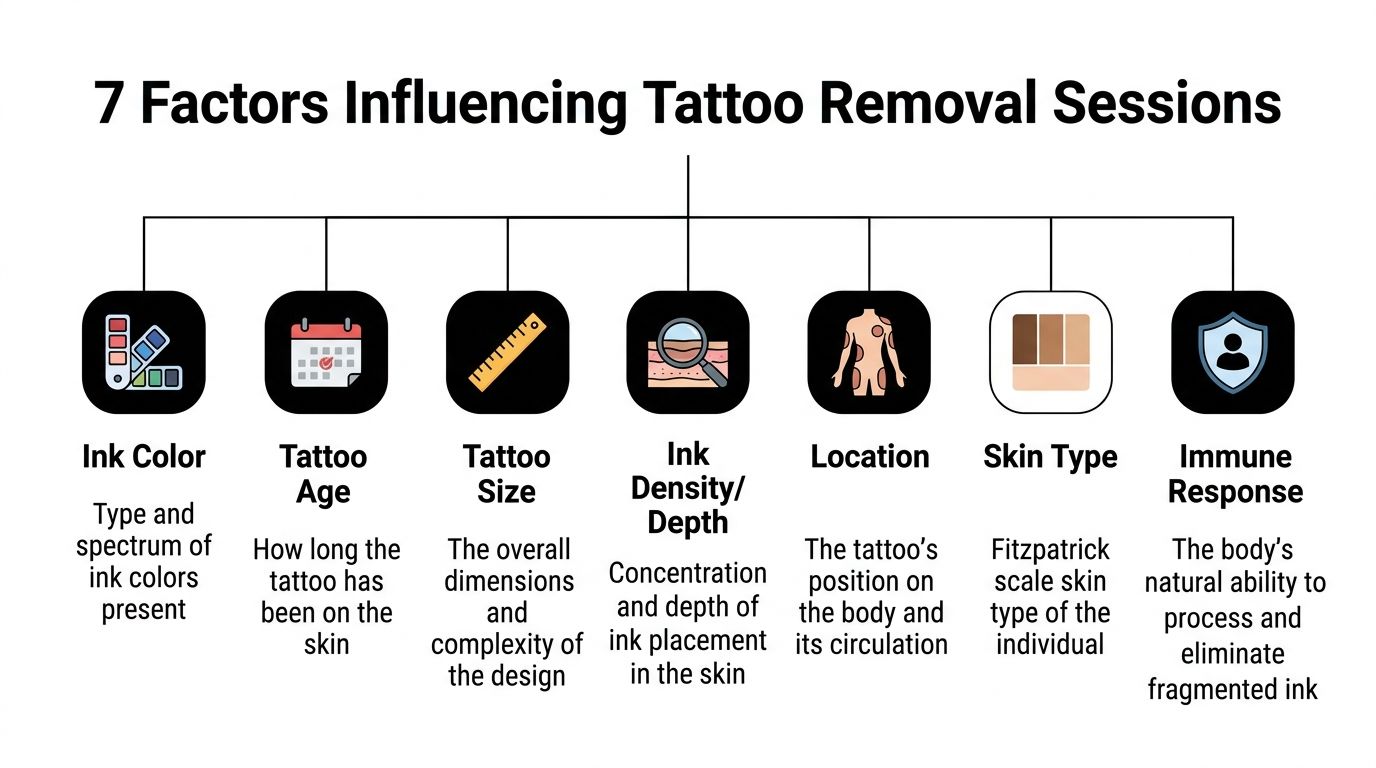
Tattoo removal session counts are shaped by linked variables such as color complexity, ink depth, tattoo age, and anatomical location. Red ink can increase the number of sessions, neck tattoos may need extended protocols, and the early sessions often give the clearest information for refining the treatment plan, as explained in this discussion of multiple-session tattoo removal variables.
For a broader look at what changes removal speed, this EradiTatt article on factors that affect tattoo removal progress is also worth reading.
1. Ink color
Black ink is usually more straightforward than a tattoo with several colors mixed together.
Red deserves special mention. Red pigment needs the right wavelength, and that can add complexity to the plan. If a tattoo includes several colors with different response patterns, one section may lighten faster while another lags behind.
2. Tattoo age
Older tattoos often behave differently from fresh-looking ones.
An older tattoo may already show some natural fading, which can help. But age alone is not enough to predict a short plan. An old professional tattoo with dense saturation can still require patience.
3. Tattoo size and design complexity
This one seems obvious, but the design matters as much as the footprint.
A small fine-line piece is different from a small but heavily packed design. A medium tattoo with open spacing may clear differently than one with layered shading and repeated passes from the original artist.
4. Ink density and depth
This is one of the biggest reasons amateur and professional tattoos often do not follow the same timeline.
Professional work usually places ink more consistently and deeper. That can make the tattoo look sharper, but it can also make the removal process longer.
5. Location on the body
Placement changes both healing and ink clearance.
A neck tattoo can require extra caution because the skin is more sensitive. Other locations may heal or respond at a different pace based on circulation and how the skin handles treatment stress.
6. Skin type
Laser settings must be chosen with skin safety in mind.
The right approach is not just about hitting ink aggressively. It is about balancing effective treatment with the protection of surrounding skin. That is why the same tattoo on two different people may not follow the exact same pace.
7. Immune response and aftercare
The laser breaks up pigment, but your body does the clearing after you leave the appointment.
Some clients process fragmented ink more steadily than others. Aftercare also matters. Healing well, protecting the treated area, and avoiding anything that disrupts recovery all support better progress.
The first session is often the most informative one. It tells the technician how your ink reacts, how your skin recovers, and whether your initial timeline needs to be adjusted.
What usually does not work
Clients often want to speed the process up by treating too frequently or ignoring aftercare because the skin “looks fine.” That usually backfires.
The fastest path is usually the controlled one. Good spacing, good healing, and consistent follow-through tend to produce the best long-term result.
Fading for a Cover-Up vs Complete Removal
Not every client wants the same finish line.
Some want the tattoo gone. Others only want enough fading to give a new artist cleaner space for a cover-up. Those are very different goals, and the difference matters when you ask how many sessions for tattoo removal Tampa.
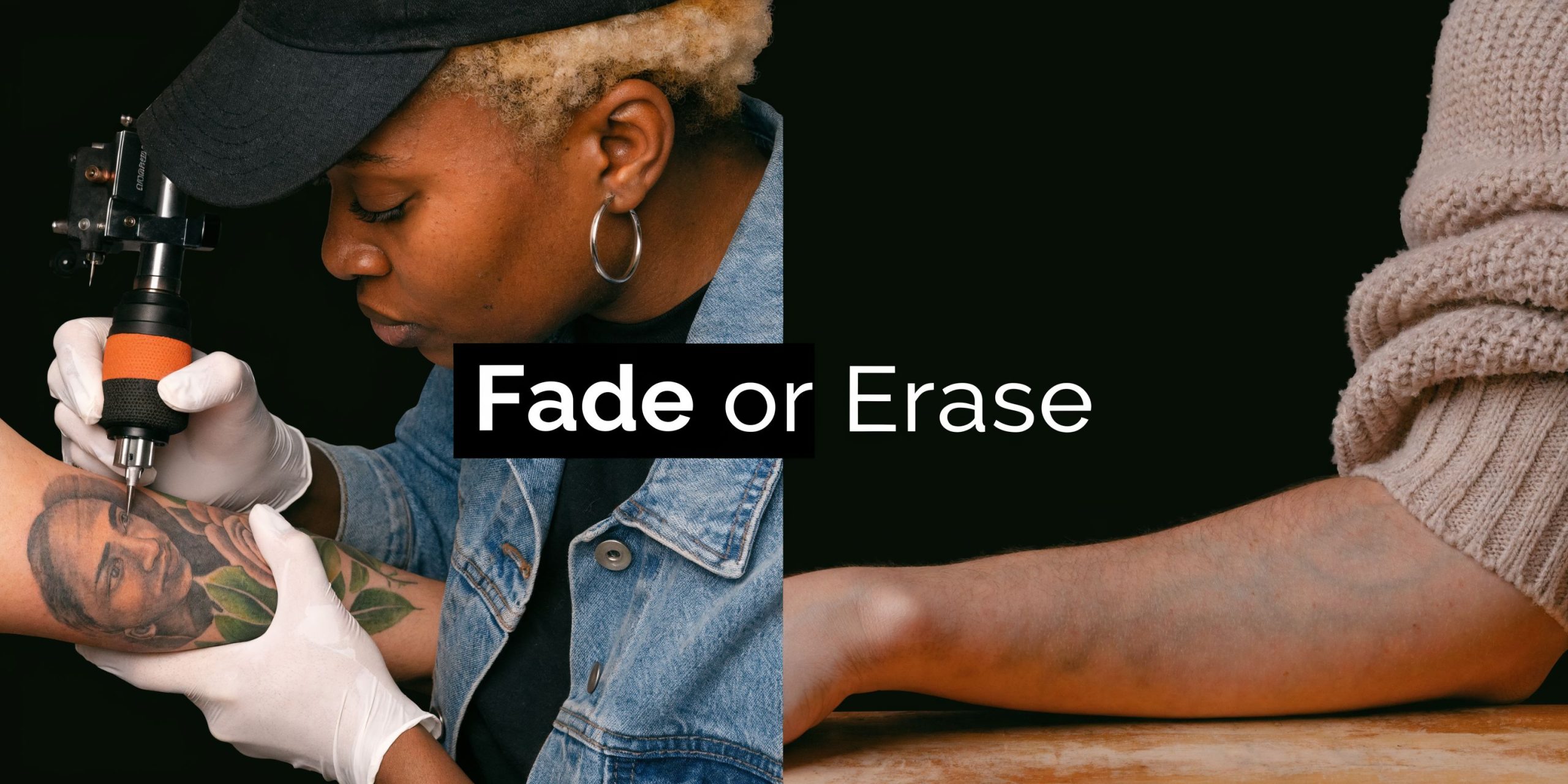
Many Tampa clients need a personalized plan because a shallow, single-color amateur tattoo can require a very different timeline than a deep, professional multi-color piece. While broad averages often mention 6-8 sessions, the consultation is where those differences get translated into a realistic timeline, as noted in this overview of laser tattoo removal expectations and consultation planning.
If your goal is a cover-up, this guide to a tattoo cover-up removal fade plan gives helpful context on how fading plans are usually approached.
Cover-up fading
For cover-up prep, the target is not perfect clearance. The target is enough lightening that a tattoo artist can work over the old design without fighting through dark lines or heavy saturation.
That usually means fewer sessions than full removal. It can also change which parts of the tattoo matter most. Sometimes the darkest outlines or a specific section of the design need the most attention.
Full removal
Complete removal is a longer commitment because the standard is different.
You are not just trying to reduce visual dominance. You are trying to continue treatment until the remaining ink is as cleared as your skin and ink profile allow. That takes more patience and a willingness to let the process unfold over time.
Why the waiting period matters
Healing time is not dead time. It is active progress time.
Sessions are commonly spaced apart so the skin can recover and the body can continue clearing shattered ink. In Tampa treatment planning, spacing is often discussed in the 4-8 week or 6-12 week range depending on the tattoo and the treatment approach, based on the verified clinical guidance provided earlier in this article.
If you rush the interval, you do not give the skin or the immune system enough time to do their part. More appointments does not automatically mean faster results.
If your deadline is tight, fading for a cover-up may be the more realistic route. If your goal is clear skin, the best approach is to build a steady plan and follow it.
Begin Your Removal Journey at EradiTatt Tampa
Technology matters. So does how that technology is used.
Advanced picosecond lasers in Tampa, including the PiQo4, can reduce session counts by 20-50% compared with older lasers and often help clients reach their goal in fewer than 10 sessions, especially when the tattoo includes stubborn or multi-colored ink, according to this overview of picosecond laser tattoo removal in Tampa.
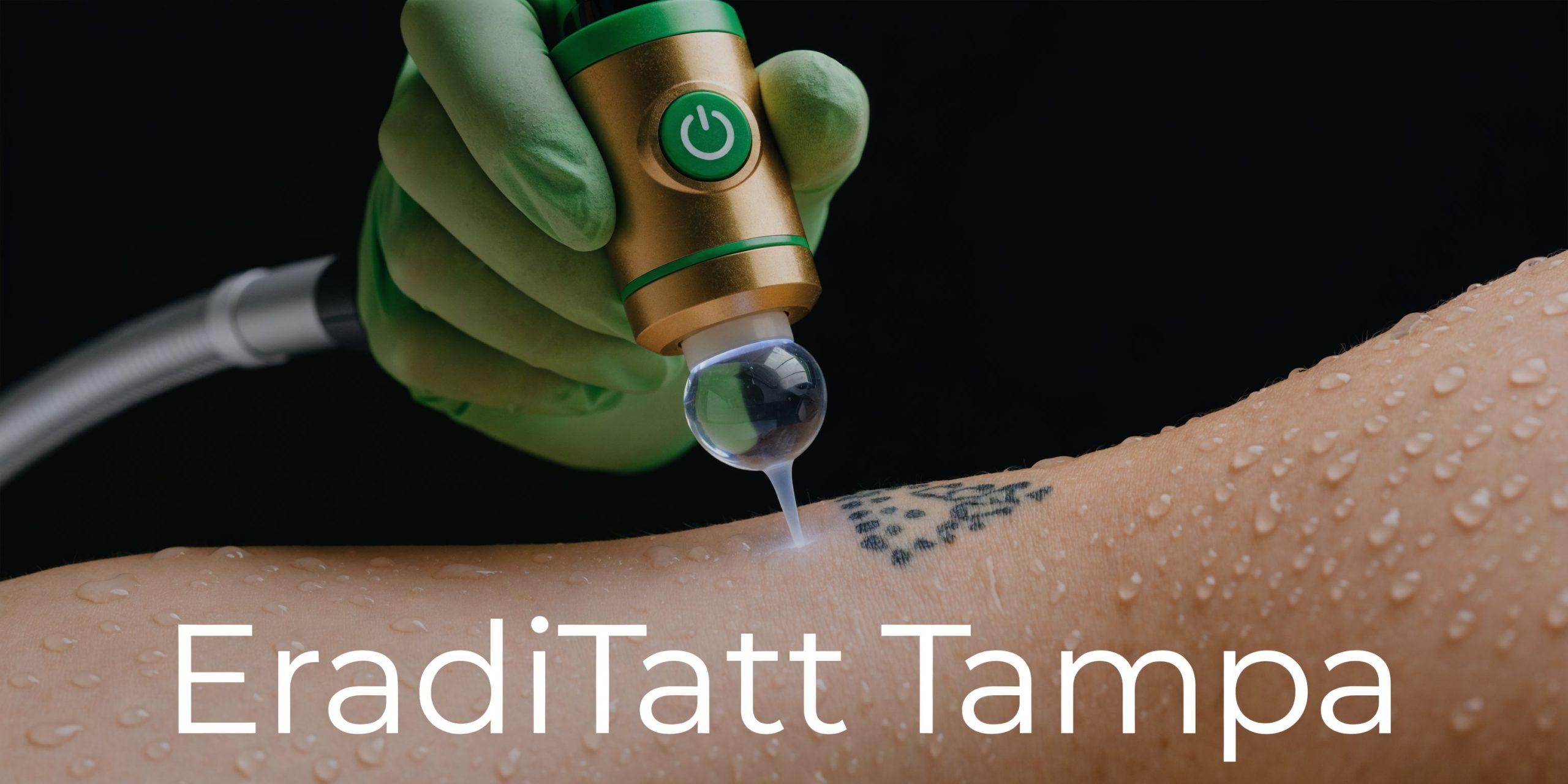
That does not mean every tattoo becomes easy. It means newer tools can break pigment into smaller particles more efficiently, which can improve progress when the settings, timing, and skin response are handled correctly.
What to expect from a real consultation
A useful consultation should do more than glance at your tattoo and name a number.
It should look at:
- Color mix: Especially whether stubborn shades are present.
- Depth and saturation: Dense professional work often needs a longer runway.
- Placement and skin response: Sensitive areas may require a more cautious plan.
- Your end goal: Full clearance versus fade for a cover-up changes the strategy.
Why transparency matters before you start
The most helpful consultations are the ones that tell you the trade-offs clearly.
If your tattoo is likely to respond steadily, you should hear that. If it has features that could lengthen the process, you should hear that too. A straight answer early prevents frustration later.
For people also trying to budget the process, this EradiTatt page on tattoo removal cost in Tampa is a useful next step because treatment planning is not only about time. It is also about total commitment across a series of sessions.
Local details that help
EradiTatt’s Tampa clinic is located at 1715 N. Westshore Blvd, Suite 100, Tampa, FL. If you want to discuss your tattoo directly, the company’s central scheduling line uses an 844 number for consultations across locations.
A good next step is simple. Bring clear photos, know whether you want fading or full removal, and be ready to discuss timing openly.
Your Tattoo Removal Questions Answered
How should I budget if I may need multiple sessions
Think in terms of total treatment planning, not just the price of one visit. A major unanswered concern for Tampa clients is the full out-of-pocket cost, and transparent explanations around package discounts or payment plans across the common 6-10 session path can reduce financial anxiety and make budgeting easier, as noted in this overview of tattoo removal cost transparency in Tampa.
What aftercare helps the process go smoothly
Protect the treated area and let it heal. Sun avoidance matters. Do not pick at the area. Consistent aftercare supports better healing and keeps you on schedule instead of creating delays because the skin is irritated or not ready for the next appointment.
Good aftercare does not magically remove extra sessions, but poor aftercare can absolutely slow your progress.
What does the treatment feel like
Most clients expect a sharp, quick sensation rather than prolonged pain. The exact feel depends on placement, tattoo density, and your own sensitivity. Areas with thinner or more delicate skin often feel more intense, but the treatment itself is typically brief compared with the full healing period that follows.
If you are ready to get a realistic estimate for your tattoo, book a consultation with EradiTatt Tattoo Removal. Bring your timeline, your questions, and your actual goal. Full removal and cover-up fading are different plans, and the right starting point is an honest assessment of the ink you have now.